
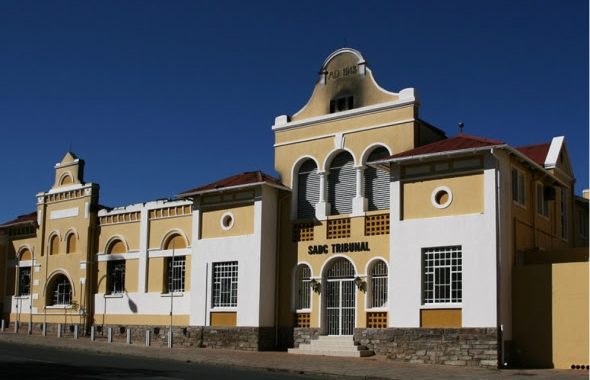

The
regional
court
of
the
SADC
Tribunal
was
closed
down
in
2012
by
the
Heads
of
State
of
the
14
Southern
African
Development
Community
countries
The
SADC
Tribunal
is
the
international
court
for
the
Southern
African
Development
Community.
This
court
ruled
repeatedly
against
the
Mugabe
regime’s
racist
and
disastrous
land
reform
programme
which
resulted
in
hyperinflation,
hunger,
extreme
poverty
and
a
diaspora
of
Zimbabweans
throughout
the
SADC
region
and
beyond.
Zimbabwe’s
response
to
the
SADC
Tribunal’s
rulings
was
open
defiance
and
retaliation.
At
its
instance,
other
heads
of
SADC
States
–
instead
of
acting
against
Zimbabwe’s
contempt
of
court
(confirmed
recurrently
by
the
SADC
Tribunal),
as
they
were
required
to
do
under
binding
international
law
–
actively
collaborated
in
what
South
African
courts
concluded
was
a
conspiracy
to
silence
the
SADC
Tribunal.
South
Africa’s
then-President
(Mr
Jacob
Zuma)
was
an
active
collaborator,
the
Constitutional
Court
held,
in
this
conspiracy.
The
Constitutional
Court
ordered
the
removal
of
South
Africa’s
signature
from
the
relevant
treaty,
a
purported
“protocol”
on
the
SADC
Tribunal,
which
was
in
truth
a
cynical
document.
The
purported
protocol
defeated
access
to
justice
and
undermined
SADC’s
international
law
obligation
to
respect
human
rights,
the
rule
of
law
and
good
governance.
As
then-Judge
President
Mlambo
(now
the
Deputy
Chief
Justice
of
South
Africa)
held,
the
tactic
of
purporting
to
adopt
such
protocol,
“instead
of
supporting
the
Tribunal”,
and
“at
the
instance
of
the
violator
of
the
Tribunal’s
orders”,
“simply
signed
away”
the
Tribunal’s
jurisdiction
“contrary
to
the
advice
of
the
Ministers
of
Justice
and
Attorneys-General”.
The
Committee
of
SADC
Ministers
of
Justice
and
Attorneys-General
had
already
adopted
in
2011
the
position
that
SADC
should
simply
reappoint
judges
to
the
SADC
Tribunal.
This
was
to
fill
the
vacancies
which
Presidents
Mugabe
and
Zuma
(and
their
SADC
counterparts)
intentionally
created
by
first
suspending
the
operations
of
the
SADC
Tribunal,
not
reappointing
new
judges,
and
thereafter
signing
the
protocol
which
attempted
to
make
the
temporary
termination
of
the
Tribunal
operation
permanent
in
respect
of
human
rights
and
citizens’
access
to
the
SADC
Tribunal.
The
Committee
of
SADC
Ministers
of
Justice
and
Attorneys-General
is
accordingly
requested
by
Saai
to
confirm
its
position
adopted
2011,
which
was
vindicated
by
judgments
by
the
South
African
court
and
other
national
courts
in
the
SADC
region.
Again
embarking
on
what
the
Constitutional
Court
described
as
a
cynical
“masterplan”
and
strategy
–
a
charade
to
sign
away
the
SADC
Tribunal’s
jurisdiction
by
purporting
to
replace
or
amend
the
existing
treaties
and
international
instruments
(as
was
done
in
2014)
–
would,
at
best,
result
in
a
yet
further
extension
of
the
unlawful
factual
situation
in
frustration
of
the
right
of
access
to
justice
and
the
rule
of
law.
Saai’s
correspondence
to
South
Africa’s
Minister
of
Justice,
in
her
capacity
as
chairperson
of
the
said
SADC
Committee,
requests
the
Committee
to
act
with
consistency
according
to
its
previous
position,
with
judgments
by
the
Constitutional
Court,
and
with
the
Committee’s
current
position
on
a
comparable
court:
the
SADC
Administrative
Tribunal,
to
which
the
Committee
is
set
to
appoint
replacement
judges.
Both
the
reappointment
of
judges
to
the
SADC
Administrative
Tribunal
and
the
re-operationalisation
of
the
SADC
Tribunal
itself
are
on
the
Committee’s
agenda.
The
Committee
meets
on
Friday,
5
June
2026,
at
Victoria
Falls,
Zimbabwe.
“Expectations
are
high
to
see
consistency
with
the
Committee’s
previous
stance
on
the
SADC
Tribunal
itself,
the
SADC
Administrative
Tribunal,
and
South
Africa’s
and
SADC
countries’
approach
to
other
international
courts
(like
the
International
Court
of
Justice).
Saai
echoes
the
Constitutional
Court’s
sentiments
that
a
functional
SADC
Tribunal
vested
with
jurisdiction
to
give
effect
to
SADC
citizens’
right
of
access
to
court,
human
rights,
democracy
and
the
rule
of
law
is
essential
to
contribute
positively
to
the
renaissance
of
Africa,
shed
its
southern
region
of
a
development-inhibiting
negative
image,
and
coordinate
and
give
impetus
to
regional
development,”
says
Saai’s
Executive
Board
chairman,
Dr
Theo
de
Jager.
Post
published
in:
Featured