
Ed.
note:
Please
welcome
Renee
Knake
Jefferson
back
to
the
pages
of
Above
the
Law.
Subscribe
to
her
Substack,
Legal
Ethics
Roundup, here.
Welcome
to
what
captivates,
haunts,
inspires,
and
surprises
me
every
week
in
the
world
of
legal
ethics.
Hello
from
San
Antonio,
where
I
attended
the State
Bar
of
Texas
Annual
Meeting last
week.
A
highlight
was
my
husband Wallace
B.
Jefferson’s keynote
speech
delivered
on Juneteenth,
where
he
recounted
his
incredible
personal
story
as
a
descendant
of
enslaved
people
who
became
the
first
African
American
Justice
and
Chief
Justice
on
the
Supreme
Court
of
Texas.
You
can
read
more
about
his
story
in this
article published
by
Duke
Law’s
Judicature
magazine
in
2023.
Here’s
a
preview:
Thirty-three
years
after Martin
Luther
King’s “I
Have
a
Dream”
speech
at
the
Lincoln
Memorial,
I
visited
Washington,
D.C.,
for
the
first
time.
It
was
Tuesday,
Nov.
5,
1996
—
a
presidential
Election
Day.
That
morning,
I
argued
my
first
case
before
the
United
States
Supreme
Court: Board
of
Commissioners
of
Bryan
County
v.
Brown.
…
I
would
stand
at
the
same
podium
where
Thurgood
Marshall
challenged
“separate
but
equal”
in Brown
v.
Board
of
Education.
The
ironies
were
inescapable:
… Brown
v.
Board and Board
v.
Brown; Thurgood
Marshall and Wallace
Jefferson —
two
lawyers
who
became
the
first
African
American
justices
on
their
respective
supreme
courts.
These
eerie
correlations
reminded
me
of
the
“unfinished
work”
that Lincoln invoked
in
his Gettysburg
Address:
that
we
must
dedicate
ourselves
to
the
same
noble
cause
for
which
those
who
fought
gave
their
last
full
measure
of
devotion.
And
our
work
is not finished.
We
are
not
yet
a
perfect
union.
But
we
are
a
union.
And
for
our
union
to
thrive,
we
must
learn
how
to
get
along.
Divided,
we
cannot
stand.
…I
won
that
case
before
the
Supreme
Court. Justice
Sandra
Day
O’Connor,
the
first
woman
ever
to
serve
on
the
Court,
wrote
the
opinion.
When
students
at
San
Antonio’s Wallace
B.
Jefferson
Middle
School graduate,
their
next
stop
is
the Sandra
Day
O’Connor
High
School.
This
is
not
irony
but
the
product
of
a
nation
that
embraces
the
radical
proposition
that
all
men
and
women
are
created
equal.
And
now
for
your
headlines,
which
span
the
past
two
weeks
because
last
week,
of
course,
featured
the Second
Annual
LER
Summer
Reading
List.
(Be
sure
to
check
it
out
if
you
missed
it!)
Highlights
from
Past
Couple
of
Weeks
–
Top
Ten
Headlines
#1 “California
Court
Upholds
John
Eastman’s
Disbarment
for
Role
in
Trump
2020
Plot.” From Politico:
“A
California
court has
upheld
a
recommendation that
attorney John
Eastman should
lose
his
law
license
because
of
his
central
role
in President
Donald
Trump’s effort
to
subvert
the
2020
election.
A
three-judge
‘review
panel’
of
the
California
State
Bar
Court
found
that
Eastman’s
conduct
was
so
egregious
—
and
his
remorse
so
lacking
—
that
the
only
remedy
was
to
permanently
prohibit
him
from
practicing
law.
…
A
judge
of
the
State
Bar
Court, Yvette
Roland,
had
recommended
Eastman’s
disbarment
last
year,
a
ruling
that
immediately
resulted
in
Eastman’s
suspension
from
practicing
law.”
Read
more here.
#2 Puerto
Rico
Adopts
Duty
of
Technology
Competence
and
Allows
Non-Lawyer
Ownership
In
New
Rules
of
Professional
Conduct. From Robert
Ambrogi in LawSites:
“I wrote
yesterday about
the Puerto
Rico
Supreme
Court’s adoption
of
the
duty
of
technology
competence,
done
as
part
of
its
promulgation
of
new
rules
of
professional
conduct
to
replace
a
code
of
ethics
that
had
governed
lawyers’
professional
conduct
in
Puerto
Rico
since
1970.
While
Puerto
Rico
modeled
its
new Rules
of
Professional
Conduct on
the American
Bar
Association’s
Model
Rules,
it
diverged
from
the
ABA
in
two
significant
respects.
One,
as
I
explained
in
yesterday’s
post,
was
to
add
a
separate
rule
devoted
to
the
duty
of
technology
competence,
rather
than
address
the
duty
through
a
comment
to
the
general
rule
on
competence,
as
the
ABA
does.
The
other
—
and
potentially
more
significant
—
divergence
was
to
revise
Rule
5.4
to
allow
non-lawyers
to
have
ownership
interests
in
law
firms.”
Read
more here.
#3 “Trump’s
Strategy
in
Law
Firm
Cases:
Lose,
Don’t
Appeal,
Yet
Prevail.” From
the New
York
Times:
“The
Trump
administration
is
ordinarily
quick
to
appeal
its
losses.
…
But
administration
lawyers
have
done
nothing
to
challenge
a
series
of
stinging
rulings
rejecting
Mr.
Trump’s
efforts
to
punish
prominent
law
firms
for
what
he
called
‘conduct
detrimental
to
critical
American
interests’
by
representing
clients
and
causes
not
to
his
liking.
The
administration’s
unconventional
litigation
strategy
is
telling,
said W.
Bradley
Wendel,
a
law
professor
at
Cornell
who
is
an
authority
on
legal
ethics.
‘They
knew
that
these
were
losing
positions
from
the
beginning
and
were
not
actually
hoping
to
win
in
court,
but
rather
to
intimidate
firms
into
settling,
as
many
firms
did,’
he
said.
‘Now
that
they
have
racked
up
the
four
losses
in
district
courts,
it
is
not
surprising
that
they
are
not
appealing,
because
I
don’t
think
they
ever
thought
these
were
serious
positions.’”
Read
more here (gift
link).
#4 “American
Bar
Association
Sues
to
Block
Trump’s
Attacks
on
Law
Firms.” From Reuters:
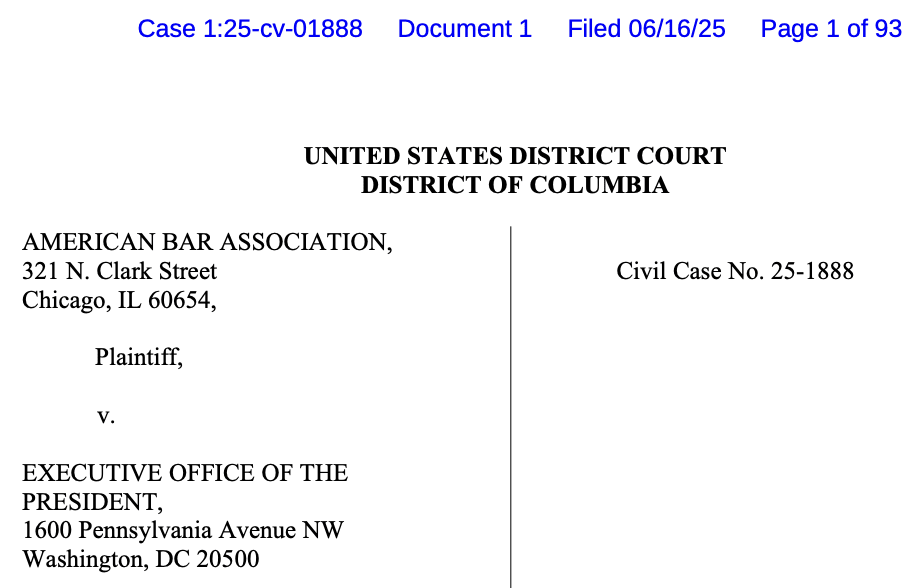
“The
American
Bar
Association
sued
the
Trump
administration
on
Monday,
seeking
an
order
that
would
bar
the
White
House
from
pursuing
what
the
ABA
called
a
campaign
of
intimidation
against
major
law
firms.
The
lawsuit, filed
in
federal
court
in
Washington,
D.C.,
said
the
administration
violated
the
U.S.
Constitution
in
a
series
of
executive
orders
targeting
law
firms
over
their
past
clients
and
lawyers
they
hired.”
Read
more here.
Download
the
complaint here,
and
read
the
ABA’s
press
release
about
the
lawsuit here.
#5 “Supreme
Court
Disclosures
Detail
Millions
in
Justices
Book
Payments.” From The
Hill:
“The
Supreme
Court
justices’
annual
financial
disclosures
were
released
Tuesday,
revealing
millions
of
dollars
in
combined
book
payments
to
the
justices
in
2024. Justice Ketanji
Brown
Jackson took
in
the
most, disclosing a nearly
$2.07
million
book
advance
from
Penguin
Random
House,
which
published
her
memoir,
‘Lovely
One,’
in
September.
Jackson
received
nearly
$894,000
the
year
prior.”
Read
more here.
#6 “Federal
Judges
are
Powerful.
Some
of
Their
Law
Clerks
Describe
a
Toxic
Work
Culture.” From NPR:
“For
more
than
a
year, NPR
has
investigated
serious
misconduct
in
the
federal
judiciary —
and
how
difficult
it
is
to
hold
judges
accountable.
At
one
end
of
the
spectrum,
we
heard
from
clerks
who
alleged they
suffered
sexual
assaults,
bullying,
and
pregnancy
discrimination.
But
the
power
imbalance
between
judges
and
their
young
clerks
also
fuels
a
broader,
more
insidious
culture,
where
clerks
are
expected
to
surrender
control
over
nearly
every
aspect
of
their
lives.”
Read
more here.
#7 “Michigan
Law
Review
Sued
for
Alleged
Racial,
Sexual
Bias.
School
Vows
Vigorous
Defense.” From
the Detroit
News:
“A
conservative
civil
rights
organization
is
asking
a
federal
judge
to
order
the Michigan
Law
Review Association
to
stop
using
race
and
sex
preferences
to
select
its
members
and
articles
and
appoint
a
court
monitor
to
oversee
future
decisions
by
the
nonprofit.
In
a
lawsuit
filed
Wednesday
in U.S.
District
Court
in
Detroit,
a
group
called
the Faculty,
Alumni,
and
Students
Opposed
to
Racial
Preferences,
or
FASORP,
accused
the
association
for
the
law
journal
of
the University
of
Michigan
Law
School of
excluding
articles
from
conservative
White
students
and
using
race
and
sex
preferences
to
select
its
members
and
articles.
…
The
group
is
suing
on
behalf
of
three
unnamed
White
male,
heterosexual
law
professors
who
have
submitted
articles
to
the
Michigan
Law
Review
in
the
past
and
were
all
rejected.
‘Individuals
A,
B,
and
C
are
unable
to
compete
on
an
equal
basis
with
authors
who
are
women,
racial
minorities,
homosexuals,
or
individuals
who
engage
in
gender-nonconforming
behavior
or
identify
with
a
gender
that
departs
from
their
biological
sex,’
according
to
the
lawsuit.”
Read
more here.
(Full
disclosure:
my
forthcoming
piece
“When
Lawyers
Protest”
will
be
published
by
the
Michigan
Law
Review
in
2026).
#8 Legal
Ethics
Scholars
File
Amicus
Brief
in
Villarreal
v.
Texas.
Along
with
several
other
legal
ethics
scholars,
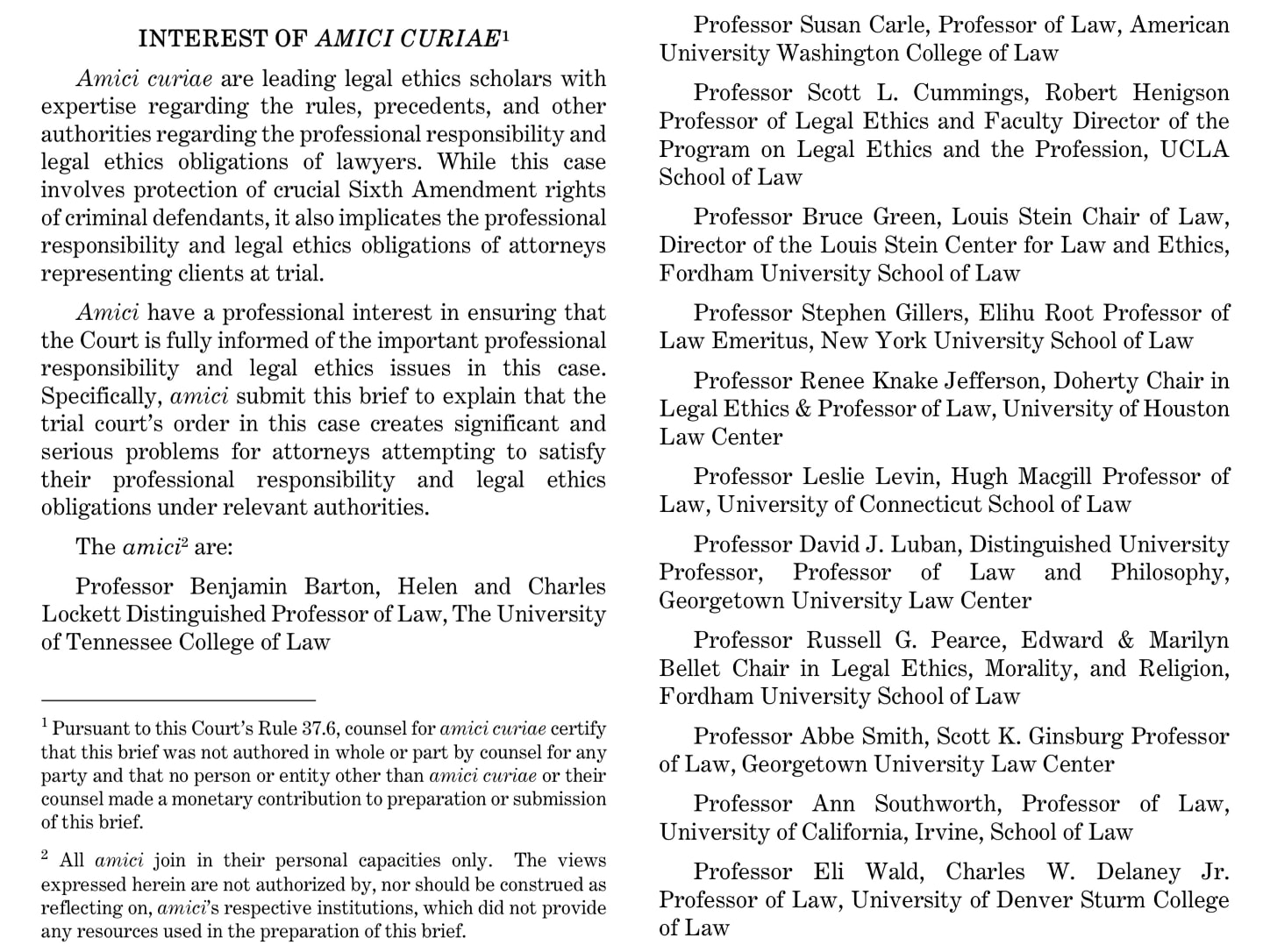
I
joined
an
amicus
brief
filed
in Villarreal
v.
Texas,
a
case
the
US
Supreme
Court
will
take
up
during
the
2025
term.
At
issue
is
whether
a
trial
court
violates
a
defendant’s
Sixth
Amendment
right
to
counsel
by
prohibiting
the
defendant
and
his
lawyer
from
discussing
testimony
during
an
overnight
recess.
We
argue
that
a
ban
on
discussions
like
this
jeopardizes
the
lawyer’s
compliance
with
core
professional
responsibilities
and
undermines
attorney-client
privilege
and
the
duty
of
confidentiality.
Read
more
and
download
the
amicus
brief here.

#9 The
Ethics
of
Book
Awards,
Law
Course
Titles,
and
Free
Speech. Two
headlines
for
#8. First,
from
the New
York
Times: “A
White
Nationalist
Wrote
a
Law
School
Paper
Promoting
Racist
Views.
It
Won
Him
an
Award.” “Preston
Damsky is
a
law
student
at
the
University
of
Florida.
He
is
also
a
white
nationalist
and
antisemite.
Last
fall,
he
took
a
seminar
taught
by
a
federal
judge
on
‘originalism,’
the
legal
theory
favored
by
many
conservatives
that
seeks
to
interpret
the
Constitution
based
on
its
meaning
when
it
was
adopted.
In
his
capstone
paper
for
the
class,
Mr.
Damsky
argued
that
the
framers
had
intended
for
the
phrase
‘We
the
People,’
in
the
Constitution’s
preamble,
to
refer
exclusively
to
white
people.
…
At
the
end
of
the
semester,
Mr.
Damsky,
29,
was
given
the
‘book
award,’
which
designated
him
as
the
best
student
in
the
class.
According
to
the
syllabus,
the
capstone
counted
the
most
toward
final
grades.
…
The
Trump-nominated
judge
who
taught
the
class, John
L.
Badalamenti,
declined
to
comment
for
this
article,
and
does
not
appear
to
have
publicly
discussed
why
he
chose
Mr.
Damsky
for
the
award.
That
left
some
students
and
faculty
members
at
the
law
school,
considered
Florida’s
most
prestigious,
to
wonder,
and
to
worry:
What
merit
could
the
judge
have
seen
in
it?
…
In
January, Carliss
Chatman,
an
associate
law
professor
at
Southern
Methodist
University,
began
a
stint
as
a
visiting
scholar
at
the
school.
It
was
not
long,
she
said,
before
a
number
of
Black
and
Jewish
students
came
to
her
with
concerns
about
Mr.
Damsky.
Ms.
Chatman
was
struck,
in
part,
by
her
own
experiences
at
the
school
in
contrast
to
Mr.
Damsky’s
award.
She
had
proposed
teaching
a
class
during
her
time
there
called
‘Race,
Entrepreneurship
and
Inequality.’
But
administrators
at
the
law
school
changed
the
name
to
‘Entrepreneurship,
she
said,
before
listing
it
in
the
course
catalog.
…
‘I
just
find
it
fascinating
that
this
student
can
write
an
article,
a
series
of
articles
that
are
essentially
manifestoes,
and
that’s
free
speech,’
Ms.
Chatman
said,
referring
to
Mr.
Damsky,
‘but
my
class
can’t
be
called
‘Race,
Entrepreneurship
and
Inequality.’”
Read
more here (gift
link). Second,
from Josh
Blackman in The
Volokh
Conspiracy: “The
New
York
Times
Launches
An
Unfair
Attack
On
Judge
Badalamenti.” Read
more here.
#10 “Pam
Bondi’s
Brother
Overwhelmingly
Defeated
in
Heated
Race
to
Lead
the
D.C.
Bar.” From NPR:
“Employment
attorney Diane
Seltzer has
won
a
closely
watched
contest
to
lead
the
D.C.
Bar
Association,
defeating
securities
lawyer Brad
Bondi in
a
race
with
record
turnout.
Seltzer
tallied
more
than
90
percent
of
the
electronic
vote
with
‘no
issues
or
irregularities’
in
the
voting
system, D.C.
Bar
CEO
Bob
Spagnoletti said
in
a
press
call
Monday.
More
than
38,000
people
voted
in
the
race,
more
than
five
times
as
many
voters
in
a
typical
election,
he
said.
The
race
became
a
microcosm
for
the
clashes
and
pressures
on
the
American
legal
system
this
year,
in
part
because
one
of
the
two
top
candidates
is
the
younger
brother
of Attorney
General
Pam
Bondi.”
Read
more here.
Get
Hired
Did
you
miss
the
150+
job
postings
from
previous
Roundups?
Find
them
all here.
Upcoming
Ethics
Events
&
Other
Announcements
Did
you
miss
an
announcement
from
previous
Roundups?
Find
them
all here.
Keep
in
Touch
-
News
tips?
Announcements?
Events? A
job
to
post? Reading
recommendations? Email [email protected] –
but
be
sure
to
subscribe
first,
otherwise
the
email
won’t
be
delivered.
Renee
Knake
Jefferson
holds
the
endowed
Doherty
Chair
in
Legal
Ethics
and
is
a
Professor
of
Law
at
the
University
of
Houston.
Check
out
more
of
her
writing
at
the Legal
Ethics
Roundup.
Find
her
on
X
(formerly
Twitter)
at @reneeknake or
Bluesky
at legalethics.bsky.social.