
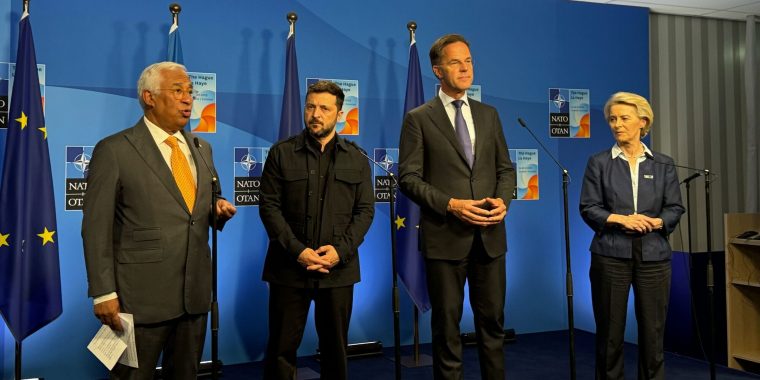
From
left,
European
Council
President
António
Costa,
Ukrainian
President
Volodymyr
Zelenskyy,
NATO
chief
Mark
Rutte
and
European
Commission
President
Ursula
von
der
Leyen
address
the
press
at
the
NATO
summit
in
The
Hague
on
Tuesday,
June
24.
(Michael
Marrow
/
Breaking
Defense)
THE
HAGUE
—
On
Tuesday
for
the
first
day
at
the
NATO
summit
here,
Ukrainian
President
Volodymyr
Zelenskyy
made
a
plea
for
continued
support
while
delivering
a
warning:
Russian
President
Vladimir
Putin
has
ambitions
beyond
Ukraine,
and
could
seek
to
move
on
a
member
of
the
multinational
alliance
within
five
years.
Shortly
after,
Zelenskyy
faced
the
press
alongside
NATO
chief
Mark
Rutte,
European
Commission
President
Ursula
von
der
Leyen
and
European
Council
President
António
Costa.
Each
gave
short
speeches,
with
Zelenskyy’s
colleagues
reaffirming
their
commitment
to
support
Ukraine
in
its
defense
against
Russia.
But
then
they
promptly
exited
the
stage
—
the
last
time
Zelenskyy
would
be
seen
for
much
of
the
conference.
European
leaders
were
steadfast
in
their
support
of
Kyiv,
but
throughout
the
high-level
meeting
Ukraine’s
plight
seemed
to
be
pushed
into
the
background,
overshadowed
by
inter-NATO
negotiations
about
a
5
percent
GDP
spending
target
and
the
surprise
American
bombing
of
Iranian
nuclear
sites
just
days
before.
Perhaps
the
most
stark
example
was
a
joint
declaration
signed
by
the
alliance
at
the
end
of
the
summit.
Whereas
the
same
event
held
in
Washington
last
year
under
then-US
President
Joe
Biden
produced
a
declaration
that
mentioned
Ukraine
59
times,
this
year’s
much
shorter
document
only
garnered
two
mentions
of
the
country.
“Allies
reaffirm
their
enduring
sovereign
commitments
to
provide
support
to
Ukraine,
whose
security
contributes
to
ours,
and,
to
this
end,
will
include
direct
contributions
towards
Ukraine’s
defence
and
its
defence
industry
when
calculating
Allies’
defence
spending,”
reads
the
only
mentions.
It
did
not
discuss
the
potential
for
Ukraine
to
join
the
alliance,
whereas
last
year’s
statement
described
Kyiv
on
an
“irreversible
path”
to
membership.
If
the
declaration
was
any
indication
—
along
with
some
fawning
private
text
messages
—
it
was
clear
this
year
that
NATO
leadership
would
play
a
deferential
role
to
US
President
Donald
Trump,
who
has
for
years
embraced
Putin
and
sharply
criticized
Zelenskyy.
Some
aesthetic
choices
may
also
have
been
made
to
placate
Trump.
At
the
summit,
Zelenskyy
opted
for
more
formal
attire,
ditching
his
casual
clothing
that
has
defined
his
image
but
earned
the
ire
of
the
American
president’s
orbit.
And
while
Zelenskyy
was
still
successful
in
securing
aid
for
Ukraine
from
Europe,
it
doesn’t
appear
he
made
progress
with
the
US,
Ukraine’s
most
important
benefactor,
whose
equipment
has
been
critical
to
stymie
Russia’s
advance.
At
a
press
conference
Wednesday
following
a
meeting
with
Zelenskyy,
Trump
acknowledged
it
is
“possible”
Putin
has
ambitions
to
invade
a
NATO
country,
but
ultimately
demurred
when
asked
whether
money
and
equipment
will
still
flow
from
Washington
to
Kyiv.
“As
far
as
money
going,
we’ll
see
what
happens,”
he
said.
(A
senior
NATO
official
later
told
reporters
US
equipment
was
still
flowing
to
Ukraine
and
would
not
run
out
anytime
“soon.”)
As
for
giving
Ukraine
desperately
needed
additional
Patriot
air
defense
systems,
Trump
said
only
that,
“we’re
going
to
see
if
we
can
make
some
available
…
they’re
very
hard
to
get.”
In
April,
Rutte
revealed
that
most
Patriots
pledged
to
Ukraine
had
arrived
in
country
and
the
remainder
would
be
delivered
in
the
near
future,
according
to
Newsweek.
While
no
material
agreements
were
made
at
the
summit,
it
didn’t
appear
to
be
a
complete
loss
for
Zelenskyy
in
his
relations
with
Trump.
At
the
very
least,
the
Ukrainian
president
received
a
consolation
prize:
Trump
softening
his
tone
on
the
conflict,
a
rhetorical
gesture
that
may
prove
to
be
important
down
the
road.
“He’s
fighting
a
brave
battle.
It’s
a
tough
battle,”
Trump
said
of
Zelenskyy,
later
adding
that
“Vladimir
Putin
really
has
to
end
that
war.
People
are
dying
at
levels
that
people
haven’t
seen
before
for
a
long
time.”

US
President
Donald
Trump,
flanked
by
Defense
Secretary
Pete
Hegseth
and
Secretary
of
State
Marco
Rubio,
in
a
press
briefing
at
the
NATO
summit
on
Wednesday,
June
25.
(Michael
Marrow
/
Breaking
Defense)
Meanwhile
on
the
battlefield,
NATO
does
not
anticipate
a
strategic
breakthrough
by
either
side
in
the
near
future,
a
separate
senior
alliance
official
told
reporters
in
a
different
briefing
on
Tuesday.
But
a
grueling
summer
is
shaping
up,
which
still
carries
the
possibility
of
an
unforeseen
advance.
Every
week
has
seen
“near
record
numbers”
of
combined
drone
and
missile
attacks
by
Russia,
the
official
said,
also
speaking
on
the
condition
of
anonymity.
The
United
States
remains
the
chief
contributor
of
intelligence,
the
official
added,
noting
that
“increasing
the
level
of
aid
delivered
to
Ukraine
will
certainly
improve
the
dynamics
on
the
battlefield,
and
vice
versa.”
Elaborating
further,
the
official
said
Russia
is
making
“steady
advances”
in
Sumy
and
eastern
Ukraine,
while
“aiming
to
create
a
buffer
zone”
around
Kyiv’s
surprise
incursion
into
Kursk.
Russia
remains
ultimately
disinterested
in
meaningful
ceasefire
talks,
the
official
added,
and
Moscow’s
arms
production
remains
strong,
with
the
ability
to
continue
financing
the
war
until
at
least
2027.
“The
real
bottom
line
is
the
situation
on
the
battlefield
continues
to
be
difficult,”
the
official
said,
praising
the
“innovative
spirit”
of
Ukrainian
forces.
“But
we’re
in
for
a
stressful
and
difficult
summer.”
Tim
Martin
contributed
to
this
report.