
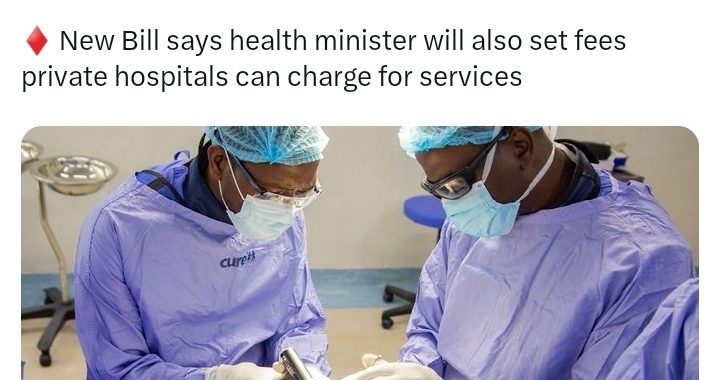

It
empowers
the
health
minister
to
cap
fees,
regulate
pricing,
and
mandates
that
private
institutions
admit
and
stabilize
emergency
patients
for
at
least
48
hours,
regardless
of
their
ability
to
pay.
This
legislation
strikes
at
the
heart
of
a
dilemma
now
familiar
in
Zimbabwe,
and
indeed
around
the
world.
Is
it
a
mandate
toward
universal
justice,
a
necessary
bulwark
against
medical
profiteering?
Or
is
it
a
dangerous
overreach,
threatening
to
collapse
a
fragile
private
healthcare
sector
already
on
its
knees?
In
this
moment,
we
must
look
clearly
at
both
potential
and
peril.
The
political
and
human
stakes
are
obvious.
Zimbabwe’s
public
health
system,
was
ravaged
by
economic
collapse
and
underfunding.
Private
hospitals
now
charge
fees
out
of
reach
for
ordinary
citizens.
In
emergencies,
stories
of
patients
turned
away
at
gates,
unable
to
pay
entry
fees,
are
lifelines
severed.
This
bill
seeks
to
make
that
impossible—no
one
may
be
refused
emergency
care
under
Section 76
of
our
constitution
.
The
optics
are
undeniably
powerful.
A
constitutional
right
made
real.
A
state
reasserting
its
duty.
Justice
framed
not
in
broken
hospitals
or
bureaucratic
promise,
but
in
tangible
half‑life
lines
drawn
in
the
corridors
of
care.
In
many
parts
of
the
world,
such
legislation
would
be
lauded
as
overdue,
essential.
The
phrase
“healthcare
as
a
human
right”
would
not
to
most
readers
sound
radical.
But
the
Golden
Rule
of
law
says: Those
with
gold
make
the
rules.
If
private
hospitals
become
compulsory
48‑hour
clinics,
no
institution
will
absorb
that
at
cost
without
compensation.
Though
the
bill
allows
for
ministerial
cost‑recovery
agreements,
there
is
scant
clarity
on
timeliness,
rates,
or
guarantees
.
Doctors’
associations
and
human‑rights
groups
have
cautioned
that
this
“reimbursement
model…
is
vague
and
may
need
further
clarification”
.
They
note
public
hospitals
owe
large
arrears;
private
hospitals
cannot
sustain
bloated
bills
without
guaranteed
payment.
A
senior
physician
told
journalists—bluntly—that
private
hospitals
would
be
overwhelmed.
Running
out
of
food,
medicine,
oxygen,
and
with
staff
stretched thin,
this
could
collapse
the
very
system
it
hopes
to
rescue
.
Indeed,
facilities
founded
on
rapid
turnover
and
revenue
per
patient
are
suddenly
tasked
with
open‑ended
guarantees.
The
question
becomes:
can
a
hospital
sustain
a
business
model
built
on
profit
under
these
constraints?
If
not
profit,
perhaps
regulation
can
fill
the
gap.
The
bill
grants
sweeping
powers
to
cap
fees
and
price
increases—even
overriding
previously
established
charges
.
Again,
early
reactions
raise
concern.
Should
the
Health
Minister,
a
political
figure,
dictate
bedside
rates?
Doctors
warn
this
amounts
to
micro‑management,
unwisely
binding
health
delivery
to
bureaucratic
fiat
.
Zimbabwe’s
medical
sector,
like
those
elsewhere,
requires
agility.
A
sudden
shortage
of
critical
drugs
or
a
spike
in
imports
costs
must
be
absorbed.
Setting
fixed
price
ceilings—with
no
adjustment
mechanisms—could
choke
innovation,
stifle
investment,
and
shrink
capacity
just
as
demand
burgeons.
There
is
another
hidden
dimension:
equity.
Who
benefits
and
who
gets
left
behind?
If
private
hospitals
can
no
longer
raise
fees,
their
board
decisions
may
include
cost‑shifting
or
prioritization
of
lucrative
cosmetic,
dental,
or
elective
services.
Those
who
can
pay
may
be
diverted
to
circumvent
price
controls.
Emergency
care,
in
practice,
might
become
a
symbolic
principle
rather
than
a
lived
guarantee.
Worse,
if
private
institutions
begin
refusing
non‑emergency
patients
to
allocate
resources
to
mandated
emergencies,
the
general
public
may
suffer.
The
designations
of
what
is
“emergency”
versus
“routine”
are
vulnerable
to
manipulation—patients
may
show
up
in
true
crisis
and
be
denied
care
on
technical
grounds.
In
systems
where
triage
protocols
are
already
weak,
this
could
create
a
two-tier
that
benefits
none.
Yet,
it’s
vital
not
to
mistake
critique
for
cynicism.
Zimbabwe’s
private
healthcare
crisis
didn’t
emerge
overnight—it
is
the
product
of
years
of
public
underinvestment,
currency
collapse,
and
structural
rot.
The
bill
must
be
judged
on
its
structural
merits,
not
just
its
risks.
It
addresses
a
moral
failing:
healthcare
should
not
be
a
luxury
to
finance
or
a
gamble
on
one’s
luck.
For
Zimbabweans,
the
question
isn’t
whether
the
state
should
intervene—it
has
to.
It’s
whether
this
intervention
is
sufficiently
nuanced,
financed,
enforceable,
and
paired
with
a
plan
to
revitalize
public
health
so
that
dependence
on
private
lifelines
can
ease,
rather
than
deepen.
International
comparisons
offer
mixed
lessons.
In
the
United
States,
coercive
“emergency
treatment
regardless
of
ability
to
pay”
exists
on
paper—but
in
practice,
hospitals
bill
uninsured
patients
at
staggering
rates
after
evacuation
orders
expire.
In
South
Africa,
private
hospitals
dominate
serious
healthcare
provision—yet
cost
schedules
are
hardly
transparent
and
access
remains
politically
contested.
In
Kenya
and
Nigeria,
recent
bills
criminalize
refusal
to
treat,
but
compliance
remains
structural,
not
legal.
Penalties
for
non-compliance
are
vague
and
enforcement
weak.
Zimbabwe’s
version
now
leads
in
constitutional
alignment—but
must
learn
from
its
neighbors’
failures
in
implementation
and
funding.
The
absence
of
public
finance
strategy
is
the
bill’s
gravest
flaw.
The
state
must
estimate
the
load
this
imposes
and
prepare
to
move
resources
accordingly.
Will
the
Health
Ministry
run
reimbursement
processes
within
30
days,
or
limp
through
six
months
of
delays?
Will
there
be
trauma
units,
ICU
surfaces,
nursing
cadre
supplements?
Or
will
the
bill
remain
a
“mythic
promise”
while
facilities
deteriorate?
As
one
doctor
argued,
the
state
should
“fix
public
hospitals
before
placing
that
burden
on
private
sector” .
This
echoes
the
Africa‑Press
critique,
which
objects
that
constitutional
alignment
alone
is
not
enough;
rehabilitating
health
infrastructure
and
expanding
workforce
capacity
is.”
.
If
it
passes
with
these
ambiguities
unresolved,
the
bill
may
amount
to
a
band‑aid
on
a
bleeding
institution.
Worse,
if
hospitals
collapse
underneath
it,
emergency
care
could
be
even
less
accessible.
We
could
end
up
with
a
leggiero
system
in
which
both
public
and
private
wards
fail
patients
and
see
two
siloed
zones
of
neglect.
But
this
disaster
is
not
inevitable.
Zimbabwe
can
pivot
the
bill
into
a
transformational
moment,
embedding
it
within
a
strategy
that
raises
standards,
finances
rescue,
and
builds
accountability.
First,
clarify
the
reimbursement.
The
Minister
should
issue
regulations
with
clear
timelines:
maximum
30
days
turnaround,
standard
kilometric
rates,
and
penalties
for
arrears.
A
trust
fund
backed
by
global
donors,
diaspora
bonds,
or
dedicated
levies
could
ensure
liquidity.
Second,
establish
triage
protocols
with
civil
society
oversight.
Define
“emergency”
clearly.
Ensure
patients
stabilized
under
the
law
are
physically
referred
to
public
facilities
when
needed—not
left
to
rot.
Third,
support
private‑public
partnerships
to
expand
capacity.
Zimbabwe’s
governorate
system
already
pools
resources—this
reform
could
channel
collaboration
not
coercion.
Fourth,
invest
in
regeneration.
The
bill
should
be
paired
with
a
10‑year
national
health
recovery
plan,
remitting
investment
in
training,
clinics,
mental
health,
rural
outreach,
supply
chains
and
digital
health
architecture.
Finally,
activate
the
Consultative
Health
Forum
Spiritually,
public
trust
hinges
on
participation.
The
bill
establishes
this
forum.
It
can
be
used
to
elevate
patient
voices—including
those
previously
turned
away.
There
is
a
philosophical
danger
that
merits
reflection.
When
states
intervene
in
justice
as
raw
power,
they
risk
eroding
the
virtue
they
intend
to
enforce.
Zimbabwe’s
government
must
avoid
the
temptation
to
rely
solely
on
statutes
to
fix
systemic
decay.
For
rights
to
mean
anything,
hospitals
must
not
fear
the
state
as
punitive
overlord—they
should
view
it
as
partner.
Otherwise,
access
could
worsen
under
political
terror,
rather
than
improve
under
rational
bureaucracy.
At
its
core,
this
bill
reveals
the
collapse
of
two
visions.
The
neoliberal
worldview
said
privatization
plus
competition
would
ensure
quality
and
access.
That
meme
now
lies
in
tatters
in
front
of
under‑funded
hospitals.
On
the
other
side,
the
authoritarian
state
worldview
insists
that
power
vested
in
ministries
can
overcome
neglect.
But
alone,
that
handbook
cracks
under
inertia.
Zimbabwe’s
future
lies
somewhere
in
between—a
hybrid
of
rights,
regulation,
resilience.
The
health
ministry
must
prove
that
legislation
can
be
more
than
coercive—it
can
be
catalytic.
International
donors,
African
Union
and
diaspora
communities
must
also
lean
in.
The
world
cannot
applaud
constitutional
benchmarks
from
Harare
and
then
leave
Zimbabweans
wandering
back
into
ration
queues.
Zimbabwe’s
struggle
stands
as
a
signal
testbed
for
a
new
global
compact:
what
happens
when
a
post‑colonial
democracy
tries
to
administer
emergency
justice
under
economic
collapse.
If
we
fail,
this
bill
will
be
seen
as
symbolic
theatre
for
the
privileged.
If
we
succeed,
it
will
become
a
model
for
what
health
justice
looks
like
in
broken
societies.
The
questions
before
Zimbabwe
are
not
just
legal—
they’re
moral.
Do
we
believe
that
lives
are
more
precious
than
ledgers?
Do
we
trust
that
institutions
can
deliver
as
well
as
legislate?
Can
we
walk
beyond
bill‑signing
into
the
hard,
tired
work
of
caregiving?
As
the
amendments
head
back
for
debate
and
potential
passage,
these
questions
must
be
asked
out
loud—not
whispered
during
committee
meetings.
If
we
cannot
demand
better,
we
cannot
claim
to
care
at
all.
Zimbabwe
is
at
a
crossroads.
Either
the
Medical
Services
Amendment
Bill
becomes
the
start
of
a
journey—toward
shared
infrastructure,
sustainable
care,
and
human
dignity—or
it
becomes
the
last
gasp
of
a
failing
system,
solar‑powered
by
political
will
and
nothing
else,
just
like
the
Zig.
In
the
half‑life
between
the
law’s
promise
and
the
loud
sirens
in
hospital
wards,
we
will
find
out
which
path
Zimbabwe
takes.
We
will
learn
if
this
is
health
justice—or
state
overreach
in
the
guise
of
compassion.
Post
published
in:
Featured