
Zimbabwe’s
efforts
to
control
malaria
have
been
dealt
a
huge
blow
as
experts
say
the
disease
has
returned
“with
a
vengeance”
after
US
aid
cuts,
with
115
outbreaks
recorded
in
2025
compared
with
only
one
last
year.
The
sharp
rise
in
cases
comes
six
months
after
Donald
Trump
halted
critical
funding
for
US
research
and
national
response
programmes.
The
cuts
in
January,
which
included
funding
for tuberculosis, HIV/Aids and
malaria
programmes,
crippled
the Zimbabwe
Entomological
Support
Programme
in
Malaria
(Zento) at
Africa
University
in
Mutare,
which
provides
the
country’s
National
Malaria
Control
Programme
with
scientific
research
to
combat
the
disease.
Cumulative
malaria
cases increased
by
180%
in
the
first
four
months
of
2025,
according
to
the
health
ministry,
while
the
number
of
malaria-related
deaths
increased
by
218%,
from
45
in
the
same
period
in
2024
to
143
in
2025.
As
of
26
June,
the
number
of
malaria
cases
had
risen
to 119,648,
with
334
deaths,
according
to
the
Zimbabwean
health
ministry.
The
distribution
of
essential
control
methods,
such
as
mosquito
nets,
was
also
disrupted,
leaving
hundreds
of
thousands
of
people
exposed
to
mosquito
bites
across
the
country.
The
health
ministry
said
in
May
that
1,615,000
insecticide-treated
nets
were
being
distributed
but
that
there
was
a
shortfall
of
600,000
due
to
the
withdrawal
of
US
funding.
Itai
Rusike,
director
of
Zimbabwe’s
Community
Working
Group
on
Health,
said
funding
shortfalls
were
jeopardising
the
country’s
significant
gains
against
malaria
over
the
past
20
years.
“Sustained
domestic
funding
is
critical
to
keep
prevention
and
treatment
efforts
on
track,”
he
said.
“If
mosquito
nets
and
preventive
medicines
for
pregnant
women
are
unavailable,
lives
will
be
lost.
When
the
supply
of
test
kits
and
first-line
treatments
is
disrupted,
malaria
cases
and
deaths
will
spiral.”
Children
under
the
age
of
five
account
for
14%
of
total
malaria
cases.
Zimbabwe
has
set
out
to
eliminate
malaria
by
2030,
in
line
with
the
ambitious goal
set
by
the
African
Union,
using
various
strategies
such
as
raising
community
awareness,
preventing
mosquito
bites
with
insecticide-treated
nets
and
spraying,
as
well
as
improving
surveillance
systems.
Dr
Henry
Madzorera,
a
former
health
minister,
said
Zimbabwe
should
mobilise
its
own
resources
to
bridge
the
funding
gap.
“We
have
a
lot
of
taxes
earmarked
for
the
health
sector
–
let
us
use
them
wisely
for
health
promotion
and
disease
prevention,”
he
said.
“People
must
be
treated
early
for
malaria.
“The
country
should
not
rely
on
donors
to
do
malaria-elimination
activities,”
Madzorera
added.
In
2024, USAID
disbursed
$270m
for
health
and
agriculture
programmes in
Zimbabwe.
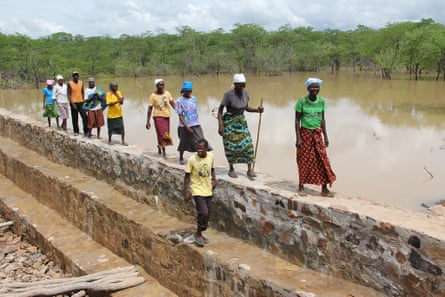
In
2024,
USAID
provided
$270m
for
health
and
agriculture
programmes
in
Zimbabwe,
such
as
this
dam. Photograph:
USAID
Zimbabwe’s
deputy
health
minister,
Sleiman
Kwidini,
admitted
the
funding
gap
left
by
the
US
cuts
had
disrupted
the
provision
of
mosquito
nets.
“We
are
now
taking
over
the
procurement
of
those
nets
after
the
US
withdrew
funding.
We
have
just
been
disturbed,
but
our
vision
is
to
eliminate
malaria
by
2030,”
he
said.
Prof
Sungano
Mharakurwa,
director
of
Africa
University’s Malaria Institute,
said
it
would
take
time
to
recover
lost
ground
but
added:
“If
we
get
funding,
we
can
hit
the
ground
running
and
promptly
return
to
scoring
successes
again,
until
we
beat
this
deadly
scourge
that
is
malaria.”
He
said
that
since
the
Zento
mosquito
surveillance
programme
began
in
Manicaland
province,
there
had
been
a
marked
reduction
in
malaria
cases
and
it
was
about
to
be
extended
when
the
US
cuts
came.
“Working
with
the
National
Malaria
Control
Programme,
it
had
just
been
expanded,”
Mharakurwa
said.
“It
was
poised
to
run
for
five
years
with
national
coverage
when
it
was
abruptly
terminated.”
Africa
University
data
shows
that
Manicaland
recorded
145,775
malaria
cases
in
2020
but
just
28,387
after
Zento
was
introduced
in
2021.
Malaria
cases
in
the
province
had
been
further
reduced
to
8,035
by
2024
before
more
than
trebling
to
27,212
the
following
year,
when
US
funding
was
cut.
Mharakurwa
said:
“The
malaria
was
back
with
a
vengeance
straight
after,
and
[numbers
of]
cases
that
were
waning
rebounded
in
2025,
surpassing
levels
that
had
ever
been
seen
since
the
beginning
of
the
project.”
Above-normal
rains
this
year,
which
aided
malaria
transmission,
had
worsened
the
situation,
he
added.