
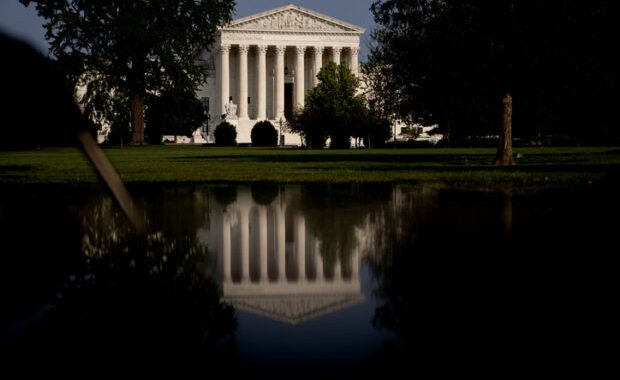

Stefani
Reynolds/Bloomberg)
The
Supreme
Court’s
shadow
docket
has
become
a
lawless
mess.
The
justices
are
issuing
extremely
consequential
rulings with
either
no
explanation
at
all,
or
with
barely
a
paragraph
of
reasoning.
No
full
briefing.
No
oral
arguments.
Just
vibes-based
constitutional
law
that
lower
courts
are
somehow
supposed
to
follow.
Now
the
Court
has
made
this
chaos
worse
by
essentially
telling
lower
courts
to
treat
these
half-baked
emergency
rulings
as
more
important
than
actual
binding
precedent.
If
you’re
a
district
court
judge,
what
do
you
do?
Follow
the
actual
binding
precedent,
or
guess
at
what
the
Supreme
Court’s
vibes-based
constitutional
law
might
mean?
Earlier
this
week,
we
wrote
about
a
district
court
judge
who
faced
this
impossible
situation.
She
was
bound
by
the
Supreme
Court’s
1935
precedent
in Humphrey’s
Executor,
which
clearly
states
that
Presidents
cannot
fire
the
heads
of
independent
agencies
like
FTC
Commissioners
(in
Humphrey’s
it’s literally about
the
firing
of
an
FTC
Commissioner).
That’s
still
good
law—the
Court
has
never
officially
overturned
it.
But
Trump
fired
FTC
commissioners
anyway,
creating
the
exact
same
legal
question
that
Humphrey’s
already
answered.
Recent
Supreme
Court
rulings
have
suggested
the
Court
might
be
willing
to
gut
independent
agencies,
but
without
actually
overturning
the
controlling
precedent.
The
judge
did
what
judges
are
supposed
to
do:
follow
binding
precedent
until
the
Supreme
Court
clearly
overrules
it.
Yesterday’s
ruling
in
a separate case
makes
this
impossible
situation
even
worse.
The
Supreme
Court
issued
another
barely-explained
shadow
docket
ruling
that
essentially
scolds
lower
courts
for
following
actual
precedent
instead
of
reading
the
tea
leaves
of
emergency
orders.
The
case,
Trump
v.
Boyle,
involves
Trump’s
firing
of
Consumer
Product
Safety
Commission
(CPSC)
commissioners.
This
follows
a
similar
shadow
docket
ruling
in
May
about
the
National
Labor
Relations
Board
(NLRB)
and
Merit
Systems
Protection
Board
(MSPB).
In
all
these
cases,
lower
courts
applied
existing
law
and
ruled
that
the
President
lacks
the
power
to
fire
these
officials.
Rather
than
take
up
these
cases
properly
with
full
briefing
and
oral
arguments,
the
Supreme
Court
just
waves
its
hand
and
declares
that
agencies
like
the
CPSC
and
NLRB
“aren’t
really
independent”
because
some
of
their
functions
involve
executive
power.
Therefore,
Trump
can
fire
them.
There
might
be
reasonable
constitutional
arguments
for
this
position.
We’ll
never
know,
because
the
Court
is
making
these
determinations
without
bothering
to
hear
them.
The
May
ruling
essentially
said:
“We
haven’t
really
looked
into
this,
but
we’re
pretty
sure
we’d
side
with
Trump
if
we
did.”
It’s
constitutional
law
by
vibes,
and
it
leaves
lower
courts
in
an
impossible
position.
On
one
hand:
Humphrey’s
Executor,
a
clear
binding
precedent.
On
the
other:
Wilcox,
a
half-baked
shadow
docket
ruling
that
essentially
says
“trust
us,
we’d
probably
overturn
this
if
we
bothered
to
think
about
it.”
In
yesterday’s
CPSC
case, the
Court’s two-paragraph ruling is
openly
dismissive
of
lower
courts
trying
to
follow
actual
law.
The
tone
essentially
asks:
“Why
aren’t
you
treating
our
unexplained
emergency
order
as
more
important
than
binding
precedent?”
Although
our
interim
orders
are
not
conclusive
as
to
the
merits,
they
inform
how
a
court
should
exercise
its
equitable
discretion
in
like
cases.
The
stay
we
issued
in
Wilcox
reflected
“our
judgment
that
the
Government
faces
greater
risk
of
harm
from
an
order
allowing
a
removed
officer
to
continue
exercising
the
executive
power
than
a
wrongfully
removed
officer
faces
from
being
unable
to
perform
her
statutory
duty.”
Ibid.
(slip
op.,
at
1).
The
same
is
true
on
the
facts
presented
here,
where
the
Consumer
Product
Safety
Commission
exercises
executive
power
in
a
similar
manner
as
the
National
Labor
Relations
Board,
and
the
case
does
not
otherwise
differ
from
Wilcox
in
any
pertinent
respect.
Even
Justice
Kavanaugh—who
clearly
wants
to
gut
independent
agencies—thinks
this
process
is
bonkers.
In
his
concurrence,
he
essentially
says:
“Look,
if
we’re
going
to
overturn
major
precedents,
maybe
we
should
actually,
you
know,
hear
arguments
about
it?”
When
an
emergency
application
turns
on
whether
this
Court
will
narrow
or
overrule
a
precedent,
and
there
is
at
least
a
fair
prospect
(not
certainty,
but
at
least
some
reasonable
prospect)
that
we
will
do
so,
the
better
practice
often
may
be
to
both
grant
a
stay
and
grant
certiorari
before
judgment.
Kavanaugh
gets
the
core
problem:
You
can’t
run
a
legal
system
on
winks
and
nudges.
Either
Humphrey’s
is
good
law
or
it
isn’t.
Either
Presidents
can
fire
independent
commissioners
or
they
can’t.
You
can’t
just
leave
everyone
guessing.
In
those
unusual
circumstances,
if
we
grant
a
stay
but
do
not
also
grant
certiorari
before
judgment,
we
may
leave
the
lower
courts
and
affected
parties
with
extended
uncertainty
and
confusion
about
the
status
of
the
precedent
in
question.
Moreover,
when
the
question
is
whether
to
narrow
or
overrule
one
of
this
Court’s
precedents
rather
than
how
to
resolve
an
open
or
disputed
question
of
federal
law,
further
percolation
in
the
lower
courts
is
not
particularly
useful
because
lower
courts
cannot
alter
or
overrule
this
Court’s
precedents.
In
that
situation,
the
downsides
of
delay
in
definitively
resolving
the
status
of
the
precedent
sometimes
tend
to
outweigh
the
benefits
of
further
lower-court
consideration.
He’s
absolutely
right.
The
Court
is
playing
hide
the
ball
with
constitutional
law,
creating
chaos
in
the
lower
courts
while
giving
Trump
a
free
pass
to
ignore
congressional
statutes.
Justice
Kagan’s
dissent
(joined
by
Sotomayor
and
Jackson)
cuts
to
the
constitutional
heart
of
the
problem:
this
approach
obliterates
separation
of
powers.
The
system
is
supposed
to
work
like
this:
Congress
writes
the
laws,
the
President
faithfully
executes
them,
and
the
judiciary
determines
whether
both
the
laws
and
the
President’s
actions
are
constitutional.
Here,
the
Court
is
effectively
eliminating
two
of
the
three
branches
(including
itself!).
Congress
deliberately
created
these
agencies
as
independent
to
insulate
them
from
political
pressure.
The
Court
is
saying
that
doesn’t
matter—the
President
can
ignore
what
Congress
wrote.
And
by
doing
this
through
unexplained
shadow
docket
rulings,
the
judiciary
is
sawing
off
its
own
constitutional
branch.
The
message
is
clear:
the
President
can
ignore
congressional
statutes,
and
we’ll
rubber-stamp
it
without
analysis,
explanation,
or
precedential
guidance.
That’s
not
separation
of
powers.
That’s
monarchy
with
judicial
blessing.
Here’s
Kagan:
In
Congress’s
view,
that
structure
would
better
enable
the
CPSC
to
achieve
its
mission—ensuring
the
safety
of
consumer
products,
from
toys
to
appliances—than
would
a
single-party
agency
under
the
full
control
of
a
single
President.
The
CPSC
has
thus
operated
as
an
independent
agency
for
many
decades,
as
the
NLRB
and
MSPB
also
did.
But
this
year,
on
its
emergency
docket,
the
majority
has
rescinded
that
status.
By
allowing
the
President
to
remove
Commissioners
for
no
reason
other
than
their
party
affiliation,
the
majority
has
negated
Congress’s
choice
of
agency
bipartisanship
and
independence.
More
damning
is
Kagan’s
critique
of
the
Court’s
circular
reasoning:
And
it
has
accomplished
those
ends
with
the
scantiest
of
explanations.
The
majority’s
sole
professed
basis
for
today’s
stay
order
is
its
prior
stay
order
in
Wilcox.
But
Wilcox
itself
was
minimally
(and,
as
I
have
previously
shown,
poorly)
explained.
See
605
U.
S.,
at – (KAGAN,
J.,
dissenting)
(slip
op.,
at
4–7).
It
contained
one
sentence
(ignored
today)
hinting
at
but
not
deciding
the
likelihood
of
success
on
the
merits,
plus
two
more
respecting
the
“balance
[of]
the
equities.”
Id.,
at – (order)
(slip
op.,
at
1–2);
see
id.,
at __–
___
(KAGAN,
J.,
dissenting)
(slip
op.,
at
4–7).
So
only
another
under-reasoned
emergency
order
undergirds
today’s.
Next
time,
though,
the
majority
will
have
two
(if
still
under-reasoned)
orders
to
cite.
“Truly,
this
is
‘turtles
all
the
way
down.’”_
“Turtles
all
the
way
down”—that’s
what
constitutional
law
looks
like
when
the
Supreme
Court
abandons
its
responsibility
to
explain
its
reasoning.
Each
unexplained
shadow
docket
ruling
becomes
precedent
for
the
next
unexplained
shadow
docket
ruling,
creating
an
infinite
regression
of
constitutional
nonsense.
This
isn’t
just
bad
legal
process—it’s
the
systematic
destruction
of
constitutional
government.
Instead
of
three
coequal
branches
with
checks
and
balances,
we’re
getting
an
imperial
presidency,
a
neutered
Congress,
and
a
Supreme
Court
that
has
transformed
from
constitutional
interpreter
to
Trump’s
enabler.
The
Court’s
shadow
docket
has
become
the
constitutional
equivalent
of
“because
we
said
so.”
That’s
not
law.
That’s
authoritarianism
with
footnotes.
And
sometimes
even
the
footnotes
are
missing.
More
Law-Related
Stories
From
Techdirt:
You
Shouldn’t
Have
To
Make
Your
Social
Media
Public
To
Get
A
Visa
On
The
Supreme
Court’s
Constitutional
Vandalism
In
Service
Of
Inherited
Wealth
Restaurant
Owner
Keeps
Getting
Denied
His
Purely
Descriptive
Trademark