
In State
of
Washington,
et
al.
v.
Trump,
et
al.,
the Ninth
Circuit
reviewed the
constitutionality
of Executive
Order
No.
14160,
issued
by
President
Trump
in
January
2025.
The
Order
attempted
to
deny
U.S.
birthright
citizenship
to
children
born
on
U.S.
soil
to
parents
who
were
either
temporarily
or
unlawfully
present
in
the
country.
The
states
of
Washington,
Arizona,
Illinois,
and
Oregon
challenged
the
Executive
Order,
arguing
it
violated
the
Fourteenth
Amendment’s
Citizenship
Clause. This
marked “[the]
first
time
that
an
appellate
court
has
weighed
in
on
the
merits
of
Mr.
Trump’s
attempt
to
end
birthright
citizenship
for
many
children
of
undocumented
immigrants
by
executive
order.”
Judge
Gould,
writing
for
the
court,
held
that
the
Executive
Order
was
unconstitutional
because
it
directly
contradicted
the
plain
language
of
the
Fourteenth
Amendment,
which
guarantees
citizenship
to
“all
persons
born
in
the
United
States
and
subject
to
the
jurisdiction
thereof.”
The
majority
opinion
emphasized
that
the
Citizenship
Clause,
as
interpreted
by United
States
v.
Wong
Kim
Ark (1898),
applies
regardless
of
parental
immigration
status.
The
panel
affirmed
a
universal
preliminary
injunction
issued
by
the
district
court,
blocking
enforcement
of
the
Order.
While
the
court
dismissed
the
claims
of
individual
plaintiffs
(due
to
their
inclusion
in
a
pending
class
action),
it
upheld
the
states’
standing
and
their
likely
success
on
the
merits.
Judge
Bumatay
dissented
in
part,
arguing
that
the
states
lacked
standing
and
that
the
court
had
overstepped
its
jurisdiction.
Judge
Gould’s
opinion
in
this
case
exhibits
several
identifiable
jurisprudential
themes
and
methods.
Textual
Fidelity
to
the
Constitution
Judge
Gould
grounds
his
opinion
in
the
unambiguous
language
of
the
Fourteenth
Amendment’s
Citizenship
Clause,
emphasizing
that
its
plain
text
guarantees
birthright
citizenship
to
all
persons
born
in
the
United
States
and
subject
to
its
jurisdiction.
He
decisively
rejects
efforts
to
reinterpret
or
limit
this
language
through
executive
policy
or
political
framing.
For
Gould,
constitutional
text
is
not
malleable
in
the
face
of
administrative
reimagining:
“We
conclude
that
the
Executive
Order
is
invalid
because
it
contradicts
the
plain
language
of
the
Fourteenth
Amendment’s
grant
of
citizenship.”
This
fidelity
to
the
written
Constitution
forms
the
cornerstone
of
his
legal
reasoning
throughout
the
opinion.
Historical
Precedent
and
Original
Understanding
In
interpreting
the
Citizenship
Clause,
Gould
relies
heavily
on
the
Supreme
Court’s
longstanding
precedent
in United
States
v.
Wong
Kim
Ark (1898).
He
meticulously
traces
the
legal
and
historical
lineage
of
birthright
citizenship,
framing
it
as
a
doctrine
solidified
by
both
judicial
authority
and
the
original
intent
behind
the
Fourteenth
Amendment.
Importantly,
Gould
connects
this
tradition
to
the
Amendment’s
repudiation
of Dred
Scott,
underscoring
that
the
Citizenship
Clause
was
meant
to
permanently
close
the
door
on
racialized
exclusions
from
citizenship.
As
he
puts
it,
“The
Supreme
Court
canvassed
English
common
law,
early
American
decisions…
and
then
held
that
the
Citizenship
Clause
stands
for
‘the
fundamental
rule
of
citizenship
by
birth…’”
Limits
on
Executive
Authority
A
recurring
theme
in
Gould’s
jurisprudence—fully
on
display
here—is
the
rejection
of
executive
authority
to
reinterpret
constitutional
guarantees.
The
President,
in
his
view,
possesses
no
Article
II
power
to
redefine
rights
enshrined
in
the
Constitution
or
to
override
settled
judicial
interpretations.
Gould
is
clear
that
constitutional
change
cannot
occur
through
unilateral
executive
will.
As
he
writes,
“The
President
was
not
granted…
the
power
to
modify
or
change
any
clause
of
the
United
States
Constitution.”
This
line
encapsulates
his
broader
constitutional
philosophy:
the
executive
is
bound
by
law,
not
a
reviser
of
it.
Judicial
Review
and
Equitable
Remedies
Gould
defends
the
district
court’s
decision
to
issue
a
universal
preliminary
injunction
against
enforcement
of
the
Executive
Order,
finding
that
such
relief
was
necessary
to
afford
meaningful
protection
to
the
plaintiff
states
and
the
individuals
affected.
While
he
stops
short
of
endorsing
nationwide
injunctions
as
a
general
rule,
he
endorses
their
use
when
tailored
to
the
constitutional
harm
at
issue.
His
reasoning
is
pragmatic
and
case-specific,
echoing
his
broader
view
that
remedies
must
track
the
scope
of
the
injury.
“We
conclude
that
the
district
court
did
not
abuse
its
discretion
in
issuing
a
universal
preliminary
injunction,”
he
affirms,
emphasizing
the
centrality
of
judicial
discretion
in
constitutional
equity.
Commitment
to
Structural
Constitutionalism
Underlying
Gould’s
opinion
is
a
deep
commitment
to
the
principles
of
separation
of
powers
and
constitutional
design.
He
reads
the
Executive
Order
as
an
encroachment
on
the
Constitution
itself,
an
effort
by
the
executive
branch
to
achieve
indirectly
what
it
cannot
do
directly.
His
concern
is
not
only
with
the
immediate
effects
of
the
order,
but
with
the
institutional
logic
it
threatens.
Gould’s
skepticism
is
clear:
“Perhaps
the
Executive
Branch,
recognizing
that
it
could
not
change
the
Constitution,
phrased
its
Executive
Order
in
terms
of
a
strained…
interpretation…”
The
statement
reflects
his
broader
apprehension
about
executive
overreach
and
underscores
his
view
that
the
judiciary
serves
as
a
bulwark
against
such
constitutional
distortions.
Judge
Gould’s
ruling
in Trump
v.
Washington underscores
his
jurisprudential
consistency
in
textual
adherence,
fidelity
to
historical
precedent,
and
robust
defense
of
constitutional
limits
on
executive
authority.
Prior
Cases
Textual
Anchoring
with
Structural
Sensitivity
Across
his
judicial
record,
Judge
Gould
exhibits
a
disciplined,
text-first
methodology,
especially
in
constitutional
and
statutory
cases.
He
begins
with
the
words
of
the
law
and
interprets
them
within
their
ordinary
meaning,
yet
consistently
situates
those
words
within
the
broader
framework
of
the
legal
or
constitutional
scheme
in
which
they
operate.
This
combination
of
textual
clarity
and
structural
sensitivity
is
evident
in
cases
like Bayliss
v.
Barnhart,
where
he
affirms
administrative
discretion
but
anchors
his
reasoning
in
evidentiary
consistency
across
the
record.
Similarly,
in Safe
Air
for
Everyone
v.
Meyer,
Gould
offers
a
narrow
reading
of
the
term
“solid
waste”
under
the
Resource
Conservation
and
Recovery
Act,
relying
on
common
usage
and
regulatory
intent.
Even
so,
he
frames
that
analysis
within
a
practical
understanding
of
environmental
reuse
and
policy
design,
showing
how
textual
precision
and
systemic
functionality
coexist
in
his
jurisprudence.
Institutional
Restraint
with
Assertive
Constitutional
Adjudication
Judge
Gould’s
decisions
reflect
a
measured
deference
to
institutional
actors—whether
agencies
or
lower
courts—until
constitutional
stakes
compel
judicial
engagement.
He
generally
respects
the
boundaries
of
administrative
governance,
but
when
fundamental
rights
or
structural
constitutional
norms
are
threatened,
he
is
willing
to
intervene
assertively.
In Menotti
v.
City
of
Seattle,
for
instance,
Gould
upholds
the
city’s
security
measures
around
protest
zones
but
carefully
articulates
the
boundaries
of
expressive
conduct
protected
under
the
First
Amendment.
Likewise,
in Kootenai
Tribe
of
Idaho
v.
Veneman,
he
invalidates
a
nationwide
injunction
blocking
a
forest
rule,
respecting
agency
discretion
while
insisting
on
rigorous
compliance
with
NEPA’s
procedural
demands.
These
decisions
typify
a
pattern
in
which
Gould’s
deference
yields
to
constitutional
stewardship—he
guards
procedural
and
participatory
rights
with
particular
care
when
they
come
under
strain
from
executive
or
administrative
power.
Procedural
Integrity
and
Evidentiary
Grounding
Gould’s
jurisprudence
is
marked
by
a
steadfast
commitment
to
procedural
rigor.
His
rulings
often
hinge
on
the
integrity
of
the
administrative
or
evidentiary
record,
reflecting
a
deep
belief
that
process
is
not
a
formality
but
a
substantive
element
of
justice.
In Bayliss,
he
upholds
the
denial
of
benefits
by
closely
examining
the
ALJ’s
record-based
rejection
of
conflicting
medical
opinions.
Likewise,
in Shrestha
v.
Holder,
Gould
affirms
an
immigration
tribunal’s
credibility
findings
but
underscores
that
such
assessments
must
be
individualized
and
holistic
under
the
REAL
ID
Act.
For
Gould,
procedural
fidelity
is
not
a
matter
of
box-checking;
it
is
essential
to
fair
adjudication
across
legal
contexts,
whether
in
administrative
review,
immigration
proceedings,
or
statutory
enforcement.
Doctrinal
Stability
Over
Innovation
When
interpreting
longstanding
doctrines—particularly
in
criminal
and
immigration
law—Gould
tends
toward
judicial
modesty.
His
opinions
reveal
a
preference
for
doctrinal
continuity
over
creative
or
aggressive
innovation.
In United
States
v.
Pacheco-Zepeda,
for
example,
he
upholds
a
sentencing
enhancement
under
8
U.S.C.
§
1326(b)(2),
explicitly
reaffirming
the
controversial Almendarez-Torres precedent
even
amid
post-Apprendi skepticism.
Similarly,
in Paladin
Associates
v.
Montana
Power,
he
applies
the
antitrust
injury
doctrine
with
fidelity
to
established
commercial
expectations,
avoiding
any
doctrinal
expansion.
These
cases
show
a
judge
who
respects
precedent
and
is
wary
of
shifting
legal
standards
absent
clear
guidance
from
Congress
or
the
Supreme
Court.
Pragmatic
Environmental
Federalism
In
his
environmental
rulings,
Gould
strikes
a
pragmatic
balance
between
federal
regulatory
objectives
and
local
governance.
He
respects
the
technical
fact-finding
and
discretionary
space
afforded
to
agencies,
yet
demands
procedural
compliance
and
analytical
transparency.
In Safe
Air and Kootenai,
he
enforces
environmental
rules
not
from
an
ideological
standpoint
but
from
a
structurally
grounded
perspective,
attentive
to
both
regulatory
goals
and
practical
implementation.
His
opinions
reflect
neither
sweeping
pro-regulatory
nor
anti-regulatory
instincts,
but
rather
a
context-specific
commitment
to
coherent
environmental
oversight
within
federalist
constraints.
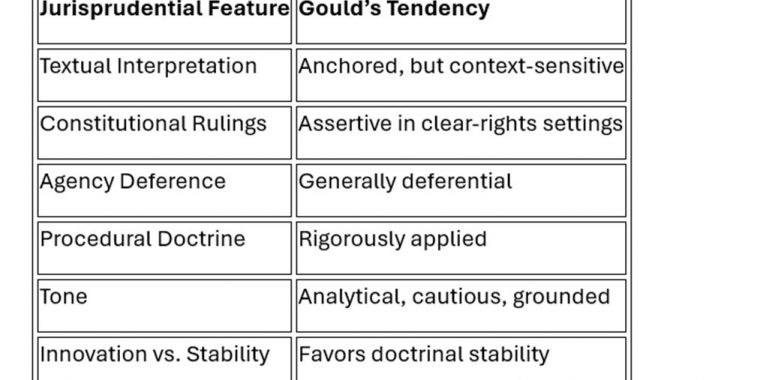
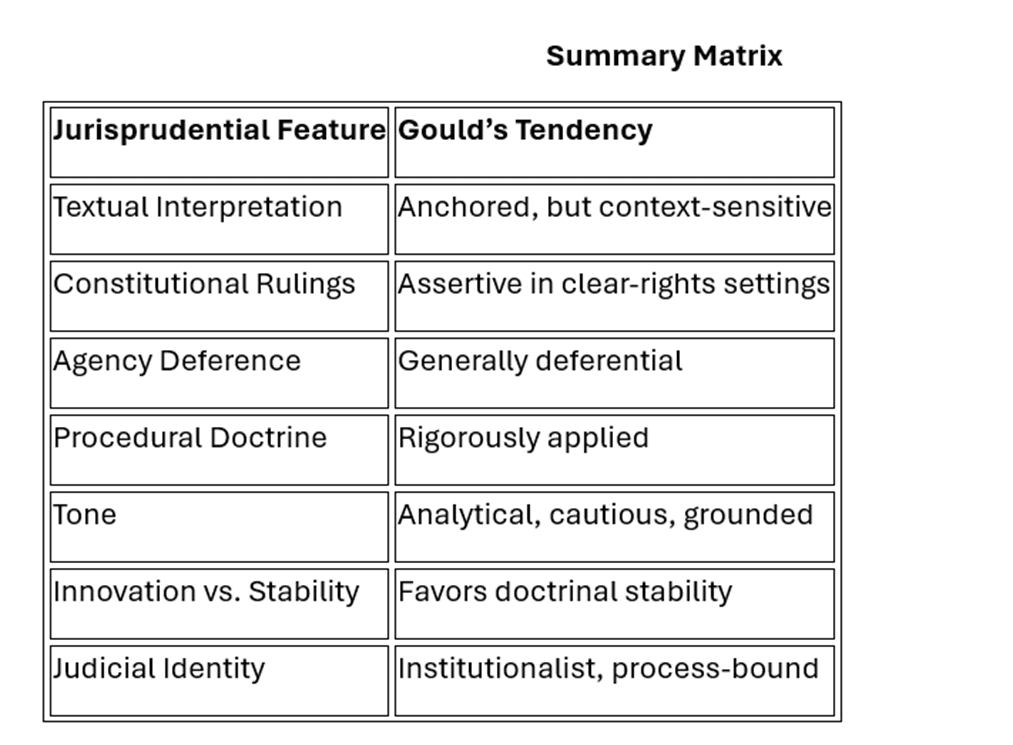
Tone:
Measured,
Analytical,
Occasionally
Cautious
Gould’s
judicial
writing
is
typically
marked
by
its
deliberative,
analytical
tone.
He
favors
statutory
and
constitutional
parsing
over
rhetorical
flourish
and
often
opts
for
cautious
language
when
constitutional
and
policy
considerations
intersect.
His
style
avoids
speculative
theorizing,
preferring
instead
to
reason
from
principle
and
precedent.
While
many
of
his
opinions
are
understated
in
tone,
they
close
with
strong
normative
affirmations
when
constitutional
limits
are
at
stake—as
in Trump
v.
Washington,
where
the
opinion
culminates
in
a
clear
defense
of
rule-of-law
commitments
and
judicial
review.
Throughout
his
corpus,
Gould
demonstrates
a
preference
for
logic
over
passion
and
for
institutional
continuity
over
improvisational
flair.
Judge
Gould’s
Jurisprudence
in Trump
v.
Washington in
Context
Doctrinal
Foundations
and
Standing
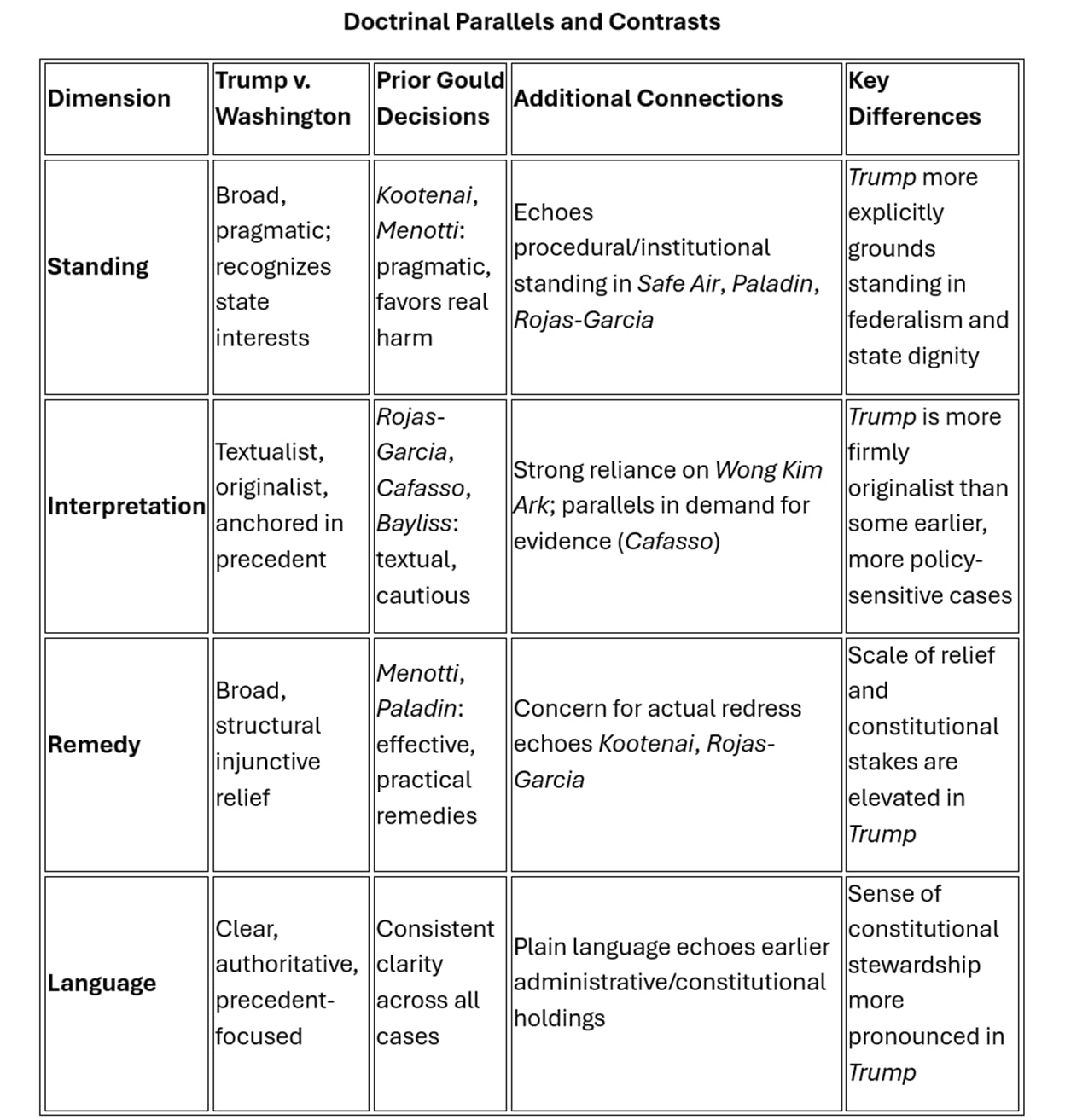
In Trump
v.
Washington,
Judge
Gould’s
approach
to
standing
reflects
a
jurisprudence
developed
across
two
decades
on
the
Ninth
Circuit,
where
he
has
repeatedly
privileged
concrete
harm
and
access
to
the
courts
over
rigid
formalism.
This
pragmatism
is
apparent
in
earlier
cases
such
as Menotti
v.
City
of
Seattle and Kootenai
Tribe
of
Idaho
v.
Veneman,
where
Gould
found
standing
for
parties
alleging
institutional,
environmental,
or
collective
harms.
The
reasoning
in Trump
v.
Washington—accepting
state
“quasi-sovereign”
interests,
such
as
the
threatened
disruption
to
health
systems
and
state
budgets,
as
a
sufficient
basis
for
standing—reprises
the
flexible,
real-world
analysis
seen
in
those
earlier
decisions.
Yet
there
are
nuances
that
distinguish
the Trump opinion.
While
cases
like Kootenai and Safe
Air
for
Everyone centered
on
environmental
or
procedural
injuries, Trump marks
an
evolution
by
explicitly
recognizing
state
dignity
and
federalism
as
components
of
the
standing
inquiry.
Where
previous
opinions
leaned
on
individualized
or
organizational
interests, Trump more
directly
affirms
the
role
of
states
as
guardians
of
their
residents’
constitutional
rights,
reflecting
a
subtle
but
important
shift
in
Gould’s
understanding
of
justiciability
in
the
federal
courts.
Constitutional
and
Statutory
Interpretation
Gould’s
interpretive
method
in Trump is
marked
by
a
commitment
to
constitutional
text,
historical
understanding,
and
fidelity
to
Supreme
Court
precedent—an
approach
consistent
with
his
readings
in
cases
like Rojas-Garcia
v.
Ashcroft and Cafasso
v.
General
Dynamics.
In
those
opinions,
Gould’s
writing
eschews
policy-driven
analysis
in
favor
of
textual
clarity
and
precedent,
and
in Trump he
deploys
the
same
analytic
rigor,
grounding
his
reading
of
the
Fourteenth
Amendment’s
Citizenship
Clause
in
the
history
and
authority
of United
States
v.
Wong
Kim
Ark.
Language
from Cafasso and Bayliss
v.
Barnhart reveals
a
consistent
thread:
Gould’s
skepticism
of
claims
or
interpretations
not
anchored
in
the
statutory
or
constitutional
text.
In Trump,
this
skepticism
manifests
as
a
refusal
to
countenance
administrative
attempts
to
reinterpret
birthright
citizenship
in
ways
that
depart
from
established
law.
This
is,
perhaps,
an
even
more
pronounced
textualism
and
originalism
than
one
finds
in
his
more
pragmatic
or
policy-sensitive
administrative
law
opinions
such
as Safe
Air or Lands
Council—a
response,
perhaps,
to
the
unique
constitutional
stakes
of
the
case.
Remedies
and
Judicial
Role
The
remedy
crafted
in Trump
v.
Washington—upholding
comprehensive
injunctive
relief—draws
on
a
jurisprudential
philosophy
evident
in
cases
like Menotti and Paladin
Associates.
Gould
consistently
maintains
that
judicial
remedies
must
be
real
and
effective,
not
simply
symbolic
or
technical.
In Menotti,
the
response
to
constitutional
violations
during
public
protest
was
both
thorough
and
attuned
to
the
scope
of
the
injury.
Similarly, Trump reflects
a
judicial
unwillingness
to
allow
core
constitutional
rights
to
be
undermined
by
executive
action,
even
in
the
face
of
complex
policy
arguments.
What
sets Trump apart
is
the
scale
and
visibility
of
the
relief.
While
Gould
has
previously
endorsed
robust
remedies
in
contexts
such
as
NEPA
enforcement
(Kootenai)
or
immigration
due
process
(Rojas-Garcia), Trump moves
into
the
heart
of
constitutional
structure,
insisting
that
the
courts
must
serve
as
a
bulwark
when
foundational
guarantees—such
as
birthright
citizenship—are
threatened
by
administrative
reinterpretation.
Language
and
Doctrinal
Evolution
Comparing
Gould’s
language
across
these
cases
reveals
both
continuity
and
evolution.
The
plainness
and
authority
with
which
he
invokes
precedent
in Trump—for
example,
“the
Fourteenth
Amendment’s
command
is
settled
and
beyond
administrative
dispute”—recalls
the
clarity
with
which
he
has
dispatched
procedural
and
statutory
claims
in Rojas-Garcia and Cafasso.
Yet
there
is
a
heightened
sense
of
constitutional
stewardship
in Trump,
perhaps
a
reflection
of
the
moment
and
the
magnitude
of
the
right
at
stake,
that
marks
an
evolution
from
his
environmental
and
administrative
law
work.
Trump
v.
Washington both
extends
and
consolidates
core
elements
of
Judge
Gould’s
jurisprudence,
reaffirming
his
commitment
to
access,
textual
fidelity,
and
meaningful
remedies,
while
also
responding
to
the
unique
constitutional
challenges
of
the
moment
with
a
pronounced
emphasis
on
federalism
and
the
enduring
power
of
the
Fourteenth
Amendment.
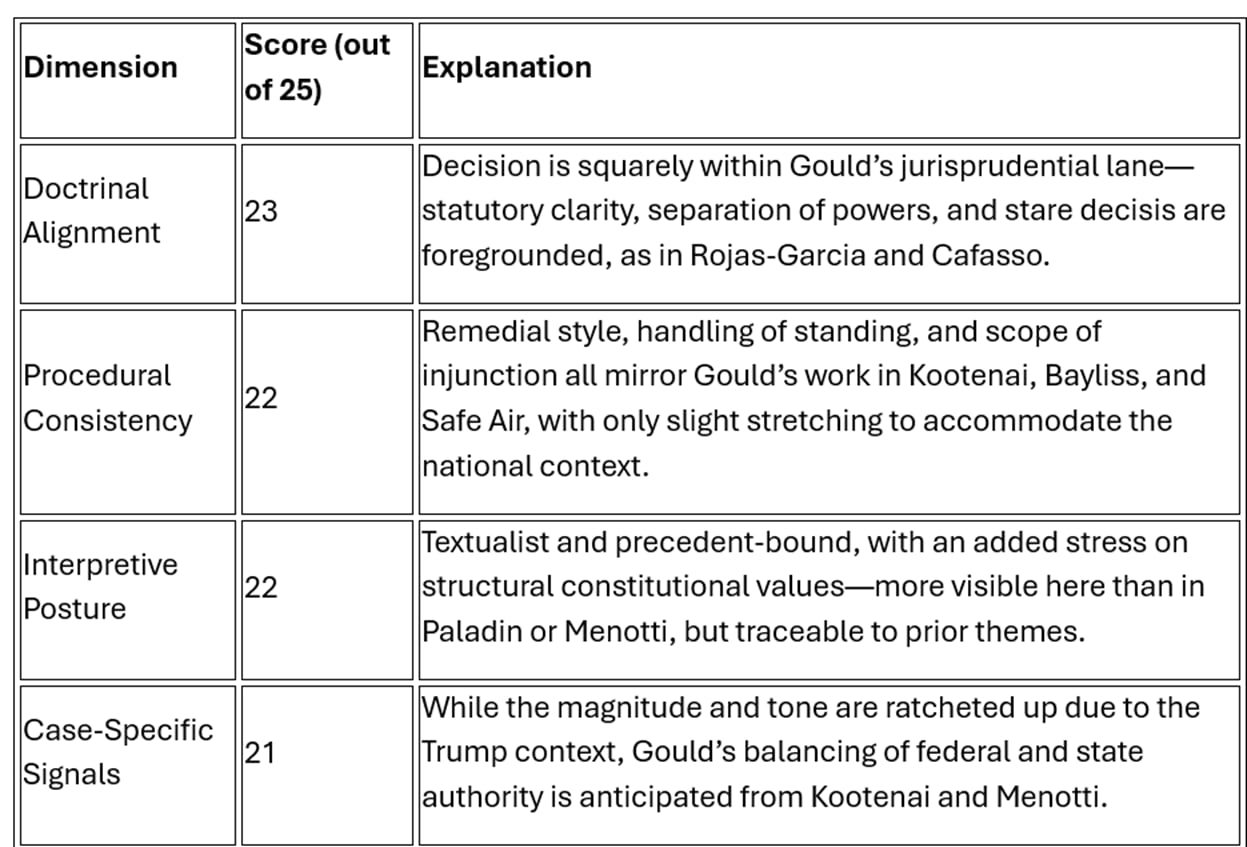
The
methodology
I
use
to
measure
predictability
below
is
similar
to that
which
I
used
in
my
previous
post on
multiple
district
court
judges’
decisions.
Judge
Gould demonstrates
high
predictability
scoring
88
on
a
predictability
scale
of
0-100,
with
his Trump
v.
Washington decision
tightly
tracking
his
established
doctrinal
and
procedural
approaches,
as
evidenced
across
the
ten-case
sample.
His
consistent
textualism,
clear
procedural
discipline,
and
fidelity
to
precedent
anchor
his
ruling—though
the
case’s
historic
scale
pushes
his
interpretive
posture
and
signals
slightly
into
more
assertive
terrain.
Takeaway:
Predictability,
Power,
and
Judicial
Character
in
the
Trump
v.
Washington
Context
The
importance
of
Judge
Gould’s
consistent,
methodical
approach
comes
into
sharp
relief
in
the
context
of Trump v. Washington.
Here,
the
stakes
are
not
only
legal
but
existential—state
autonomy,
federal
reach,
and
the
outer
boundaries
of
executive
action
are
all
on
the
table.
The
fact
that
Gould’s
decision
can
be
so
closely
mapped
to
his
jurisprudence
in
earlier,
less
politically
charged
domains
(federal
environmental,
administrative,
and
immigration
law)
is
not
a
mere
historical
curiosity,
it
seems
intentional.
Why
does
this
matter
for
the
Trump
case?
It
provides
litigants,
government
actors,
and
the
public
with
a
clear
“grammar”
for
understanding
both
the
outcome
and
the
legal
route
by
which
it
was
reached.
In
moments
when
executive
power
is
expanding
or
being
contested,
a
judge’s
capacity
for
doctrinal
and
procedural
predictability
acts
as
a
check
against
both
overreach
and
ad
hoc
decision-making.
Gould’s
ruling
signals
to
the
parties—and
to
the
watching
nation—that
the
judiciary,
even
under
stress,
is
anchored
in
precedent
and
method,
not
headlines.
Extrapolating
to
Other
Judges
and
Future
Litigation:
Gould’s
approach
offers
a
template
for
evaluating
judicial
behavior
in
similar
flashpoint
cases—whether
they
arise
from
Trump-era
policies
or
from
future
moments
of
executive
assertion.
For
judges
with
similarly
high
procedural
and
doctrinal
consistency
one
can
reasonably
expect
that
challenges
to
federal
executive
action
will
be
assessed
with
a
clear
eye
to
precedent,
text,
and
process,
and
that
the
scope
of
remedies
will
track
established
judicial
practice
rather
than
personal
or
political
preference.
For
judges
whose
records
show
greater
case-specific
variance
or
a
more
experimental
interpretive
style,
the
outcome
may
be
less
predictable—remedies
may
be
broader
or
narrower,
and
the
tone
or
scope
of
judicial
engagement
may
shift
more
dramatically
in
response
to
the
political
moment.
But
even
here,
using
Gould
as
a
benchmark
allows
scholars
and
practitioners
to
measure
just
how
far
a
given
decision
veers
from
established
patterns
and,
crucially,
why.
In
the
ongoing
legal
battles
over
Trump-era
executive
actions,
knowing
the type of
judge
on
the
case
is
as
important
as
knowing
the
legal
merits.
Gould’s
predictability
in Trump
v.
Washington underscores
that,
in
times
of
national
controversy,
the
judiciary’s
most
vital
contribution
may
be
the
consistency—and
transparency—of
its
reasoning,
not
the
ideology
of
its
result.
This
context
provides
both
a
reassurance
and
a
warning:
predictability
fosters
trust
in
the
legal
system,
but
every
departure
from
a
judge’s
established
path
will
be
all
the
more
visible,
and
all
the
more
consequential,
when
the
stakes
are
this
high.
The
Dissent
of
Judge
Bumatay:
A
Focus
on
Judicial
Modesty
and
the
Separation
of
Powers
Judge
Bumatay’s
partial
concurrence
and
dissent
in
the Washington
v.
Trump birthright
citizenship
litigation
does
not
simply
dispute
the
merits.
Instead,
he
sharply
reframes
the
case
as
a
test
of
judicial
self-restraint
and
fidelity
to
the
limits
of
Article
III,
offering
a
meditation
on
the
dangers
of
overreach
even
in
the
face
of
intense
policy
controversy.
The
Stakes
and
the
Court’s
Role
Bumatay
begins
with
an
acknowledgement
of
the
emotional
and
political
charge:
“Fewer
questions
could
be
more
important
than
deciding
who
is
entitled
to
American
citizenship.”
He
openly
concedes
that
“citizenship
in
our
country
is
worth
fighting
for.”
Yet,
he
pivots
quickly
to
the
idea
that
the
role
of
the
judiciary
is
not
to
answer
every
significant
or
contentious
question:
“No
matter
how
significant
the
question
or
how
high
the
stakes…we
must
adhere
to
the
confines
of
‘the
judicial
Power.’”
Exceeding
those
limits—even
in
pursuit
of
justice—he
warns,
“violates
the
Constitution.”
Judicial
Power:
Separation
of
Powers
and
Historical
Perspective
Drawing
on
the
lessons
of
the
Founding
era,
Bumatay
emphasizes
that
“concentrating
too
much
authority
in
only
a
few
hands
corrupts
and
threatens
our
freedoms.”
The
heart
of
his
argument
is
that
the
federal
judiciary,
like
the
other
branches,
is
bounded:
“A
vital
separation-of-powers
limit
on
the
judiciary
is
that
we
may
only
grant
party-specific
relief.”
For
Bumatay,
universal
injunctions
are
a
recent,
dangerous
innovation—“runaway
universal
injunctions
conflict
with
the
judicial
role—encouraging
federal
courts
to
‘act
more
like
a
legislature.’”
He
leans
on
the
Supreme
Court’s
recent
pronouncement
in Trump
v.
CASA:
“universal
injunctions
‘lack
a
historical
pedigree’
and
‘fall
outside
the
bounds
of
a
federal
court’s
equitable
authority
under
the
Judiciary
Act.’”
Thus,
only
when
“it
would
be
all
but
impossible
to
devise
relief
that
reaches
only
the
plaintiffs”
may
a
broader
remedy
issue,
and
such
cases
are
“by
far
the
exception.”
Standing
as
a
Double
Check
Judge
Bumatay’s
dissent
is
as
much
about
standing
as
it
is
about
injunctive
scope.
He
describes
standing
as
“another
separation-of-powers
mechanism
to
guard
against
judicial
overreach,”
one
that
“keeps
courts
in
their
place:
deciding
only
concrete
disputes
between
an
injured
plaintiff
and
a
defendant
according
to
the
law.”
If
courts
loosen
standing
while
tightening
injunctive
relief
(or
vice
versa),
they
merely
“push
the
air
to
the
other
end”
of
the
balloon—resulting
in
an
“inflated
power
for
the
judiciary.”
This
leads
to
Bumatay’s
main
critique
of
the
majority:
that
the
states
do
not
have
standing
because
their
alleged
fiscal
injuries
are
“too
speculative
and
contingent
at
this
stage
to
constitute
injuries
in
fact.”
Even
if
the
executive
order
eventually
has
downstream
financial
effects
on
states’
Medicaid
or
CHIP
reimbursements,
such
injuries
depend
on
“contingent
future
events
that
may
not
occur
as
anticipated,
or
indeed
may
not
occur
at
all.”
He
describes
the
chain
of
causation
as
“riddled
with
contingencies
and
speculation.”
Third-Party
and
Parens
Patriae
Limits
Bumatay
is
particularly
concerned
about
states
“artfully
pleading”
their
way
around
Article
III
and
parens
patriae
limitations
by
recasting
the
rights
of
their
citizens
as
fiscal
harms.
He
reiterates,
“it’s
blackletter
law
that
‘[a]
State
does
not
have
standing
as
parens
patriae
to
bring
an
action
against
the
Federal
Government.’”
(Haaland
v.
Brackeen).
The
dissent’s
tone
is
wary:
“Like
other
parties,
States
must
show
a
cognizable
harm
to
themselves—not
just
their
residents—before
invoking
federal
court
jurisdiction
to
challenge
federal
government
policy.”
On
Self-Inflicted
Injuries
and
Judicial
Restraint
Even
where
the
states’
budgets
are
impacted,
Bumatay
finds
the
harm
“self-inflicted”—if
Washington
chooses
to
provide
Medicaid
to
children
who
are
ineligible
for
federal
reimbursement,
that
is
“Washington’s
alone”
to
bear.
“No
State
can
be
heard
to
complain
about
damage
inflicted
by
its
own
hand.”
Bumatay
consistently
invokes
Supreme
Court
authority
to
support
these
limits:
“Plaintiffs
cannot
rely
on
speculation
about
‘the
unfettered
choices
made
by
independent
actors
not
before
the
courts’”
(Clapper
v.
Amnesty
Int’l),
and
“federal
courts
would
become
a
forum
for
any
parties
to
air
generalized
grievances”
if
such
speculative
injuries
sufficed.
On
the
Merits:
No
Opinion
Because
he
finds
standing
lacking,
Bumatay
deliberately
declines
to
reach
the
merits
of
the
constitutional
question
or
the
scope
of
the
injunction.
“Absent
a
party
with
Article
III
standing,
it’s
premature
to
address
the
merits
of
the
citizenship
question
or
the
scope
of
the
injunction.”
Key
Elements
of
Judge
Bumatay’s
Jurisprudence
in
This
Dissent
Article
III
Rigor
and
Judicial
Restraint
At
the
core
of
Judge
Bumatay’s
dissent
is
a
sustained
insistence
that
the
judiciary
remain
within
the
bounds
of
its
constitutional
authority.
He
roots
his
analysis
in
Article
III’s
strict
limitations,
warning
against
the
temptation
for
courts
to
resolve
pressing
national
controversies
by
extending
their
jurisdiction
beyond
what
the
Constitution
allows.
For
Bumatay,
the
separation
of
powers
is
not
merely
a
structural
feature—it
is
a
safeguard
against
judicial
overreach.
He
argues
forcefully
that
courts
“must
adhere
to
the
confines
of
‘the
judicial
Power,’”
and
that
to
exceed
those
confines,
even
for
causes
that
seem
morally
urgent
or
politically
divisive,
is
itself
a
constitutional
violation.
The
judiciary,
in
his
view,
is
not
empowered
to
act
as
a
“roving
commission”
to
arbitrate
broad
social
conflicts;
its
role
is
to
adjudicate
concrete
disputes
between
parties.
Skepticism
Toward
Universal
Injunctive
Relief
Judge
Bumatay
expresses
particular
concern
about
the
increasingly
common
use
of
universal—or
nationwide—injunctions
by
federal
courts.
He
challenges
both
their
historical
legitimacy
and
their
legal
justification,
noting
that
such
sweeping
relief
“lacks
a
historical
pedigree”
and
“falls
outside
the
bounds
of
a
federal
court’s
equitable
authority.”
In
his
dissent,
he
carefully
distinguishes
between
what
a
court may grant
and
what
it should grant,
emphasizing
that
equitable
relief
broader
than
necessary
to
redress
the
plaintiffs’
injuries
is
permissible
only
in
the
rarest
of
circumstances.
For
Bumatay,
equitable
power
is
not
a
license
for
judicial
maximalism.
Rather,
he
suggests,
“equity
sometimes
demands
that
courts
grant
less
than
complete
relief,”
especially
when
narrower
remedies
suffice.
Standing
and
the
Limits
of
Judicial
Access
A
central
pillar
of
Bumatay’s
dissent
is
his
strict
application
of
standing
doctrine.
He
insists
that
parties
must
demonstrate
their
own
concrete
injuries,
and
he
challenges
attempts
to
stretch
standing
principles
to
permit
third-party
or
derivative
claims.
His
opinion
reiterates
that
“a
party
must
assert
his
own
legal
rights
and
interests”
and
critiques
the
notion
that
states
can
sue
the
federal
government
under
a
generalized
parens
patriae
theory.
Notably,
he
employs
a
vivid
analogy
to
warn
against
manipulating
doctrine
to
suit
political
exigencies:
“We
can’t
tighten
one
[doctrine]
but
loosen
the
other.
That
would
be
like
squeezing
one
end
of
a
balloon—it
just
pushes
all
the
air
to
the
other
end.”
For
Bumatay,
such
doctrinal
balancing
is
not
a
game
of
counterweights
but
a
matter
of
constitutional
integrity.
Concrete
Injury
and
the
Problem
of
Speculation
The
dissent
places
significant
weight
on
the
requirement
that
plaintiffs
demonstrate
not
just
harm,
but non-speculative harm.
Bumatay
is
sharply
critical
of
the
majority’s
willingness
to
credit
theories
of
standing
based
on
projected
downstream
effects,
indirect
costs,
or
hypothetical
future
behaviors.
He
characterizes
the
states’
theory
of
injury
as
speculative
on
two
fronts:
first,
because
it
relies
on
uncertain
predictions
about
the
implementation
of
the
Executive
Order;
and
second,
because
it
presumes
independent
third-party
reactions
to
federal
policy.
In
his
view,
this
kind
of
conjectural
harm
is
not
sufficient
to
invoke
federal
jurisdiction.
Courts,
he
maintains,
are
not
authorized
to
decide
cases
on
“what-ifs.”
Caution
in
the
Face
of
Political
Disputes
Perhaps
most
fundamentally,
Judge
Bumatay’s
dissent
is
a
plea
for
judicial
humility.
He
does
not
deny
the
constitutional
stakes
of
the
case,
nor
does
he
diminish
the
importance
of
the
underlying
issues.
Rather,
he
insists
that
constitutional
adjudication
must
be
grounded
in
restraint,
patience,
and
respect
for
the
separation
of
powers.
Courts,
in
his
view,
should
“wait
until
the
federal
government
provides
its
plans
before
acting.”
His
opinion
is
wary
of
open-ended
judicial
engagement
in
policy
arenas—especially
when
the
claims
before
the
court
rest
on
uncertain
futures
or
abstract
projections.
Bumatay
is
not
unconcerned
with
constitutional
rights,
but
he
argues
that
their
vindication
must
come
through
channels
that
preserve
the
judiciary’s
limited
and
defined
role
in
the
constitutional
order.
A
Judicial
Philosophy
of
Caution
and
Containment
In Trump
v.
Washington,
Judge
Bumatay’s
dissent
presents
a
tightly
disciplined
account
of
what
courts
can—and
cannot—do
under
the
Constitution.
It
is
a
defense
not
of
executive
power
per
se,
but
of
judicial
restraint
in
the
face
of
political
urgency.
His
framework
privileges
doctrinal
containment
over
judicial
experimentation,
and
it
expresses
deep
skepticism
toward
remedies
and
standing
theories
that
depart
from
historical
practice
or
constitutional
text.
In
this
case,
it
seems
that
for
Bumatay,
the
judiciary’s
legitimacy
depends
on
its
refusal
to
exceed
its
charter—no
matter
the
stakes.
In
this,
his
dissent
serves
both
as
a
jurisprudential
counterpoint
to
the
majority
and
as
a
broader
warning
about
the
cost
of
crossing
constitutional
lines,
even
for
causes
that
courts
may
find
sympathetic.
Judge
Bumatay’s
dissent
is
a
map
of
modern
judicial
skepticism—insisting
that
even
constitutional
showdowns
like
birthright
citizenship
must
proceed
“in
manageable
proportions,”
with
concrete
injuries,
and
strictly
within
the
judicial
role
as
defined
by
Article
III.
His
opinion
is
less
about
whether
the
policy
is
wise,
and
more
about
the
guardrails
that
keep
courts
from
acting
“more
like
a
legislature.”
Bumatay:
Jurisprudential
Style
&
Patterns
Textual
Fidelity
and
Skepticism
Toward
Legislative
Purpose
Judge
Bumatay’s
judicial
writing
is
consistently
defined
by
rigorous
textualism.
His
interpretive
method
resists
judicial
innovation,
preferring
a
literal
application
of
statutory
and
constitutional
text.
Bumatay
warns
against
allowing
legislative
purpose,
policy
consequences,
or
abstract
goals
to
override
the
precise
language
of
enacted
laws.
This
theme
appears
prominently
in
his
dissent
in Center
for
Investigative
Reporting
v.
DOJ,
where
he
rejected
an
“anti-entrenchment”
reading
of
FOIA
in
favor
of
a
strict
construction
of
a
later-enacted
appropriations
bar.
Likewise,
in Chicken
Ranch
Rancheria
v.
California,
he
parsed
the
Indian
Gaming
Regulatory
Act
(IGRA)
to
determine
that
its
list
of
negotiable
compact
topics
was
indeed
exhaustive—yet
cautioned
that
violating
the
list
was
only
evidentiary,
not
dispositive,
of
bad
faith.
He
favored
remand
for
a
neutral
statutory
test
rather
than
reliance
on
legislative
history
or
generalized
aims.
This
insistence
on
statutory
parsing
over
purpose-driven
reasoning
also
framed
his
partial
dissent
in Solar
Energy
Industries
Ass’n
v.
FERC,
where
he
questioned
the
use
of
Chevron
deference
and
challenged
NEPA
standing.
Anti-Entrenchment
and
Legislative
Supremacy
Bumatay
regularly
invokes
constitutional
principles
of
non-entrenchment,
holding
that
no
Congress
can
bind
its
successors
through
procedural
devices
like
“magic
words”
rules.
In CIR
v.
DOJ,
he
asserted
that
a
later
statute
barring
FOIA
disclosure
must
prevail
over
an
earlier
process-laden
transparency
law
(the
OPEN
FOIA
Act),
even
though
the
later
law
omitted
a
formal
citation
requirement.
His
citations
to
Chief
Justice
Marshall
and
Justice
Scalia
underscore
his
belief
in
legislative
supremacy
as
a
cornerstone
of
democratic
governance.
In
his
view,
courts
must
respect
the
textual
hierarchy
of
statutes,
not
superimpose
judicial
preferences
for
transparency
or
regulatory
clarity
where
the
law
is
unambiguous.
Formal
Doctrinal
Minimalism
and
Institutional
Modesty
A
hallmark
of
Bumatay’s
jurisprudence
is
his
refusal
to
innovate
or
expand
doctrine
without
clear
textual
grounding.
Whether
addressing
Second
Amendment
rights
in Duncan
v.
Bonta,
where
he
rejected
balancing
tests
in
favor
of
historical
tradition,
or
voting
claims
in Mi
Familia
Vota
v.
Fontes,
where
he
declined
to
infer
standing
from
policy-oriented
legislative
findings,
Bumatay
maintains
a
minimalist
stance.
In
his
jurisprudence,
courts
do
not
exist
to
optimize
policy;
they
exist
to
interpret
and
apply
law.
This
deference
to
the
political
branches
is
not
passive,
but
structural:
it
is
the
very
definition
of
judicial
constraint.
Structural
Constitutionalism
and
Limits
on
Government
Power
Bumatay
frequently
foregrounds
federalism,
separation
of
powers,
and
the
constitutional
design
in
his
opinions.
In Chicken
Ranch
Rancheria,
he
objected
to
the
majority’s
reliance
on
legislative
objectives
to
override
the
textual
bounds
of
IGRA,
warning
that
such
reasoning
risks
state
overreach
and
infringes
on
tribal
sovereignty.
In California
Restaurant
Ass’n
v.
Berkeley,
which
he
authored,
Bumatay
struck
down
a
municipal
ordinance
banning
natural
gas
hookups,
holding
it
preempted
by
federal
energy
law.
These
cases
reflect
his
broader
view
that
structure
is
not
theoretical—it
is
protective.
Judicial
fidelity
to
structure
constrains
both
state
and
federal
power,
preserving
individual
and
institutional
liberty.
Procedural
Discipline
Anchored
in
Statutory
Commands
While
Bumatay
values
process
and
record-based
adjudication,
his
procedural
analysis
always
remains
textually
bounded.
In In
re
Facebook,
Inc.
Sec.
Litig., his
dissent
focused
on
statutory
elements
of
loss
causation
under
securities
law,
resisting
any
move
toward
factual
speculation
or
plausibility
thresholds
unmoored
from
statute.
Similarly,
in Betschart
v.
Oregon,
he
insisted
that
habeas
relief
hinges
on
the
strict
application
of
procedural
defaults
as
outlined
by
statute,
not
equity
or
policy
goals.
For
Bumatay,
process
matters
only
insofar
as
it
is
legislated.
He
will
not
extend
doctrines
or
rules
beyond
what
the
law
demands.
Tone:
Assertive,
Formal,
and
Anchored
in
Method
Bumatay’s
judicial
voice,
especially
in
dissent,
is
direct,
formal,
and
often
critical
of
the
majority’s
interpretive
philosophy.
He
warns
frequently
of
“judicial
amendments”
and
cautions
against
judges
who
“divine”
congressional
purpose
at
the
expense
of
clear
text.
His
prose
draws
heavily
on
Supreme
Court
precedent,
especially
the
writings
of
Justices
Scalia
and
Thomas,
as
well
as
textualist
scholarship.
Though
his
tone
can
be
sharp,
it
is
grounded
in
method,
not
ideology.
He
rejects
balancing
tests,
rejects
speculation,
and
rejects
results-driven
reasoning—preferring
instead
to
build
each
opinion
around
the
scaffolding
of
constitutional
and
statutory
form.
Bumatay’s
opinions
reflect
a
high-contrast
textualist
philosophy—he
is
resolutely
anti-purposivist,
defends
congressional
flexibility,
and
resists
judicial
expansion
or
contraction
of
doctrine.
His
dissents
often
serve
as
line-by-line
critiques
of
any
move
away
from
statutory
text,
with
pointed
warnings
about
judicial
overreach,
legislative
entrenchment,
or
“policy-driven”
reasoning.
Judge
Bumatay’s
Jurisprudence
in Trump
v.
Washington in
Context
Doctrinal
Foundations
and
Standing
In Trump
v.
Washington,
Judge
Bumatay’s
partial
concurrence/dissent
reflects
an
approach
found
throughout
his
background
opinions:
textual
rigor,
institutional
separation
of
powers,
and
skepticism
of
novel
expansions
of
standing.
Bumatay’s
view
in Trump—questioning
whether
the
states’
alleged
injuries
met
the
standard
for
Article
III
standing—tracks
his
pattern
in
cases
like East
Bay
Sanctuary
Covenant and Mi
Familia
Vota,
where
he
repeatedly
insists
on
a
“concrete,
particularized,
and
judicially
manageable”
injury.
His
dissent
in Solar
Energy
Industries
Association
v.
FERC likewise
demonstrates
resistance
to
procedural
or
environmental
standing
based
on
speculative
or
attenuated
theories
of
harm.
Where
other
panels
have
sometimes
embraced
broader
“quasi-sovereign”
state
interests
or
relaxed
procedural
standing
(as
in Safe
Air or Kootenai under
the
Gould
model),
Bumatay’s
writing
is
more
constrained:
he
anchors
standing
in transparently
textual and historical limits,
often
referencing
the
Supreme
Court’s
most
restrictive
precedents.
In Trump,
he
casts
doubt
on
whether
the
risk
to
state
resources,
or
to
“state
dignity,”
suffices
for
federal
court
intervention—a
stance
foreshadowed
in
his
environmental
and
FOIA
dissents.
Constitutional
and
Statutory
Interpretation
Bumatay’s Trump opinion
exhibits
his
core
method:
exacting
textualism,
originalist
reasoning,
and
aversion
to
implied
rights
or
penumbras.
Like
his
dissent
in Chicken
Ranch
Rancheria (IGRA
case),
he
starts
with
the
constitutional
or
statutory
language,
mapping
it
against
contemporaneous
historical
sources
and
Supreme
Court
touchstones.
In Trump,
his
reading
of
the
Fourteenth
Amendment’s
Citizenship
Clause
is
“anchored
in
text,
structure,
and
original
meaning,”
rejecting
what
he
characterizes
as
judicial
policy-making.
This
is
a
consistent
pattern:
in Duncan
v.
Bonta (Second
Amendment/magazine
ban),
he
hews
closely
to
constitutional
text,
original
intent,
and
Supreme
Court
precedent,
sharply
delimiting
judicial
innovation.
In Center
for
Investigative
Reporting
v.
DOJ,
he
objects
to
statutory
“entrenchment”
doctrines
not
found
in
the
statutory
language.
Across
his
opinions,
Bumatay’s
method
resists
broad
constructions
not
compelled
by
the
text—eschewing,
for
example,
“purpose-driven”
or
“functional”
arguments
when
they
might
disrupt
the
constitutional
order.
Remedies
and
Judicial
Role
In
his Trump partial
concurrence/dissent,
Bumatay’s
approach
to
remedy
and
judicial
restraint
mirrors
his Chicken
Ranch dissent:
courts
should
not
order
structural
relief
unless
the
statutory
or
constitutional
predicates
are
unmistakably
met.
He
frequently
warns
against
judicial
overreach,
urging
that
remedial
powers
should
not
“vitiate
the
separation
of
powers”
or
create
“novel
forms
of
relief”
absent
clear
textual
authorization.
This
echoes
his
skepticism
in Solar
Energy
Industries
Association (remand
without
vacatur,
judicial
review
under
NEPA)
and
his
refusal
to
innovate
procedural
rights
in Betschart
v.
Oregon (pretrial
habeas/class
action).
Bumatay’s
remedies
are bounded,
tailored, and
structurally
respectful.
Language
and
Doctrinal
Views
Bumatay’s
prose
is
direct,
declarative,
and
polemically
clear—but
usually
avoids
rhetorical
excess.
In Trump,
he
emphasizes
“the
original
meaning
of
the
Citizenship
Clause”
and
warns
against
“judicially
invented
exceptions.”
This
is
consistent
with
his
tone
in Duncan and Chicken
Ranch,
where
he
stakes
out
the
consequences
of
what
he
sees
as
doctrinal
deviation
(“judicial
entrenchment,”
“sidestepping
plain
text”)
while
insisting
that
only
Congress
or
the
Supreme
Court
should
alter
well-settled
rules.
Unlike
Judge
Gould—whose
pragmatism
occasionally
tempers
his
text-first
approach—Bumatay
rarely
accommodates
practical
or
policy-driven
exceptions.
The
result
is
a
jurisprudence
that
is
sometimes
narrower,
but
predictably
so.
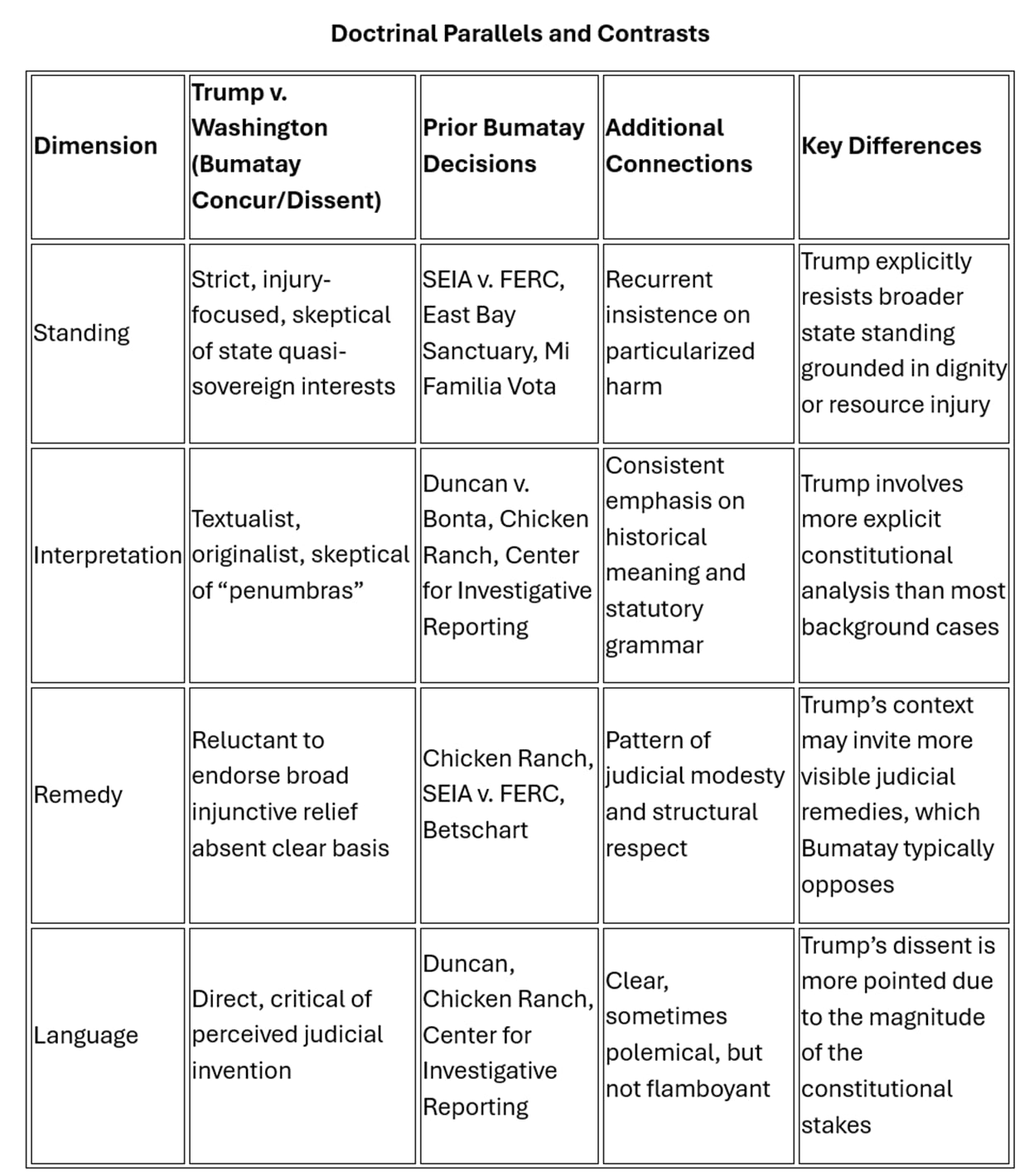
Bumatay’s
Trump
v.
Washington
concurrence/dissent
fits
squarely
within
his
established
jurisprudence:
rigorous
textualism,
fidelity
to
original
meaning,
and
institutional
modesty.
His
partial
dissent
resists
both
novel
expansions
of
standing
and
broad
constitutional
remedies—prioritizing
the
limits
and
roles
set
by
constitutional
text
and
precedent.
This
distinguishes
his
approach
from
more
pragmatic
or
policy-sensitive
jurists,
and
brings
a
predictable,
if
sometimes
austere,
perspective
to
the
court’s
handling
of
contested
constitutional
controversies.
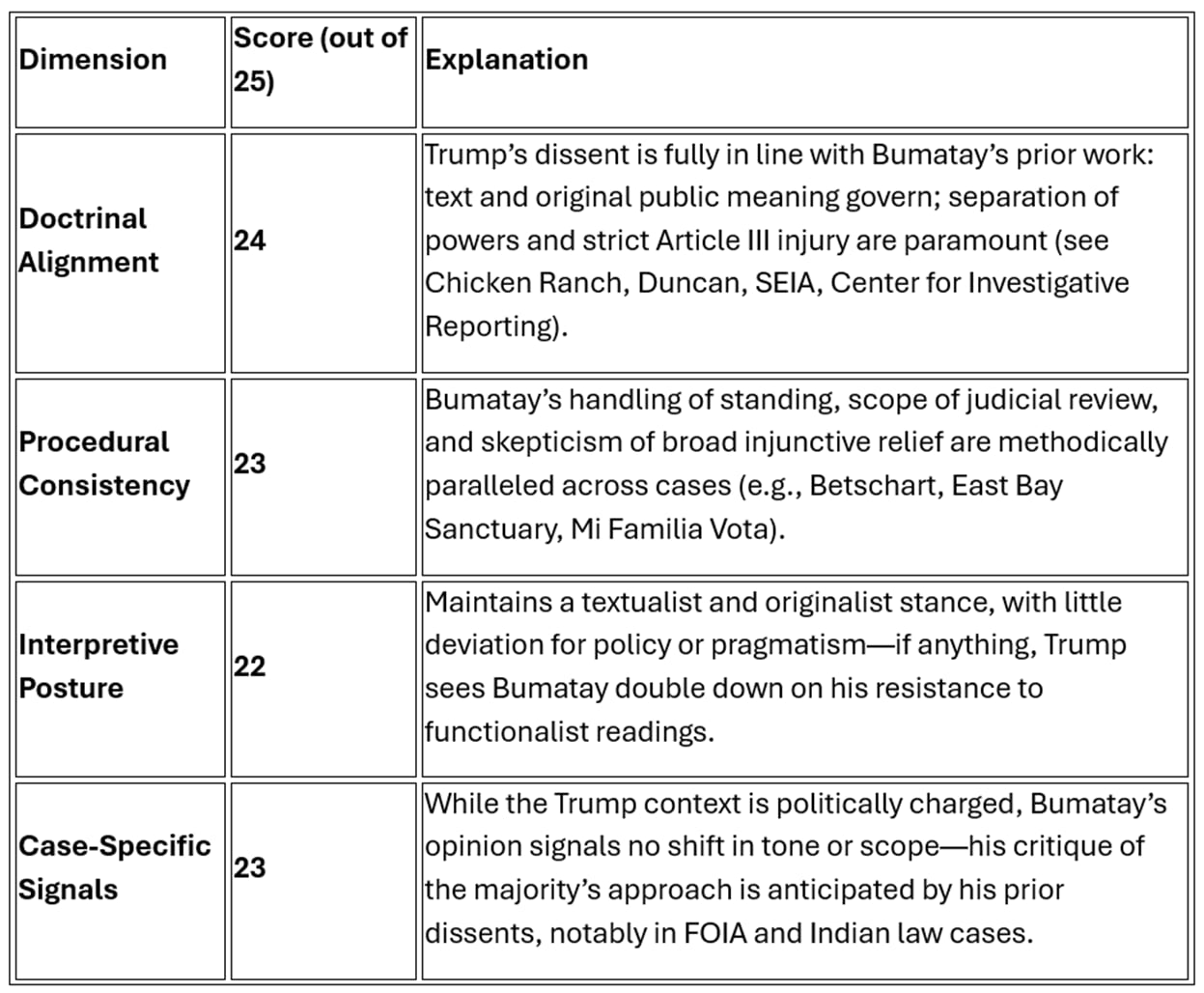
Judge
Bumatay
(92/100)
demonstrates
exceptional
predictability,
with
his
Trump
v.
Washington
concurrence/dissent
closely
mirroring
his
established
approach
to
text,
standing,
and
constitutional
separation
of
powers.
Across
the
sampled
decisions,
Bumatay’s
jurisprudence
is
marked
by
a
disciplined
textualism,
a
cautious
approach
to
standing,
and
an
institutional
humility
regarding
the
judiciary’s
remedial
reach.
The
Trump
case
presents
an
unusually
high-profile
and
high-stakes
forum
for
these
themes,
but
Bumatay’s
opinion
is—if
anything—even
more
insistent
on
doctrinal
limits
and
original
meaning
than
in
his
prior,
sometimes
more
technical,
dissents.
Judge
Bumatay’s
approach
in
Trump
v.
Washington
is
a
model
of
jurisprudential
constancy.
Whether
in
the
context
of
environmental
standing,
regulatory
disputes,
or
hot-button
constitutional
litigation,
his
work
provides
clear
advance
notice
to
litigants:
doctrinal
boundaries
matter,
and
the
court
will
not
stretch
them
to
accommodate
the
political
moment. This
predictability
is
not
only
a
matter
of
professional
style,
but
a
form
of
judicial
integrity—a
check
against
drift
or
opportunism
in
high-profile
disputes.
Why
does
this
matter
for
the
Trump
litigation?
-
Clarity
for
litigants: Parties
know
that
Bumatay
will
hew
to
textual
limits
and
procedural
rigor—arguments
from
policy
or
equity
are
unlikely
to
prevail
absent
statutory
or
constitutional
warrant. -
Legitimacy
and
transparency: Especially
in
contentious
national
litigation,
Bumatay’s
disciplined
reasoning
reinforces
public
trust
that
the
law,
not
the
news
cycle,
shapes
judicial
outcomes. -
Benchmark
for
divergence: Any
future
deviation
by
Bumatay
from
this
baseline
would
be
immediately
visible—and
would
carry
outsized
weight
in
assessing
the
trajectory
of
his
judicial
philosophy.
Broader
implications:
Bumatay’s
record
offers
a
“control
group”
for
studying
conservative
textualist
judges
in
periods
of
political
crisis
or
constitutional
ferment.
As
the
Trump-era
legal
battles
persist
(or
evolve),
those
seeking
to
forecast
judicial
behavior—whether
government
counsel,
advocacy
groups,
or
fellow
judges—can
look
to
Bumatay’s
consistency
as
a
predictor
of
outcome,
tone,
and
doctrinal
method.
In
moments
of
maximal
political
stress,
predictability
in
judicial
reasoning
is
itself
a
constitutional
value. Bumatay’s
Trump
v.
Washington
opinion
exemplifies
this—not
because
it
resists
controversy,
but
because
it
resists
the
gravitational
pull
of
the
moment
in
favor
of
continuity
and
law.
Why
Bumatay
Scores
Higher:
-
Doctrinal
Rigidity
Across
Domains:
Bumatay’s
Trump
opinion
mirrors
the
tone,
scope,
and
method
of
his
prior
dissents
almost
exactly—whether
in
cases
about
energy
regulation
(CRA
v.
Berkeley),
tribal-state
compacts
(Chicken
Ranch),
or
standing
doctrine
(Mi
Familia
Vota).
There
is
no
perceptible
adaptation
to
the
political
or
constitutional
scale
of
the
Trump
case. -
Remedial
Minimalism
and
Article
III
Formalism:
While
Gould’s
remedy
was
doctrinally
justified,
it
expanded
his
usual
scope
in
light
of
the
issue’s
gravity.
Bumatay,
by
contrast,
applies
the
same
narrow
remedial
logic
and
Article
III
standing
rigor
seen
in
Betschart
and
SEIA,
refusing
to
broaden
judicial
reach
despite
national
implications. -
Tone
and
Language
Consistency:
Gould’s
Trump
opinion—though
measured—takes
on
a
more
assertive
constitutional
tone
than
seen
in
earlier
administrative
law
decisions.
Bumatay’s
dissent,
however,
reads
exactly
like
his
prior
work:
restrained,
originalist,
and
laser-focused
on
statutory
limits.
Where
Gould
Diverges
Slightly:
Gould
remains
doctrinally
consistent
but
allows
modest
evolution
in
interpretive
posture
and
remedy
to
match
the
constitutional
scale
of
the
case.
His
Trump
opinion
reveals
a
judicial
willingness
to
more
assertively
defend
federalism
and
citizenship
guarantees,
which
slightly
extends
beyond
his
prior
rulings
on
environmental
and
statutory
matters.
Bottom
Line
Judge
Bumatay
scores
higher
not
because
his
jurisprudence
is
“better,”
but
because
it
is
more
internally
rigid
and
less
reactive
to
context.
His
dissent
in Trump
v.
Washington is
almost
indistinguishable
in
method
and
tone
from
his
prior
dissents—reflecting
a
tightly
bounded
judicial
philosophy.
Gould,
by
contrast,
shows
a
more
responsive
and
context-aware
application
of
long-held
principles,
leading
to
a
small
but
meaningful
shift
in
interpretive
force.
Who
Is
Right?
A
Jurisprudential
Fork
in
the
Road
On
internal
consistency,
Judge
Bumatay
is
the
more
rigidly
stable
voice.
Across
dissents
in
domains
as
varied
as
administrative
law,
energy
regulation,
and
constitutional
federalism,
his
interpretive
method—text-first,
structure-bound,
and
skeptical
of
judicial
remedy—is
virtually
unchanged.
The
Trump
v.
Washington
dissent
follows
that
template
precisely.
If
predictability
means
methodological
uniformity
regardless
of
political
context,
Bumatay
prevails.
Judge
Ronald
M.
Gould,
by
contrast,
is
predictably
methodical
but
contextually
responsive.
He
adheres
to
textualism
and
procedural
rigor,
but
in
Trump
v.
Washington,
his
opinion
shows
an
assertiveness
that
reflects
the
constitutional
weight
of
the
case.
While
still
grounded
in
precedent,
Gould
allows
his
role
as
judicial
guardian
to
guide
how
text
and
history
apply
in
existential
moments.
Who
Is
Right
Depends
on
What
You
Believe
the
Judiciary’s
Role
Is:
-
Gould
is
right
if
you
believe
that:-
The
Constitution’s
structural
guarantees—like
birthright
citizenship—demand
a
judiciary
capable
of
assertive
protection
when
executive
power
overreaches. -
Standing
doctrine
and
remedial
scope
must
flex
slightly
to
preserve
fundamental
rights
in
moments
of
systemic
stress. -
History,
precedent,
and
purpose
illuminate
constitutional
text
and
deserve
weight
alongside
grammatical
reading.
-
The
-
Bumatay
is
right
if
you
believe
that:-
The
judicial
branch’s
most
vital
contribution
is
restraint
and
clarity,
even
in
politically
charged
cases. -
Text
and
structure
alone
should
guide
constitutional
adjudication,
and
departure
from
procedural
thresholds
(like
standing
or
justiciability)
risks
unprincipled
expansion. -
Remedies
should
never
scale
up
simply
because
the
stakes
are
high—judicial
power
must
be
constant,
not
reactive.
-
The
The
question
isn’t
only
who
reached
the
better
outcome—it’s
what
kind
of
legal
system
we
trust
to
adjudicate
political
controversy.
Gould
models
a
judiciary
that
flexes
to
preserve
rights;
Bumatay
models
one
that
resists
the
pull
of
the
moment.
One
guards
liberty
through
engagement,
the
other
through
restraint.
Click
here
to
read
more
from
Legalytics…
Adam
Feldman
runs
the
litigation
consulting
company
Optimized
Legal
Solutions
LLC.
Check
out
more
of
his
writing
at Legalytics and Empirical
SCOTUS.
For
more
information,
write
Adam
at [email protected]. Find
him
on
Twitter: @AdamSFeldman.