
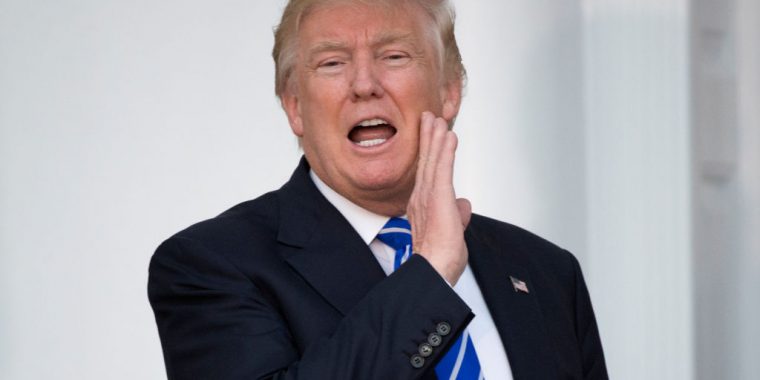
by
DON
EMMERT/AFP
via
Getty
Images)
Intel
just
agreed
to
give
the
federal
government
a
roughly
10
percent
ownership
stake.
It’s
reportedly
a
common
stock
deal
that
binds
the
federal
government
to
vote
with
the
board
unless
the
board
is
voting
to
undermine
the
deal
itself.
The
deal
is
a
payoff
for
the
CHIPS
Act,
a
$280
billion
funding
authorization
to
boost
the
domestic
semiconductor
industry.
The
Biden
administration
pushed
for
the
funding,
Trump
pushed
for
the
vig.
Theoretically,
the
equity
stake
belongs
to
the
government
and
not
Trump
personally,
but
we
thought
that
about
Air
Qatari
One
too.
The
company
needed
lawyers
to
protect
its
interests
in
making
such
a
consequential
deal,
so
it
turned
to…
a
law
firm
that
agreed
to
give
Trump
$100
million
in
free
gifts
in
exchange
for
settling
an
attack
on
their
ability
to
stay
in
business.
It’s
the
sort
of
fact
pattern
a
professional
responsibility
professor
couldn’t
put
on
an
exam
or
they’d
be
laughed
out
of
the
academy:
a
sophisticated
client,
a
well-heeled
firm,
and
a
high-stakes
extortion
effort.
Trump’s
getting
flack
from
some
Democrats
pointing
out
that
a
Republican
just
went
further
in
seizing
the
means
of
production
than
any
fever
dream
Fox
News
ever
cooked
up
about
Zohran
Mamdani.
But
that
assumes
the
Trump
administration
is
guided
by
a
“coherent
economic
vision”
or
“sense
of
shame.”
To
be
honest,
I’ve
always
thought
deals
like
this
made
a
lot
of
sense.
The
federal
government
took
an
ownership
stake
in
GM
in
exchange
for
its
bailout
during
the
Obama
administration.
As
a
consequence,
when
the
manufacturer
came
back,
taxpayers
were
much
better
off
than
when
they
went
in.
For
all
the
scare-mongering
over
socialism,
the
American
economic
system
already
rests
on
capitalistic
gains
and
socialized
losses.
Taking
an
equity
stake
lets
the
taxpayers
in
on
the
gains
too.
It
also
helps
avoid
“picking
winners
and
losers”
if
the
beneficiaries
of
government
cash
have
to
share
a
slice
of
their
gains
with
the
public
that
their
better
managed
competitors
don’t.
Frankly,
this
is
how
every
financially
ruinous
stadium
deal
should
get
handled
—
if
the
owner
wants
a
handout
for
the
team,
then
the
investment
should
pay
off
directly
and
not
rely
on
some
trickle-down
nonsense.
But
that
doesn’t
mean
deals
should
be
negotiated
by
lawyers
who
recently
settled
an
extortion
bid
for
$100
million
with
the
counterparty.
Intel
is
not
a
mom-and-pop
cobbler
blissfully
unaware
of
its
lawyers’
dealings.
It’s
a
sophisticated
party
that
knew
Skadden
is
$100
million
in
hock
to
the
Trump
administration.
Indeed,
it
likely
counted
on
it.
The
Trump
administration
walked
up
to
Intel
and
said,
“nice
little
funding
authorization
you
got
there…
shame
if
something
happened
to
it,”
and
Intel
immediately
turned
to
lawyers
who
already
surrendered
to
a
similar
threat
for
advice.
It’s
not
because
they
were
thoroughly
impressed
with
Skadden’s
brilliant
negotiation
there
(if
they
were
impressed
by
that…
then
maybe
it
explains
why
they
needed
a
bailout).
As
J.D.
Vance,
Yale
Law’s
enduring
shame,
already
proved,
Trump
doesn’t
care
what
you’ve
done
to
him
in
the
past
as
long
as
you’re
willing
to
be
obsequious
today.
Skadden
earned
a
lot
of
good
will
with
the
administration
by
coughing
up
pro
bono
commitments.
Good
will
that
Intel
would
be
remiss
to
pass
up.
And
Intel
is
exactly
the
sort
of
client
the
rules
trust
to
make
an
informed
waiver.
While
professional
responsibility
focuses
primarily
on
the
client,
it’s
also
—
at
least
somewhat
—
a
matter
of
protecting
public
trust
in
the
profession.
Just
because
the
client
can
waive
a
conflict
doesn’t
mean
it’s
good
for
the
legal
industry
to
have
firms
owing
the
government
still
unfulfilled
nine-digit
settlements
while
ostensibly
negotiating
against
it.
That’s
how
the
public
loses
its
already
rock
bottom
faith
in
lawyers.
Ideally,
ethics
rules
shouldn’t
just
exist
to
keep
dumb
clients
from
getting
tricked.
They
should
also
keep
smart
clients
from
normalizing
corruption.
 Joe
Joe
Patrice is
a
senior
editor
at
Above
the
Law
and
co-host
of
Thinking
Like
A
Lawyer.
Feel
free
to email
any
tips,
questions,
or
comments.
Follow
him
on Twitter or
Bluesky
if
you’re
interested
in
law,
politics,
and
a
healthy
dose
of
college
sports
news.
Joe
also
serves
as
a
Managing
Director
at
RPN
Executive
Search.