
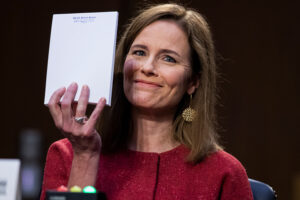
by
Tom
Williams-Pool/Getty
Images)
Amy
Coney
Barrett
has
written
a
book.
She’s
the
latest
in
a
long
line
of
Supreme
Court
justices
supplementing
their
public
service
salary
with
millions
of
dollars
—
reportedly
a
$2
million
advance
worth,
to
be
precise
—
despite
her
meager
record
as
a
milquetoast
functionary
for
a
reactionary
project
that
she
doesn’t
seem
to
understand.
And
that
seems
to
be
the
identity
Barrett
wants
to
cultivate.
Diving
into
a
copy
of
the
manuscript,
CNN’s
Joan
Biskupic
pulls
out
a
series
of
passages
where
Barrett
tries
to
drape
herself
in
the
role
of
a
powerless
cog
in
the
judicial
process.
Whether
she’s
being
honest
with
herself
or
this
is
just
a
bit
is
up
for
debate,
but
the
memoir
sections
reveal
Barrett
is
certainly
not
the
proto-David
Souter
that
liberals
imagined
her
to
be
over
the
summer.
Take,
for
instance,
her
thoughts
on
Dobbs,
the
case
that
put
her
on
the
Court
to
the
extent
she’s
only
there
because
Republicans
wanted
a
woman
to
replace
Ruth
Bader
Ginsburg
when
the
time
came
to
strike
down
Roe:
Barrett
writes
that
the
“complicated
moral
debate”
about
abortion
distinguishes
it
from
other
rights
more
traditionally
recognized
as
fundamental
that
enjoy
broad
public
support,
including
“the
rights
to
marry,
have
sex,
procreate,
use
contraception.”
Who
wants
to
break
the
news
to
her
about
the
nation’s
traditional
“broad
public
support”
for
the
right
to
marry
and
use
contraceptives?
We
don’t
know
from
the
snippets
in
the
CNN
story
if
Barrett
goes
on
to
provide
any
evidence
for
this
claim,
but
based
on
her
record
writing
opinions,
we’ll
safely
assume
she
does
not.
If
she
did,
she
would
have
to
deal
with
the
fact
that
abortion
was
MORE
BROADLY
POPULAR
when
she
voted
to
strike
it
down
(62%-36%
approval)
than
interracial
marriage
was
in
1967.
A
mere
5%
of
whites
TOTAL
supported
interracial
marriage
in
the
decade
before
the
Loving
decision.
In
fact,
interracial
marriage
didn’t
enjoy
majority
support
in
the
United
States
until
the
LATE
1990s.
Of
course,
Barrett
doesn’t
really
care
about
a
constitutional
right
being
“deeply
rooted
in
US
history.”
That’s
all
puffery
from
an
intellectually
bankrupt
movement.
If
“the
rights
to
marry,
have
sex,
procreate,
use
contraception”
remain
constitutionally
protected,
it
will
be
because
they’re
convenient
for
her
personal
political
mission…
for
now.
There’s
no
coherent
argument
for
upholding
these
rights
if
she
honestly
believes
that
constitutional
rights
are
truly
contingent
upon
popular
support.
When
Alito
strikes
down
Roe
and
make
asides
about
coming
for
marriage
equality
next,
it’s
at
least
honest.
So
what’s
Barrett
even
trying
to
accomplish
with
this
passage?
Everyone
who
has
ever
interacted
with
a
Federalist
Society
chapter
knows
exactly
what
she’s
going
for.
Every
Federalist
Society
happy
hour
has
at
least
one
student
who
gets
off
on
telling
people
that
they
aren’t
really
in
favor
of
mass
suffering,
they
just
care
so
much
about
judicial
restraint.
They’ll
take
every
opportunity
to
sigh
about
“hard
cases”
and
claim
their
“personal
sympathies”
lie
elsewhere,
and
then
cast
the
deciding
vote
to
crush
people
anyway.
As
though
it’s
the
height
of
nobility
to
gloss
over
cruelty
with
bargain
brand
stoicism.

Apparently,
Barrett
wants
to
cast
herself
in
this
lazy,
tired
role
as
the
reluctant
executioner.
These
are
the
kids
who
go
out
of
their
way
to
separate
themselves
from
the
Alito
trolls
planning
“Upside
Down
Flag
Day”
(catered
by
Chick-fil-a),
hoping
to
convince
the
rest
of
the
class
that
—
deep
down
—
they
care
about
women’s
rights
too,
it’s
just
that
the
courts
aren’t
the
proper
vehicle
to
protect
them.
Maybe,
if
the
rest
of
the
students
are
gullible
enough
to
buy
that,
the
reluctant
conservative
can
still
go
to
all
the
parties!
It’s
legal
philosophy
as
self-flagellation
cosplay.
It’s
all
bullshit
of
course.
If
these
people
sincerely
believed
that
they’re
just
against
involving
the
courts
in
an
issue
properly
left
to
Congress,
they’d
go
home
and
vote
for
Bernie
Sanders
or
something.
But
they
don’t.
They
strike
down
voting
rights
and
turn
around
to
vote
for
legislators
pushing
voter
suppression
laws.
It’s
all
a
con.
After
the Dobbs ruling
was issued
in
June
2022 and
Barrett
was
on
a
family
vacation,
a
brother-in-law
arrived
with
a
copy
of
the
decision,
saying
he
was
following
the
justice’s
mantra
to
“read
the
opinion.”“Dobbs
did
not
top
the
list
of
things
I
wanted
to
talk
about
on
vacation,”
Barrett
writes,
referring
to
court
tensions
on
the
case,
an
investigation
over
a
leaked
draft,
security
threats,
and
protests
at
her
house.Still,
she
says,
she
hugged
him.
Oh
no!
I’m
sure
Chief
Justice
Warren
always
dreaded
having
to
explain
the
“tough
choices”
involved
in
all
those
civil
rights
cases.
Justices
actually
love
talking
about
this
stuff,
especially
if
they
can
cast
themselves
as
the
heroes
of
their
own
fight
for
justice.
Sam
Alito
and
Clarence
Thomas
plan
whole
vacations
to
talk
about
their
opinions
with
the
highest
bidders!
In
preparing
a
memoir,
it’s
not
just
what
the
author
writes,
but
also
what
stories
they
choose
to
include
in
the
book.
This
anecdote
about
her
brother-in-law
doesn’t
add
much,
but
she
felt
compelled
to
include
it
to
demonstrate…
what?
That
she
is
–
at
least
occasionally
–
self-aware
enough
that
she’s
making
up
indefensible
bullshit
that
she
squirms
when
talking
to
her
own
family
about
what
she’s
doing
to
the
country?
On
the
subject
of
conveying
meaning
through
editorial
choices,
one
thing
I’ve
always
appreciated
about
Joan
Biskupic’s
writing
is
how
she
can
deliver
very
pointed
criticism
even
within
CNN’s
stricter
journalistic
guidelines.
She
can’t
point
out
—
like
some
outlets
can
—
that
Barrett’s
infamous
“read
the
opinion”
remark
is
condescending
nonsense
that
even
the
justice
can’t
possibly
believe.
But
Biskupic
can
juxtapose
the
brother-in-law
story
by
immediately
cutting
to
a
reminder
that
Barrett
is
neck
deep
in
the
Supreme
Court’s
shadow
docket
shenanigans.
“As
long
as
litigants
continue
filing
emergency
applications,
the
Court
must
continue
deciding
them,”
Barrett
writes,
minimizing
the
justices’
control
of
the
situation.
Except
one
way
—
indeed,
the
proper
way
based
on
hundreds
of
years
of
Anglo-American
jurisprudence
—
is
to
resolve
the
petitions
by
maintaining
the
status
quo
in
advance
of
trial.
The
Supreme
Court
could
respond
to
emergency
petitions
seeking
a
stay
on
arbitrarily
and
capriciously
blowing
up
millions
and
millions
of
dollars
worth
of
government
research,
setting
back
projects
that
could
take
years
to
fully
restaff,
by…
granting
the
stay.
Instead,
and
without
explanation,
the
majority
has
greenlit
the
administration’s
violations
of
decades
worth
of
administrative
law
while
Barrett
shrugs
and
declared
“what
else
could
we
do?”
Though,
in
Barrett’s
defense,
maybe
she’s
better
off
not
explaining
her
opinions.
She
recently
attempted
to
counter
a
Justice
Jackson
dissent,
resulting
in
a
pouting
concurrence
that
would’ve
failed
1L
legal
writing
at
every
law
school
in
the
land.
“We
will
not
dwell
on
Justice
Jackson’s
argument…”
she
wrote
before
a
conclusory
and
unsupported
claim
of
“nuh
uh”
in
legalese.
As
a
rhetorical
strategy,
“we
will
not
dwell”
simultaneously
poisons
the
well
and
preemptively
lowers
expectations
for
her
own
attempted
response.
A
more
direct
translation
was
“I
cannot
defend
the
majority’s
opinion
so
don’t
expect
to
see
any
supporting
evidence
here,
but,
like,
seriously,
Jackson’s
crazy
and
I
refuse
to
dignify
her
arguments
with
a
response.”
But
it
was
reluctant
executioner
rearing
her
head
again,
as
the
crux
of
her
lament
was
that
Jackson
suggested
courts
have
the
power
to
protect
rights
—
and
courts
simply
aren’t
the
right
actor
to
do
anything.
At
least
until
there’s
a
Democratic
president.
But
for
now,
Barrett
has
a
brand
to
sell
and
that
brand
is
FedSoc’s
sad
Hamlet:
reluctant,
powerless,
oh-so-burdened.
She
wants
you
to
know
that
she’s
not
a
troll
taking
aim
at
every
key
precedent
of
the
last
70
years
from
Griswold
to
Brown
—
she’s
going
to
do
it
anyway,
but
she
wants
you
to
know
she’ll
feel
really
bad
about
it.
She’s
just
the
handmaiden
of
cruelty.
But
she’s
not
reluctant.
She’s
not
helpless.
She’s
just
as
much
of
a
troll,
but
she
still
wants
to
be
invited
to
your
party.
 Joe
Joe
Patrice is
a
senior
editor
at
Above
the
Law
and
co-host
of
Thinking
Like
A
Lawyer.
Feel
free
to email
any
tips,
questions,
or
comments.
Follow
him
on Twitter or
Bluesky
if
you’re
interested
in
law,
politics,
and
a
healthy
dose
of
college
sports
news.