
by
Andrew
Harnik/Getty
Images)
Bursting
an
“EO”
Myth?
Two
weeks
into
the
new
term,
a
Seattle
courtroom
offered
the
year’s
defining
image
of
presidential
power
meeting
its
limits:
a Ninth
Circuit
panel
upheld a
nationwide
block
on
the
administration’s
attempt
to
curtail
birthright
citizenship,
acknowledging
that
the
judges’
interpretation
of
the
Constitution—not
a
presidential
pen
stroke—sets
the
terms
of
American
membership.
Weeks
earlier,
in
Baltimore,
a
federal
judge
had temporarily
enjoined key
parts
of
two
DEI-related
executive
orders
as
both
vague
and
speech-burdening—an
early
reminder
that
even
marquee
directives
can
stall
at
the
courthouse
door—before
the
Fourth
Circuit
stayed
that
injunction
while
the
appeal
plays
out.
More
than
half
of
the
administration’s
major
orders
this
year
hit
a
judicial
roadblock,
often
within
weeks.
And
the
action
has
hardly
been
confined
to
the
usual
venues:
the
administration
even
took
the
extraordinary
step
of suing
all
15
federal
judges in
Maryland
over
a
deportation-related
order—only
to
see
the
case
tossed.
The
result
is
a
litigation
map
that
runs
through
Washington,
D.C.,
Seattle,
and
Baltimore
as
reliably
as
it
does
through
Texas,
with
trial
and
appellate
courts
asked—again
and
again—to
decide
how
far
executive
power
can
go
on
contact
with
statute
and
Constitution.
The
Supreme
Court,
for
its
part,
has signaled
that
the
outer
edge
of
that
power will
be
tested
in
cases
now
moving
onto
its
docket—an
arena
where
campaign-trail
ambition
meets
Article
II
in
full
daylight.
In
other
words,
the
myth
of
the
instant,
untouchable
executive
order
collided
this
year
with
a
more
grounded
reality:
in
a
polarized
moment,
the
federal
judiciary
has
become
the
first
responder
to
the
biggest
policy
fights,
not
as
a
partisan
counterforce
but
as
the
system’s
built-in
referee.
This
trend
highlights
a
new
reality
of
American
governance:
in
an
era
of congressional
gridlock,
courts
are
where
politics
move
next.
In
the
past
this
placed
courts
as
a
main
engine creating
policy in
the
void
of
action
by
Congress
and
Executive.
Now
Trump
seems
to
have
acknowledged
this
vacuum
and
has
taken
the
reins
on
action
from
both
Congress
and
the
courts.
EOs
now
serve
as
a
President’s
bid
to
deliver
fast
policy
wins
to
their
base,
but
the
opposition
(state
attorneys
general,
advocacy
groups,
and
even
some
businesses)
now
reflexively
races
to
court
to
halt
those
policies.
The
result
is
that
the
ultimate
fate
of
many
high-profile
EOs
is
decided
by
judges,
not
just
by
the
stroke
of
a
pen.
Far
from
being
all-powerful,
executive
orders
in
2025
were
immediately
pulled
into
a
political-legal
tug-of-war,
demonstrating
that
when
it
comes
to
major
policies,
the
President’s
power
is
checked
early
and
often
by
the
courts.
To
dig
into
this
area
of
litigation,
this
article
analyzes
a
comprehensive
dataset
of
327
federal
district
court
cases
challenging
executive
orders
issued
through
the
first
half
of
August
2025.
This
“EO
Litigation
Tracker”
captures
each
case’s
issue
area,
the
presiding
judge
and
their
appointing
president,
the
relief
sought
(Temporary
Restraining
Order
or
Preliminary
Injunction),
whether
an
injunction
was
granted
(and
if
so,
whether
it
was
nationwide
in
scope),
and
the
outcome
(whether
the
EO
was
upheld
or
enjoined
in
the
end).
By
categorizing
cases
by
policy
issue
and
by
the
type/scope
of
injunctive
relief,
patterns
emerged
that
tell
a
political
story:
which
issues
provoked
the
most
legal
battles,
and
where
(and
before
whom)
those
battles
played
out.
The
Tracker
also
groups
cases
by
the
court’s
location
(circuit)
and
by
each
presiding
judge’s
background
to
see
how
ideological
leanings
might
have
influenced
results.
This
article
focuses
on
the
judicial
dimensions
of
these
decisions.
A
second
article
will
emphasize
policy
area
where
orders
are
under
judicial
scrutiny.
Who
Decides?
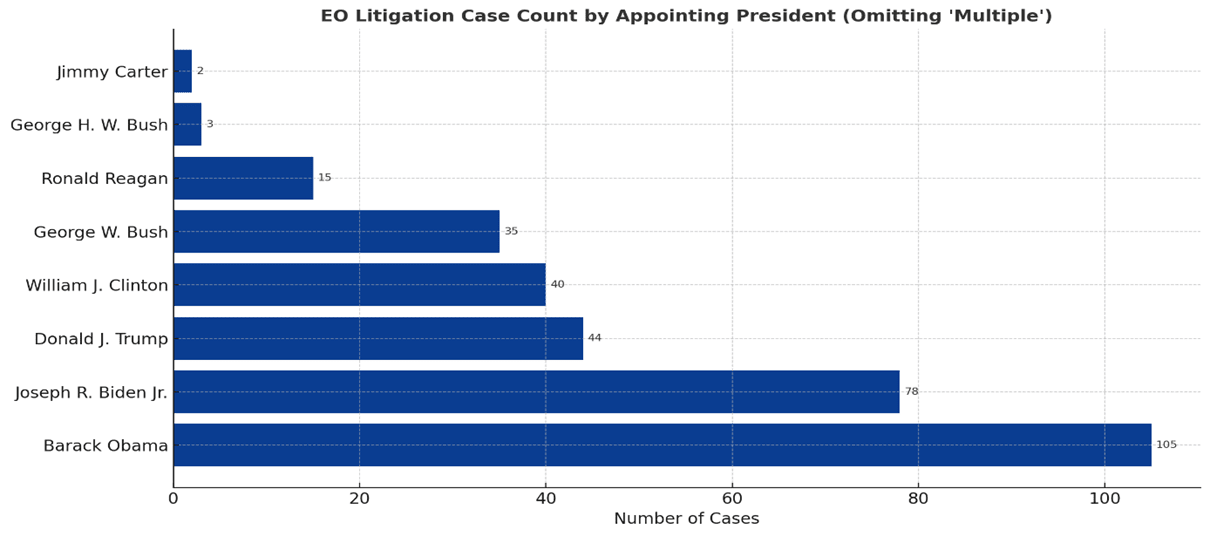
This
chart
shows
that
most
EO
cases
in
2025
were
decided
by
judges
appointed
by
Barack
Obama
(105)
and
Joseph
R.
Biden
Jr.
(78)—together,
well
over
half
of
the
total
shown.
Donald
Trump
(44),
William
J.
Clinton
(40),
and
George
W.
Bush
(35)
appointees
handled
a
smaller
but
still
substantial
share,
while
Reagan
(15),
George
H.
W.
Bush
(3),
and
Carter
(2)
trailed.
The
skew
reflects
where
plaintiffs
filed—especially
D.D.C.
and
coastal
circuits—more
than
any
single
judge’s
ideology,
and
it
helps
explain
why
many
outcomes
tilted
against
the
administration;
the
figure
omits
judges
that
were
nominated
by
one
president
and
held
over
for
confirmation
under
another
president.
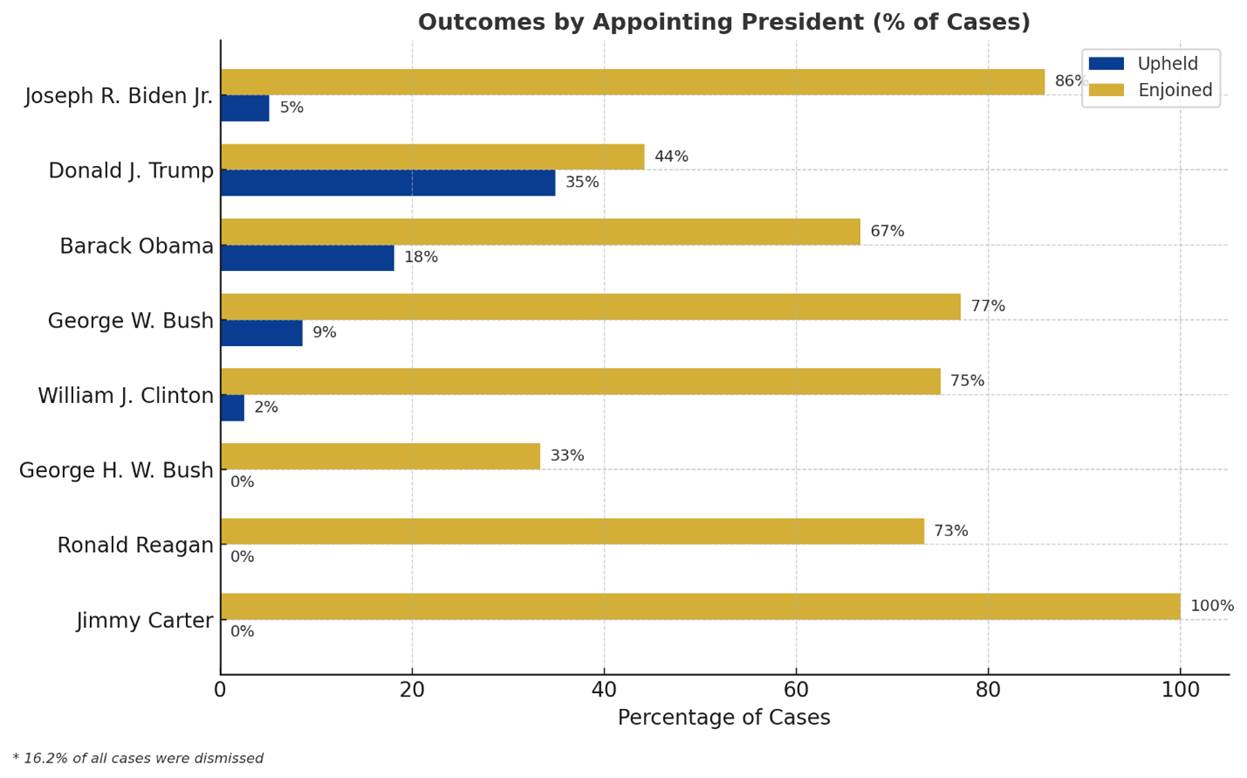
The
graph
above
tracks
case
outcomes
by
the
appointing
president
of
the
presiding
judge.
Trump
and
Obama
appointees
show
the
largest
upheld
slices,
but
even
there,
injunctions
still
outnumber
affirmances.
Reagan,
Clinton,
and
Biden
appointees
have
only
slivers
of
upheld
EOs
while
George
H.
W.
Bush
(and
to
a
lesser
extent
Reagan
and
George
W.
Bush)
appointees
have
comparatively
larger
dismissal
shares.
The
pattern
suggests
judges’
political
backgrounds
and
ideology
matters
at
the
margins,
but
the
prevailing
story
is
broad
judicial
skepticism
of
the
orders
at
the
interim
stage
regardless
of
who
appointed
the
judge.
By
mid-2025,
the
administration
lost
far
more
than
it
won.
Of
the
274
cases
that
reached
a
clear
outcome
in
2025,
232
(approximately
85%)
enjoined
the
EO
or
related
agency
action
in
whole
or
part,
while
42
(15%)
upheld
it.
Party-of-appointing-president
mattered,
but
not
enough
to
save
most
orders.
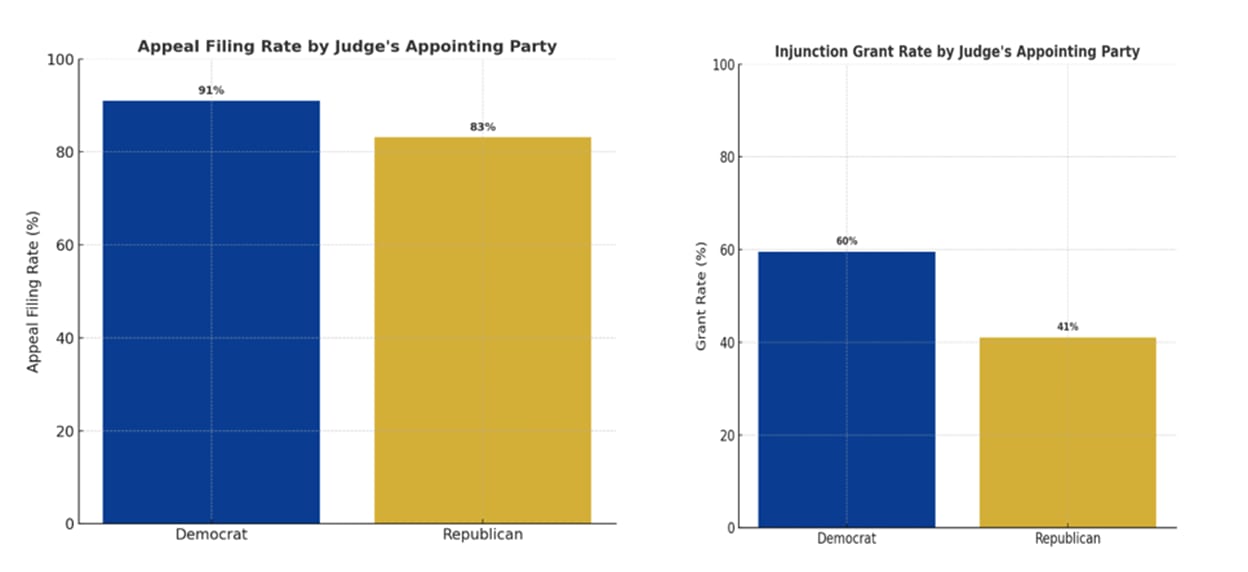
Democratic
appointees
ruled
against
the
EO
about
88%
of
the
time;
Republican
appointees
did
so
about
77%
of
the
time.
On
early
relief,
Democratic
appointees
granted
preliminary
injunctions
in
roughly
60%
of
cases,
compared
with
about
42%
for
Republican
appointees.
The
gap
tracks
expectations—but
the
striking
fact
is
how
often
judges
from
both
camps
found
legal
defects
serious
enough
to
sink
the
orders.
The
trend
isn’t
new—and
it
cuts
both
ways. Analyses
show that
most
nationwide
injunctions
(before
the
Supreme
Court
essentially
prohibited
them
in Trump
v.
CASA)
against
both
Trump’s
first
term
and
Biden’s
administration
came
from
judges
appointed
by
the
opposite
party.
Policy
fights
are
increasingly
resolved
through
legal
briefs
and
emergency
motions,
with
courtroom
wins
and
losses
carrying
the
weight—and
the
political
aftershocks—of
legislative
victories
or
defeats.
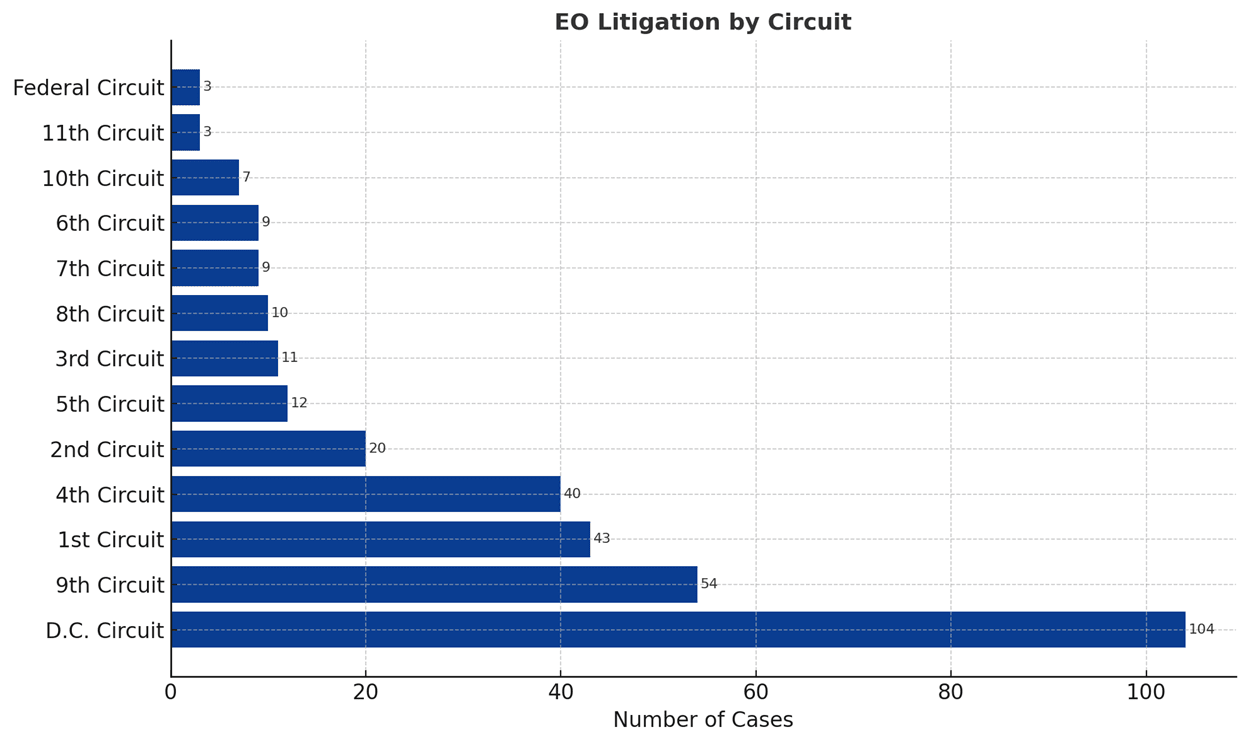
The
Emerging
Pattern
The
biggest
driver
wasn’t
just
ideology;
it
was
where
the
lawsuits
were
filed.
The
District
of
Columbia
was
ground
zero:
104
of
327
cases—just
over
30%—ran
through
D.D.C..
That’s
logical
and
strategic.
National
policies
are
administered
in
Washington,
the
judges
there
are
steeped
in
administrative
law,
and
both
government
and
public-interest
lawyers
know
the
forum
well.
Blue-state
venues
like
the
Northern
District
of
California,
the
District
of
Massachusetts,
and
the
District
of
Maryland
also
drew
heavy
fire,
reflecting
plaintiffs’
choices
to
file
where
they
expected
a
receptive
ear
to
statutory
and
APA
arguments.
Texas—the
star
of
nationwide
policy
fights
under
the
prior
administration—was
relatively
quiet.
The
Fifth
Circuit
(Texas,
Louisiana,
Mississippi)
accounted
for
only
12
cases
(approximately
3.7%),
while
the
Ninth
Circuit
saw
53
(approximately
16%)
and
the
First
Circuit
logged
43.
In
a
role-reversal,
liberal
states
and
advocacy
groups
led
the
charge
in
2025
and
steered
cases
to
D.C.,
California,
and
the
Northeast
rather
than
to
Texas.
Inside
those
busy
forums,
repeat
players
mattered.
In
D.D.C.,
judges
such
as
Paul
Friedman,
John
Bates,
Rudolph
Contreras,
and
Timothy
Kelly
handled
multiple
EO
cases.
Despite
different
appointing
presidents,
they
often
converged
on
results—frequently
enjoining
or
striking
down
orders
when
they
viewed
defects
as
obvious
(conflicts
with
statute,
APA
shortcuts,
or
shaky
authority).
Executive
orders
set
the
agenda,
but
judges
set
the
bounds.
In
2025,
venue
strategy
and
ideology
shaped
the
skirmishes,
yet
basic
law
resolved
the
disputes
for
the
time
being.
With
the Supreme
Court
poised to
refine
the
rules,
any
presidency
should
expect
its
biggest
EOs
to
face
the
courtroom
first.
**
This
work
would
not
be
possible
without
the
inimitable
assistance
of Daniel
Thompson.
Click
here
to
read
more
from
Legalytics…
Adam
Feldman
runs
the
litigation
consulting
company
Optimized
Legal
Solutions
LLC.
Check
out
more
of
his
writing
at Legalytics and Empirical
SCOTUS.
For
more
information,
write
Adam
at [email protected]. Find
him
on
Twitter: @AdamSFeldman.