

In
2047,
Ahmad
Hakim
and
his
family
are
climate
refugees
fleeing
the
Levantine
Consolidation
Zone
after
Ahmad
refused
to
place
his
daughters
in
mandatory
fertility
conscription.
The
family
seeks
sanctuary
in
CoralNet,
a
community
governed
though
“judicial
meshes”
combining
human,
AI,
and
nonhuman
perspectives.
It’s
unlikely
that
we’re
less
than
25
years
away
from
animals
weighing
in
on
judicial
decisions,
but
I,
for
one,
welcome
our
new
Orca
overlords
—
they
seem
to
have
the
right
idea.
Authorities
deny
sanctuary
to
Ahmad
himself,
while
provisionally
granting
sanctuary
to
his
wife
and
children,
on
the
grounds
that
Ahmad
refuses
to
allow
AI
copilots
for
himself
or
his
children,
refuses
verification
literacy
training,
and
rejects
CoralNet’s
epistemic
infrastructure.
As
a
hypothetical,
it
goes
a
lot
further
out
there
than
your
1L
Torts
final.
This
is
the
background
for
the
Karl
Popper
Legal
Reasoning
Scholarship
competition,
challenging
law
students
to
navigate
a
future
dominated
by
“artificial
intelligence,
climate
change,
and
evolving
concepts
of
personhood
and
humanism”
as
well
as
rising
global
authoritarianism.
Law
students
are
given
a
description
of
the
case
and
a
body
of
real
and
hypothetical
precedent,
and
asked
to
enter
a
2000-5000
word
submission
in
the
form
of
either
a
party
brief,
a
judicial
opinion,
or
a
scholarly
analysis.
And,
in
keeping
with
an
AI-driven
future,
students
are
not
only
allowed,
but
encouraged
to
use
AI
in
their
submissions.
The
competition
has
$25,000
prize
pool
and
is
open
to
JD/LLB,
LLM,
SJD,
and
PhD
candidates,
either
working
solo
or
in
teams
up
to
three.
First
prize
earns
$10,000,
the
two
runners-up
receive
$2,500
each,
and
seven
finalists
will
take
home
$500.
The
deadline
is
October
10,
2025,
23:59
UTC.
LinkedIn
cofounder
Reid
Hoffman
took
to,
well,
LinkedIn
to
express
his
interest
in
the
competition:
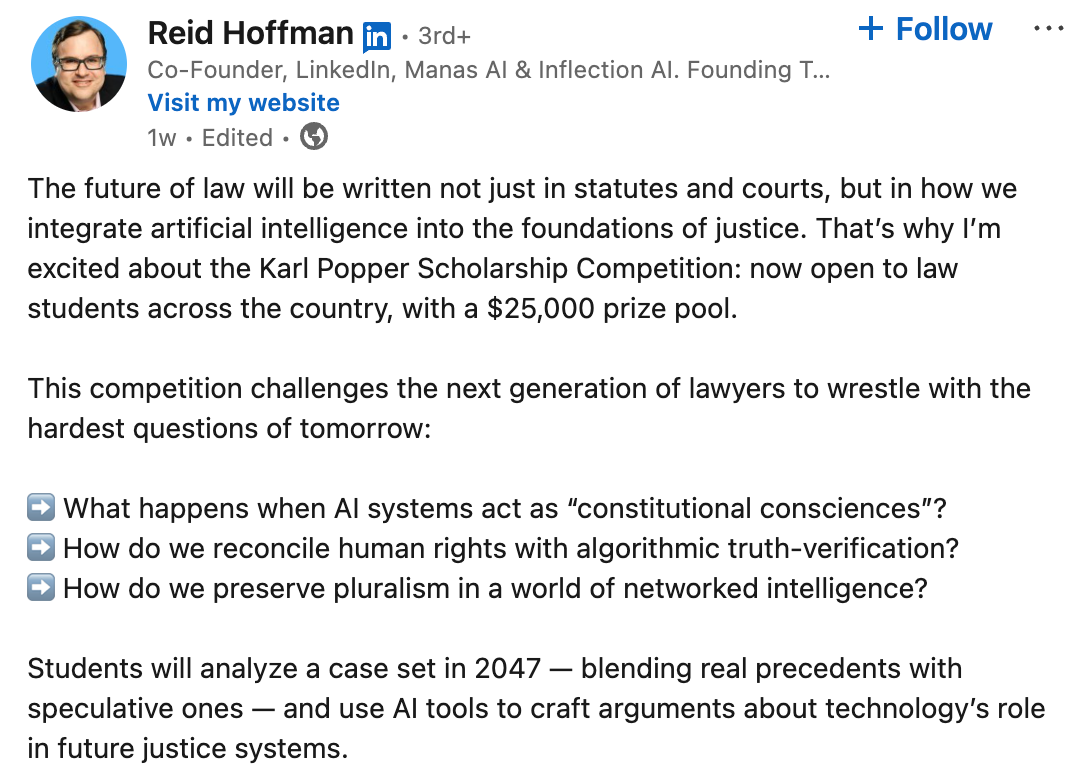
The
future
of
law
being
written
by
“how
we
integrate
artificial
intelligence
into
the
foundations
of
justice”
sounds
appropriately
dystopian,
but
the
present
of
law
is
written
by
a
mix
of
Calvinball
and
“who
paid
for
Clarence
Thomas’s
last
vacation,”
so
maybe
ChatGPT
should
take
a
stab
at
it.
There
is
an
AI
executive
out
there
claiming
his
AI
can
replace
human
judges.
He
is
also
an
idiot.
But
even
if
artificial
intelligence
won’t
take
its
place
in
the
foundations
of
justice,
it’s
certainly
going
to
reshape
the
legal
workflow.
Lawyers
already
use
these
word
calculators
the
same
way
they
historically
used
junior
associates,
to
write
first
drafts
that
get
marked
up
enough
to
make
Theseus
wince.
Judges
will
also
employ
more
AI
in
their
process,
even
if
they
don’t
want
to,
as
legal
research
products
integrate
more
and
more
AI
on
the
backend.
AI
hallucinations
have
embarrassed
lawyers
up
and
down
the
prestige
scale.
The
best
hope
for
the
next
generation
of
attorneys
is
to
get
them
actively
employing
the
technology
early
so
they
can
figure
out
what
it
can
and
cannot
actually
do.
Law
schools
will
harbor
understandable
skittishness
about
turning
students
loose
on
AI-assisted
projects,
making
competitions
like
this
one
all
the
more
important.
Beyond
the
technology,
the
competition
asks
an
interesting
philosophical
question,
inspired
by
Karl
Popper
himself,
about
the
limits
of
tolerance.
Popper
famously
warned
that
tolerance
requires
a
society
to
be
intolerant
of
intolerance,
a
timely
maxim
to
remember
as
some
of
the
loudest
demands
for
“free
speech”
come
from
those
preaching
intolerance.
How
does
a
society
balance
open
discourse
with
a
tolerating
a
media
landscape
built
around
hijacking
it
for
fascist
ends?
The
best
answer
historically
is
to
let
the
audience
speak
freely
themselves:
to
protest,
to
mock,
and
to
boycott.
Those
rights
of
the
audience
have
come
under
assault
from
those
who
want
to
say
that
free
speech
is
the
affirmative
right
to
be
protected
from
criticism.
This
interpretation,
couched
in
the
language
of
freedom,
was
always
a
precursor
to
fascism
because
its
fundamental
logic
rests
on
coercive
government
action
to
silence
opposition.
So
when
we
start
seeing
FCC
licenses
dangled
to
get
late-night
hosts
removed
for
making
jokes,
it’s
just
one
more
step
on
the
road
to
eroding
the
guardrails
protecting
society
from
intolerance.
But,
Popper’s
tolerance
paradox
goes
deeper
than
speech,
the
hypothetical
asks
about
granting
asylum
to
a
father
who
espouses
racist
and
misogynist
views
that
clash
with
the
community
while
keeping
a
family
fleeing
persecution
together.
Should
a
society
seek
to
keep
out
intolerance
at
the
cost
of
punishing
the
whole
family?
When
should
the
state
sacrifice
cultural
pluralism
to
protect
the
individual
rights
of
the
family
members?
Then
throw
the
concept
of
compelled
AI
copilots
onto
all
this.
It’s
a
fascinating
competition.
Read
more
about
it
here.
And
remember,
you
have
until
October
10,
2025,
23:59
UTC
to
enter.
 Joe
Joe
Patrice is
a
senior
editor
at
Above
the
Law
and
co-host
of
Thinking
Like
A
Lawyer.
Feel
free
to email
any
tips,
questions,
or
comments.
Follow
him
on Twitter or
Bluesky
if
you’re
interested
in
law,
politics,
and
a
healthy
dose
of
college
sports
news.
Joe
also
serves
as
a
Managing
Director
at
RPN
Executive
Search.