
Ed.
note:
Please
welcome
Renee
Knake
Jefferson
back
to
the
pages
of
Above
the
Law.
Subscribe
to
her
Substack,
Legal
Ethics
Roundup, here.
Welcome
to
what
captivates,
haunts,
inspires,
and
surprises
me
every
week
in
the
world
of
legal
ethics.
Happy
First
Monday! On
the
first
Monday
of
each
month,
you
get
a
longer
version
of
the
Roundup
with
the headlines plus reading
recommendations, job
postings, events,
and
many
other
features.
The
first
Monday
in
October
is
extra
special
because
it
is
also
the
opening
day
for
the U.S.
Supreme
Court’s
2025
Term.
In
2010,
I
wrote
a
law
review
article
called “The
Supreme
Court’s
Increased
Attention
to
the
Law
of
Lawyering:
Mere
Coincidence
or
Something
More?” I
described
what
has
turned
out
to
be
the
high-water
mark
for
cases
involving
legal
ethics
issues
taken
up
by
the
Supreme
Court
in
a
particular
term.
There
were
seventeen
— seventeen! —
such
cases
during
the
2009
Term.
You
can read
the
full
article
here if
you
want
to
know
more
about
the
cases
from
the
2009
Term.
But
what
about
the
Supreme
Court’s
docket
for
the
upcoming
term? So
far
we
have
only
one.
But
to
be
fair
the
Court
has
only granted
cert to
a
few
dozen
cases
to
date.
I’ll
be
keeping
an
eye
out.
For
now,
here’s
an
overview
of Villarreal
v.
Texas,
which
will
be
argued today.
Along
with
several
other
legal
ethics
scholars,
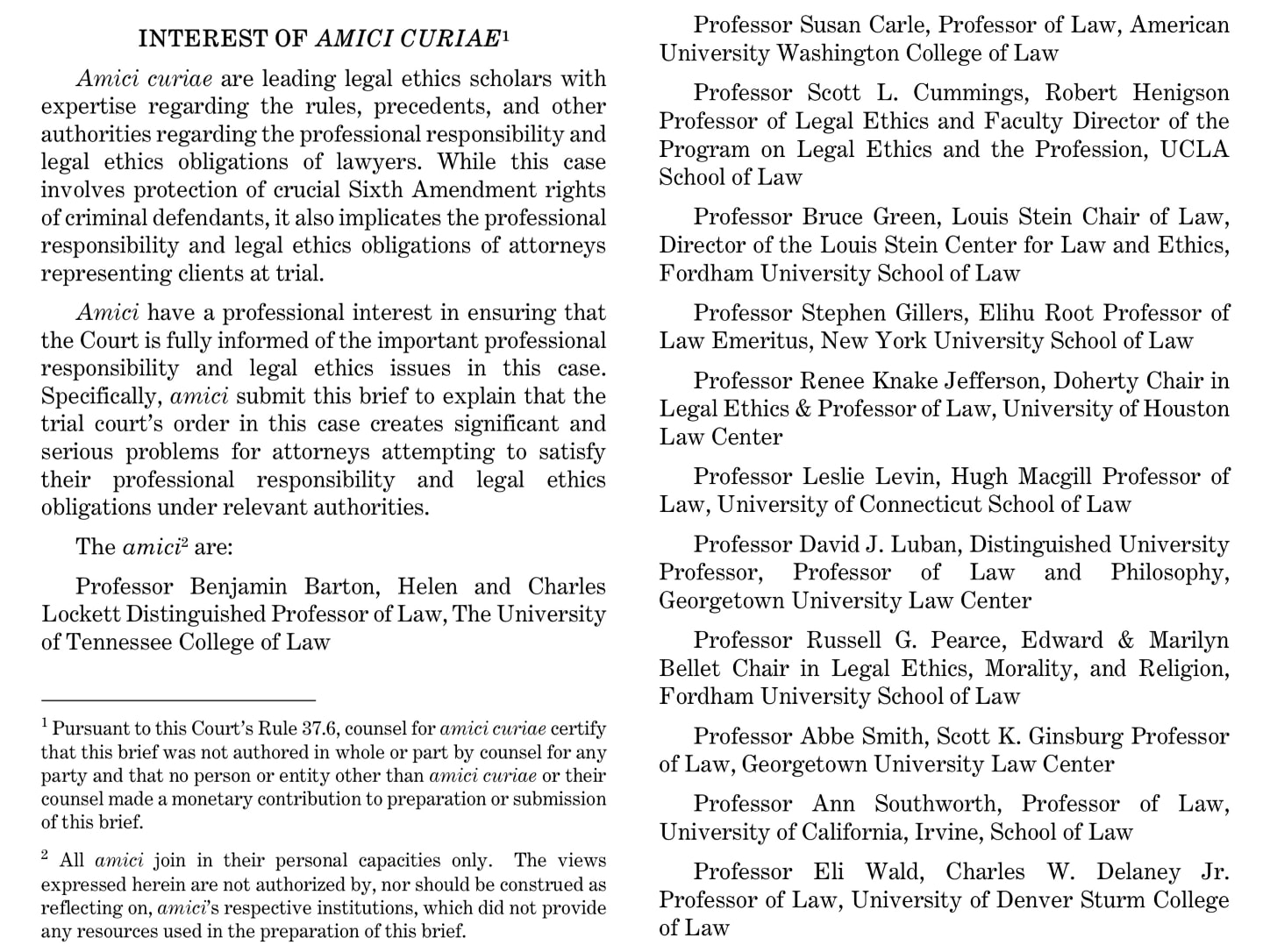
I
joined
an
amicus
brief
filed
in
this
case.
At
issue
is
whether
a
trial
court
violates
a
defendant’s
Sixth
Amendment
right
to
counsel
by
prohibiting
the
defendant
and
his
lawyer
from
discussing
testimony
during
an
overnight
recess.
We
argue
that
a
ban
on
discussions
like
this
jeopardizes
the
lawyer’s
compliance
with
core
professional
responsibilities
and
undermines
attorney-client
privilege
and
the
duty
of
confidentiality.
Read
more
and
download
the
amicus
brief here.

In
totally-unrelated-to-legal-ethics
news,
I’ve
been
listening
nonstop
to
the
newly-released
album
from Taylor
Swift,
The
Life
of
a
Showgirl
(reviewed here by
The
New
York
Times
–
gift
link).
At
the
moment,
my
favorite
tracks
are
CANCELLED!
and
Opalite.
Whatever
you
think
of
her
music,
she
always
leaves
her
fans
with
something
to
look
forward
to.
I
hope
that’s
what
I’m
doing
here
for
legal
ethics
fans
each
week!

Taylor
Swift/Republic
Records,
Public
domain,
via
Wikimedia
Commons
Now,
let’s
get
started
with
the
headlines.
Don’t
forget
to
keep
scrolling
down
to
the
very
end
for
all
the
“First
Monday”
extra
features.
Enjoy!
Highlights
from
the
Past
Week –
Top
Ten
Headlines
#1 “Texas
Plans
to
End
ABA’s
Role
in
State’s
Law
School
Oversight.” From Reuters: “The
Supreme
Court
of
Texas
said
in
an
order
on
Friday
that
it
‘is
of
the
tentative
opinion
that
the
ABA
should
no
longer
have
the
final
say’
on
whether
a
law
school’s
alumni
can
sit
for
the
Texas
Bar
or
be
licensed….University
of
Houston
law
dean Leonard
Baynes told
Reuters
on
Monday
that
he
was
pleased
the
court
showed
commitment
to
law
degree
portability
and
avoiding
onerous
requirements
on
law
schools.
But
Baynes
said
the
‘order
creates
uncertainty
for
legal
education
in
the
backdrop
of
an
already
chaotic
world
of
higher
education.’”
Read
more here.
#2
“The
Justice
Department
Seeks
Information
on
the
Georgia
D.A.
Who
Prosecuted
Trump.” From
the New
York
Times: “The
Department
of
Justice
has
issued
a
subpoena
for
records
related
to
the
travel
history
of Fani
T.
Willis,
the
Georgia
district
attorney
who
charged President
Trump in
a
sweeping
election
interference
case,
according
to
a
federal
grand
jury
subpoena
reviewed
by
The
New
York
Times.
The
scope
of
the
investigation
is
not
yet
clear.
Also
unclear
is
whether
Ms.
Willis
is
the
target
of
the
inquiry
and
whether
she
will
ultimately
face
charges.
Grand
jury
proceedings
are
secretive
by
law.
But
the
document
reviewed
by
The
Times
is
an
indication
that
the
Justice
Department
under
President
Trump
may
be
investigating
another
one
of
his
old
foes.”
Read
more here.
#3
“Michigan
Justices
Issue
Scaled-Back
Judicial
Anti-Bias
Rule.” From Bloomberg
Law: “The
Michigan
Supreme
Court
on
Wednesday tweaked a
conduct
rule
barring
judges
from
exhibiting
bias
or
harassing
those
in
their
courtrooms,
but
didn’t
go
as
far
as
a
proposal
from
earlier
this
year.
The
rule
previously
said
a
judge
‘should’
treat
everyone
fairly
and
respectfully,
‘without
regard
to
a
person’s
race,
gender,
or
other
protected
personal
characteristic.’
The
new
one,
which
goes
into
effect
Jan.
1,
says
a
judge
must
perform
their
duties
‘without
bias
or
prejudice.’
It
changes
‘should’
to
‘shall,’
and
says
they
‘shall
not
intentionally
or
recklessly,
in
the
performance
of
judicial
duties,
manifest
bias
or
prejudice’.”
Read
more here.
#4
“What
Ethics
Rules
Say
On
Atty
Discipline
For
Online
Speech.” From
the Law360: “Though
law
firms
are
free
to
discipline
employees
for
their
online
commentary
about Charlie
Kirk or
other
social
media
activity,
saying
crude
or
insensitive
things
on
the
internet
generally
doesn’t
subject
attorneys
to
professional
discipline
under
the
Model
Rules
of
Professional
Conduct,
says Stacie
H.
Rosenzweig at
Halling
&
Cayo.”
Read
more here.
#5
“Ethics
Opinion
1286:
Requesting
Former
Clients
to
Write
Google
Reviews.” From
the New
York
State
Bar
Association: “A
lawyer
may
ask
a
former
client
to
write
a
Google
review
of
the
lawyer’s
services,
and
may
offer
the
former
client
a
nominal
gift
for
doing
so,
provided
the
lawyer
does
not
draft
the
Google
review
for
the
client
or
condition
the
gift
on
the
content
of
the
review.
The
lawyer
may
not
use
the
former
client’s
confidential
information
to
the
disadvantage
of
the
former
client.”
Read
more here.
#
6
“Supreme
Court
Ethics
Issues
Trace
to
John
Roberts’
‘Original
Sin,’
New
Book
Alleges.” From
the Rolling
Stone: “When
he
was
pitching
himself
to George
W.
Bush for
a
seat
on
the
highest
court
in
the
land, John
Roberts famously
declared
that
judges
should
be
like
‘umpires,’
making
calls
but
never
stepping
up
to
the
plate
for
either
team.
Bush
liked
the
line
so
much
he
didn’t
just
give
Roberts
a
seat
on
the Supreme
Court,
he
installed
him
as
chief
justice
—
the
youngest
person
to
hold
that
job
in
almost
200
years.
A
new
book, Without
Precedent —
an
excerpt
of
which
has
been
shared
exclusively
with Rolling
Stone —
suggests
another
powerful
reason
why
Bush
may
have
felt
such
extraordinary
confidence
appointing
Roberts
to
the
most
powerful
position
in
the
U.S.
judiciary.
At
the
time
that
Roberts
was
auditioning
for
the
job,
he
was
also
presiding
over
a
critical
case
to
which
the
Bush
administration
was
a
party
—
and
rather
than
acting
as
an
ump
in
that
case,
author Lisa
Graves suggests,
Roberts
was
practically
pinch-hitting
for
Bush
and
his
cronies.”
Read
more here.
#7
“Using
Military
Lawyers
as
Immigration
Judges
is
Ill-Advised
and
Potentially
Illegal.” From
the Brennan
Center
for
Justice: “The
Trump
administration’s reported
authorization of
600
military
lawyers
to
act
as
temporary
immigration
judges
would
deprive
immigrants
of
a
fair
hearing
and
further
erode
the
line
between
the
military
and
civilian
government.
This
is
true
regardless
of
the
professionalism
of
the
military
lawyers.
Immigration
judges
are
specially
trained
administrative
judges
in
the
Department
of
Justice
who
oversee deportation hearings.
…
In
addition, ethical
rules are
fundamental
to
the
rule
of
law,
but
the
legal
and
ethical
obligations
of
military
lawyers
and
immigration
judges
are
in
tension.”
Read
more here.
#8
“Update
to
‘Conflict
U.’:
Some
Judges
Are
Recusing
Due
to
a
University
Conflict.” From Fix
the
Court: “In
July,
Fix
the
Court
released
a
report
called Conflict
U. that
identified
24
federal
judges
who
did
not
recuse
in
six
dozen
cases
involving
the
universities
where
they
also
serve
as
law
school
instructors.
This
practice
raises
clear
conflict-of-interest
concerns,
despite
being
sanctioned
by
judiciary
policy.
The
report
urges
reforms
to
strengthen
recusal
practices
and
restore
public
trust
in
judicial
ethics.
This
past
month,
Fix
the
Court
conducted
follow-up
research
on
this
issue,
and
what
we
found
was
somewhat
surprising:
several
judges
with
adjunct
positions
at
law
schools
are,
in
fact,
choosing
to
recuse
when
the
law
schools’
parent
universities
find
themselves
in
their
courtrooms.”
Read
more here.
#9
“Law,
Layers
and
the
Battle
Against
Antisemitism.” From Eli
Wald (Denver)
in JOTWELL reviewing Antisemitism
and
the
Law by Robert
Katz: “According
to
the
American
Bar
Association
Model
Rules
of
Professional
Conduct,
a
lawyer
is
‘a
representative
of
clients,
an
officer
of
the
legal
system
and
a
public
citizen
having
special
responsibility
for
the
quality
of
justice.
As
Deborah
Rhode
has
astutely
pointed
out,
however, lawyers’
duties
as
public
citizens
have
long
been
more
of
a
rhetorical
ploy
than
an
actual
commitment,
in
need
of
elaboration
and
exposition.
In
the
twenty-first
century,
lawyers
have
been
forced
to
come
to
terms
with
their
asserted
role
as
public
citizens
in
the
face
of
the
#MeToo
and
the
Black
Lives
Matter
movements,
reform
calls
for
the
deregulation
of
the
legal
profession
designed
to
increase
access
to
legal
services
for
those
who
cannot
afford
to
pay
for
them,
and
attacks
on
the
rule
of
law.
Professor
Robert
Katz’
new
casebook, Antisemitism
and
the
Law,
constitutes
an
important
contribution
sure
to
help
those
aiming
to
understand
the
obligations
of
lawyers
to
pursue
justice
and
combat
discrimination.”
Read
more here.
#10 “Dealing
with
Social
Media
&
Public
Comment:
Legal
Ethics
Lessons
for
Corporate
Counsel.” From JD
Supra: “Social
media
can
turn
small
moments
into
corporate
crises
overnight.
For
in-house
counsel,
the
ethical
challenges
are
particularly
complex:
protecting
confidential
information,
addressing
employee
conduct,
and
managing
public
backlash
when
private
behavior
goes
viral.
…
The
Oklahoma
and
Texas
Rules
of
Professional
Conduct
frame
the
lawyer’s
obligations
when
social
media
collides
with
the
workplace.”
Read
more here.
Recommended
Reading
“Legal
Insurance
and
Its
Limits” by Nora
Freeman
Engstrom (Stanford).
From
the
abstract:
Courts
are
buckling
under
the
weight
of
a
staggering
access-to-justice
crisis.
In
three-quarters
of
cases,
at
least
one
side
lacks
a
lawyer,
default
judgments
are
on
the
rise,
and
most
Americans
with
valid
claims
never
take
legal
action.
The
situation
is
dire,
and
it
understandably
has
policymakers
casting
about
for
a
fix.
On
the
menu
are
a
range
of
uncontroversial
reform
ideas,
such
as
expanding
legal
aid,
supporting
system
simplification,
and
promoting
pro
bono.
But
it
is
increasingly
clear
that
those
measures—even
if
accomplished—would
not
make
a
dent
in
the
problem.
Attention
is
thus
turning
to
other
reform
ideas,
such
as
relaxing
unauthorized
practice
of
law
(UPL)
rules
and
scrapping
Model
Rule
5.4(d),
the
provision
that
prevents
nonlawyers
from
even
partially
owning
entities
that
deliver
legal
services.
Both
reforms
are
promising.
But
both
would
dilute
the
longstanding
lawyers’
monopoly.
Perhaps
not
surprisingly,
the
bar
is
fighting
these
reforms
tooth-and-nail.Into
this
roiling
landscape,
some
now
have
a
new
idea:
legal
insurance.
They
suggest
that
legal
insurance
is
the
way
to
expand
access
to
justice
for
middle
and
working-class
Americans.
Reformers
are
also
quick
to
point
out
that—unlike
a
relaxation
of
UPL
restrictions
or
the
abolition
of
Rule
5.4(d)—legal
insurance
stands
to
benefit
lawyers.We
have
seen
this
play
before.
In
the
1970s,
the
bar
seized
on
legal
insurance
as
a
solution
to
what
was
then
seen
as
an
urgent
access-to-justice
crisis
afflicting
the
middle-class.
…
This
Article
recovers
the
lost
history
of
the
country’s
first
experiment
with
legal
insurance.
In
so
doing,
it
seeks
to
forestall
another
false
start.
In
addition,
by
drawing
on
a
range
of
disciplines—including
insurance
law
(particularly
insights
concerning
moral
hazard
and
adverse
selection),
behavioral
economics,
legal
ethics,
and
the
legal
profession—this
Article
explains
why
the
legal
insurance
idea
floundered,
and
seems
destined
to
flounder,
going
forward.
“Interoperable
Legal
AI
for
Access
to
Justice” by Drew
Simshaw (UNLV).
From
the
abstract:
The
access-to-justice
gap
is
growing,
affecting
individuals
with
both
civil
and
criminal
needs
in
the
United
States.
Though
these
challenges
are
multifaceted,
procedural
barriers
in
the
U.S.
legal
system
can
often
inhibit
access-to-justice
efforts.
The
resulting
inequities
undermine
fairness
for
those
interacting
with
courts
and
jeopardize
the
legitimacy
of
the
broader
legal
system.
Legal
technology
driven
by
artificial
intelligence
(AI)
has
been
heralded
for
its
potential
to
combat
these
challenges
on
three
access-to-justice
fronts
that
are
often
conceptualized
in
isolation:
a
consumer
(i.e.,
self-help)
front,
a
legal-service-provider
front,
and
a
court
front.
Progress
on
each
of
these
fronts
is
apparent,
though
not
at
the
pace
or
scale
necessary
to
make
meaningful
inroads
into
closing
the
justice
gap
nationwide.
The
time
has
come
to
appreciate
that,
although
progress
on
all
three
fronts
is
necessary
for
closing
the
justice
gap
and
maximizing
fairness,
it
is
insufficient
if
there
is
not
also
some
level
of
shared
commitment
and
coordination
across
–
and
not
just
within
–
all
fronts.
This
Essay
argues
that
technological
and
procedural
legal
interoperability
–
that
is,
widespread
consistency
in
technology
design
and
related
processes
–
should
be
at
the
forefront
of
these
efforts,
particularly
as
they
relate
to
artificial
intelligence.
Further,
although
the
consumer
and
legal-services
fronts
remain
critically
important,
courts
should
be
recognized
as
the
necessary
drivers
in
achieving
this
interoperable
legal
AI.
Legal
Ethics
Trivia
From
the
Texas
Center
for
Legal
Ethics,
here’s
the
question
of
the
month:
“How
much
do
you
know
about
the
ethics
rules
governing
law
firm
names?” Test
yourself
at
this
website where
you
can
read
a
short
hypothetical,
select
an
answer,
and
see
your
results.
So
far,
only
31%
have
gotten
it
right.
Will
you?

Get
Hired
Did
you
miss
the
350+
job
postings
from
previous
weeks?
Find
them
all here.
Assistant
General
Counsel,
State
Bar
of
Georgia
—
Atlanta. From
the
posting:
“The
primary
purpose
of
this
position
is
to
review,
investigate,
and
prosecute
violations
of
the
Georgia
Rules
of
Professional
Conduct.
Act
as
lead
counsel
in
all
aspects
of
prosecuting
disciplinary
cases
including
drafting
pleadings,
conducting
discovery,
conducting
hearings
before
the
Special
Master,
presenting
oral
argument
before
the
Special
Master
and
State
Disciplinary
Review
Board,
and
negotiating
settlements
of
disciplinary
matters.”
Learn
more
and
apply here.
Associate
Counsel,
American
Bar
Association
Center
for
Professional
Responsibility
–
Chicago/Hybrid. From
the
posting:
“Serve
as
national
legal
expert
in
the
field
of
legal
and
judicial
ethics
and
professional
responsibility
law.
Provide
expertise
to
ABA
governance,
ABA
entities,
state,
local,
national
and
international
legal
community.
Develop
substantive
legal
resources
to
ensure
and
enhance
the
Association’s
continued
status
as
the
preeminent
legal
authority
in
professional
responsibility
law.”
Salary
range
$89,280
–
$109,740
annually.
Learn
more
and
apply here.
Attorney
x
2,
Texas
Ethics
Commission
—
Austin/Hybrid. From
the
posting:
”The
Texas
Ethics
Commission
is
hiring
two
attorneys
to
perform
entry
level
to
moderately
complex
attorney
work
administering
and
enforcing
state
ethics
laws.
Work
for
the
Enforcement
Division
would
involve
investigating
and
processing
sworn
complaints,
conducting
discovery
and
hearings,
and
drafting
and
negotiating
settlements.
These
positions
will
work
under
moderate
supervision
with
significant
latitude
for
the
use
of
initiative
and
independent
judgment.”
Salary
range
$75,000
–
$102,000
annually.
Learn
more
and
apply here.
Conflicts
Staff
Attorney,
Cooley
LLP
—
Multiple
Locations. From
the
posting:
“Working
closely
with
Associate
Directors
of
Conflicts,
the
Conflicts
Staff
Attorney
is
responsible
for
assuring
compliance
with
applicable
Rules
of
Professional
Conduct
and
assisting
and
managing
other
loss
prevention
functions.
The
Conflicts
Staff
Attorney
is
a
staff
attorney
who
understands
the
rules
that
govern
legal
practice
and
can
perform
practical
processes
to
ensure
compliance
with
those
rules.”
Salary
range
$125,000
–
$190,000
annually.
Learn
more
and
apply here.
Legal
Operations
Manager,
United
Airlines
—
Chicago. From
the
posting:
”Our
department
is
seeking
a
legal
operations
manager
with
proven
experience
in
data
analytics
and
managing
the
day-to-day
administrative
operations
of
a
corporate
legal
department
while
supporting
and
driving
strategic
initiatives.
This
position
reports
to
the
Chief
Legal
Operations
Officer
and
plays
a
pivotal
role
in
optimizing
the
department
to
run
more
efficiently
and
effectively.”
Salary
range
$99,750.00
to
$129,924.00
annually.
Learn
more
and
apply here.
Senior
Attorney
–
Ethics
&
Advertising,
The
Florida
Bar
—
Tallahassee. From
the
posting:
”Provides
oral
ethics
opinions
to
Florida
Bar
members
on
the
Ethics
Hotline,
advises
reporters
and
others
generally
regarding
application
of
the
Rules
of
Professional
Conduct.
Reviews
attorney
advertisements
for
compliance
with
the
Rules
Regulating
The
Florida
Bar;
answers
advertising
questions
on
the
Hotline
and
issues
written
opinions;
staffs
the
Standing
Committee
on
Advertising,
drafts
formal
and
informal
advisory
advertising
opinions,
performs
legal
research
on
advertising
issues,
drafts
amendments
to
the
lawyer
advertising
rules,
prepares
agenda
items
for
meetings,
attends
meetings
and
conference
calls,
and
reviews
minutes.”
Minimum
starting
salary
$85,247.22
annually.
Learn
more
and
apply here.
Upcoming
Ethics
Events
&
Other
Announcements
Did
you
miss
an
announcement
from
previous
weeks?
Find
them
all here.
-
October
9-10.
Complex
Litigation
Ethics
Conference,
Center
for
Litigation
and
Ethics,
UC
Law
SF. Learn
more here. -
October
16,
3-5PM
Central.
“Lawyers
Who
Lead:
Ethics,
Influence,
and
Impact”,
University
of
Houston
Law
Center. Join
me
for
a
conversation
along
with H.
Stephen
Grace
Jr. (President
and
Founder
H.S.
Grace
&
Co.)
and Andrew
Gratz (Founder
of
the
Initiative
on
Lawyers
as
Leaders).
Learn
more
and
register here. -
December
8-9.
Australia
and
New
Zealand
Legal
Ethics
Colloquium
VIII,
University
of
Otago,
New
Zealand. The
2025
colloquium
will
explore
the
evolving
expectations
of
lawyers
in
a
world
where
professional
conduct
is
increasingly
scrutinized
through
the
lens
of
public
morality
and
social
justice.
We
encourage
submissions
that
engage
with
questions
such
as:
What
are
the
limits
of
role
morality
in
legal
practice?
How
should
legal
ethics
respond
to
the
rise
of
“cancel
culture”
and
public
backlash
against
lawyers?
How
can
the
legal
profession
maintain
its
commitment
to
the
rule
of
law
while
remaining
responsive
to
democratic
values
and
social
change?What
does
accountability
look
like
for
lawyers
representing
controversial
clients
or
causes?
How
should
legal
education
evolve
to
prepare
future
lawyers
for
these
ethical
complexities?
Learn
more here. -
December
9
@
noon
–
1PM
Eastern.
Florida
Bar
CLE
“What
Messy
Celebrity
Breakups
Teach
About
Legal
Ethics.” From
the
program
description:
“What
do Gwyneth
Paltrow, J.
Lo,
and Ryan
Seacrest all
have
in
common?
They
all
had
messy,
public
breakups
that
offer
surprisingly
rich
lessons
about
attorney
ethics
and
professional
conduct.
Professional
legal
educator Stuart
Teicher,
Esq. (known
as
The
CLE
Performer)
uses
celebrity
relationship
drama
to
explore
the
rules
of
professional
conduct
in
ways
that
are
both
memorable
and
practical.
From
power
couple
joint
representation
disasters
to
confidentiality
breaches
that
make
tabloid
headlines,
these
high-profile
relationship
meltdowns
mirror
the
ethical
dilemmas
attorneys
face
in
their
own
practices.
You’ll
discover
how
celebrity
scandals
illuminate
key
ethical
principles,
making
complex
rules
easier
to
understand
and
remember
when
real
ethical
challenges
arise
in
your
practice.
This
program
combines
real
celebrity
situations
with
hypothetical
scenarios
to
create
engaging
teaching
moments
that
stick.”
Learn
more here. -
January
6-9. Association
of
American
Law
Schools
Annual
Meeting,
Section
on
Professional
Responsibility
Events. I’ll
be
moderating
the
Section’s
main
program
on
“The
Law
Professor’s
Role
in
Protecting
Our
Legal
System” which
will
be
held
January
8
from
2:35-3:50
PM.
Learn
more here.
Keep
in
Touch
News
tips?
Announcements?
Events? A
job
to
post? Reading
recommendations? Email [email protected] –
but
be
sure
to
subscribe
first,
otherwise
the
email
won’t
be
delivered.
Renee
Knake
Jefferson
holds
the
endowed
Doherty
Chair
in
Legal
Ethics
and
is
a
Professor
of
Law
at
the
University
of
Houston.
Check
out
more
of
her
writing
at
the Legal
Ethics
Roundup.
Find
her
on
X
(formerly
Twitter)
at @reneeknake or
Bluesky
at legalethics.bsky.social.