The
Justice
Department
lied
in
a
judicial
misconduct
complaint
against
Chief
Judge
James
Boasberg
of
the
US
District
Court
for
the
District
of
Columbia,
referring
to
attached
evidence
that
was
not
provided
and
may
not
even
be
in
the
possession
of
the
DOJ.
The
complaint,
addressed
to
Chief
Judge
Sri
Srinivasan
of
the
DC
Circuit,
alleged
that
Judge
Boasberg
attempted
to
intimidate
Chief
Justice
John
Roberts
at
the
March
meeting
of
the
Judicial
Conference
and
made
“improper
public
comments”
about
pending
cases
in
violation
of
the
Judicial
Canon.
The
nastygram,
signed
by
the
AG’s
chief
of
staff
Chad
Mizelle,
was
vague
on
the
source
of
its
information,
simply
dropping
a
footnote
to
“Attachment
A
at
16.”
But
no
such
attachment
was
included
in
the
copy
of
the
complaint
slipped
to
reporters
in
July.
That
missing
attachment
is
the
subject
of
a
FOIA
suit
filed
by
Law
and
Chaos,
and
we
can
now
exclusively
confirm
that
no
such
copy
was
provided
to
Chief
Judge
Srinivasan
either,
according
to
a
source
familiar
with
the
matter.
And
so
far
Judge
Srinivasan
has
had
no
better
luck
kicking
loose
this
attachment
than
we
have.
In
short,
the
judiciary
was
provided
zero
evidence
of
Judge
Boasberg’s
supposed
“improper
public
comments
about
President
Donald
J.
Trump
to
the
Chief
Justice
of
the
United
States
and
other
federal
judges
that
have
undermined
the
integrity
and
impartiality
of
the
judiciary.”
This
would
suggest
that
the
complaint
was
purely
performative,
lodged
solely
to
discredit
a
jurist
who
has
issued
rulings
adverse
to
the
Trump
administration.
Under
the
guise
of
protecting
the
“integrity
and
impartiality
of
the
judiciary,”
the
Trump
administration
is
in
fact
working
to
undermine
it.
Lies,
damn
lies,
and
The
Federalist
The
first
reporting
on
Judge
Boasberg’s
comments
at
the
Judicial
Conference
came
from
conservative
propagandist
Margot
Cleveland
at
The
Federalist,
who
affected
outrage
that
“Judge
Boasberg
and
his
fellow
D.C.
District
Court
judges
would
discuss
how
a
named
Defendant
in
numerous
pending
lawsuits
might
respond
to
an
adverse
ruling.”
She
hyperventilated
about
“those
judges’
clear
disregard
for
the
presumption
of
regularity
—
a
presumption
that
requires
a
court
to
presume
public
officials
properly
discharged
their
official
duties,”
without
informing
her
readers
that
the
presumption
is
by
custom,
not
statute,
and
can
be
abrogated
when
the
government
lies
to
courts.
Which
it
has.
And
she
indignantly
insisted
that
the
Trump
administration
abides
by
each
and
every
court
order.
It
hasn’t.
Cleveland’s
July
16
article
referred
to
a
“memorandum”
in
which
“a
member
of
the
Judicial
Conference
summarized
the
March
meeting.”
Law
and
Chaos
can
report
that
this
memorandum
was
compiled
as
minutes
of
the
multi-day
conference,
distributed
by
the
drafter,
and
released
by
a
third
party.
Cleveland
claims
to
have
a
copy
of
this
memo,
but
the
DOJ
has
been
quite
cagey.
This
raises
the
possibility
that
“Attachment
A”
to
the
DOJ’s
letter
is
not
the
memorandum
itself,
but
rather
rightwing
reporting
on
the
document,
either
from
Cleveland
or
from
another
outlet.
Free
that
information!
On
July
28,
Law
and
Chaos’s
parent
company
filed
a
FOIA
request
for
“Attachment
A”
along
with
expedited
processing,
since
this
is
a
single
document
in
the
possession
of
the
attorney
general.
There
is
no
argument
that
the
document,
which
appears
to
be
generated
by
a
member
of
the
judiciary
and
given
to
the
DOJ,
is
not
an
agency
record
subject
to
FOIA.
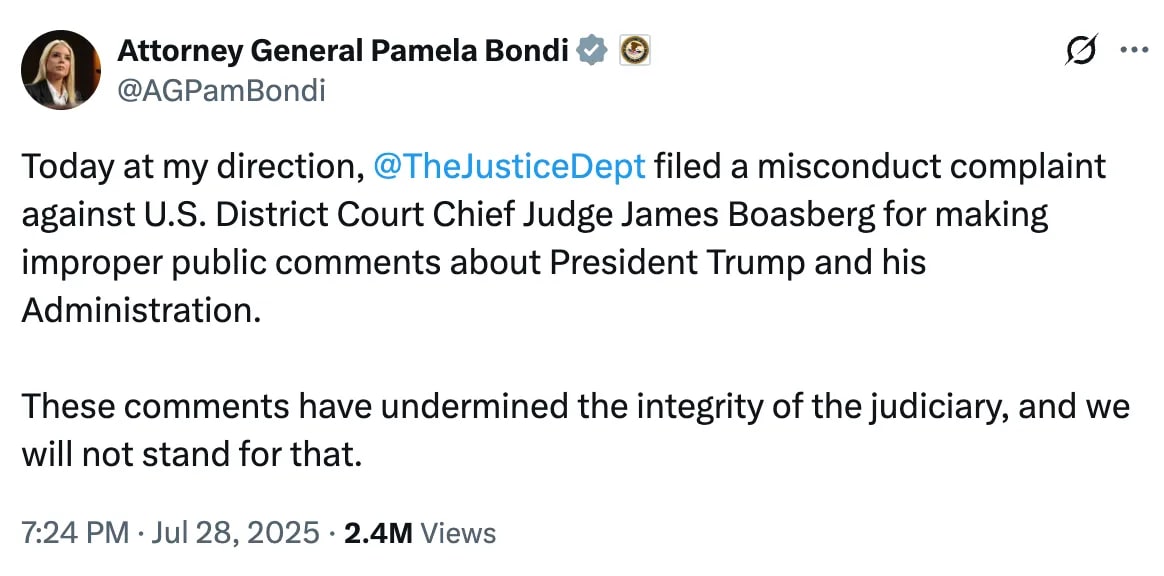
And
clearly
this
is
a
matter
of
public
interest,
since
it
was
tweeted
out
by
the
AG
herself
and
covered
in
every
major
newspaper
in
America.
And
yet,
the
DOJ’s
Office
of
Information
Policy
refused
our
request
to
expedite,
claiming
that
it
“cannot
identify
a
particular
urgency
to
inform
the
public
about
an
actual
or
alleged
federal
government
activity
beyond
the
public’s
right
to
know
about
government
activities
general.”
Even
more
bizarrely,
it
informed
us
that
it
was
assigning
our
request
to
the
complex
track,
the
proverbial
“slow
boat
to
China,”
meaning
we
could
be
waiting
years
to
get
it.
We
appealed,
noting
that
the
search
involves
“one
document
maintained
by
one
office”
and
“in
the
custody
of
the
Office
of
the
Attorney
General,
for
which
OIP
processes
all
FOIA
requests.”
That
appeal
was
rejected
by
Christina
Troiani,
Chief
of
Administrative
Appeals,
who
stuck
by
the
claim
that
asking
for
one
document,
recently
on
the
desk
of
the
AG,
involves
“a
search
for
and
collection
of
records
from
field
offices
or
other
separate
offices,
and
thus
your
client’s
request
falls
within
‘unusual
circumstances.’”
And
so
we
moved
for
partial
summary
judgment.
As
our
attorney
Kel
McClanahan
of
National
Security
Counselors
noted,
this
story
is
newsworthy
because
it
reflects
on
the
credibility
of
some
branch
of
the
government
—
although
whether
that
branch
is
the
judicial
or
executive
is
not
obvious:
To
be
clear,
this
Court
need
not
accept
DOJ’s
allegations
about
Chief
Judge
Boasberg
as
accurate;
it
need
only
accept
that
DOJ
has
stated
them
in
a
formal
judicial
filing
and
cannot
retreat
from
them
now
when
it
is
inconvenient.
According
to
DOJ’s
own
words,
the
document
requested
by
Law
and
Chaos
clearly
raises
“possible
questions
about
the
government’s
integrity
which
affect
public
confidence.”
28
C.F.R.
§
16.5(e)(1)(iv).
Moreover,
this
is
doubly
true
if
the
Court
considers
DOJ’s
allegations
not
to
be
accurate,
because
that
would
raise
definite
questions
about
DOJ’s
integrity
which
affect
public
confidence.
Either
way,
this
case
involves
possible
questions
about
some
Government
official’s
integrity
which
affect
public
confidence,
whether
that
Government
official
is
a
Chief
Judge
of
a
U.S.
district
court
or
the
DOJ
Chief
of
Staff.
Publicity
stunts
can
backfire
It’s
clear
that
the
DOJ
intended
to
fire
off
this
supposed
ethics
complaint,
win
a
news
cycle,
and
move
on.
After
publicly
braying
for
Judge
Boasberg’s
impeachment,
it
couldn’t
even
be
bothered
to
answer
Judge
Srinivasan’s
follow
up
questions.
And
now
it
denies
the
hype
AG
Bondi
herself
fomented,
claiming
that
this
supposed
threat
to
the
integrity
of
the
judiciary
is
a
matter
of
no
public
interest.
This
judicial
complaint
could
have
been
a
press
release
—
and
very
clearly
was.
But
that
doesn’t
make
it
immune
from
FOIA.
So
cough
it
up,
Pam.
We’re
waiting!
Subscribe
to
read
more
at
Law
and
Chaos….
Liz
Dye and Andrew
Torrez produce
the
Law
and
Chaos Substack and podcast.
You
can
subscribe
to
their
Substack
by
clicking
the
logo: