
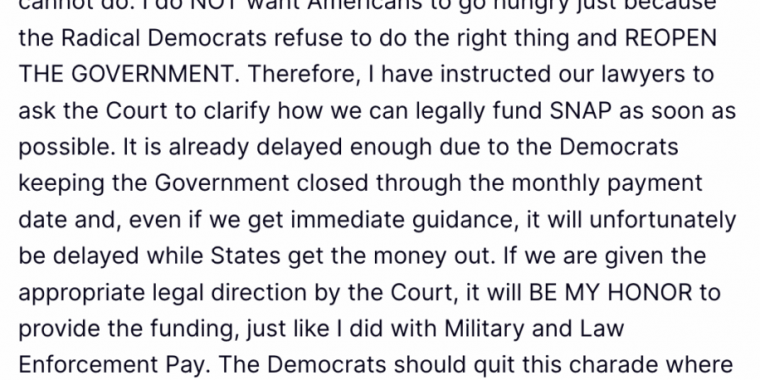
On
Halloween,
President
Trump
announced
that,
if
ordered
to
by
a
court,
“it
will
BE
MY
HONOR”
to
fund
SNAP
benefits
and
feed
the
41
million
Americans
who
rely
on
them.
Turns
out
…
not
so
much.
Instead
the
Trump
administration
opted
to
defy
an
order
by
Judge
John
McConnell,
Jr.
in
Rhode
Island
to
get
the
money
out
to
hungry
Americans.
Specifically,
on
November
1,
the
court
directed
the
Department
of
Agriculture
to
either
tap
into
a
$23
billion
reserve
fund
for
Child
Nutrition
Programs
and
fully
fund
November
SNAP
entitlements,
or
use
$4.6
billion
in
SNAP
reserves
to
make
an
immediate
partial
payment
to
the
states.
The
USDA
opted
to
do
neither,
instead
docketing
a
declaration
claiming
to
have
transmitted
“revised
issuance
tables
to
State
agencies,”
transferring
the
obligation
to
individual
states
to
rejigger
and
resubmit
their
own
funding
requests.
“As
is
required
by
Federal
law,
after
receiving
notice
from
FNS,
State
agencies
must
recode
their
eligibility
systems
to
adjust
for
the
reduced
maximum
allotments,”
the
government
wrote,
adding
that
“For
at
least
some
States,
USDA’s
understanding
is
that
the
system
changes
States
must
implement
to
provide
the
reduced
benefit
amounts
will
take
anywhere
from
a
few
weeks
to
up
to
several
months.”
Judge
McConnell
hit
the
roof.
At
a
hearing
on
Thursday,
he
scoffed
at
the
DOJ’s
suggestion
that
it
couldn’t
possibly
tap
the
Child
Nutrition
Programs,
which
are
fully
funded
through
June,
without
starving
children.
He
called
the
DOJ’s
protests
“entirely
pretextual
given
the
numerous
statements
made
in
recent
weeks
by
the
president
and
his
administration
officials
who
admit
to
withholding
full
SNAP
benefits
for
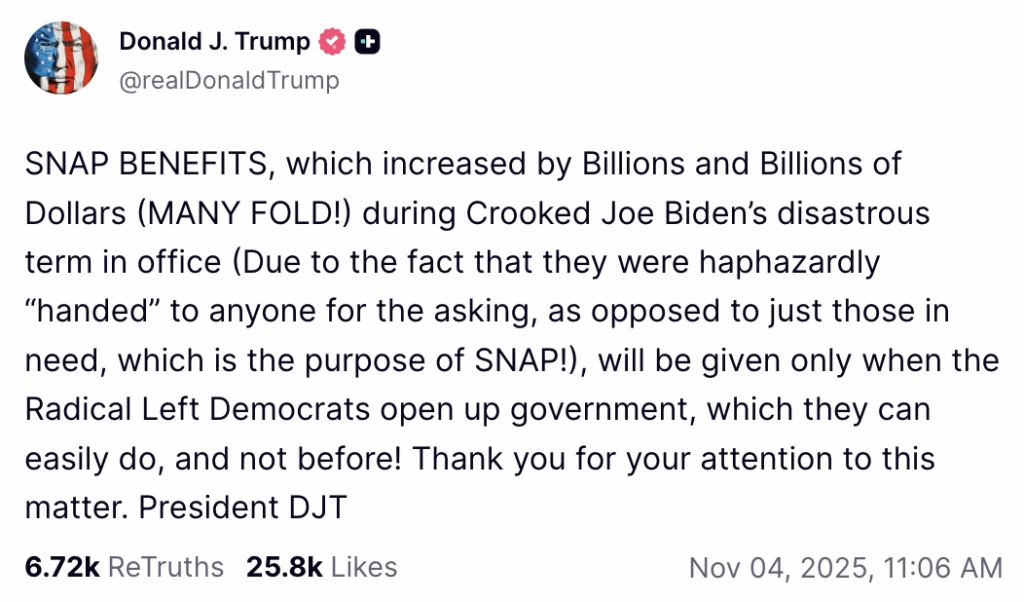
political
reasons.”
He
followed
up
the
oral
order
with
a
written
TRO
instructing
the
USDA
to
tap
the
emergency
funds
immediately.
Instead,
the
administration
raced
to
the
First
Circuit
and
demanded
immediate
relief
from
“this
unprecedented
injunction
[that]
makes
a
mockery
of
the
separation
of
powers.”
The
government
requested
a
ruling
by
4
p.m.,
teeing
up
yet
another
request
for
“emergency
relief”
at
SCOTUS.
The
states
submitted
their
response,
arguing
that
the
trial
court
did
not
abuse
its
discretion
when
it
ordered
the
government
to
feed
people.
So
now
it’s
on
the
First
Circuit
to
decide
if
allowing
41
million
people
to
go
hungry
is
arbitrary
and
capricious
or
simply
a
president
virtuously
guarding
his
prerogatives
and
the
federal
fisc.
And
then
it’s
on
to
SCOTUS
to
see
if
there
are
five
votes
for
the
theory
that
separation
of
powers
requires
courts
to
let
the
president
starve
people
as
a
tool
to
bludgeon
his
political
enemies.
As
the
Founders
intended!
Liz
Dye lives
in
Baltimore
where
she
produces
the
Law
and
Chaos substack and podcast.