
In
a
redacted
brief
filed
Nov.
19
with
the
3rd
U.S.
Circuit
Court
of
Appeals,
Thomson
Reuters
urged
the
court
to
affirm
the
Delaware
district
court’s
ruling
that
ROSS
Intelligence
infringed
Westlaw’s
copyrights
by
copying
thousands
of
its
attorney-written
headnotes
to
train
an
AI-powered
legal
research
tool.
“Copying
protectable
expression
to
create
a
competing
substitute
isn’t
innovation:
it’s
theft,”
the
brief
asserts.
“This
basic
principle
is
as
true
in
the
AI
context
as
it
is
in
any
other.”
The
85-page
brief
(which
you
can
read
here),
signed
by
Kirkland
&
Ellis
partners
Dale
Cendali,
Joshua
Simmons
and
Miranda
Means,
defends
the
copyrightability
of
Westlaw’s
headnotes,
the
editorial
summaries
written
by
its
attorney-editors,
and
portrays
them
as
a
hallmark
of
creative
legal
analysis
rather
than
mere
factual
summaries.
“For
over
a
hundred
years
and
as
recently
as
2020,”
TR’s
brief
argues,
“the
Supreme
Court
has
upheld
‘the
reporter’s
copyright
interest
in
explanatory
materials
including
headnotes.”
Citing
Callaghan
v.
Myers
(1888)
and
Georgia
v.
Public.Resource.Org
(2020),
TR
calls
headnotes
“a
paradigmatic
example
of
protectable
material,”
and
argues
that
the
Delaware
court
was
right
to
treat
2,243
of
them
as
copyrightable
works.
TR
asserts
that
its
headnotes
are
crafted
through
numerous
creative
editorial
choices
—
how
to
phrase
the
point
of
law,
how
many
headnotes
to
create,
which
facts
or
concepts
to
include,
which
case
passages
to
link
and
how
to
categorize
them
within
the
West
Key
Number
System.
These
choices,
TR
says,
easily
satisfy
the
minimal
creativity
required
by
Feist.
ROSS,
the
brief
says,
“may
want
to
ignore
the
Supreme
Court’s
numerous
statements
that
headnotes
are
protectable,
as
it
did
in
its
opening
brief,
but
this
Court
must
follow
binding
precedent.”
‘Knew
It
Could
Not
Legally
Access
Westlaw’
TR’s
account
portrays
ROSS
as
a
commercial
actor
that
knowingly
copied
Westlaw
to
build
a
rival
product.
After
being
denied
a
Westlaw
license,
ROSS
allegedly
hired
the
outsourcing
firm
LegalEase
Solutions
to
scrape
Westlaw
data
and
convert
headnotes
into
“question
and
answer”
pairs
for
training
its
AI
model.
According
to
exhibits
described
in
the
brief,
LegalEase
contractors
“copied
the
West
Headnotes
into
the
form
of
questions”
and
then
copied
“the
case
passages
that
West’s
attorney-editors
had
selected
to
link
to
those
headnotes.”
TR
accuses
ROSS
of
using
bots
to
“scrape
Westlaw
en
masse,”
creating
“thousands
of
Bulk
Memos
quickly”
and
copying
“hundreds
of
thousands
of
annotated
cases.”
(Two
days
before
using
ROSS
in
2020,
TR
settled
litigation
against
LegalEase
based
on
similar
facts,
with
the
two
parties
agreeing
to
entry
of
a
consent
judgment
and
stipulated
permanent
injunction in
the
U.S.
District
Court
in
Minnesota.)
The
brief
asserts
that
ROSS
used
the
resulting
material
multiple
times
in
training
its
AI
system.
It
cites
testimony
that
ROSS
already
possessed
a
repository
of
case
law
but
needed
Westlaw’s
editorial
analysis
to
build
a
functional
search
tool
capable
of
mapping
natural-language
questions
to
relevant
case
passages.
ROSS’s
conduct,
TR
contends,
was
not
inadvertent:
“ROSS
knew
it
could
not
legally
access
Westlaw.
When
ROSS
directly
asked
TR
for
a
Westlaw
subscription,
TR
expressly
declined.”
Yet
after
learning
this,
the
brief
says,
ROSS
induced
first
another
company
(whose
name
is
redacted)
and
then
LegalEase
to
get
ROSS
access
anyway.
‘A
Direct
Substitute,
Not
a
Transformative
Use’
On
the
question
of
fair
use,
TR’s
central
argument
is
that
ROSS’s
platform
“substituted
for
and
competed
with
Westlaw
in
the
legal
research
platform
market.”
It
says
ROSS’s
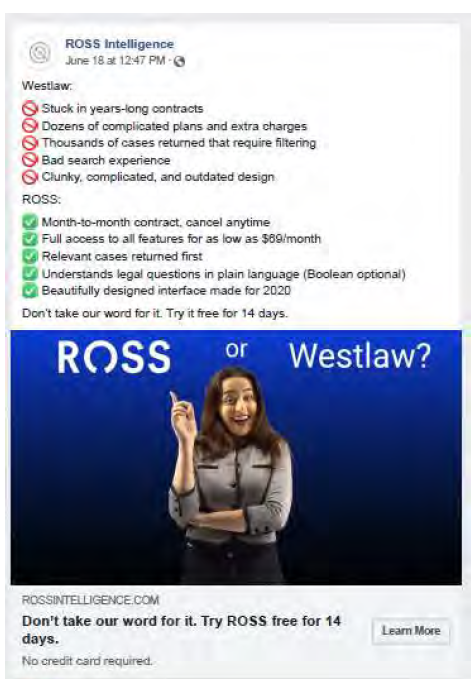
marketing
materials
explicitly
positioned
its
AI
as
a
“Westlaw
replacement,”
even
using
slogans
like
“ROSS
or
Westlaw?”
alongside
a
price
comparison
ad
—
a
copy
of
which
is
reproduced
in
the
brief.
Under
the
Supreme
Court’s
2023
decision
Andy
Warhol
Found.
for
the
Visual
Arts
v.
Goldsmith,
TR
says,
ROSS’s
use
was
not
“transformative”
because
it
served
“the
same
purpose
as
the
original,”
which
was
to
“help
researchers
find
and
understand
the
law.”
It
draws
a
contrast
with
other
cases,
such
as
one
involving
Google
Books,
which
merely
indexed
books
and
drove
users
back
to
the
originals.
See
all
my
coverage
of
this
litigation
here.
Here,
it
contends,
ROSS
“copied
the
Westlaw
content
that
already
provided
a
way
for
researchers
to
find
and
understand
law
to
develop
a
competing
way
to
find
and
understand
law.”
TR
also
accuses
ROSS
of
acting
in
bad
faith,
noting
a
similar
case
in
which
the
court
found
bad
faith
when
the
defendant
“requested
a
license,
was
refused
one,
and
then
obtained
a
copy
from
a
third
party
rather
than
paying
the
requisite
fee.”
That,
it
says,
“is
precisely
what
happened
here,
where
ROSS
was
refused
a
license
and
then
illicitly
went
through
a
third
party.”
Harm
to
Westlaw’s
Markets
Much
of
TR’s
brief
focuses
on
market
harm,
which
it
argues
is
the
most
important
of
the
fair
use
factors.
It
argues
that
ROSS’s
copying
deprived
TR
of
several
valuable
markets:
-
The
existing
market
for
Westlaw
subscriptions. -
The
potential
market
for
licensing
Westlaw
content
as
AI
training
material. -
The
exclusive
ability
to
train
its
own
AI
using
that
content.
“ROSS
harmed
the
original
market
for
Westlaw
by
substituting
therefor,”
TR
argues,
and
it
“diminished
the
value
of
the
Westlaw
content
by
depriving
TR
of
its
exclusive
ability
to
train
its
own
AI
on
that
content.”
A
ruling
in
ROSS’s
favor
would
have
broad
consequences,
the
brief
argues.
“If
any
competitor
could
copy
the
Westlaw
content
to
train
their
own
legal
research
platform,
why
on
earth
would
anyone
pay
TR
for
it?”
AI
Innovation
or
‘Parasitic
Copying’?
Responding
to
arguments
from
ROSS
and
others
that
enforcing
TR’s
copyright
in
this
case
would
hinder
AI
progress,
TR
suggest
that
is
alarmist,
pointing
out
that
Westlaw
itself
has
used
artificial
intelligence
“long
before
the
founders
of
ROSS
were
in
school.”
The
company
cites
milestones
from
its
own
AI
history
dating
back
to
the
1990s,
including
its
1992
launch
of
the
“first
commercially
available
search
engine
with
probabilistic
rank
retrieval”
and
the
2018
launch
of
WestSearch
Plus,
an
AI-powered
research
feature.
“AI
development
has
moved
forward
at
a
rapid
pace
since
the
decision
below
was
entered,
and
will
surely
continue
to
do
so,”
the
brief
says.
While
there
may
be
scenarios
where
training
an
AI
algorithm
using
copyrighted
material
is
fair
use,
“this
scenario
—
where
the
copying
was
for
purposes
of
creating
a
commercial
substitute
for
the
original
—
is
not
one
of
them.”
The
brief’s
concluding
paragraph
drives
home
the
theme
that
ROSS’s
behavior
is
not
about
innovation
but
misappropriation:
“This
case
may
involve
AI,
but
it
is
far
from
novel.
ROSS
indisputably
pilfered
the
creativity
of
a
competitor
to
bring
to
market
a
substitute.
ROSS’s
copying
was
not
technological
advancement.
It
was
theft.”