

For
decades,
conventional
wisdom
was
that
a
business
plan
was
a
necessary
prerequisite
to
launching
a
law
firm.
Trouble
was,
drafting
a
comprehensive
business
plan
gave
lawyers
an
excuse
to
lose
themselves
in
analysis
paralysis
—
endless
research,
interviews
with
colleagues,
and
economic
projections
built
on
hypotheticals
—
when
that
time
would
have
been
better
spent
talking
to
real
clients
and
building
momentum.
What’s
more,
when
lawyers
would
finally
emerge
from
their
months-long
planning
cocoon,
their
predictions
invariably
collided
with
reality,
sending
them
back
to
the
drawing
board
for
more
prognostication.
With
the
advent
of
the
move
fast
and
break
things
tech
era,
formal
business
plans
gave
way
to
lighter
tools
like
the
business
model
canvas
and
pitch
decks
and
SWOT
analyses.
These
were
easier
to
complete,
but
they
still
tended
to
be
one-time
exercises:
useful
for
clarifying
direction,
less
helpful
for
driving
day-to-day
implementation
once
the
firm
actually
launched.
With
AI,
everything
shifts.
Behold
the
Cornerstone
Prompt:
a
device
that
doesn’t
just
declare
your
firm’s
reason
for
being
—
it
embeds
that
purpose
into
every
formation
step
that
follows.
In
other
words,
the
Cornerstone
Prompt
fuses
design
with
deployment.
It
takes
the
big
ideas
in
your
head
and
enables
you
to
implement
them,
right
now,
while
the
energy
is
alive
and
the
moment
is
yours.
A
cornerstone,
as
Wikipedia
puts
it,
is
the
first
stone
set
in
a
masonry
foundation
—
the
reference
point
for
every
stone
that
comes
after.
Get
that
first
stone
right,
and
the
whole
structure
rises
true.
That’s
what
the
Cornerstone
Prompt
does
for
your
firm:
it’s
the
first
stone
you
set
with
intention,
so
everything
you
build
from
there
aligns,
strengthens,
and
stands
for
something
unmistakably
yours.
Sidenote:
The
Cornerstone
Prompt
draws
inspiration
from
Connecticut
criminal
defense
attorney
Jay
Ruane,
who
introduced
a
comprehensive
“Master
Prompt”
system
at
last
month’s
Best
Era
AI
Conference.
Jay
uses
his
Master
Prompt
to
run
a
thriving
practice.
Think
of
the
Cornerstone
Prompt
as
the
focused
starter
slice
of
that
larger
system
—
the
foundation
you
can
build
on.
(If
you
want
a
full-scale,
firm-running
prompt
of
your
own,
you
can
reach
out
to
Jay
directly.)
Step
1:
Commit
Your
Vision
To
Paper
With
A
Guided
Interview
To
develop
your
Cornerstone
Prompt,
you’ll
want
to
start
by
answering
the
following
series
of
questions.
You
can
type
out
the
responses
or
use
AI-powered
dictation
tools
to
give
a
stream-of-consciousness
response.
Unlike
with
a
formal
business
plan,
grammar
and
precision
don’t
matter
at
this
juncture.
You
just
want
to
capture
your
ideas;
AI
will
handle
the
details.
Below
is
a
condensed
version
of
the
questions:
-
Purpose:
Why
this
firm,
why
now?
What
client
problem
or
market
gap
are
you
here
to
fix? -
Direction:
Write
your
mission
(what
you
do
today
and
for
whom)
+
vision
(impact/reputation
in
5–10
years).
List
your
non-negotiable
values. -
Clients:
Who
are
your
ideal
client
segments?
Who
is
not
a
fit?
What
triggers
them
to
hire
a
lawyer? -
Problems:
What
are
their
top
3–5
pains,
what’s
at
stake,
and
what
outcomes
do
they
want
most? -
Offer:
What
practice
areas/matter
types
are
in
scope
vs.
out
of
scope?
What
states/jurisdictions
now
and
later? -
Value/Unique
Selling
Proposition:
What
results
do
you
deliver
consistently?
What’s
your
signature
approach?
Why
choose
you
over
competitors
—
your
plain-English
USP. -
Experience:
How
should
clients
feel
working
with
you?
What
communication
standards
and
boundaries
define
great
service? -
Growth
channels:
How
will
clients
find/hire
you?
(referrals,
SEO,
LinkedIn,
community,
ads,
etc.)
Map
intake
from
first
contact
→
signed
engagement. -
Ops
basics:
Key
activities
that
drive
outcomes
and
growth.
Key
resources
(team
roles,
tech,
networks).
Key
partners/referral
sources. -
Money:
Revenue
streams
(hourly/flat/contingency/retainer/subscription/hybrid)
+
what
services
map
to
each.
Pricing
philosophy.
Major
costs
and
year-one
financial
goals. -
Brand
+
success:
If
your
firm
were
a
person,
what
3–5
traits
would
it
have?
Desired/avoided
associations.
What’s
your
ideal
caseload
and
culture?
-
Voice:
Describe
or
share
examples
of
the
writing
style
or
voice
consistent
with
your
brand
and
mission.
Step
2:
Create
The
Cornerstone
Prompt
Once
you’ve
completed
the
interview,
prompt
the
AI
platform
as
follows:
You’re
a
law-firm
strategist.
Interview
me
(mission/vision,
ideal
clients,
value
+
USP,
practice
scope,
jurisdictions,
brand
voice,
revenue
model,
BMC
elements,
success
metrics).
Convert
my
answers
into
a
reusable
Cornerstone
Master
Prompt
that
I
can
paste
into
future
AI
chats
so
everything
I
draft
matches
my
firm’s
niche,
tone,
and
strategy.
Once
the
prompt
is
created,
upload
it
into
a
platform’s
preferences
or
knowledge
base
or
simply
attach
it
each
time
you
prompt
ChatGPT.
Here’s
an
example
of
how
it
works.
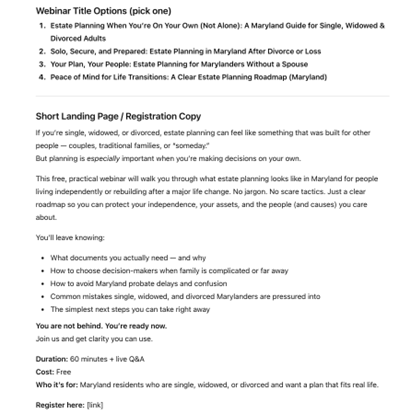
I
asked
ChatGPT
(but
you
can
use
any
AI
platform)
to
develop
a
Cornerstone
Prompt
for
a
Maryland
estate
planning
firm
focused
on
single,
divorced,
and
widowed
people.
Once
I
had
my
Cornerstone
Prompt,
I
asked
Chat
GPT
it
to
generate
ad
copy
for
a
webinar
consistent
with
the
Cornerstone
Prompt. Without
any
further
instruction,
here’s
what
it
came
up
with:
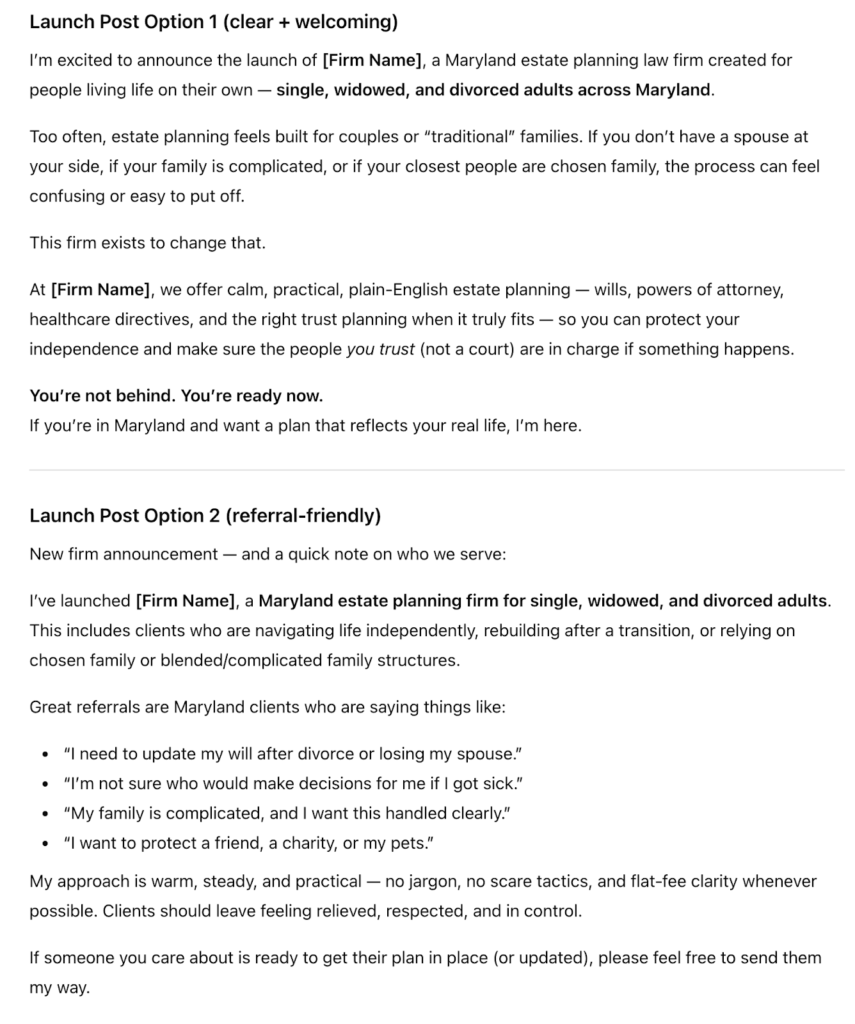
Then
I
asked
for
law
firm
announcements
consistent
with
my
Cornerstone
Prompt
and
here’s
what
ChatGPT
delivered:
I
realize
that
these
samples
are
a
bit
vanilla.
But
that’s
because
I
didn’t
take
the
time
to
complete
the
interview
questions
in
much
detail.
If
you
do
that,
the
output
will
be
more
robust
—
and
more
distinctly
yours.
The
Cornerstone
Prompt
offers
a
framework
for
what
you
want
to
build,
and
generative
AI
serves
as
the
mechanism
for
putting
it
into
practice.
This
approach
slashes
the
amount
of
time
between
idea
and
implementation,
allowing
you
to
launch
more
quickly
and
before
you
lose
your
nerve.
More
importantly,
it
keeps
your
decisions,
messaging,
and
systems
aligned
as
you
grow
—
so
your
firm
doesn’t
drift
away
from
the
practice
you
intended
to
build.

Carolyn
Elefant
is
one
of
the
country’s
most
recognized
advocates
for
solo
and
small
firm
lawyers.
She
founded
MyShingle.com
in
2002,
the
longest-running
blog
for
solo
practitioners,
where
she
has
published
thousands
of
articles,
resources,
and
guides
on
starting,
running,
and
growing
independent
law
practices.
She
is
the
author
of
Solo
by
Choice,
widely
regarded
as
the
definitive
handbook
for
launching
and
sustaining
a
law
practice,
and
has
spoken
at
countless
bar
events
and
legal
conferences
on
technology,
innovation,
and
regulatory
reform
that
impacts
solos
and
smalls.
Elefant
also
develops
practical
tools
like
the AI
Teach-In to
help
small
firms
adopt
AI
and
she
consistently
champions
reforms
to
level
the
playing
field
for
independent
lawyers.
Alongside
this
work,
she
runs
the
Law
Offices
of
Carolyn
Elefant,
a
national
energy
and
regulatory
practice
that
handles
selective
complex,
high-stakes
matters.