

Zimbabwe’s
economy
is
projected
to
rebound
strongly
in
2025
with
an
estimated
6.6%GDP
growth
due
to
robust
growth
in
agriculture,
services,
and
continued
investments
in
mining
and
steel,
according
to
the
new Zimbabwe
Economic
Update: Fostering
a
Business-Enabling
Regulatory
Environment
for
Private
Sector
Growth,
published
on
December
2,
2025.
This
growth
outpaces
many
peers
in
the
Sub-Saharan
Africa
region.The
medium‑term
growth
also
remains
positive,
anticipated
to
remain
elevated
at
5%
in
2026,
though
fiscal
slippages,
external
shocks,
and
climate-related
disasters
such
as
droughts
still
pose
significant
threats
to
the
current
stability.
Zimbabwe’s
tight
monetary
policy
since
late
2024
has
helped
improve
inflation
dynamics
and
stabilize
the
Zimbabwe
Gold
(ZiG)
currency.
Therefore,
inflation
is
expected
to
moderate
to
single
digits
in
2026
and
decrease
further
to
5%
over
the
medium-term.
Poverty
is
expected
to
decline
gradually
as
growth
recovers,
but
remains
sensitive
to
weather
shocks
and
inflation,
with
rural
households
particularly
exposed
due
to
the
dependence
on
rain-fed
agriculture,
slow
off-farm
jobs,
and
inadequate
social
protection.
“Now
that
the
macroeconomy
is
improving,
the
Government’s
position
in
re-prioritizing
efforts
to
improve
the
ease
of
doing
business
to
improve
Zimbabwe’s
private
sector
growth
and
competitiveness
are
more
than
necessary
to
enhance
the
overall
growth
and
eventually
translate
economic
growth
into
lasting
economic
benefits,” says Victor
Steenbergen,
Senior
Country
Economist
for
Zimbabwe.
To
sustain
a
strong
economic
growth
momentum
for
Zimbabwe,
the
ZEU
recommends
the
following:
-
Implementation
of
the
policies
set
out
in
the
Economic
Reforms
Matrix
of
the
Structured
Dialogue
Platform
(SDP)
for
Arrears
Clearance
and
Debt
Resolution.
This
will
help
to
continue
macroeconomic
stability
and
enhance
growth.
Progress
on
the
SDP
also
provides
opportunities
to
help
unlock
affordable
external
credit
lines
and
stimulate
much-needed
public
and
private
sector
investment
to
boost
growth. -
Continued
efforts
to
anchor
the
existing
price
and
exchange
rate
stability,
which
will
support
economic
growth
and
job
creation
while
avoiding
reversing
the
prevailing
stability
gains. -
Sustained
implementation
of
the
Presidential
Ease
of
Doing
Business
Initiative,
to
improve
the
business
environment,
stimulate
investment,
and
promote
private
sector-led
growth
thereby
reinforcing
the
recent
gains,
boosting
competitiveness,
and
translating
economic
growth
into
lasting
economic
benefits.
The
ZEU
special
topic
“Fostering
a
Business-Enabling
Regulatory
Environment
for
Private
Sector
Growth”
analyzes
the
current
business
environment.
Case
studies
of
compliance
requirements
from
several
sub-sectors
show
significant
regulatory
burdens.
Analysis
in
agriculture,
agro-processing,
and
tourism
reveal
that
some
sub-sectors
face
up
to
28
different
legal
and
regulatory
requirements,
often
involving
multiple
government
ministries
and
agencies.
The
mapping
of
sectoral
business
regulations
provides
three
main
findings:
-
High
and
regressive
fee
burdens:
Compliance-related
fees
and
levies
often
generate
significant
monetary
costs
for
firms,
with
formal
requirements
in
certain
sectors
even
exceeding
annual
revenues
for
some
subsectors. -
Inadequate
transparency
and
reliance
on
manual
processes:
Several
requirements
continue
to
rely
on
paper-based
processes
that
also
require
physical
visits
to
the
offices
of
relevant
Ministries,
Departments,
and
Agencies
(MDAs)
due
to
lack
of
readily
available
information
online
on
regulatory
requirements. -
Overlapping
mandates:
Multiple
MDAs
often
issue
requirements
and
conduct
inspections
targeting
the
same
public
policy
goal,
creating
additional
procedural
and
cost
burdens
for
minimal
public
policy
gain.
The
ZEU
recognizes
the
notable
progress
on
the
recent
regulatory
reforms
by
the
Government
of
Zimbabwe
under
the
Presidential
Ease
of
Doing
Business
initiative,
which
among
others
is
addressing
the
current
complex
and
burdensome
regulatory
environment
especially
for
Small
and
Medium
Enterprises
(SMEs).
The
first
phase,
finalized
in
September
2025
with
analytical
support
from
the
World
Bank
Group,
focused
on
the
beef,
dairy,
stockfeed,
and
tourism
sectors,
leading
to
the
reduction
or
elimination
of
several
levies
and
fees.
To
further
support
the
Presidential
Ease
of
Doing
Business,
the
Government
of
Zimbabwe
should
complete
the
regulatory
stocktaking
and
regulatory
simplification
for
the
12
priority
sectors
in
the
next
12
months.
There
is
also
a
need
for
a
more
ambitious
medium-term
agenda
to
foster
Zimbabwe’s
business-enabling
environment,
which
focus
on
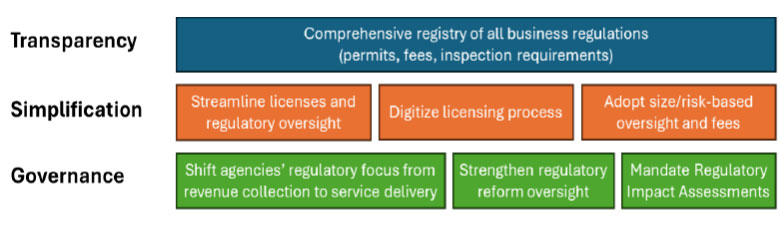
three
broad
pillars
of
transparency,
simplification,
and
governance
(Figure
1):
-
Regulatory
Transparency: Create
a
comprehensive
public
registry
of
licenses,
fees,
and
inspection
requirements
to
reduce
uncertainty
and
discretion
while
ensuring
that
all
this
information
is
regularly
updated,
and
accessible
to
firms
and
citizens. -
Regulatory
Simplification: Consolidate
overlapping
procedures
and
inspections
and
adopt
risk‑based
and
size‑appropriate
compliance
regimes
to
lower
burdens
on
SMEs.
This
streamlining
will
help
lower
costs
for
firms,
while
allowing
regulators
to
allocate
resources
more
efficiently. -
Regulatory
governance: Strengthen
central
oversight
of
regulatory
reforms
and
shift
agencies
towards
a
service‑delivery
mindset.
These
reforms
also
require
clarifying
institutional
mandates,
reviewing
agency
fee
structures,
and
ensuring
regulations
serve
the
public
interest
rather
than
institutional
revenue
needs.
Figure
1.
Key
policy
areas
to
foster
a
business-enabling
regulatory
environment
Effective
implementation
of
these
reforms—anchored
on
strong
institutional
leadership
and
improved
administrative
efficiency—can
lower
compliance
costs,
stimulate
firm
growth,
and
lay
the
foundation
for
a
more
competitive
and
inclusive
economy.