


The
report,
detailing
the
performance
of
the
country’s
12
direct
life
assurers,
shows
the
industry
is
dominated
by
a
few
key
products
and
players,
raising
concerns
about
market
concentration
and
consumer
protection.
Direct
life
insurers
generated
total
insurance
revenue
of
ZWG4.59
billion,
approximately
US$172.05
million,
a
39
percent
increase
from
the
US$123.77
million
recorded
in
the
same
period
in
2024.
However,
this
revenue
is
heavily
concentrated.
Foreign
currency-denominated
revenue
accounted
for
55
percent
of
total
insurance
income,
down
seven
percent
from
the
previous
period’s
62
percent,
mainly
due
to
exchange
rate
stability.
“Heritage
Life
and
Nhaka
Life
failed
to
submit
their
mandatory
foreign
currency
reports.
The
Commission
urges
industry
players
to
submit
all
required
reports
on
time
to
avoid
regulatory
sanctions.”
Funeral
assurance
and
group
life
assurance
continued
to
be
the
primary
sources
of
income
for
the
life
insurance
sector,
together
accounting
for
82
percent
of
the
total
revenue.
The
share
of
revenue
generated
from
funeral
assurance
and
group
life
assurance
is
steadily
rising,
affecting
the
market
share
of
traditional
life
assurance
products.
IPEC
noted
that
a
“notable
trend
in
the
life
insurance
industry
is
the
shift
from
traditional
long
term
products
towards
predominantly
renewable
annual
policies.”
This
change
is
especially
clear
in
funeral
assurance
and
group
life
assurance
policies
currently
available.
This
practice
raises
regulatory
concerns
about
its
compliance
with
the
Funeral
Directive’s
objectives,
particularly
regarding
the
level
of
policyholder
protection,”
read
the
report.
As
a
result,
the
industry
is
strongly
encouraged
to
strictly
follow
the
rules
set
out
in
the
Funeral
Directive.
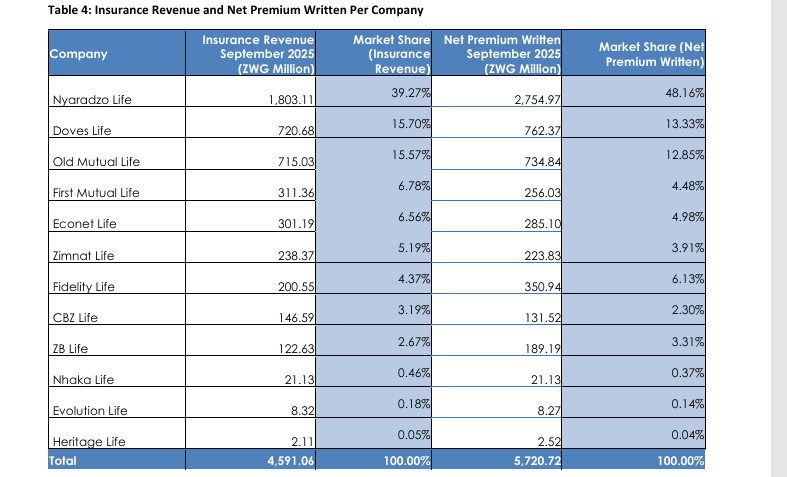
“Nyaradzo
Life
Assurance
Company
holds
the
leading
position
in
the
life
assurance
sector
with
a
39.27
percent
market
share,
largely
driven
by
its
predominant
revenue
from
funeral
assurance
policies,”
the
report
states.
The
total
revenue
of
the
top
five
companies
in
the
sector
reached
ZWG3.85
billion,
equivalent
to
US$144.33
million.
These
top
five
companies
collectively
account
for
84
percent
of
the
sector’s
total
revenue,
indicating
a
“moderately
concentrated
market.”
The
sector’s
product
mix
remains
narrow,
with
traditional
long-term
products
losing
ground.
“Funeral
assurance
remains
the
main
driver
of
the
life
assurance
sector,
representing
68.04
percent
of
total
revenue.
Group
life
assurance
is
the
second-largest
segment,
making
up
14.27
percent
of
total
revenue,”
the
report
notes.
This
concentration
raises
regulatory
concerns,
with
IPEC
highlighting
“a
notable
trend
in
the
life
insurance
industry
is
the
shift
from
traditional
long-term
products
towards
predominantly
renewable
annual
policies.
“This
change
is
especially
clear
in
funeral
assurance
and
group
life
assurance
policies
currently
available.
This
practice
raises
regulatory
concerns
about
its
compliance
with
the
Funeral
Directive’s
objectives,
particularly
regarding
the
level
of
policyholder
protection.”
A
significant
concern
for
the
regulator
is
the
high
number
of
policies
that
are
sold
but
ultimately
not
activated
by
customers.
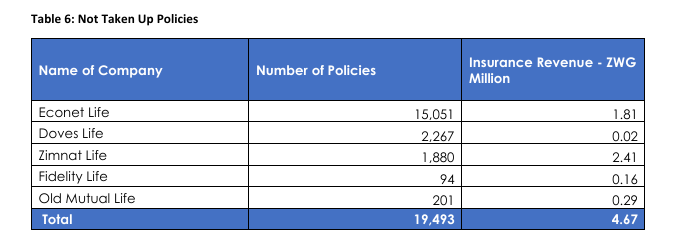
During
the
quarter,
the
sector
reported
19,493
Not
Taken
Up
(NTU)
policies,
leading
to
a
loss
of
projected
revenue
of
ZWG4.67
million.
The
report
singles
out
specific
companies
for
scrutiny
–
Econet
Life,
Doves
Life,
and
Zimnat
Life,
Fidelity
Life
and
Old
Mutual
Life,
which
are
strongly
advised
to
promptly
initiate
an
investigation
into
the
underlying
causes
of
their
high
NTU
rates.
“This
may
include
conducting
surveys
to
identify
specific
issues
such
as
affordability,
poor
product
understanding,
or
dissatisfaction
with
the
onboarding
process.”
IPEC
further
warns
that
“life
assurers
are
encouraged
to
closely
monitor
how
agents
present
their
products
to
potential
clients
to
prevent
misrepresentation.”
The
sector
also
continues
to
struggle
with
policies
lapsing
after
sale.
It
started
the
third
quarter
with
2
122
824
active
policies,
of
which
97
111
lapsed,
resulting
in
a
lapse
ratio
of
4.57
percent.
“Policy
lapses
are
mainly
attributed
to
affordability
issues
and
changes
in
policyholders’
circumstances,”
the
report
finds.
It
urges
insurers
to
maintain
“proactive
and
effective
communication
with
policyholders
before
lapses.”
One
company,
Nhaka
Life,
reported
an
alarmingly
high
lapse
ratio
of
27.59
percent.
“It
is
strongly
recommended
that
Nhaka
Life
conduct
detailed
experience
analyses
to
identify
the
main
reasons
for
these
elevated
lapse
rates,”
IPEC
advises,
urging
the
company
to
“craft
and
execute
targeted,
data-driven
strategies
to
lower
lapse
rates
and
enhance
policyholder
retention.”
The
report
concludes
that
the
sector’s
over-reliance
on
funeral
assurance
is
unsustainable
for
long-term
growth,
calling
for
strategic
innovation
and
diversification
to
rebuild
public
trust
and
ensure
the
industry’s
future
relevance.
Post
published
in:
Business