

Florida
has
decided
that
the
American
Bar
Association
is
just
too
much.
Yesterday,
the
Florida
Supreme
Court
graciously
opened
the
door
to
alternative
law
school
accreditors
by
cutting
off
the
ABA
as
its
sole
accepted
accreditor
for
law
schools.
The
court
framed
this
as
a
bold
strike
for
institutional
freedom
and
not,
say,
an
effort
to
turn
public
legal
education
into
a
Heritage
Foundation
book
club.
According
to
the
court,
“The
Court’s
goal
is
to
promote
access
to
high-quality,
affordable
legal
education
in
law
schools
that
are
committed
to
the
free
exchange
of
ideas
and
to
the
principle
of
nondiscrimination.”
For
the
record,
the
GOP
interpretation
of
“free
exchange
of
ideas
and
to
the
principle
of
nondiscrimination”
in
law
schools
just
got
the
new
dean
of
Arkansas
fired
before
she
even
started,
so
take
this
per
curiam
pronouncement
from
a
collection
of
Republican
appointees
with
appropriate
levels
of
salt.
This
move
comes
hot
on
the
heels
of
Texas
pulling
the
same
stunt,
because
nothing
conveys
careful,
evidence-based
educational
policymaking
like
red
states
passing
around
the
anti-wokeness
bong
and
taking
rips.
In
a
Tweet,
Professor
Orin
Kerr
offered
a
much
more
charitable
reading
of
the
Florida
decision:
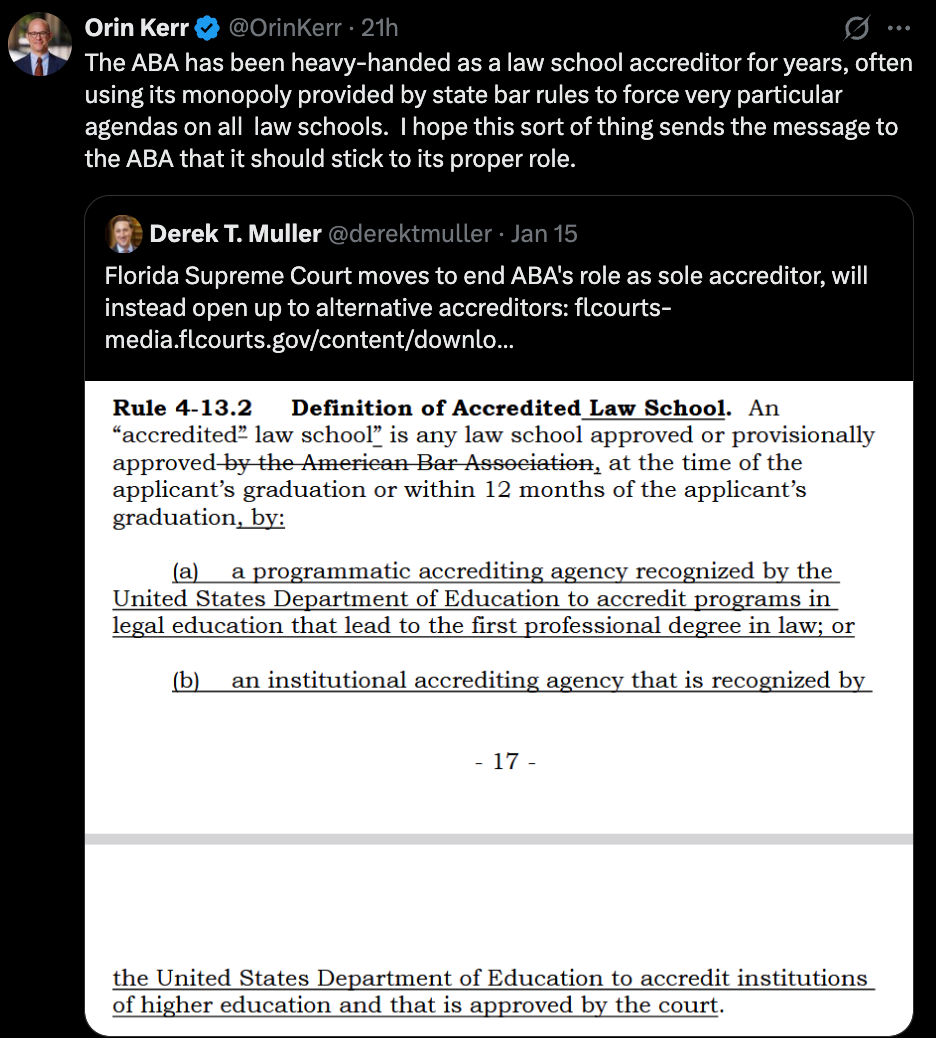
The
“particular
agendas”
that
the
ABA
pushed
—
which
at
this
point
are
all
but
abandoned
—
were
diversity
commitments.
Obviously,
there
are
people
who
think
diversity
training
is
an
objectionable
agenda.
We
call
those
people
“white
supremacists.”
But
the
ABA
recognized
a
diverse
legal
workforce
as
advantageous,
both
within
the
workplace
and
to
the
reality
of
a
diverse
client
base,
and
determined
that
credible
law
schools
should
operate
accordingly.
It’s
why
comments
like
“stick
to
its
proper
role”
miss
the
mark.
The
“proper
role”
of
an
accreditor
in
professional
education
is
to
make
sure
a
school’s
graduates
meet
the
demands
of
the
profession.
If
a
school
is
graduating
attorneys
unable
to
even
consider
unconscious
biases
doing
active
harm
to
their
clients,
that’s
a
professional
education
issue.
Were
the
specific
requirements
imposed
by
the
ABA
the
best
way
to
promote
diversity?
That’s
arguable.
But
Texas
and
Florida
aren’t
interested
in
that
debate,
they
object
to
the
idea
that
diversity
should
be
promoted
at
all.
If
anyone
thinks
this
break
will
lead
to
Texas
and
Florida
law
schools
becoming
more
committed
to
the
“free
exchange
of
ideas
and
to
the
principle
of
nondiscrimination,”
they
should
promptly
remove
their
heads
from
their
asses
before
causing
serious
colon
damage.
We
actually
know
the
trajectory
of
these
decisions
because
they’re
already
playing
out
in
these
states’
undergraduate
institutions.
Texas
A&M
just
canceled
a
philosophy
course
because
the
school
decided
Plato
was
too
woke.
“[T]he
Board
of
Regents
has
clarified
that
core
curriculum
courses,
which
includes
PHIL
111
Contemporary
Moral
Issues,
cannot
include
issues
related
to
race
ideology,
gender
ideology,
or
topics
related
to
sexual
orientation
or
gender
identity,”
the
professor
was
told.
They
banned
a
2400-year-old
text
because
they
felt
PLATO’s
views
on
gender
were
too
dangerously
contemporary.
Florida’s
future
isn’t
much
different.
The
New
College
of
Florida
became
that
state’s
guinea
pig
for
reworking
higher
education
along
the
sort
of
“free
exchange”
principles
its
supreme
court
writes
about
in
the
ABA
decision.
In
January
2023,
Governor
Ron
DeSantis
stuffed
the
board
with
conservative
politicians
and
right-wing
influencers
like
Christopher
Rufo
and
set
out
to
remake
the
curriculum.
Three
years
later,
spending
has
skyrocketed
and
rankings
have
plummeted.
The
school
has
dropped
nearly
60
spots
in
the
U.S.
News
rankings
—
from
76th
to
135th
—
while
spending
roughly
$134,000
per
student.
Retention
is
down.
Graduation
rates
are
down.
One
faculty
member
described
the
enrollment
situation
as
“kind
of
like
a
Ponzi
scheme:
Students
keep
leaving,
so
they
have
to
recruit
bigger
and
bigger
cohorts.”
Another
former
New
College
official
said
of
school
president
Richard
Corcoran’s
administration,
“academically,
Richard’s
running
a
Motel
6
on
a
Ritz-Carlton
budget.”
That’s
what
we’re
looking
at
as
these
states
break
from
the
ABA
and
seek
an
“alternative”
that
we
all
know
will
end
up
being
PragerU.
Just
like
the
Trump
Bible,
they’re
just
going
to
leave
the
Fourteenth
Amendment
section
out
of
Con
Law.
For
what
it’s
worth,
Florida
Justice
Jorge
Labarga
filed
a
dissenting
opinion,
noting
that
“the
ABA
has
developed
incomparable
expertise
in
the
accreditation
process,”
recognizing
that
ABA
standards
“provide
consumer
protections,
public
accountability
and
institutional
transparency
.
.
.
protecting
against
predatory
admissions
and
poor
programs
outcomes.”
He’s
the
lone
member
of
the
Florida
Supreme
Court
not
appointed
by
Ron
DeSantis.
It’s
tragic
for
the
talented
in-state
students
who
want
to
attend
a
quality
public
institution,
but
we
need
to
consider
how
other
states
respond
to
this.
At
what
point
do
degrees
from
these
ideologically
captured
institutions
stop
being
professionally
valid
for
licensing
purposes?
That
might
sound
extreme,
but
we’re
talking
about
an
accreditation
regime
that’s
hostile
to
Plato.
A
law
school
operating
under
restrictions
like
that
simply
isn’t
producing
graduates
that
should
fill
jurisdictions
with
a
lot
of
trust.
When
California
experimented
with
moving
away
from
the
bar
exam
monopoly,
people
kicked
and
screamed
about
it.
And
it
was
a
disaster,
imposed
upon
applicants
far
too
quickly.
Texas
and
Florida
have
embarked
into
much,
much
more
problematic
uncharted
waters
and
the
outcry
needs
to
be
a
lot
more
robust.
 Joe
Joe
Patrice is
a
senior
editor
at
Above
the
Law
and
co-host
of
Thinking
Like
A
Lawyer.
Feel
free
to email
any
tips,
questions,
or
comments.
Follow
him
on Twitter or
Bluesky
if
you’re
interested
in
law,
politics,
and
a
healthy
dose
of
college
sports
news.
Joe
also
serves
as
a
Managing
Director
at
RPN
Executive
Search.