

It’s
easy
to
get
disheartened
watching
the
Trump
administration
losing
these
habeas
cases
and
yet
nothing
actually
changing.
The
government
seems
content
to
take
its
lumps
at
the
margins
while
continuing
to
tear
ass
around
the
country.
For
Homeland
Security,
it’s
a
numbers
game,
and
instilling
a
culture
of
permanent
fear
is
worth
a
judicial
scolding
every
couple
days.
But
this
strategy
might
get
expensive
if
the
Third
Circuit’s
view
takes
hold.
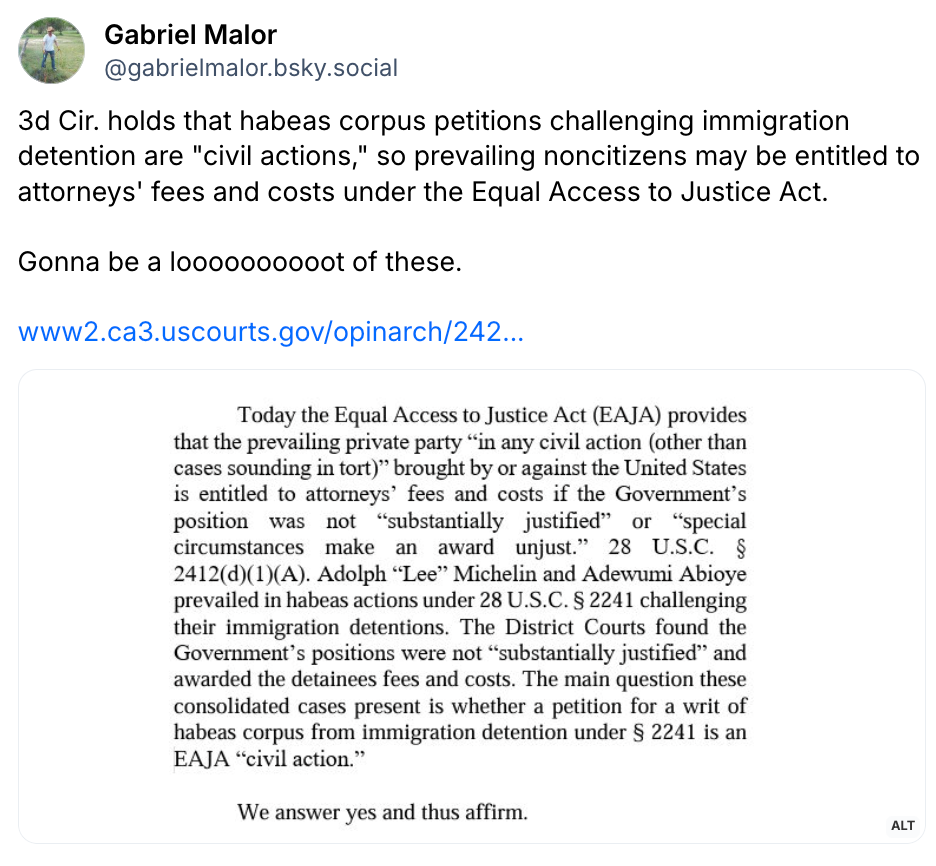
Because
according
to
an
appellate
decision
earlier
today,
the
Equal
Access
to
Justice
Act
would
cover
successful
habeas
petitions,
giving
the
victims
of
ICE’s
harassment
access
to
fees
and
costs.
The
case,
Michelin
v.
Warden
Moshannon
Valley
Correctional
Center,
consolidated
two
appeals
involving
immigrants
detained
for
extended
periods
—
one
for
over
a
year
and
the
other
for
over
16
months
—
without
bond
hearings.
Both
won
their
habeas
petitions
and
sought
attorney’s
fees
under
the
Equal
Access
to
Justice
Act.
The
government,
in
a
move
that
should
surprise
absolutely
no
one,
decided
to
fight
that
too.
The
government
argued
that
habeas
corpus
isn’t
really
a
“civil
action”
under
the
EAJA
because
it’s
some
kind
of
“hybrid”
proceeding.
This
went
about
as
well
as
you’d
expect
when
the
court
is
sitting
on
literal
centuries
of
established
law.
“A
petition
for
a
writ
of
habeas
corpus
has
been
a
civil
action
since
before
our
law
was
our
law,”
begins
the
opinion.
Even
if
the
court
were
to
indulge
the
government’s
argument
as
it
applies
to
releasing
people
from
criminal
detention,
“we
are
not
reviewing
habeas
petitions
for
release
from
criminal
detention.
We
are
reviewing
them
for
release
from
immigration
detention.
In
that
context,
every
element
is
civil.”
A
hybrid
of
a
civil
action
and
a
civil
action
is
a
civil
action.
The
opinion
systematically
dismantled
the
government’s
attempts
to
read
exceptions
into
the
statute’s
plain
language.
The
EAJA
covers
“any
civil
action
(other
than
cases
sounding
in
tort).”
The
court
took
the
revolutionary
stance
that
“any”
means…
“any.”
Congress
knew
how
to
exclude
categories
when
it
wanted
to
because
it
explicitly
carved
out
torts.
If
Congress
had
wanted
to
exclude
habeas,
it
could
have
said
so.
That’s
the
sort
of
ruling
that
should
make
immigration
enforcement
officials
think
twice
before
opposing
habeas
petitions
in
cases
where
they’ve
locked
someone
up
for
over
a
year
without
so
much
as
a
bond
hearing.
It
won’t,
because
they’ll
just
move
even
more
quickly
to
whisk
people
away
to
the
Fifth
Circuit
where
that
body’s
deep
respect
for
“textualism”
has
already
decided
that
“any”
means
Congress
probably
had
a
secret
list
of
exceptions
that
only
the
Fifth
Circuit
can
divine.
But
it
definitely,
probably
included
not
applying
to
immigrants
they
reckon.
Though
a
win
is
still
a
win.
The
financial
stakes
aren’t
huge
—
Tom
Homan
could
theoretically
fit
several
in
a
single
Cava
bag
—
but
the
thing
about
the
government
playing
a
numbers
game
is
that
volume
adds
up
fast.
Every
successful
immigration
detainee
in
the
Third
Circuit
forcing
the
government
to
pony
up
fees
costs
the
government
both
money
and
time.
And
with
a
circuit
split,
the
Supreme
Court
faces
pressure
to
resolve
the
matter,
something
the
Third
Circuit
opinion
takes
into
account,
concluding
with
a
direct
challenge
to
the
justices:
We
close
by
echoing
the
Supreme
Court’s
recent
reflections
on
the
historic
role
of
the
writ
of
habeas
corpus.
“When
English
monarchs
jailed
their
subjects
summarily
and
indefinitely,
common-law
courts
employed
the
writ
as
a
way
to
compel
the
crown
to
explain
its
actions—and,
if
necessary,
ensure
adequate
process
.
.
.
before
allowing
any
further
detention.
The
Great
Writ
was,
in
this
way,
no
less
than
‘the
instrument
by
which
due
process
could
be
insisted
upon.’”
Brown
v.
Davenport,
596
U.S.
118,
128
(2022)
(citation
omitted)
(quoting
Hamdi
v.
Rumsfeld,
542
U.S.
507,
555
(2004)
(Scalia,
J.,
dissenting)).
It
remains
so
today.
With
this
history
in
mind,
we
affirm.
Will
this
shame
the
Supreme
Court
into
respecting
its
own
recent
history,
or
will
the
majority
embrace
hypocrisy?
 Joe
Joe
Patrice is
a
senior
editor
at
Above
the
Law
and
co-host
of
Thinking
Like
A
Lawyer.
Feel
free
to email
any
tips,
questions,
or
comments.
Follow
him
on Twitter or
Bluesky
if
you’re
interested
in
law,
politics,
and
a
healthy
dose
of
college
sports
news.
Joe
also
serves
as
a
Managing
Director
at
RPN
Executive
Search.