
In
2013,
the
Legal
Services
Corporation
published
the
landmark
study,
Report
of
The
Summit
on
the
Use
of
Technology
to
Expand
Access
to
Justice.
The
report
forcefully
made
the
case
that
technology
could
be
a
powerful
–
indeed,
essential
–
tool
in
narrowing
the
justice
gap,
and
its
recommendations
helped
shape
the
last
decade
of
legal
innovation
in
the
United
States.
“Technology
can
and
must
play
a
vital
role
in
transforming
service
delivery
so
that
all
poor
people
in
the
United
States
with
an
essential
civil
legal
need
obtain
some
form
of
effective
assistance,”
that
report
presciently
asserted.
Now,
marking
its
most
comprehensive
technology
initiative
since
that
seminal
report,
the
LSC
has
released
a
new
report,
The
Next
Frontier:
Harnessing
Technology
to
Close
the
Justice
Gap,
which
represents
the
findings
of
an
extensive
two-year
Technology
Summit
process
that
kicked
off
with
LSC’s
50th
anniversary
in
2024.
Related:
LawNext
Episode
58:
Jim
Sandman,
President
of
the
Legal
Services
Corporation.
Like
its
predecessor,
this
new
report
offers
an
ambitious
roadmap
for
leveraging
technology
to
narrow
America’s
justice
gap.
It
presents
seven
detailed
recommendations
aimed
at
helping
the
nation’s
130
LSC-funded
legal
services
organizations
adopt
cutting-edge
technologies
–
particularly
artificial
intelligence
–
to
expand
access
to
justice
for
low-income
Americans.
A
Collaborative
Process
The
report,
which
was
published
in
December,
is
the
end
result
of
a
deliberative
process
that
started
when
more
than
50
technology
leaders,
legal
services
practitioners,
court
personnel,
and
other
stakeholders
participated
in
a
full-day
workshop
in
Charlotte,
N.C.,
in
February
2024,
ahead
of
LSC’s
Innovations
in
Technology
Conference
that
year.
(I
was
among
the
50
who
participated
that
day.)
The
process
continued
over
subsequent
months
through
four
focused
workgroups
that
examined:
-
Supporting
more
legal
services
organizations
to
adopt
baseline
technologies. -
Supporting
more
LSC
grantees
to
adopt
advanced
technological
practices
and
processes. -
Supporting
LSC
and
its
grantees
to
use
technology
to
measure
impact
more
effectively. -
Supporting
LSC
and
the
field
to
identify
and
promote
innovative
solutions
including
AI
technologies,
to
drive
efficiency
improvements
that
would
result
in
greater
impact.
The
initiative
also
included
extensive
stakeholder
interviews,
focus
groups
with
field
experts
and
grantees,
and
strategic
conversations
among
LSC
leadership
about
strengthening
the
LSC’s
Technology
Initiative
Grant
(TIG)
program
–
which
has
awarded
923
grants
totaling
more
than
$92
million
since
2000.
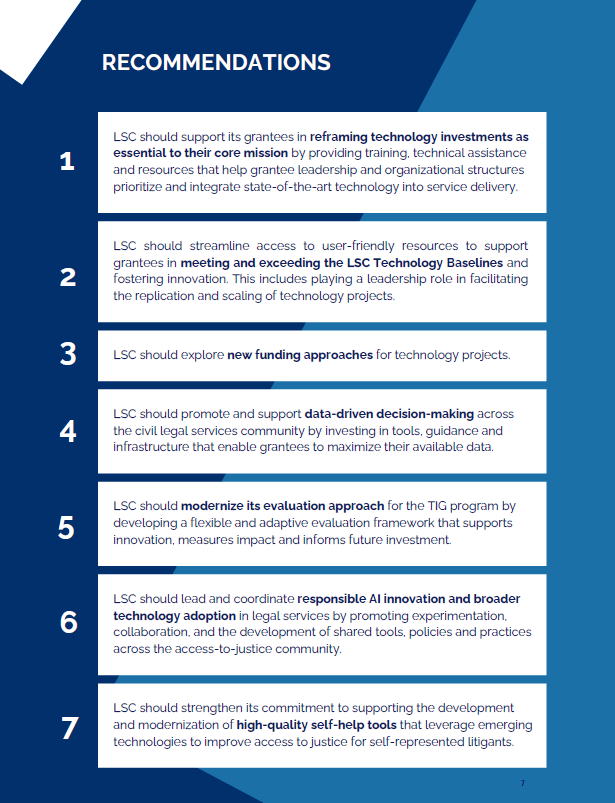
Seven
Recommendations
to
Narrow
the
Justice
Gap
The
report
opens
with
sobering
context:
LSC’s
2022
Justice
Gap
Report
found
that
low-income
Americans
received
inadequate
or
no
legal
help
for
92%
of
their
civil
legal
problems.
Whether
facing
eviction,
unemployment,
child
custody
issues
or
domestic
violence,
too
many
low-income
Americans
navigate
the
legal
system
alone.
Despite
this
need,
LSC
grantees
had
to
turn
away
one
of
every
two
requests
for
help
they
received
in
the
prior
year
due
to
limited
resources.
To
help
address
this
justice
gap,
the
summit
produced
seven
interconnected
recommendations
that
LSC
characterizes
as
“a
call
to
action”
for
accelerating
transformative
technology
use:
-
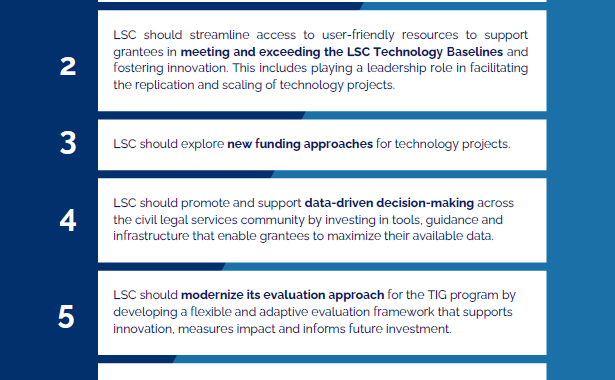
Reframe
Technology
as
Core
Mission
The
report’s
first
recommendation
is
that
LSC
should
support
grantees
in
treating
technology
investments
as
essential
to
their
core
mission
–
not
as
a
luxury
–
by
providing
training,
technical
assistance
and
resources
that
help
leadership
prioritize
and
integrate
state-of-the-art
technology
into
service
delivery.
The
report
notes
that
legal
services
organizations
often
struggle
with
a
“scarcity
mindset”
that
causes
them
to
eschew
potentially
game-changing
technology
investments.
The
report
cites
a
2024
survey
that
found
that
45%
of
nonprofits
said
they
spend
too
little
on
technology,
with
“lack
of
available
budget”
cited
as
the
most
common
barrier.
The
report
identifies
several
ways
in
which
LSC
can
encourage
and
support
LSOs
to
embrace
“culture
change”
on
issues
of
technology.
Among
them:
-
Documenting
compelling
stories
about
technology
investments
that
dramatically
improved
efficiencies
and
impact. -
Conducting
surveys
of
grantee
technology
practices
to
highlight
priorities
and
opportunities. -
Integrating
comprehensive
technology
assessments
into
LSC’s
oversight
visits. -
Providing
training
on
using
dashboards
and
data
visualization
for
strategic
planning,
operational
decision-making
and
service
delivery.
-
Streamline
Access
to
Resources
The
second
recommendation
is
that
LSC
should
create
user-friendly,
centralized
resources
to
help
grantees
meet
and
exceed
the
LSC
Technology
Baselines
–
a
guide
to
the
key
technologies
LOSs
should
have
in
place
–
while
also
fostering
innovation,
including
facilitating
replication
and
scaling
of
successful
technology
projects.
The
report
acknowledges
that
while
LSC,
LSNTAP
(Legal
Services
National
Technology
Assistance
Project),
and
others
provide
various
resources,
grantees
need
“curated
information
and
guidance”
to
cut
through
what
one
participant
called
the
“firehose”
of
technology
developments.
To
that
end,
the
report
recommends
that
LSC:
-
Develop
a
centralized,
user-friendly
hub
for
technology
resources,
case
studies
and
promising
practices. -
Coordinate
with
LSNTAP
and
stakeholders
to
ensure
consistent
messaging
and
reduce
duplication. -
Share
information
about
commonly
used
technology
products. -
Promote
replicable
projects
through
webinars,
case
studies
and
shared
toolkits. -
Create
clear
guidance
on
data
collection
and
evaluation
expectations.
-
Explore
New
Funding
Approaches
The
report’s
third
recommendation
is
that
LSC
should
explore
alternative
funding
models
for
technology
projects
to
better
match
the
pace
of
technological
change
and
grantees’
evolving
needs.
The
current
TIG
process
–
from
application
to
grant
approval
to
beginning
work
–
can
take
10
months
to
a
year.
“Sometimes
there’s
a
sense
that
you
are
designing
a
tech
project
and
then
you
have
to
twiddle
your
thumbs
to
fill
time,”
said
Eli
Mattern
of
Community
Legal
Services
in
Orlando.
The
report
recommends
several
activities
LSC
can
pursue
to
explore
new
funding
approaches
and
ensure
that
the
TIG
program
remains
a
key
driver
of
technology
innovation.
Among
them:
-
Implement
rolling
application
deadlines
throughout
the
year. -
Fast-track
planning
grants
or
“proof-of-concept”
grants
for
initial
research. -
Allow
flexible
implementation
periods
for
grantees
to
adjust
strategies. -
Create
“sandbox
environments”
for
collaborative
experimentation
on
common
challenges. -
Fund
cohorts
of
grantees
working
on
similar
challenges
to
promote
collaborative
innovation. -
Prioritize
projects
with
high
replication
and
scalability
potential.
-
Promote
Data-Driven
Decision-Making
Fourth
of
the
recommendations
is
that
LSC
should
invest
in
tools,
guidance
and
infrastructure
that
enable
grantees
to
maximize
their
available
data
for
strategic
planning,
operational
decisions
and
service
delivery,
the
report
recommends.
The
report
highlights
success
stories
such
as
Legal
Aid
Society
of
Cleveland’s
discovery
through
website
analytics
that
driver’s
license
suspensions
related
to
unpaid
fines
was
a
major
concern,
leading
to
research
and
a
report
that
helped
change
state
policy.
However,
the
report
says
that
summit
participants
identified
an
array
of
barriers
that
keep
them
from
making
data-informed
practices
more
central
to
their
work.
These
include:
-
Resource
constraints
and
cultural
resistance
among
lawyers. -
Lack
of
standard
measures
across
organizations. -
Data
quality
issues
and
confidentiality
concerns. -
Difficulty
accessing
and
using
court
data.
To
address
these
issues
and
encourage
more
data-driven
decision
making,
the
report
says
that
LSC
should:
-
Fund
TIG
projects
that
advance
data-informed
practices
(dashboards,
automated
data
collection,
performance
analytics). -
Modify
reporting
requirements
to
support
streamlined,
automated
data
collection. -
Provide
technical
assistance
on
interpreting
and
applying
data. -
Identify
and
share
effective
data
use
examples.
-
Modernize
TIG’s
Evaluation
Approach
The
next
recommendation
is
that
LSC
should
modernize
its
evaluation
approach
for
the
TIG
grant
program
by
developing
a
flexible,
adaptive
evaluation
framework
that
supports
innovation,
measures
impact
and
informs
future
investment,
the
report
says.
Current
evaluation
requirements
can
feel
like
“rote
compliance”
exercises.
The
report
calls
for
evaluation
formats
that
better
match
project
scope
and
complexity.
These
might
include:
-
Iterative/rapid
assessments
for
short-term
grants
and
pilot
projects. -
Rolling
report
models
capturing
midcourse
learning. -
Developmental
evaluations
for
projects
with
evolving
goals. -
Longitudinal
or
post-grant
evaluations
of
selected
projects.
In
addition,
the
report
recommends
that
LSC:
-
Ensure
TIG
awards
include
adequate
evaluation
funding. -
Create
a
repository
of
proven
evaluation
techniques
and
templates. -
Incorporate
findings
into
grantmaking
decisions
and
technical
assistance. -
Fund
projects
exploring
new
technology
methods
for
data
collection.
-
Lead
Responsible
AI
Innovation
The
sixth
recommendation
is
that
LSC
should
coordinate
responsible
AI
innovation
and
broader
technology
adoption
by
promoting
experimentation,
collaboration
and
development
of
shared
tools,
policies
and
practices
across
the
access-to-justice
community.
This
is
perhaps
the
report’s
most
forward-looking
recommendation.
While
acknowledging
concerns
about
AI
accuracy,
ethics
and
privacy,
summit
participants
expressed
strong
support
for
LSC
helping
legal
services
organizations
identify
the
best
current
AI
uses
while
exploring
safety
and
security
issues.
The
report
cites
survey
data
from
LSC’s
AI
Peer
Learning
Labs
(which
had
enrolled
570
legal
aid
providers
as
of
summer
2025)
showing
significant
openness
to
this.
Eighty-five
percent
of
participants
rated
their
organizations
as
moderately
to
very
open
to
working
with
AI,
although
70%
cited
“lack
of
knowledge
about
AI
and
how
to
use
it”
as
a
barrier.
To
advance
the
responsible
use
of
AI
in
legal
services,
the
report
says,
LSC
should:
-
Leverage
its
convening
power
through
regular
collaboration
among
providers,
technologists
and
courts. -
Establish
a
centralized
repository
of
AI
case
studies,
trusted
platforms
and
implementation
guidance. -
Create
model
data
privacy
and
governance
policies. -
Share
and
promote
commonly
used
AI
platforms
with
safety
guidance. -
Invest
in
standardized,
trusted
technology
projects
implementable
across
jurisdictions. -
Establish
sandbox
environments
for
safe
experimentation.
The
report
highlights
several
promising
LSC-funded
AI
projects,
including:
-
Lone
Star
Legal
Aid’s
development
of
a
suite
of
customized
AI-powered
chatbots
providing
24/7
legal
information. -
Southeast
Louisiana
Legal
Services’
AI-driven
legal
needs
screening
integrated
with
the
Louisiana
211
network. -
Legal
Aid
of
North
Carolina’s
Justice
Hub
with
AI-enabled
mobile-friendly
intake.
-
Strengthen
Self-Help
Tools
The
report’s
final
recommendation
is
that
LSC
should
support
development
and
modernization
of
high-quality
self-help
tools
that
leverage
emerging
technologies
to
improve
access
for
self-represented
litigants.
The
report
quotes
David
Bonebrake,
deputy
director
of
LSC’s
Office
of
Program
Performance,
who
said
that,
with
LSOs
turning
away
half
of
all
help
requests,
low-income
people
are
not
just
facing
an
access-to-justice
gap.
“There’s
also
a
self-help
gap
where
people
lack
high-quality,
usable
tools
to
navigate
the
legal
process
themselves.”
To
address
this,
the
report
recommends
that
LSC:
-
Fund
emerging
technologies
such
as
AI-driven
chatbots,
intelligent
document
assembly
and
triage
systems). -
Encourage
user-centered
design
with
self-represented
litigants
involved
in
tool
development. -
Facilitate
collaboration
and
knowledge-sharing
on
successful
self-help
models. -
Encourage
integration
among
self-help
platforms
and
other
systems,
such
as
courts,
libraries
and
referral
networks. -
Provide
guidance
on
improving
usability,
accessibility
and
equity. -
Support
multilingual
resources
and
accessibility
features. -
Explore
how
self-help
tools
can
support
community
justice
workers
and
other
non-lawyers.
Technology
Spotlights
Throughout
the
report,
LSC
highlights
successful
TIG-funded
projects
demonstrating
the
potential
of
these
recommendations.
They
include:
-
Bay
Area
Legal
Services
(Florida)
integrated
document
automation
and
case
management
firm-wide,
training
more
than
100
staff
in
business
process
improvements
and
automating
29
commonly
used
documents. -
Kansas
Legal
Services
enhanced
the
statewide
DLAW
platform
and
legal
information
website
with
mobile-friendly
design,
better
navigation,
and
a
chatbot
–
improvements
benefiting
legal
aid
organizations
in
other
states
using
the
same
open-source
platform. -
Community
Legal
Services
of
Mid-Florida
developed
a
guided
navigation
chatbot
that
had
more
than
11,500
unique
visitors
and
more
than
3,000
conversations
in
just
three
months. -
Legal
Aid
of
North
Carolina
is
creating
an
AI-enabled
Justice
Hub
as
a
mobile-friendly
online
intake
and
client
portal
to
serve
3
million
eligible
residents. -
Lone
Star
Legal
Aid
(Texas)
has
emerged
as
a
national
leader
with
guided
online
interviews
that
have
helped
over
100,000
individuals,
a
Legal
Aid
Content
Intelligence
platform
that
automatically
monitors
legal
changes,
and
a
suite
of
AI-powered
chatbots.
Comparing
the
Summit
Reports
While
both
the
2013
and
2025
summit
reports
share
the
goal
of
transforming
legal
services
delivery
through
technology,
they
reflect
dramatically
different
technological
landscapes.
The
2013
report
focused
on
then-emerging
technologies
such
as
mobile
access,
cloud
computing
and
statewide
legal
information
websites.
It
proposed
ambitious
visions
for
document
assembly,
triage
systems
and
data
integration,
many
of
which
have
since
been
implemented.
The
2025
report
builds
on
that
foundation
but
reflects
the
AI
revolution.
Where
the
2013
report
discussed
basic
automation
and
information
access,
the
2025
report
grapples
with
generative
AI,
chatbots
capable
of
real-time
legal
guidance,
and
intelligent
systems
that
can
draft
documents
and
analyze
case
patterns.
The
new
report
also
places
much
greater
emphasis
on:
-
Data-driven
decision-making
and
evaluation
(receiving
dedicated
recommendations). -
User
experience
and
design
thinking. -
Replication
and
scaling
of
successful
projects. -
Cultural
change
within
organizations
around
technology
adoption. -
Responsible
innovation
given
AI’s
risks
and
uncertainties.
Perhaps
most
significantly,
the
2025
report
is
more
action-oriented
and
specific.
Where
the
2013
report
was
more
a
visionary
blueprint,
this
latest
report
is
more
an
operational
roadmap.
Rather
than
painting
a
broad
vision,
it
provides
detailed,
implementable
recommendations
with
concrete
suggested
actions
for
LSC.
As
one
summit
participant,
Margaret
Hagan,
executive
director
of
the
Legal
Design
Lab
at
Stanford
University,
said
in
the
report:
“Now
is
the
time
to
strike.
More
and
more
people
are
open
to
using
these
technologies
as
they
hear
more
about
their
potential.
“If
our
goal
is
to
close
the
justice
gap
and
get
more
legal
services
to
more
people,”
she
continued,
“then
it’s
time
to
demonstrate
the
power
and
effectiveness
of
these
AI
tools
in
making
that
happen.”
What’s
Next
LSC
has
pledged
to
act
on
these
recommendations
“in
ways
that
support
its
grantees
in
leveraging
technology
in
civil
legal
services
to
ensure
that
more
low-income
Americans
can
find
the
legal
advice,
support
and
representation
they
need.”
But
the
organization
acknowledges
that
it
cannot
and
should
not
do
it
alone
–
funders,
courts,
law
schools,
technology
vendors
and
others
must
play
important
roles
in
a
field-wide
effort,
it
says.
For
legal
aid
organizations,
technology
vendors,
and
access-to-justice
advocates,
this
report
provides
a
thoughtful
roadmap
for
the
next
phase
of
legal
services
innovation.
Its
emphasis
on
AI,
data-driven
practices,
and
user-centered
design
reflects
the
route
we
should
all
follow
to
meaningfully
narrow
the
justice
gap.
“Technology
alone
will
not
close
the
justice
gap
in
the
U.S.
today,”
the
report
says,
“but
it
can
and
must
play
a
vital
supporting
role.”