
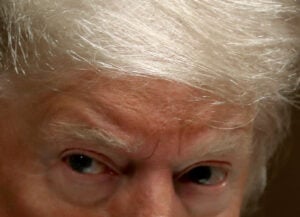
by
Mark
Wilson/Getty
Images)
The
Trump
administration’s
fixation
on
Biglaw
has
become
one
of
the
strangest
—
and
most
legally
embarrassing
—
throughlines
of
this
term.
As
regular
readers
know,
the
White
House
has
rolled
out
a
series
of
executive
orders
aimed
squarely
at
elite
law
firms,
premised
on
the
idea
that
representing
certain
clients,
participating
in
diversity
initiatives,
or
otherwise
displeasing
the
administration
is
somehow
a
punishable
offense.
The
result?
Judicial
smackdown
after
judicial
smackdown.
Courts
across
the
ideological
spectrum
have
struck
these
orders
as
blatantly
unconstitutional,
rejecting
the
administration’s
efforts
to
weaponize
federal
contracting
power
and
punish
protected
speech
and
association.
Conservative
judges.
Liberal
judges.
All
reading
the
same
Constitution
and
arriving
at
the
same
conclusion:
no,
the
president
does
not
get
to
blacklist
law
firms
because
he
doesn’t
like
them.
There
was
also
the
EEOC
gambit;
an
attempt
to
frame
Biglaw
diversity
efforts
as
unlawful
discrimination.
That,
too,
fizzled.
As
Bloomberg
Law
reports,
the
EEOC
quietly
wrapped
up
its
investigation
without
much
to
show
for
it,
a
tacit
admission
that
the
agency’s
legal
theory
was
never
going
to
hold
water.
Then
came
the
FTC,
with
the
administration
floating
an
antitrust
theory
attacking
law
firms
for
their
participation
in
diversity
programs
(the
Mansfield
Certification
program).
Actual
antitrust
experts
reacted
with
something
between
bafflement
and
laughter.
A
diversity
initiative
(particularly
one
that’s
been
blessed
by
a
federal
judge)
as
cartel
behavior?
That’s
a
legal
yoga
pose
no
court
is
likely
to
attempt
without
pulling
a
muscle.
What’s
striking
about
all
of
this
isn’t
just
the
aggression;
it’s
how
bad
the
lawyering
is.
These
are
theories
that
collapse
under
even
casual
scrutiny.
And
yet,
here
we
are.
The
administration
keeps
losing
in
court,
keeps
advancing
new
theories,
and
keeps
pretending
that
the
next
swing
will
finally
connect.
It
hasn’t.
When
firms
have
actually
fought
back,
they’ve
won.
Overwhelmingly.
But
here’s
the
uncomfortable
part:
despite
the
administration’s
abysmal
legal
record,
the
campaign
against
Biglaw
hasn’t
been
a
total
failure. Faced
with
facially
unconstitutional
executive
orders,
nine
major
firms (Paul
Weiss,
Skadden,
Kirkland,
Latham,
Cadwalader,
Willkie
Farr,
Simpson
Thacher,
Milbank,
and
A&O
Shearman)
chose
not
to
litigate,
and
instead sought Trump’s
seal
of
approval,
providing
millions
in
pro
bono
payola,
that
is,
free
legal
services
on
behalf
of conservative
clients
or
approved
causes in
order
to
avoid
Trumpian
retribution.
That
capitulation,
which
Above
the
Law
has
chronicled
in
detail,
remains
one
of
the
most
consequential
outcomes
of
this
pressure
campaign.
The
government
didn’t
need
good
law;
it
just
needed
enough
leverage
to
scare
firms
into
compliance.
And
the
chilling
effect
hasn’t
stopped
there.
Even
firms
not
directly
targeted
have
quietly
revised
DEI
language,
pulled
affinity-group
pages,
and
softened
public
commitments,
all
preemptive
obedience
dressed
up
as
“risk
management.”
The
FTC’s
latest
bullying
move
may
yet
succeed,
not
because
it’s
legally
sound,
but
because
it
signals
that
the
administration
is
willing
to
keep
throwing
punches
until
someone
flinches.
Power
doesn’t
always
need
doctrinal
coherence
to
be
effective.
Sometimes
all
it
needs
is
enough
bluster
and
enough
fear
to
convince
powerful
institutions
to
fold
without
a
fight.
 Kathryn
Rubino
is
a
Senior
Editor
at
Above
the
Law,
host
of
The
Jabot
podcast,
and
co-host
of
Thinking
Like
A
Lawyer.
AtL
tipsters
are
the
best,
so
please
connect
with
her.
Feel
free
to
email
her
with
any
tips,
questions,
or
comments
and
follow
her
on
Twitter
@Kathryn1 or
Mastodon
@[email protected].