

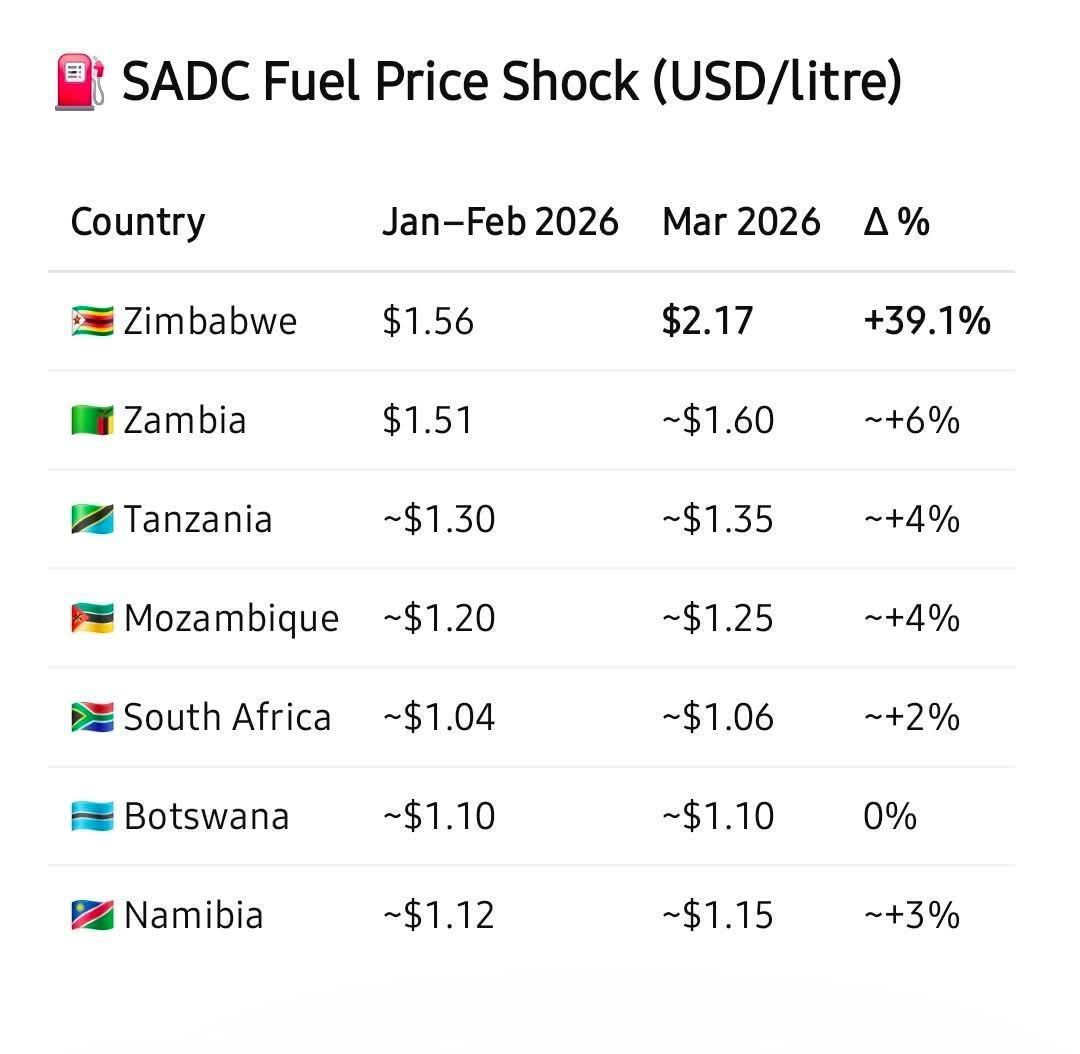
A
LOT
has
been
said
about
the
price
of
fuel
in
Zimbabwe
relative
to
other
countries
in
the
region
in
the
wake
of
the
Iran
war
and
disruption
to
international
fuel
supply
chains.
But
let
us
at
least
compare
like
with
like.
It
is
pointless
lining
up
pump
prices
in
coastal
economies
with
port
access
against
those
of
landlocked
countries
that
must
drag
fuel
inland
at
great
cost.
The
only
sensible
comparisons
are
Zambia
and
Botswana.
And
even
there,
Zimbabwe
has
moved
first.
The
others
will
move
too.
They
always
do.
The
only
real
comparison
is
after
everyone
has
had
their
turn
at
the
pump.
That
said,
there
are
real
issues
here
and
they
expose
the
structural
deficits
in
the
Zimbabwean
economy.
As
some
of
us
have
argued
for
a
while,
there
is
a
latent
United
States
dollar
inflation
in
Zimbabwe
over
and
above
the
inflation
of
the
greenback
itself.
The
“base
effect”
crowd
say
otherwise,
but
that
collapses
under
the
lightest
inspection.
Take
a
simple
metric:
US
dollar
interest
rates
in
Zimbabwe
are
around
18
percent
on
the
dollar.
In
neighbouring
countries,
including
those
with
weaker
currencies,
comparable
inflation
dynamics
are
nowhere
near
as
punishing.
Fuel
imports
into
Zimbabwe
are
financed
through
letters
of
credit
carrying
steep
financing
costs
for
local
firms.
That
is
not
the
prevailing
reality
in
SADC
comparables.
It
is
also
worth
considering
that
Zimbabwe
may
not
have
the
reserves
it
says
it
has.
If
reserves
were
genuinely
comfortable,
the
average
cost
of
fuel
would
cushion
short-term
spikes
in
crude
oil.
Instead,
Zimbabwe
behaves
like
a
country
buying
close
to
the
spot
price
and
living
hand
to
mouth.
That
is
why
it
is
so
often
first
to
adjust.
Not
because
it
is
uniquely
honest,
efficient
or
clairvoyant,
but
because
it
has
less
room
to
pretend.
The
SADC
comparables
also
expose
the
ZiG
problem.
Elsewhere,
foreign
currency
markets
are
allowed
at
least
some
freedom
to
breathe.
As
geopolitical
events
buffet
commodity
markets,
currencies
like
the
rand
and
the
kwacha
strengthen
and
weaken
in
response.
It
is
part
of
the
shock
absorber.
When
gold
and
platinum
prices
rose,
South
Africa,
being
mineral
rich,
saw
the
rand
strengthen.
When
oil
rose,
the
rand
weakened.
For
consumers
paid
in
rand,
the
pain
is
delayed
and
partly
spread
out.
The
same
is
true
of
the
Zambian
kwacha
when
copper
prices
surge.
It
can
strengthen
on
the
way
up,
then
weaken
and
absorb
part
of
the
import
cost
on
the
way
down.
In
Zimbabwe,
by
contrast,
the
ZiG
sits
there
like
a
portrait
on
the
wall,
unmoved
by
events,
while
the
central
bank
insists
it
is
backed
by
gold.
Other
currencies
in
the
region
are
pure
fiat
and
yet
somehow
manage
to
behave
more
honestly.
What
does
this
mean
for
Zimbabwe?
I
often
run
polls
and
questionnaires
on
X
(Twitter)
to
gauge
sentiment.
As
gold
prices
rose,
I
asked
whether
people
would
hedge.
Most
said
no.
They
wanted
to
ride
the
wave.
Zimbabweans
are
natural
risk-takers
and
that
national
habit
seems
to
have
travelled
all
the
way
into
government.
But
the
whole
point
of
derivative
markets
is
to
hedge,
not
merely
to
cheer
from
the
sidelines
while
prices
soar.
Reserves,
too,
are
meant
to
do
a
job.
They
are
supposed
to
cover
six
months
or
more
and
act
as
a
hedge
against
volatility.
So
if
gold
is
rising,
hedge.
There
is
nothing
foolish
about
hedging
at
$3,800
an
ounce
if
it
gives
you
cover
on
the
cost
side
as
well.
The
ban
on
mineral
ore
exports
may
prove
one
of
the
more
self-defeating
policy
choices
of
the
period.
Australia,
under
a
liberal
social
democratic
government
no
less,
had
the
sense
to
let
ore
exports
to
China
surge
and
ended
up
as
one
of
the
few
countries
posting
a
budget
surplus.
South
Africa,
meanwhile,
has
idle
smelters
because
many
are
loss-making.
the
government
of
Zimbabwe
looked
at
this
landscape
and
somehow
picked
the
worst
of
both
worlds,
the
wrong
policy
at
precisely
the
wrong
moment.
Meanwhile,
production
and
supply
chains
in
Zimbabwe
almost
entirely
depend
on
road
because
rail
is
defunct.
Yet
if
ever
there
was
a
sector
that
could
have
underwritten
rail
revival,
it
was
mining.
The
miners
would
have
been
the
biggest
beneficiaries,
especially
on
export
corridors
into
China-linked
trade
routes.
The
government
did
not
need
to
do
everything
itself.
It
merely
needed
to
provide
the
right
framework
and
stick
to
it
long
enough
for
private
capital
to
believe
it.
Markets
are
better
at
solving
these
issues
–
free
markets
in
the
foreign
currency,
fuel
and
mining
sectors
–
and
not
government
directives.
Tinashe
Murapata
is
a
Zimbabwean
economist
and
podcaster