

If
you’re
subscribed
to
the
various
legal
industry
newsletters,
you
might
have
noticed
that
this
morning’s
installment
of
the
American
Lawyer
Morning
Update
shared
a
couple
of
stories
about
the
ongoing
crisis
in
the
Middle
East.
Or,
perhaps
more
accurately,
a
couple
of
stories
about
Biglaw
partners
fretting
about
making
their
next
yacht
payment
because
of
the
ongoing
crisis
in
the
Middle
East.
Specifically,
here’s
a
screencap
from
the
newsletter
that
went
out
this
morning:
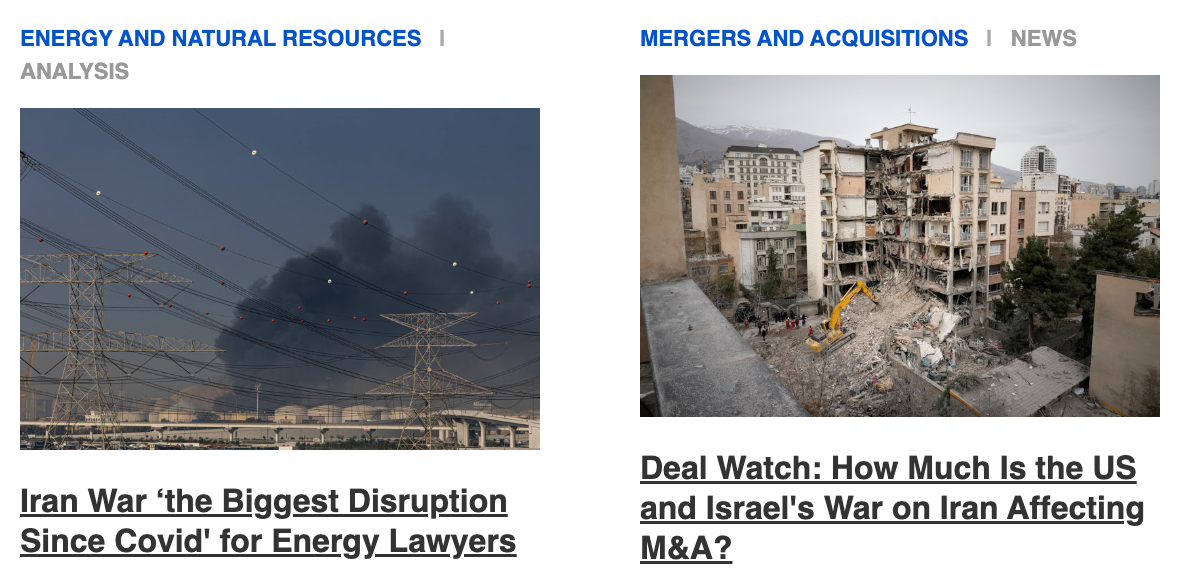
“The
Biggest
Disruption
Since
Covid
for
Energy
Lawyers”
and
“How
Much
Is
the
US
and
Israel’s
War
on
Iran
Affecting
M&A?”
On
the
one
hand,
you
have
to
appreciate
a
trade
publication
for
its
commitment
to
the
bit.
On
the
other
hand….
Kicking
off
a
shooting
war
in
the
Middle
East
undeniably
impacts
lawyers.
That’s
newsworthy
within
the
industry.
We
covered
it
here
at
Above
the
Law,
for
example
discussing
the
evacuation
plans
Biglaw
firms
activated
(quoting
the
American
Lawyer’s
earlier
take
on
the
same
subject
even!)
when
missiles
started
flying
across
the
Middle
East.
With
Biglaw
colleagues
sheltering
in
place
in
Dubai
while
drones
target
nearby
buildings,
that’s
a
legal
industry
story
with
obvious
human
stakes.
And
there’s
certainly
an
economic
story
to
be
had
here.
The
war
has
upended
a
region
with
major
energy
significance.
But
there’s
a
subtle
distinction
between
framing
a
headline
around
the
war
being
“a
new
challenge
for
global
energy”
and
“a
big
disruption
for
energy
lawyers.”
The
former
sounds
like
another
economic
dimension
to
a
global
news
story
and
the
latter
sounds
like
it’s
an
inconvenience
for
lawyers.
Pairing
it
with
an
image
of
black
smoke
rising
from
an
explosion
gives
real,
“Won’t
Someone
PLEASE
Think
Of
The
Billables?!?”
energy.
Just
show
a
generic
oil
tanker
if
you’re
trying
to
tell
an
energy
market
story.
The
Deal
Watch
article
isn’t
even
really
about
Iran.
It
opens
by
noting
that
M&A
deal
volume
for
2026
is
20%
below
2025
levels
—
and,
you
know,
thoughts
and
prayers
for
the
deal
lawyers
—
and
then
cites
recent
reports
from
the
financial
industry
disputing
how
much
to
blame
the
war
for
M&A
woes.
Then
the
bulk
of
the
article
is
a
routine
rundown
of
big
deals
of
the
week.
The
paired
image
of
a
destroyed
apartment
building
doesn’t
seem
a
natural
match
with
the
subject
of
deal
flow.
That
said,
maybe
I’m
crazy,
but
I
kind
of
appreciate
this
specific
story
preview
on
a
subversive
level.
Unlike
the
first
headline’s
“Iran
War,”
this
title
assigns
agency
to
the
U.S.
and
Israel
for
initiating
the
conflict.
Hell,
I’m
using
“Iran
War”
in
my
headline
because
“US
and
Israel’s
War
on
Iran”
is
a
whole
lot
of
extra
words
—
so
that’s
a
choice.
Rather
than
using
a
generic
image
of
smoke
or
showing
a
facility
damaged
by
Iranian
drones,
the
picture
shows
a
destroyed
residential
building
in
Iran,
doubling
down
on
assigning
responsibility
to
Trump
and
Netanyahu
for
kicking
off
the
war
and
triggering
the
ensuing
fallout.
There
might
be
a
lot
more
going
on
here
than
it
seems
at
first
glance.
Still,
there’s
a
delicate
balance
to
writing
a
trade
story
about
a
life
and
death
event.
Create
some
distance
between
the
human
cost
and
the
abstract
legal
market
impacts.
Lawyers
will
still
find
their
way
to
the
story
because
no
one
is
better
at
thinking
everything
is
really
about
them
than
lawyers
—
the
news
doesn’t
need
to
give
them
any
help.
Earlier:
Biglaw
Drafts
Evacuation
Plans
As
Missiles
Fly
In
The
Middle
East
 Joe
Joe
Patrice is
a
senior
editor
at
Above
the
Law
and
co-host
of
Thinking
Like
A
Lawyer.
Feel
free
to email
any
tips,
questions,
or
comments.
Follow
him
on Twitter or
Bluesky
if
you’re
interested
in
law,
politics,
and
a
healthy
dose
of
college
sports
news.
Joe
also
serves
as
a
Managing
Director
at
RPN
Executive
Search.