
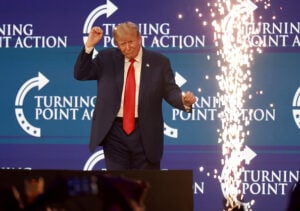
by
Joe
Raedle/Getty
Images)
Donald
Trump
really
wants
to
get
out
of
the
civil
case
arising
from
his
role
in
the
January
6
hootenanny,
where
he
told
his
assembled
followers
to
“fight
like
hell”
or
“you’re
not
gonna
have
a
country
any
more,”
and
then
they
stormed
the
Capitol,
rubbed
feces
on
the
walls,
and
tried
to
hang
Mike
Pence.
Trump
hoped
to
get
the
case
tossed
with
the
help
of
the
Supreme
Court’s
newly
minted
immunity
standard,
figuring
if
it’s
good
enough
to
allow
him
to
send
SEAL
Team
6
to
assassinate
a
rival,
then
it’s
got
to
be
good
enough
to
get
him
out
of
a
civil
suit.
Alas,
Judge
Amit
Mehta
just
ruled
that,
at
least
some
of
the
president’s
alleged
actions
in
whipping
up
the
crowd
that
morning
fell
outside
even
the
Supreme
Court’s
wildly
expansive
view
of
what
counts
as
an
“official”
act
for
the
purposes
of
immunity.
Trump
also
asked
the
court
to
reconsider
its
prior
ruling
that
Trump’s
speech
on
the
Ellipse
that
morning
could
plausibly
be
construed
as
incitement
and
fall
outside
the
protection
of
the
First
Amendment.
And
one
gem
tucked
away
toward
the
back
of
the
79-page
opinion
—
helpfully
flagged
by
Lawfare’s
Roger
Parloff
—
addressed
Trump’s
First
Amendment
argument
that,
if
you
think
about
it,
he’s
basically
like
a
rapper.
That
might
be
a
misspelling.
As
a
final
salvo,
President
Trump
resuscitates
an
argument
the
court
previously
rejectedbut
with
a
twist.
He
again
insists
that
an
adverse
ruling
“will
open
floodgates
for
incitement
decisions”
and
thereby
constrain
First
Amendment
protections.
Before,
his
focus
was
on
the
impact
such
ruling
would
have
on
political
speech.
Now
his
concern
is
over
the
“ramifications
for
public
citizen
speech.”
To
illustrate
the
point,
he
poses
the
hypothetical
of
a
popular
rapper
(bearing
some
resemblance
to
Eminem)
whose
concert
performance
leads
to
fan
violence.
(citations
omitted)
I
assume
“some
resemblance
to
Eminem”
means
that
even
as
a
longshot
hypothetical
Trump
made
sure
his
lawyers
made
him
white.
It
goes
something
like
this.
The
rapper
is
known
for
his
provocative
and
controversial
lyrics,
which
“describe
explicit
violent
acts,
including
gun
violence,
rape,
and
a
description
of
the
rapper
drowning
his
wife.”
It
is
widely
reported
in
the
news
that
his
song
lyrics
are
inspiring
young
people
to
“act
emotionally
and
sometimes
violently.”
The
rapper
is
aware
of
this
phenomenon.
Yet,
when
he
takes
the
stage
in
front
of
thousands
of
fans,
he
performs
his
“most
aggressive”
songs
and
stokes
his
audience’s
passions
saying,
“Fight
the
Man!
Fight
the
Establishment!
Don’t
let
them
tell
you
what
to
do!
Fight
like
hell!”
Chaos
ensues.
Inspired
by
these
words,
concert
goers
“storm[]
the
nearest
establishments,”
stealing
food
from
concession
stands,
attacking
vendors,
and
“beating
down
security
guards
to
access
the
backstage
areas
of
the
venue.”
(citations
omitted)
Stan
could
still
get
that
autograph
if
Mike
Pence
has
the
courage.
Personally,
I
never
liked
the
argument
that
Trump
should
be
responsible
for
his
Ellipse
speech.
The
whole
thing
felt
too
similar
to
the
frivolous
lawsuits
against
DeRay
Mckesson,
alleging
that
the
civil
rights
activist
should
be
responsible
for
injuries
caused
by
others
at
a
protest
he
attended.
Trump’s
role
in
exacerbating
the
riot
by
failing
to
take
reasonable
steps
to
quell
the
violence
and
withholding
National
Guard
assistance
could
give
rise
to
a
claim,
but
the
speech
itself
always
felt
like
a
bridge
too
far.
But,
if
the
courts
are
going
to
indulge
the
Mckesson
case
nonsense,
then
it’s
only
fair
to
hold
Trump
to
the
same
standard.
As
for
the
rap
analogy,
Judge
Mehta
found
it
lacking
a
few
critical
elements:
But
here
is
what
is
missing
from
the
President’s
hypothetical.
There
is
no
contention
that,
for
weeks
before
the
concert,
the
rapper
told
his
fans
that
the
Establishment
had
taken
something
valuable
from
them
through
fraud
and
deceit.
No
assertion
that
the
rapper
knew
his
fans
had
prepared
to
act
violently
on
that
very
day
(including
by
bringing
weapons
to
the
show)
to
reclaim
what
was
taken
from
them.
No
averment
that
during
the
performance
the
rapper
specifically
identified
the
members
of
the
Establishment
who
took
this
thing
of
value.
And
no
allegation
that,
at
the
show’s
crescendo,
he
implored
his
fans
to
“Fight
the
Establishment”
and
“Fight
like
hell”and
then
directed
them,
without
warning
local
law
enforcement,
to
descend
thousands
strong
onthe
very
place
the
Establishment
was
working
to
finally
take
away
that
thing
of
value.
Only
if
those
facts
are
included
does
the
rap
concert
begin
to
resemble
January
6,
and
only
then
do
the
artist’s
song
lyrics
and
exhortation
to
“Fight
like
hell”
mirror
the
Ellipse
Speech.
The
court
would
agree
that,
in
this
revised
hypothetical,
the
rapper’s
expression
plausibly
are
words
of
incitement.
But
not
in
the
incomplete
one
posed
by
the
President.
While
Trump
was
always
a
long
way
from
forging
a
complete
analogy
to
January
6,
he
could
have
at
least
met
some
of
Judge
Mehta’s
conditions
if
he’d
just
built
the
analogy
around
any
of
the
many
musical
acts
from
60s
folk
to
90s
rap
with
songs
explicitly
about
“Fighting
the
Man
and
the
Establishment.”
But
the
legal
team
would
rather
have
a
suboptimal
example
like
Eminem
than
let
Trump
be
compared
to
N.W.A.
And,
to
be
clear,
it
shouldn’t
be
incitement,
but
Fuck
Tha
Police
would
make
for
a
stronger
comparison
in
a
case
about
a
crowd
attacking
the
literal
Capitol
Police.
So
the
case
can
proceed
with
Democratic
members
of
Congress
and
Capitol
Police
officers
who
were
there
that
day
getting
their
shot
in
court.
As
for
the
rap
concert
analogy,
it
now
joins
the
proud
lineage
of
Trump
legal
arguments
that
managed
to
be
both
creative
and
self-defeating.
(Opinion
on
the
next
page…)
 Joe
Joe
Patrice is
a
senior
editor
at
Above
the
Law
and
co-host
of
Thinking
Like
A
Lawyer.
Feel
free
to email
any
tips,
questions,
or
comments.
Follow
him
on Twitter or
Bluesky
if
you’re
interested
in
law,
politics,
and
a
healthy
dose
of
college
sports
news.
Joe
also
serves
as
a
Managing
Director
at
RPN
Executive
Search.