

by
Win
McNamee/Getty
Images)
The
Trump
Administration’s
case
is
like
a
failed
cold
call.
We
all
sat
back
and
felt
schadenfreude
second-hand
embarrassment
when
Solicitor
General
Sauer
didn’t
have
the
foresight
to
tee
up
a
reply
to
the
biggest
advocate
for
Native
sovereignty
in
the
history
of
Supreme
Court
Justices
asking
about
how
the
administrations
domicile
requirement
would
impact
Native
American
citizenship.
But
like
a
cold
call
gone
bad,
sometimes
an
instructor’s
brilliance
seeps
through
and
condenses
high
theory
into
an
approachable,
easily
consumable
thing.
Like
batteries
and
lasagna!
If
you
were
to
asked
to
explain
a
battery,
you’d
probably
provide
an
example:
one
AAA
Energizer
battery
suffices.
But
we
all
know
that
despite
how
useful
examples
can
be,
they
aren’t
in
themselves
explanations.
Not
to
mention
that
without
a
clear
understanding
of
the
concepts
you
may
give
faulty
examples:
you
could
define
a
battery
as
a
thing
that
stores
energy,
but
that
would
include
odd
things
you’d
want
to
exclude
like
fat
reserves
and
uranium.
What
a
battery
is
is
simple:
a
thing
that
changes
chemical
reactions
into
electrical
energy
using
an
anode,
cathode
and
an
electrolyte.
Or,
to
bring
the
theory
back
down
to
earth,
think
about
a
tray
of
lasagna!
You
ever
prepare
a
tray
of
lasagna,
cover
it
with
aluminum
foil,
throw
it
in
the
oven
to
find
out
that
the
aluminum
foil
is
sticking
to
the
damn
cheese?
That’s
because
you
made
a
battery!
It’s
a
simple,
concrete
example
that
drives
home
the
essential
parts
of
a
battery
and
how
easy
they
can
be
to
make,
but
if
someone
mishandles
your
explanation
and
takes
it
to
mean
that
you
should
try
to
power
a
Tesla
with
comfort
food,
you
should
take
that
as
a
sign
that
they’re
stupid
and
move
on.
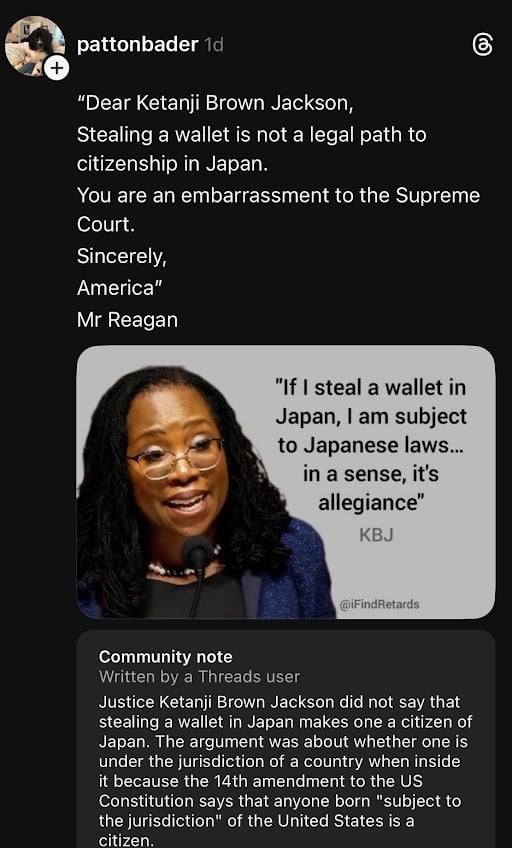
Justice
Jackson
used
a
hypothetical
about
an
American
stealing
in
Japan
to
shed
some
light
on
the
legal
concept
of
“allegiance”
and
dumb
dumbs
who
didn’t
understand
the
purpose
of
the
example
are
trying
to
spin
it
as
some
big
DEI
gotcha
moment.
You
can
hear
her
below:
In
a
case
about
the
“subject
to
the
jurisdiction
thereof”
chunk
of
the
birthright
clause,
the
stealing
in
Japan
example
shows,
in
a
very
common
sense
way,
how
even
a
non-citizen
would
be
subject
to
Japan’s
laws
penalizing
theft
if
they
stole
something
while
they
were
visiting
the
country.
Further,
non-citizens
would
still
be
able
to
(at
least
in
theory)
employ
legal
avenues
to
get
their
property
back
via
the
Japanese
government
because
of
the
same
local
allegiance,
which
clarifies
how
the
“subject
to
the
jurisdiction
thereof”
bit
of
the
clause
would
engage
with
foreign
nationals
acting
within
the
parameters
of
the
US.
Still,
people
somehow
found
a
way
to
misunderstand
her
entirely:
Sometimes
the
children
left
behind
are
grown
ass
adults.
The
funniest
thing
about
this
is
that
the
most
vocal
critics
have
all
the
qualifications
of
being
some
dude
in
a
car.
Skip
to
about
1:24
for
a
big
dose
of
weaponized
ignorance:
Just
because
it
didn’t
make
sense
to
you
doesn’t
mean
it
didn’t
make
sense.
There
are
some
ideas
people
aren’t
ready
for;
I
for
one
am
still
trying
to
wrap
my
head
around
how
gut
microbiomes
can
effect
mood
and
happiness,
but
I
also
know
better
than
to
bash
scientists
who
specialize
in
this
because
I
don’t
understand
the
mechanics
of
a
regular
diet
of
grilled
cheese
sandwiches
making
the
dark
thoughts
come
at
3
AM.
I
give
unto
Caesar
what
is
his
and
go
about
my
lunch.
Scientists
enjoy
a
(dwindling)
expertise
deference
that
judges
don’t
get
the
benefit
of.
It
is
understandable
for
lay
people
to
make
the
mistake
of
thinking
law
is
an
easily
accessible
discipline
because
it
really
just
boils
down
to
words
on
a
page
and
they
can
read.
But
there
is
a
problem
with
that
approach.
They
probably
don’t
actually
read
that
well
—
most
Americans
read
on
a
7th-8th
grade
reading
level
which
makes
interpreting
the
Constitution
a
hard
chestnut
to
crack
when
the
Hemingway
App
(admittedly
not
the
end
all
be
all
of
evaluating
reading
level)
clocks
the
Constitution
and
the
first
14
amendments
at
being
post-graduate
level.
Reading
well
also
goes
further
than
being
able
to
just
identify
words:
it
also
factors
in
being
able
to
read
author
intent,
comparative
analysis
and
all
sorts
of
other
things
you
miss
when
your
first
response
to
hearing
Ketanji
is
to
start
bashing
former
President
Biden.
It
is
almost
like
thinking
like
a
lawyer
takes
more
work
than
listening
to
a
sound
clip
and
sounding
off
as
you
drive
to
do
your
errands.
Tough
crowd,
Justice
Jackson.
Dumb
too,
but
that’s
not
polite
to
say.
Chris
Williams
became
a
social
media
manager
and
assistant
editor
for
Above
the
Law
in
June
2021.
Prior
to
joining
the
staff,
he
moonlighted
as
a
minor
Memelord™
in
the
Facebook
group Law
School
Memes
for
Edgy
T14s
.
He
endured
Missouri
long
enough
to
graduate
from
Washington
University
in
St.
Louis
School
of
Law.
He
is
a
former
boat
builder
who
is
learning
to
swim
and
is
interested
in
rhetoric,
Spinozists
and
humor.
Getting
back
in
to
cycling
wouldn’t
hurt
either.
You
can
reach
him
by
email
at
[email protected]
and
by
Tweet/Bluesky
at @WritesForRent.