

Kash
Patel’s
massive
lawsuit
against
The
Atlantic
asserts
dubious
defamation
claims,
but
could
it
also
be…
AI
slop?
The
$250
million
complaint
filed
in
D.C.
federal
court
—
a
necessity
to
avoid
the
anti-SLAPP
laws
that
would
almost
certainly
make
this
a
financial
albatross
for
Patel
down
the
road
—
largely
underwhelmed.
Irrelevant
preening,
misspellings,
and
a
complete
disregard
for
the
looming
“actual
malice”
roadblock
made
the
complaint
look
less
like
a
serious
defamation
claim
and
more
a
desperate
performative
plea
to
convince
Donald
Trump
that
Patel
is
“a
fighter”
who
doesn’t
deserve
to
be
kicked
to
the
curb
like
so
many
other
scandal-plagued
administration
officials.
Big
Lie
lawyer
Jesse
Binnall
—
who
launched
this
case
by
promptly
publicizing
allegations
that
The
Atlantic
did
NOT
actually
print,
exposing
his
own
client
to
claims
they
contend
are
defamatory
—
managed
to
get
the
lawsuit
filed
first
thing
on
Monday.
While
we
focused
on
the
flimsy
legal
claims
and
embarrassing
strategic
choices,
Caroline
Stout
locked
in
on
some
curious
phrasing:
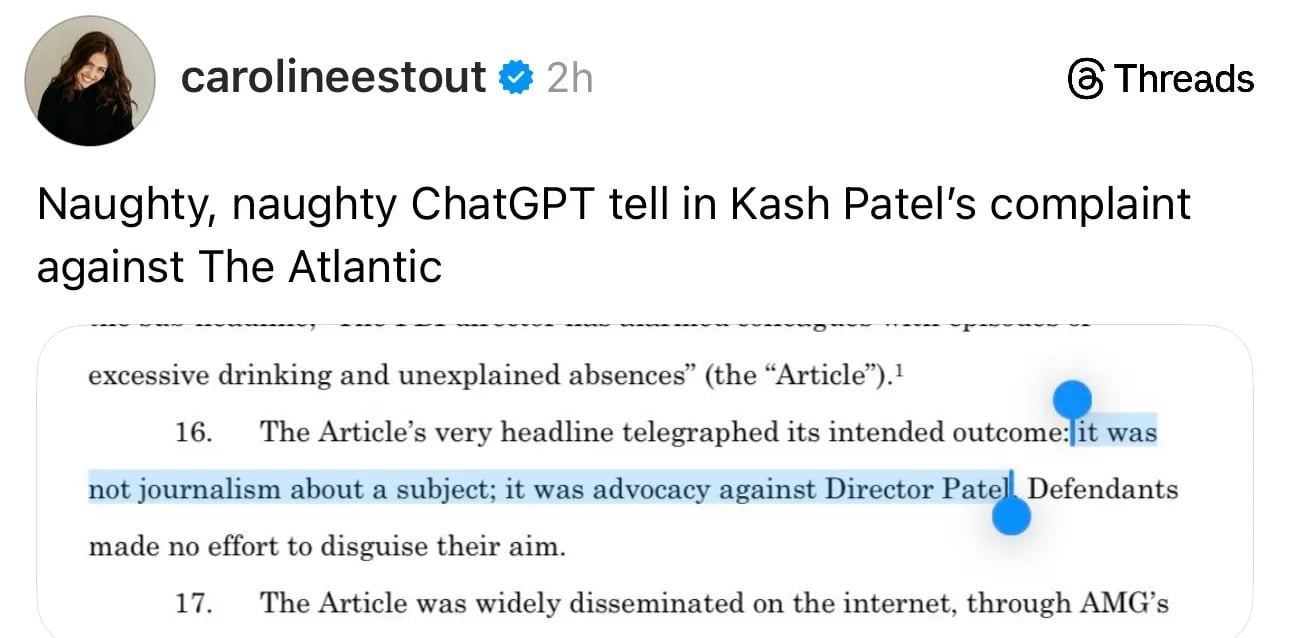
This
rhetorical
device,
which
I
call
“Digiorno
Parallelism”
as
in
“it’s
not
delivery;
it’s
Digiorno,”
ranks
among
the
more
infamous
signs
of
AI.
It’s
not
fair
to
blame
AI
every
time
you
run
across
this
construction
—
just
like
not
every
em-dash
is
computer-generated
—
but
it
doesn’t
inspire
a
lot
of
confidence
in
human
authorship.
You
might
assume
—
as
I
did
—
that
AI
is
not
dumb
enough
to
use
words
like
“feable”
or
“politices,”
two
prominent
misspellings
in
the
complaint,
and
presume
that
indicates
human
writing.
While
it
might
prove
to
be
human
slop,
those
errors
are,
as
I
discovered,
the
rare
sorts
of
misspellings
AI
can
make.
Most
humans
would
misspell
“feeble”
by
leaving
out
an
“e,”
but
LLMs
are
more
prone
to
make
phonetic
spelling
errors,
such
as
imagining
a
“fea-”
opening.
Likewise,
“politices”
is
the
sort
of
token
sequence
confusion
an
LLM
can
fall
prey
to,
especially
in
a
complaint
that
bounces
between
politics
and
policies.
That
said,
humans
definitely
wrote
some
of
this
complaint.
Most
AI
products
understand
the
legal
process
well
enough
not
to
litter
the
text
with
gratuitous,
irrelevant
editorializing.
There
are
too
many
asides
like
suggesting
the
reporter
wasn’t
“a
minimally
competent
journalist,”
or
other
bush
league
flourishes
that
AI
would
be
too
professional
to
include
unprompted.
Still,
Stout’s
observation
got
me
looking
at
the
text
and
finding
more
and
more
quirky
language.
So
I
decided
to
run
the
whole
complaint
through
an
AI
detector
to
see
what’s
up.
What
does
TextGuard
have
to
say:
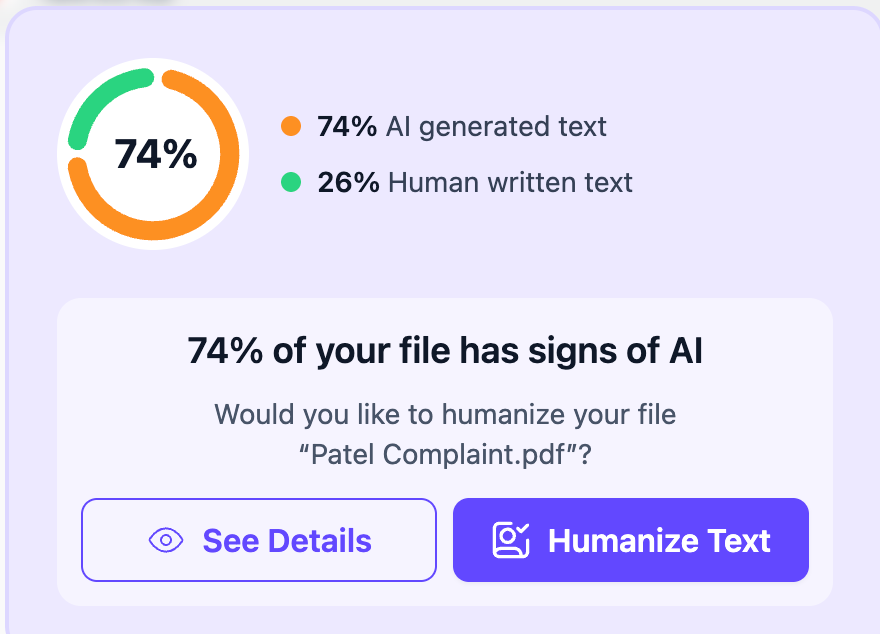
Now,
recently
an
AI
detector
decided
that
Mary
Shelley’s
Frankenstein
was
likely
AI-generated,
so
take
these
findings
with
the
appropriate
margarita
rim
of
salt.
Complaints
are
stylized
documents,
and
it’s
easy
for
a
detector
to
confuse
their
repetition
for
an
LLM.
But
even
if
the
lawyers
used
AI
to
create
a
draft
complaint…
there’s
nothing
necessarily
wrong
with
that!
It’s
not
a
party
foul
to
use
AI
tools
to
generate
a
complaint
under
time
pressure
—
even
if
the
time
pressure
in
this
case
was
entirely
self-imposed
by
a
client
hoping
to
seize
the
narrative
upper
hand.
Complaints
(should
be)
relatively
mechanistic,
making
them
prime
candidates
for
AI
collaboration.
Frankly,
AI
could
help
an
overeager
human
lawyer
from
allowing
zealous
bloviating
take
over
the
cold,
formal
tone
plaintiffs
should
aspire
to
bring
to
their
complaints.
As
long
as
the
user
doesn’t
go
back
and
tell
the
algorithm
to
punch
up
the
vitriol.
Purists
may
cringe
at
some
of
the
AI-isms
—
and
human
editors
should
be
vigilant
in
weeding
them
out
—
but
AI
will
increasingly
be
a
fixture
of
the
lawyer
workflow.
If
Patel’s
lawyers
weren’t
using
it,
they
were
sacrificing
efficiency.
An
AI
complaint
isn’t
creating
a
lot
of
the
mischief
we
associate
with
AI.
Ideally,
it’s
derived
from
a
clear
timeline
and
documented
facts,
just
rearranged
into
a
standard
format.
That’s
where
AI
typically
shines,
if
the
user
will
let
it.
It’s
not
like
a
complaint
includes
any
hallucinated
law.
Unless
you
count
whatever
Binnall
read
that
made
him
think
he
could
clear
the
actual
malice
hurdle
with
“[n]umerous
Atlantic
pieces
over
the
past
two
years
have
characterized
Director
Patel
as
unqualified,
dangerous,
corrupt,
or
mentally
unstable.”
Because
that
case
very
much
does
not
exist.
Earlier:
Kash
Patel’s
$250
Million
Defamation
Lawsuit
Looks
Better
With
Beer
Goggles
FBI
Director
Promises
To
Pound
‘The
Atlantic’
Like
A
Six
Pack
On
A
Tuesday
 Joe
Joe
Patrice is
a
senior
editor
at
Above
the
Law
and
co-host
of
Thinking
Like
A
Lawyer.
Feel
free
to email
any
tips,
questions,
or
comments.
Follow
him
on Twitter or
Bluesky
if
you’re
interested
in
law,
politics,
and
a
healthy
dose
of
college
sports
news.
Joe
also
serves
as
a
Managing
Director
at
RPN
Executive
Search.