Does Zimbabwe have force labour in its diamond mines? – The Zimbabwean

GETTY IMAGES

Zimbabwe has dismissed the allegations. Secretary for Information Nick Mangwana says the US has no evidence of this, and that Washington has been “misinformed or misled”.

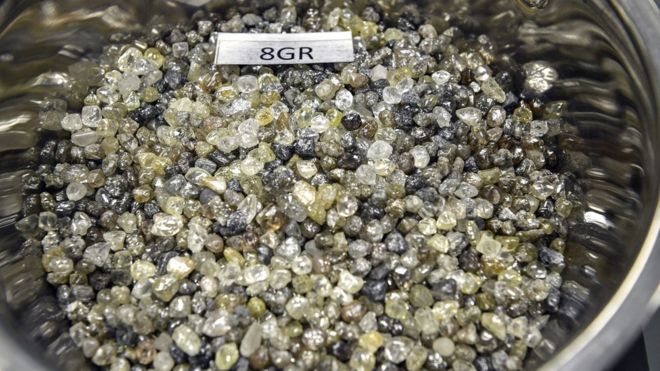
The Marange mining region in the east of Zimbabwe is estimated to have one of the world’s richest diamond reserves and is a vital revenue earner for a country in a dire economic straits.

Zimbabwe’s rough diamond exports

$US millions

 

Source: The Kimberley Process

What is the US accusation?

The US cites employment practices in which individuals seeking work in the mines bribe security officials to allow them inside the secure area.

Once inside, according to Brenda Smith of the US Customs and Border Agency, workers are not permitted to leave, and those who resist are punished with physical/sexual violence or arrest.

The US government says it is “well documented”.

What is the evidence?

Access for journalists and rights groups to these areas is highly restricted, with special authorisation required to gain access.

A group that monitors employment practices at the Marange diamond mines has collected testimonies of forced labour practices.

The chairman of the Bocha Diamond Trust, Moses Mukwada, told the BBC there had been cases of villagers being rounded up and forced to work in the mines.

Other groups, however, are more cautious.

The Centre for Natural Resources Governance (CNRG), an organisation that campaigns for rights in mining areas, says it has documented physical violence against miners, but doesn’t have information that forced labour is prevalent.

“As an organisation, we are not totally dismissing the issue [of forced labour], but we have no information [from the US government] and we would like to know who is forcing who,” says Simiso Mlevu, a spokesperson for CNRG.
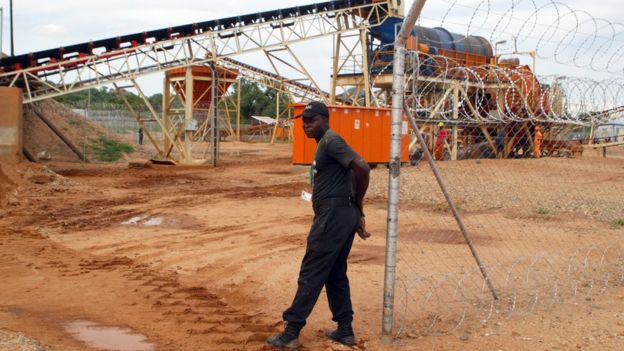
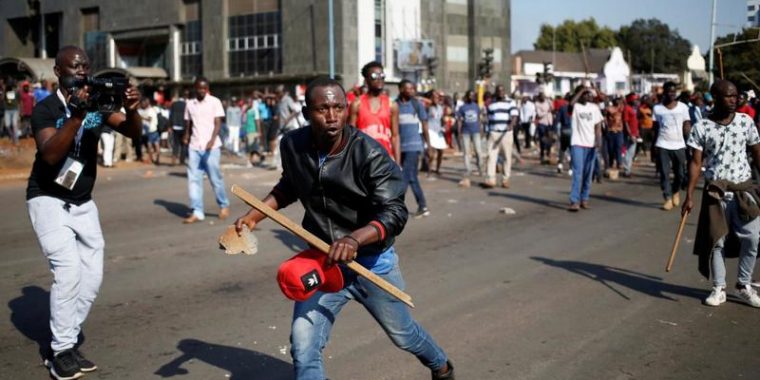
A file photo from 2011 shows a private security employee guarding a diamond processing plant in the diamond-rich eastern Marange region of ZimbabweAFP/GETTY IMAGESThe army and private security guards control access to the Marange diamond mines

This isn’t the first time that allegations of human rights abuses have been directed at the Zimbabwe government’s operation in the Marange mines.

Rights groups have regularly called for the diamonds to be classified as “conflict diamonds” to restrict exports, and back in 2011 the BBC found evidence of the use of severe beatings and sexual assault in the area.

“The sad truth is that diamonds tainted by human rights abuses from Marange or elsewhere can still reach the global diamond market easily,” the CNRG says.

It estimates that about 40 deaths occur annually as a result of the ill-treatment of mineworkers.

Labour rights elsewhere in Zimbabwe

Human Rights Watch published a report in 2018 saying that forced labour was an issue in the country’s tobacco farms.

The US government also released a report last year documenting child labour practices.

However, Zimbabwe says it is making efforts to tackle forced labour and in 2019 ratified the UN’s Forced Labour Convention, a commitment to eradicate the practice.

RENAMO rejects results, calls for new elections

Post published in: Business

When your entire salary buys 7kg beef and some peanut butter: How hyperinflation hit Zimbabwe – The Zimbabwean

“The prices are unbelievable. That is why I am looking at my phone calculator,” John Betani tells Fin24. “I was just calculating if the money I have can buy what I need for my son.  Life is just tough now, my brother.”

Betani, a civil servant, earns ZW$900 (US$48.50 or around R720) monthly.

Although he has just been paid, Betani says the salary cannot sustain a family of six, given the rapid price increases for basic commodities in the country.

Betani is shopping for his son’s boarding school food.

Apart from the foodstuffs for his son, the school has also asked for an additional amount of ZW$950 for school fees after hyperinflation eroded value.

“The school fees top-up is ZW$950 and my salary is ZW$900,” he says. “I don’t know how to raise this money and survive this month.”

“I want to buy Mamma’s peanut butter, 1 litre at $61.”

That way, he says, he will split the peanut butter between the family and his son at school.

A smaller bottle of peanut butter costs ZW$27.

“We are sharing the little we have. But more attention is given to the one at school,” Betani says.

“When the economy was dollarised, I could save and still have money in the bank the next pay day. Basic things like grocery and family upkeep were not a hassle.”

And he still has to feed his family on the same salary, he says.

According to the Public Accountants and Auditors Board (PAAB), a body mandated to regulate auditing and accounting standards in the southern African country, Zimbabwe is now in hyperinflation territory again.

“The PAAB can advise that there is broad market consensus within the accounting and auditing professions that the factors and characteristics to apply the financial reporting in hyperinflationary economies standard (IAS 29), in Zimbabwe have been met,” reads the PAAB statement, seen by Fin24.

IAS 29 relates to financial reporting in hyperinflationary economies.

Inflation was in August recorded at 300%, the second-highest in the world after Venezuela in the period, according to the International Monetary Fund.

Massive erosion

High inflation has brought with it massive erosion of earnings for individuals and companies.

The country’s statistics agency, Zimstat, will not publish annualised inflation price numbers until February of next year to enable the government to collect more data comparing price information on a like-for-like basis.

Finance Minister Mthuli Ncube said in August that Zimstat would only release the numbers in 2020 because prices are no longer measured in United States dollars, making the figures incomparable.

But some believe the inflation figure is in fact higher that 300% last recorded in August.

Despite the ban on inflation readings, the effects of hyperinflation are evident.

A merchandiser for a company that manufacturer’s peanut butter, jam and other edible spreads, who preferred anonymity, tells a tale of an economy deep in crisis.

“Our sales have gone down by a worrying margin. Customers now consider our products as luxuries. The cost of living is now very high,” he says.

“Because of the state of the economy, we have cut on the orders that go into wholesalers. In the past, we used to give them stock that would be stocked in their warehouses.”

Now, his company only stocks products for the shelves.

This is because inventory turnover ratio is at an all-time low, he says.

Stock turnover rate is considered to be a measure of sales performance.

“Our target market in wholesalers is civil servants. Whenever it was pay day, our sales would jump. Civil servants just got paid and we have not felt the impact,” the merchandiser told Fin24. “Stock we sold in a week now takes about a month and a half.”

The wholesaler, a popular shopping destination for low-income earners, civil servants and smaller retailers, is a ghost of its former self.

Only a handful of people are walking around, holding empty shopping baskets.

Those who choose to part with cash in the shop, carefully select basics such as rice and flour.

Eroded purchasing power

Such is the plight of many Zimbabwean business and individuals as hyperinflation strikes again.

Unnerved by the situation, retailers such as Mohamed Mussa put out notices that prices on shelves could vary at the till as the Zimbabwe dollar lost its value.

Purchasing power has been eroded. For instance, bread, which retailed at US$1 in dollarised Zimbabwe now costs ZW$15.

A kg of beef retails from ZW$80-120, depending on the grade.

Zimbabwe first experienced hyperinflation from around 2005 until 2009. It hit 500 billion percent at its peak in 2008.

As the currency suffered, the Zimbabwean unit was discarded and the US dollar adopted as legal tender.

But workers are bearing the brunt of hyperinflation.

This is because when the central bank introduced bond notes, currency authorities said it was on par with the US dollar in December 2016, and employers maintained US dollar salaries.

When government in February this year introduced a managed interbank foreign currency market and abandoned the parity policy on the US and the local currency, employers did not adjust salaries to reflect the new exchange rates between the US dollar and the local currency.

How did the wheels come off?

Zimbabwe had a negative balance of trade position and a current account deficit, financed the budget deficit through creation of electronic money (RTGS$) and issuance of treasury bills, and general economic mismanagement triggered the latest round of inflation.

Deep in the throes of hyperinflation, Zimbabwe may be forced to redollarise once again.

“GeoNutrition” to tackle hunger in Zimbabwe

Post published in: Business

“GeoNutrition” to tackle hunger in Zimbabwe – The Zimbabwean

The University of Nottingham is taking aim at hunger from micronutrient deficiencies after receiving £14.8 million from UK Research and Innovation.

The midlands uni will carry out new research into mineral micronutrient deficiencies (MMNDs) with partners in Zimbabwe. MMNDs are a persistent global challenge which affect the growth, development, health and livelihoods of more than 2 billion people worldwide.

MMNDs are especially prevalent in Low Income Countries in sub-Saharan Africa (SSA) and South Asia. Women and children are at greater risk of MMNDs due to unequal access to nutrient-rich foods within the home.

Working alongside research and policy partners in southern Africa, the University of Nottingham’s research team from the School of Biosciences has already built up substantial knowledge on how to alleviate MMNDs, based on ongoing research, and lessons learned from an existing portfolio of long standing collaborations supported through Global Challenge Research Fund and other funding.

These projects are seeking to understand local nutrition, from soil to people via complex food system pathways, described as a ‘GeoNutrition’ approach, and strengthening research capacity.

This work is part of an ongoing collaboration between the University of Nottingham, the University of Zimbabwe, Lilongwe University of Agriculture & Natural Resources, Malawi, and the British Geological Survey.

The Government of Zimbabwe plans to conduct a national MMND survey in 2020/21 and the research team will inform the design of this full survey, specifically by translating GeoNutrition research findings from Malawi into a pilot survey.

The pilot will include surveys of soil and food crop composition, together with biomarker assessments among people. The pilot survey work will be combined with training and research capacity strengthening activities in Zimbabwe, Malawi, and the UK.

Professor Martin Broadley, one of the Nottingham lead researchers, said: “We are excited to be able to translate our GeoNutrition research into practice, working together with colleagues in Malawi, UK and Zimbabwe.

“Our previous research has developed innovative approaches to spatial micronutrient mapping in soils, crops, and people. Here, we shall enable our colleagues and partners at the University of Zimbabwe to support their government to conduct the first national-scale surveys of MMNDs.

“We shall also be developing our collaborative ethos of GeoNutrition, to empower local, long-term solutions to the global challenge of MMNDs through research capacity strengthening at individual and institutional levels.”

The projects have been funded as part of UKRI’s GCRF Innovation and Commercialisation Programme, developed to fast track promising research findings into real-world solutions.

These new awards are the next step in developing co-produced policy tools and commercial opportunities for products and services that can be used by local communities to help make their lives and environments healthier, safer and more sustainable.

Before re-engagement, Zimbabwe needs to regain lost trust – The Zimbabwean

The Zimbabwean government’s flagging international re-engagement roadshow continues this week as top officials attend the annual meetings of the World Bank and International Monetary Fund in Washington.

They are promoting the government’s agenda of economic reform that they hope will bring the desperately needed external finance potentially available from international financial institutions and global investors. But the initial enthusiasm, at home and abroad, for President Emmerson Mnangagwa’s ‘new dispensation’ and the potential of its economic reform programme have subsided in the wake of repeated political unrest and social protest.

Fiscal austerity and the rapid devaluation of the new currency have added pain to lives of citizens already living in a deepening economic crisis.
Those earning in RTGS/ Bond/ Zim Dollars have seen their real wages fall to 5% of what they were a year ago.

Decades of economic mismanagement has weakened resilience. 8.5-million people are now food insecure as a result of a drought which has also exposed the country’s dependence on hydroelectricity from a single source, Kariba, and highlighted the lack of investment in new generation. Factories operate for only a few hours a day — or often at night.

Reform is clearly necessary, and the Mnangagwa government has promised it. But the challenge of making it happen is daunting. The ambition to transition to a private sector economy, where the government is a ‘referee’ and not a ‘player’, is a significant shift for a country with a long history of government intervention in, and management of, the economy.

Reforms to encourage private sector growth have been attempted since the 1980s but have been undermined by the inconsistent implementation of legislation and policy, deep-seated corruption, and politically expedient and profligate state spending.

So unlocking urgently needed international assistance will depend on reform that moves beyond the economy and takes on entrenched patterns of political behaviour and generations of bad governance.

Put simply, the government needs to rebuild trust and confidence with businesses and citizens if its latest plans are to succeed.

Zimbabwe’s long-suffering businesses and communities will drive recovery. More the stubborn succulents that have survived, rather than new green shoots of growth.

Chatham House research has brought private sector players together to identify policy options to support economic growth to 2030.

Many Zimbabweans currently rely on small scale agriculture or informal mining as a means of survival. These offer critical opportunities for growth and upscaling through formalisation. However, formalisation cannot be forced, and will only happen when people have faith in government.

An important first step in re-building this relationship is to improve people’s everyday interactions with the state, including clamping down on low-level corruption and improving service delivery. It is imperative that economic reform does not increase the reach of an already-bloated civil service, both for efficiency and to limit opportunities for rent-seeking.

Trust must also be built on adherence to the rule of law. Businesses need to have confidence in court orders and dispute resolution mechanisms.

Cutting red-tape and state bureaucracy is also crucial for improving the business environment. Hotels, for instance, currently must obtain a license for each individual TV, rather than a single one to cover the whole premises.

In the wake of the fast track land reform programme, security of land tenure is key to reviving agriculture. But it is also critical for clarifying usage rights for other competing economic activities such as mining and conservation for eco-tourism. In mining, for example, there is a need for clarity on compensation for holders of land absorbed for mine expansion or where new discoveries are made.

The government must also develop a fair tax and royalty regime for business, most importantly mining, that protects companies and encourages investment at the same time as demonstrating real benefits for Zimbabwe’s people. For example, the government has dropped its controversial policy to push local ownership of the mining industry, but cannot return to the status quo of a nationally-dominant industry that contributes little to the public purse, or the common good.

Transforming the relationship between state and citizen will not be easy. Pushing back the state’s predation of the economy faces opposition from vested interests who benefit from the opportunities for graft.

Zimbabwe is deeply politically divided. The establishment of a multiparty Political Actors Dialogue has created a space for dialogue between ZANU-PF and smaller parties but has so far been boycotted by the Movement for Democratic Change. And the ruling party itself remains divided between military and civilian elements, as well as the remnants of the G40 faction formerly aligned behind Grace Mugabe.

Crucially, whatever choices it makes, the government must get better at communicating with the Zimbabwean people and engage in a renewed and sincere conversation with businesses and citizens. In particular, the private sector must have a greater voice in policy formation. The Presidential Advisory Council and Tripartite Negotiating Forum have opened avenues for businesses to input into policy making. But these must be extended to small businesses and ordinary citizens.

Man found dead – The Zimbabwean

19.10.2019 14:20

A Harare man was found dead early this morning on the railway line that separates Mufakose and Budiriro 5B, his family suspects foul play. Willard Matsanga, 24 better known as Wezha, was found by a passer-by lying beside the railway track. He is alleged to have been murdered on his way to Budiriro.

He had deep cuts in the face and head suspected to have been caused by a sharp golf club that was found nearby, and his body had bruises.

When the Zimbabwean news crew visited the alleged murder scene, his body had not been ferried to the mortuary.

Family spokesperson Silvia Matsanga said she was failing to come to terms with her brother’s death.

She said her brother had no money on his person, but police who searched his body recovered his USB and wallet intact.

“I last saw my brother fit and well yesterday (Friday) when he was leaving for the bar. I was informed by my neighbours around 7 AM that my brother had been found dead near the railways,” she said.

“I rushed to the scene only to find my brother lying dead. I couldn’t believe my eyes. Blood had clotted on his face and head  from  deep cuts he sustained.”

Silvia said she suspects that one of his girlfriends, who allegedly fought over him at the night club on Saturday night, had a hand in her brother’s death.

“We were chased by thugs late at night when we were coming from the bar,”  said his friend Taurai.

The family spokesperson said they are still waiting for their parents to arrive from their rural home in Buhera for burial arrangements to be finalised.

Residents who spoke to the Zimbabwean expressed shock over the incident.

“Willard was a very friendly person. Everyone in the neighbourhood knew him. I still can’t believe he’s gone,” said a neighbour who preferred anonymity.

Efforts to get a comment from Harare police national police spokesperson Assistant Commissioner Paul Nyathi were fruitless as her mobile phone went unanswered

Before re-engagement, Zimbabwe needs to regain lost trust
Child abuse brewing

Post published in: Featured

Get To The Point ASAP

As American trial lawyers, we trace our professional heritage to England where filings, with all that their flourish, at one time (and still sometimes now) started, “Now comes the plaintiff, herein, by and through his counsel, Dewey, Cheatham, and Howe, solicitors ….” With that tradition, it’s easy to understand why lawyers, especially junior lawyers, love to lose themselves in unnecessary words, especially in writing.

But remember what your goal is. If it’s to sound like a London lawyer from medieval times, you’re likely in the wrong field and should join a theater group. But if you’re a trial lawyer, your goal should be to win for your client (as it always must be, whatever it means for a given client to win in a given matter). And that means getting your point across fully, and forcefully, but also quickly.

We all think that our listeners — and, especially, our readers — have all the time in the world to actually read everything we write. They don’t. They’re busy. Most state court judges are overwhelmed and can barely get through all the papers litigants pile into their courtrooms. More than one judge has admitted to me that, before an oral argument on a motion, the judge read only a bench memo and, maybe, some tables of contents of the brief (or, as one judge told me, only the reply brief since she figured that that paper distilled the open issues better than any other filing regarding the motion).

It’s not only judges who are busy. Your clients are, too. A disquisition email update is not what they need. At our firm our practice is to summarize, if at all possible, the issue in the subject header, then to have one very quick paragraph noting what it is the client must know, along with an indication as to whether we do, or do not, need follow up, to discuss, or any other action. Then, below that, we will get into details (some clients do want that, I admit). This way if the client only has time to spend, say, 15 seconds on the email (and don’t hope that your busy clients have more time than that), the clients get the point and can move on.

This applies to oral advocacy as much as written. If the judge asks you a complicated question at oral argument requiring a complicated answer, fine, be ready to give the long answer (though also be ready to be cut off while giving it). But summarize the answer — really quickly; nothing is better than “Yes” or “No” in immediate response to a question — then give a bit more background, then get into more, and only if needed. The same would apply to an opening before a jury or arbitrator: They may have to sit in the room and look at you while you speak. But they don’t have to listen, so make it fast.

Don’t use your communications to show the listener or reader how smart you are. Use your communications to get your point across very quickly and win.


john-balestriereJohn Balestriere is an entrepreneurial trial lawyer who founded his firm after working as a prosecutor and litigator at a small firm. He is a partner at trial and investigations law firm Balestriere Fariello in New York, where he and his colleagues represent domestic and international clients in litigation, arbitration, appeals, and investigations. You can reach him by email at john.g.balestriere@balestrierefariello.com.

Branding: It’s More Than Just A Fluffy Word

(Image via Getty)

Have you ever read Legally Innovative by Anna Lozynski (@legallyinnovative on Instagram), General Counsel of L’Oréal? In my opinion, you probably should. Why? Glad you asked. In it, she asserts that branding, whether personal or for your legal department, is an important subject. And we as lawyers need to pay attention, and possibly change our mindset about it.

Many lawyers dismiss branding as “marketing speak,” as if the discipline of marketing is inferior to the substantive and respectable practice of law. But let me be clear: In the age of consumerism, positive perceptions and substance are not mutually exclusive. In fact, mastering both is a sign of mastery and maturity. It should be the goal of every professional, including legal professionals.

I heard Anna speak at Legal Operators recently. She is very insightful. Here are my takeaways which you may find useful if you are embarking on a journey of branding yourself, your legal practice, or your legal department.

Leverage Your Emotion

Take some time to consider what is the one thing that defines you as an operator. How do you as a lawyer make those around you –- your coworkers, your friends, your superiors, your direct reports, and others — feel? In the end, a brand is a feeling. First impressions can create a lasting impression.

Remember, you are a human first. All our interactions make others feel a certain way. In a world where brands are everywhere, designed to create certain (usually positive) feelings on their consumers, you need to turn your mind to the brand of your legal function. How will you make the interaction with your legal department a positive experience? What is the consistent impact you want to make?

You Are a Mystery, And That’s a Problem

In her book, Anna says, “Perception is 9/10ths of reality. A legal team brand allows you to help shape that external perception as well as stay true to what the team is trying to achieve. It’s a unique identifier, its own QR code.”

What lawyers do is largely a mystery to their clients. It could be legal voodoo for all they care. Your clients just want a solution in their timeframe, if possible. That is a real problem for developing a recognizable, powerful brand unless your goal is to be a “that weirdo” that everyone tolerates as a necessity (hint, not a good strategy!). If you are thinking, “I am special. I am a lawyer. I think differently,” it is time to stop. Yes, you are unique and special because you’re an expert. But you’re also part of a business, so try to be a little less misunderstood. You see the world differently by virtue of your legal training — try not to always underscore that.

What is one trait that differentiates you and your team? All your customers should have the same expectations no matter who on your team they interact with. A brand is about consistent experience, approach, and mindset. It is about producing predictably positive experiences every time.

What’s a clear story that you and the members of your team are telling to cut through all the noise?

Consider creating branding guidelines that correspond with the “feel” of the legal department brand — use it as part of your communications and interactions with your colleagues. Consistently. What do you and your team stand for? What is your “why”? What is the “why” for your team? Why are you bothering to get up every morning and do the hard work?

(And, please don’t tell me it is “the mortgage,” which is, in fact, the most frequent answer I got when I interviewed with various national and international law firms almost 15 years ago! In fact, I haven’t joined many law firms based on this answer. How depressing that it is the reason one gets up in the morning and bothers to show up to work.)

Get to Know Your Communications Colleagues

Do you have friends in communications departments? Why not? You should! Is your legal team regular in company communications? One way to achieve this is to have regular monthly meetings with your internal and external communications colleagues to make sure that your team is in the cycle of being highlighted and profiled just like everyone else in the business.

Do your stakeholders or clients know a little about the person behind the lawyer?

As Anna says, “Defining the image of the business of the legal team need not be fluffy. Rather, it can be progressive, showcasing that the team is a little (or a lot) clever, sassy and engaging. Use this as an opportunity to recreate the team’s perception and narrative, and get those creative juices flowing in a way that might be surprising.”


Olga V. Mack is the CEO of Parley Pro, a next-generation contract management company that has pioneered online negotiation technology. Olga embraces legal innovation and had dedicated her career to improving and shaping the future of law. She is convinced that the legal profession will emerge even stronger, more resilient, and more inclusive than before by embracing technology. Olga is also an award-winning general counsel, operations professional, startup advisor, public speaker, adjunct professor, and entrepreneur. Olga founded the Women Serve on Boards movement that advocates for women to participate on corporate boards of Fortune 500 companies. Olga also co-founded SunLaw, an organization dedicated to preparing women in-house attorneys to become general counsels and legal leaders, and WISE to help female law firm partners become rainmakers. She authored Get on Board: Earning Your Ticket to a Corporate Board Seat and Fundamentals of Smart Contract Security. You can email Olga at olga@olgamack.com or follow her on Twitter @olgavmack. 

When Serving On The Supreme Court Is A Family Affair

Calling All Legal Ops Leaders: The 2019 LDO Survey Is Live

Calling All Legal Ops Leaders: The 2019 LDO Survey Is Live

If you are your organization’s operations head, please participate in this year’s survey and receive exclusive access to the complete results, an unparalleled resource of insight into KPIs and reporting, eDiscovery best practices, legal spend, law department management strategy, and more.

If you are your organization’s operations head, please participate in this year’s survey and receive exclusive access to the complete results, an unparalleled resource of insight into KPIs and reporting, eDiscovery best practices, legal spend, law department management strategy, and more.

Tennessee Deputy Sued Twice In The Same Day Over A Roadside Anal Search And A Forced Baptism

You’ve got to be a special kind of law enforcement officer to have two lawsuits filed against you in the same day. Hamilton County Deputy Daniel Wilkey is that kind of special. The Tennessee law enforcement officer managed to violate rights against enough people that two of them retained lawyers. This suggests Deputy Wilkey violates rights on a regular basis, but maybe not egregiously enough to merit a lawsuit in every case.

Both cases here are disturbing. And they’re disturbing in very different ways. I’ve never read a civil rights lawsuit against an officer that included claims of a forcible religious experience, but here we are. (h/t Peter Bonilla)

The first lawsuit [PDF], filed by Shandle Riley, alleges that Deputy Wilkey followed her to a friend’s house from a nearby gas station. Once he had (sort of) pulled her over, things got weird quick.

First, Deputy Wilkey claimed Riley was holding meth. To prove this, he engaged in a full body patdown. Then he ordered her to take off her bra and “shake her bra and shirt” to prove she hadn’t stashed any meth there. Riley asked for a female officer to be present during this “search” but the deputy told her the law doesn’t require female cops to search female citizens.

He then asked if she had anything illegal in her car. She said she had a marijuana roach stashed in a pack of cigarettes. At that point, Deputy Wilkey became verbally abusive. Then he decided to strike a deal with the alleged criminal. We’ll go to the lawsuit for that because… well, it offers the driest recounting of a positively insane situation.

Wilkey then approached Plaintiff and asked her if she was “saved” and believed in Jesus Christ.

Plaintiff stated that she believed in Jesus Christ, but that she was not “saved” by her own choice.

Wilkey then told Plaintiff that God was talking to him during the vehicle search, and Wilkey felt the Lord wanted him to baptize the Plaintiff.

Wilkey further told Plaintiff that he felt “the spirit.”

Um. Do what now?

These are words coming from the mouth of a sworn peace officer. And that’s not the end of it. The option given to Riley was to participate in this highly-unconventional baptism presided over by an officer of the law or get thrown into the gaping maw of the criminal justice system with as much force as Deputy Wilkey could muster. If Riley agreed to a baptism, Wilkey said he would only cite her for marijuana possession and speak to the judge on her behalf. Riley complied with Wilkey’s demands, which included grabbing towels from her friends house and following Wilkey’s cruiser out to a nearby lake.

At the lake, Riley and Wilkey were joined by Deputy Jacob Goforth, who did nothing as Wilkey proceeded with the “baptism.”

Wilkey told Plaintiff that Goforth was present because, in order for a baptism to be valid, a witness must “attest” to the ritual.

Wilkey then stripped nearly naked, with only his boxer shorts on.

Wilkey then gave Plaintiff the option to strip too, but Plaintiff declined.

Wilkey then lead Plaintiff into the near waist deep and frigid water, placed one hand on Plaintiff’s back, and his other hand on Plaintiff’s breasts, and completely submerged Plaintiff under the water.

Wilkey held Plaintiff under water for several moments, then with his hands still positioned on her back and breasts, raised Plaintiff from the cold water.

Plaintiff was shivering uncontrollably, and felt horribly violated.

Unfortunately for Riley, I doubt there’s a case on point that will easily eliminate Wilkey’s qualified immunity defense. But hopefully, the court will recognize this is batshit insane enough it doesn’t need to find a case on point to find Wilkey violated her rights. To top it all off, Riley held up her end of the under-the-color-of-law bargain. Deputy Wilkey did not.

At no time did Wilkey ever [go to] court on Plaintiff’s behalf and speak to the judge.

If that was the only thing Wilkey was being sued about, it would be enough to question his fitness for duty. But as you already know, this isn’t the end of the accusations against the deputy.

The second lawsuit, filed in the same court on the same day, alleges Deputy Wilkey engaged in a suspicionless stop that turned into an impromptu roadside anal cavity search and the beating of a handcuffed man. And oh my god does it start with one of the dumbest things an officer has ever said to defend a pretextual stop. From the lawsuit [PDF]:

Wilkey followed Plaintiffs, and conducted a traffic stop of the Plaintiffs on the false claims of “window tint violation” and that he could smell the odor of marijuana as Wilkey followed the plaintiffs.

This assertion of Wilkey’s exceptional olfactory senses is followed by a parade of brutalities inflicted on the passenger of the pulled-over vehicle at the hands of the deputy. Fortunately for the plaintiffs, this whole interaction was recorded.

Here’s the lawsuit’s description of those events:

Wilkey handcuffed James, and the individual Defendants took James to the front of one of their police vehicles.

Wilkey then began to grab James’ genitals. When James told Wilkey that James had an untreated and large hernia and that Wilkey’s actions were causing James pain, Brewer and Wilkey jerked James’ arms high above his back, and slammed James face-down onto the hot engine hood, causing injury to James.

Wilkey and Brewer then beat James with fists, knees, and feet, slammed James to the ground, and continued their brutalization of James.

Wilkey and Brewer then removed James’ pants and shoes, while still beating James.

Wilkey and Brewer then forced James’ face back onto the hot hood of the same police vehicle and continued to jerk his arms high above his back, and beat James.

While Brewer continued to force James’ face back onto the hot hood of the same police vehicle and jerk his arms high above his back Wilkey donned a set of gloves, pulled down James’ underwear, and conducted an anal cavity search of James.

The lawsuit goes on to note that James suffered numerous injuries including “tearing of his anus” and an aggravation of his existing hernia. The charges brought against James (the deputies discovered drugs in his underwear) were all dropped after the dashcam video was made public.

Deputy Wilkey has been suspended, but it’s the nice kind that means he’ll be paid to do nothing while the Sheriff’s Office decides what to do with him. It would seem obvious he’s too expensive to keep around.

Tennessee Deputy Sued Twice In The Same Day Over A Roadside Anal Search And A Forced Baptism

More Law-Related Stories From Techdirt:

States Rush To Protect Net Neutrality On Heels Of Court Ruling
Marc Benioff Calls For Section 230 To Be Abolished At The Same Time His Company Is Relying On 230 To Get Out Of A Lawsuit
The Ultimate Aim Of China’s 2016 Cybersecurity Law Is Now Clear: Nothing Digital Can Be Secret From The Authorities