Jenner
&
Block
Expects
Associates
In
4
Days
A
Week:
The
change
is
set
for
March
1st,
2026.
Harvard
Law
Professor
Deported
Over
Shooting
Pellet
Gun:
The
nearby
synagogue
thinks
it
was
fair
game,
but
that’s
not
enough
to
stop
antisemitism
accusations.
There
Goes
The
Evidence!:
The
DOJ’s
case
against
James
Comey
somehow
got
even
weaker.
The
White
House
Is
Still
Starstruck
With
Sabrina
Carpenter:
Could
you
imagine
a
more
annoying
fan?
Quitting
Before
You
Start:
Alina
Habba
steps
down
from
the
job
she
didn’t
actually
have.
AI
Trends
Are
Shifting
The
Work
In-House:
It
gets
harder
for
outside
firms
to
justify
price
hikes
when
everyone
has
the
same
LLM.
Today,
the
Golden
Globes
announced
nominees
in
the
inaugural
podcast
category.
Which
host
of
a
Golden
Globe-nominated
podcast
has
a
JD
from
Boston
College?
Hint:
They
began
their
career
as
a
public
defender,
though
the
law’s
not
the
focus
of
the
nominated
podcast.
Ed.
note:
This
article
first
appeared
in
an
ILTA
publication.
When
law
firms
discuss
technology
adoption,
the
spotlight
typically
falls
on
lawyers
or
partners
as
the
primary
decision-makers
whose
buy-in
determines
a
rollout’s
level
of
success.
However,
the
support
of
a
different
type
of
legal
professional
is
equally
critical
for
ensuring
successful,
long-term
technology
adoption:
administrative
professionals.
Admins
often
serve
as
the
quiet
bridge
holding
all
the
moving
parts
of
a
law
firm
(and
its
clientele)
together.
With
unique
insight
into
the
workflows
of
different
practice
groups
and
office
culture,
they
understand
how
both
non-partner
attorneys
and
partners
operate,
and
where
those
workflows
intersect.
Their
interdepartmental
perspective
makes
them
natural
connectors
who
can
spot
adoption
challenges
long
before
they
become
firmwide
frustrations.
The
Nuance
of
Generational
Shifts
One
nuanced
observation
in
conversations
about
multi-generational
legal
workspaces
is
that
younger
attorneys
today
are
more
independent
than
their
predecessors.
They
rely
less
on
administrative
support
staff.
They
draft
their
own
documents,
manage
their
calendars,
and
navigate
systems
independently.
This
shift,
however,
does
not
mean
that
admin
staff
are
any
less
vital.
Partners
and
associates
alike
still
take
cues
from
trusted
staff
who
normalize
new
workflows.
At
the
same
time,
a
new
generation
of
administrative
professionals
is
entering
the
legal
sector.
Many
are
navigating
evolving
expectations
in
their
roles,
balancing
traditional
support
functions
with
new
responsibilities
tied
to
technology,
process
efficiency,
and
client
service.
Just
as
younger
attorneys
are
redefining
how
support
looks
in
legal
practices,
these
new
administrative
professionals
are
redefining
how
support
is
delivered,
and
when
empowered
with
training
and
visibility,
they
can
become
powerful
allies
in
driving
adoption.
Why
Administrative
Professionals
Matter
in
Adoption
Administrative
professionals
sit
in
a
unique
position
within
law
firms.
They
sit
at
the
intersection
of
workflows,
practice
groups,
and
attorney
levels,
giving
them
a
unique
perspective
that
is
invaluable
during
a
rollout.
•
Workflow
Insight:
Admins
understand
the
nuances
of
how
different
practice
groups
operate.
A
litigation
secretary
knows
the
pressure
of
tight
filing
deadlines,
while
a
corporate
secretary
might
focus
on
version
control
in
long
drafting
cycles.
These
insights
enable
them
to
quickly
identify
areas
where
a
new
system
may
cause
friction
and
help
mitigate
it.
•
Bridging
Non-Partner
Attorneys
and
Partners:
Admin
staff
often
see
both
sides.
They
understand
what
partners
prioritize
(client
demands,
efficiency,
risk
reduction)
and
what
associates
juggle
(billable
hours,
document-heavy
workflows,
balancing
learning
with
output).
This
dual
perspective
positions
them
to
bridge
adoption
gaps.
•
Trusted
Influencers:
Attorneys,
especially
partners,
often
lean
on
their
secretaries
for
day-to-day
processes.
If
an
admin
embraces
a
new
tool,
the
attorneys
they
support
are
more
likely
to
follow
suit.
Administrative
professionals
also
bring
a
diverse
range
of
experience
to
the
table.
Seasoned
administrative
staff
carry
an
institutional
memory
of
“how
things
really
get
done”
across
practice
groups,
making
them
invaluable
when
new
technologies
disrupt
long-standing
processes.
Meanwhile,
the
new
generation
of
administrative
professionals
entering
firms
is
often
more
comfortable
with
technology
while
also
navigating
changing
expectations
for
their
roles.
When
firms
empower
both
groups,
valuing
the
wisdom
of
experienced
staff
while
equipping
newer
professionals
with
tools
to
grow
into
evolving
roles,
they
create
a
stronger
bridge
for
technology
adoption
that
works
across
generations
and
practice
groups.
Challenges
When
Admins
Are
Overlooked
Unfortunately,
administrators
are
often
the
last
to
know
about
the
newest
tech
tools
decision
makers
choose
to
implement
at
their
firm.
They
must
adjust
on
the
fly,
support
attorneys
immediately,
and
keep
workflows
moving,
all
without
having
been
appropriately
included
in
the
planning.
This
approach
creates
two
significant
issues:
1.
Change
Fatigue:
Admin
professionals
are
constantly
adapting
to
new
processes
and
technologies.
Without
context
or
support,
every
rollout
can
feel
like
just
“one
more
thing,”
which
kills
morale
and
buy-in.
2.
Missed
Opportunity:
By
excluding
admins,
law
firms
lose
the
chance
to
leverage
their
insight
into
practice
group
workflows.
The
result?
Adoption
strategies
that
miss
the
mark
for
different
groups
or,
worse,
inconsistent
adoption
across
the
firm.
The
business
impact
is
real.
If
an
attorney
struggles
with
a
new
system
and
their
admin
isn’t
confident
in
it
either,
frustration
builds
quickly.
Missed
deadlines,
duplication
of
effort,
and
resistance
to
future
rollouts
all
stem
from
this
gap.
How
Firms
Can
Empower
Admin
Staff
Here
are
practical,
real-world
strategies
firms
can
use
to
position
administrative
professionals
as
technology
adoption
champions:
Admin
Inclusion
in
Pilot
Groups
•
Action:
Before
firmwide
rollouts,
include
secretaries
and
paralegals
in
pilot
testing
alongside
attorneys.
•
Impact:
Provides
admins
with
early
exposure,
enabling
them
to
anticipate
both
partner
and
non-partner
workflows
and
position
themselves
as
trusted
go-to
resources
as
adoption
scales.
•
Example:
Secretaries
who
piloted
a
new
DMS
became
the
primary
point
of
support
for
attorneys,
significantly
easing
the
rollout.
Feedback
Loops
with
Practice
Groups
•
Action:
Create
structured
channels
for
admins
to
share
adoption
challenges
by
practice
group.
•
Impact:
Surfaces
workflow
differences
early,
ensuring
adoption
strategies
feel
relevant
across
the
firm.
•
Example:
Set
up
quarterly
meetings
where
attorneys
and
admin
staff
share
what’s
working,
what’s
not,
with
new
tools.
Recognition
and
Visibility
•
Action:
Highlight
administrative
professionals
who
model
adoption
in
firm
newsletters,
town
halls,
or
rollout
communications.
•
Impact:
Sends
a
clear
message
that
admins
are
valued
partners
in
change,
encouraging
others
to
follow
their
lead.
•
Example:
Spotlight
secretaries
as
“tech
champion”
during
a
DMS
rollout,
boosting
morale
and
motivating
peers
to
adopt
faster.
Together,
these
strategies
shift
admins
from
being
“reactors”
to
becoming
drivers
of
adoption.
Stronger,
Sustainable
Adoption
When
firms
leverage
administrative
professionals
as
champions
of
change,
adoption
rates
improve
and
change
becomes
more
sustainable.
Why?
•
Consistency:
Admins
help
establish
standardization
across
practice
groups
by
reinforcing
best
practices
daily.
•
Efficiency:
Lawyers
at
all
levels
benefit
when
the
staff
who
manage
workflows
are
confident
and
equipped.
•
Inclusivity:
Recognizing
administrative
staff
as
adoption
partners
fosters
a
culture
of
shared
responsibility,
rather
than
placing
all
the
burden
on
lawyers.
•
Resiliency:
When
admins
are
trusted
champions,
they
are
more
willing
to
support
future
rollouts,
reducing
resistance
and
smoothing
the
path
for
ongoing
innovation.
The
reality
is
this:
technology
adoption
in
law
firms
is
never
just
about
the
tool
itself.
It’s
about
people,
and
the
people
who
often
make
the
difference
are
those
behind
the
scenes,
keeping
workflows
moving
no
matter
what’s
thrown
at
them.
Conclusion
For
too
long,
the
conversation
around
technology
adoption
has
centered
on
attorneys
and
partners.
However,
adoption
does
not
occur
in
a
vacuum;
it
takes
place
within
the
day-to-day
workflows
that
administrative
staff
are
most
familiar
with.
By
bringing
them
into
the
conversation
early
and
recognizing
their
impact,
firms
can
transform
admin
staff
from
passive
supporters
into
active
strategists.
They
become
the
bridge
between
partners
and
non-partners,
between
practice
groups,
and
ultimately
between
resistance
and
adoption.
So
in
your
next
rollout,
do
not
just
train
attorneys
and
hope
adoption
sticks.
Empower
the
professionals
who
keep
the
workflows
running.
Because
when
admin
staff
move
from
support
to
strategy,
everybody
wins.
Michelle
Zaman
is
a
Senior
Technology
Trainer
at
Morrison
Foerster
LLP
(MoFo),
where
she
leads
firmwide
learning
initiatives
that
drive
technology
adoption
and
innovation.
Her
background
in instructional design brings
strategic
insight
to
the
creation
of
people-centered
learning
experiences. She leverages generational
diversity
to
drive
legal
innovation
and enhance
law
firms’
long-term
sustainability. Michelle recently
joined
ILTA’s
NextGen
Legal
Innovators
Advisory
Group
to
support
and
mentor
the
next
generation
of
legal
technology
professionals.
Picture
this:
A
senior
partner
at
a
major
firm
now
spends
her
evenings
personally
checking
every
citation
in
briefs
drafted
by
associates.
Or
local
counsel
pouring
over
the
cites
in
a
brief
sent
by
national
counsel.
Or
an
overworked
judge
having
to
review
the
work
of
their
clerk
for
accuracy.
Why?
Because
none
of
them
can
trust
that
someone
else
has
used
ChatGPT.
I
have
previously
written
about
the
risks
that
the
legal
AI
volcano
may
be
about
to
erupt
due
to
an
infrastructure
gap
and
the
fact
that
the
savings
from
AI
tools
will
be
more
than
offset
by
the
cost
of
verifying
the
output,
as
discussed
in
a
Cornell
study.
But
there’s
one
more
reason
for
concern:
the
reality
of
verification
requirement
is
creating
a
situation
that’s
not
sustainable.
Every
lawyer
simply
can’t
check
every
citation
to
ensure
the
necessary
verification.
The
time
and
cost
burden
are
too
great.
So
not
only
will
the
cost
of
verifying
exceed
the
AI
savings,
it
will
create
a
systemic
breakdown
of
trust
relationships
with
which
we
have
gotten
work
done
for
decades.
This
creates
an
impossible
situation
that
threatens
the
entire
AI
adoption
thesis.
Why
the
Bubble
May
Burst
(Part
III)
Why
does
the
verification
burden
suggest
that
the
AI
bubble
may
be
about
to
burst,
and
the
volcano
erupt?
The
way
most
lawyers
and
many
judges
traditionally
work
has
been
to
rely
on
others
for
things
like
drafting
and
research.
The
associate.
The
law
clerk.
The
national
counsel.
Indeed,
there
are
reports
of
hallucinations
contained
in
judicial
opinions
where
the
research
and
drafting
was
done
by
law
clerks
who
unbeknownst
to
the
judges
used
a
LLM
to
assist
in
their
work.
But
we
are
already
seeing
that
reliance
breaks
down
as
those
with
less
experience
and
training
take
the
easy
way
out
and
rely
on
ChatGPT,
resulting
in
hallucinations
and
inaccuracies
in
important
papers
with
far-ranging
results.
It
only
takes
one
slip-up
by
a
super
busy
but
high-quality
associate
who
resorts
to
ChatGPT
that
leads
to
financial
penalties
for
the
senior
lawyer
and
firm,
if
not
worse.
The
fact
that
the
use
of
hallucinated
and
inaccurate
cases
is
occurring
so
often
suggests
more
and
more
people
are
using
LLMs
to
do
things
they
should
not
be
doing.
And
that
suggests
that
the
trust
between
partners
and
associates,
local
and
national
counsel,
and
judges
and
their
clerks
may
erode
if
the
use
of
AI
continues
on
its
present
course.
The
Risks
May
Be
Too
Great
to
Trust
As
also
pointed
out
in
the
Cornell
study,
because
law
requires
such
a
high
degree
of
accuracy,
the
impact
and
exposure
from
hallucination
and
exposure
are
indeed
significant
as
discussed
before.
Courts
are
imposing
large
fines.
There
are
ethical
concerns.
There
is
the
publicity
and
embarrassment
of
the
lawyers
and
their
firms.
There
is
the
potential
loss
of
business
and
even
malpractice
claims.
And
as
pointed
out
in
the
Cornell
study,
the
impact
of
hallucinations
in
judicial
opinions
can
have
a
cascading
effect.
Because
of
the
high
risks,
can
any
lawyer
ever
justify
not
verifying
every
citation
in
every
pleading
they
sign?
Can
any
judge?
Given
the
risks
and
the
number
of
reported
cases,
can
anyone
rely
on
the
representation
of
someone
else
that
no
AI
tools
were
used
in
their
work
when
they
are
signing
the
pleading?
Consider
the
implications
of
this.
Every
lawyer
signing
every
pleading
and
every
judge
signing
every
opinion
must
verify
the
citations
and
the
output
for
accuracy.
Rely
on
an
associate
to
draft
a
brief
and
do
research,
check
their
cites.
Rely
on
your
law
clerk
to
draft
an
opinion,
check
the
cites.
Get
a
brief
from
national
counsel
and
your
local
counsel,
check
the
cites.
It’s
not
an
excuse
to
say
to
the
judge
or
the
client,
my
ace
associate
dropped
the
ball
and
used
ChatGPT
a
little
too
much.
But
every
lawyer
verifying
everything
is
simply
not
a
workable
or
cost-effective
system.
And
it’s
certainly
not
one
that
yields
the
savings
that’s
being
touted.
In
fact,
it
may
end
up
being
a
more
costly
system.
It’s
not
that
AI
is
now
too
big
to
fail.
It’s
that
the
risk
of
its
use
is
too
big
to
trust.
But
What
About
Humans?
Why?
When
we
rely
on
humans
for
these
kinds
of
tasks,
we
have
some
element
of
trust
for
how
they
approach
things,
how
they
process
problems
and
information.
The
likelihood
a
human
will
make
up
a
fictitious
case
is
pretty
low:
they
understand
the
repercussions
pretty
well.
ChatGPT
doesn’t.
The
chances
for
a
citation
to
be
inaccurate
and
not
support
the
proposition
for
which
it
is
offered
is
perhaps
higher
but
still
low.
It’s
certainly
not
as
high
as
that
of
AI.
It’s
the
consistency
in
thinking
patterns,
the
transparency,
that
allows
us
to
have
that
trust
and
reliance
in
fellow
humans.
But
that’s
not
the
case
with
AI.
The
verification
problem
destroys
the
trust
in
the
output
of
anyone
and
everyone.
The
costs
of
verification
are
too
great.
The
disruption
to
the
process
too
great.
When
I
was
an
associate,
I
knew
the
cost
of
screwing
up.
I
would
never
have
dreamed
of
creating
a
fictitious
case
citation.
None
of
us
would.
But
in
the
age
of
AI,
is
it
realistic
to
expect
that
overworked
associates
won’t
resort
to
an
LLM
in
an
unguarded
moment?
And
picture
local
counsel
getting
a
brief
at
4
p.m.
for
a
5
p.m.
filing,
with
no
time
to
verify
dozens
of
citations
from
lawyers
they’ve
never
met.
(And
who
might
not
get
paid
to
verify
anyway.)
What
Can
We
Do?
No
doubt
AI
is
a
good
tool
for
some
things.
But
as
its
flaws
get
exposed
and
the
risks
of
its
use
are
magnified,
we
may
see
the
clock
turned
back
on
the
riskier
use
cases.
We
may
see
the
realization
that
it
is
simply
not
a
viable
tool
where
the
risks
of
being
wrong
are
not
tolerable.
When
the
volcano
of
problems
erupts,
law
firms
and
courts
may
come
to
the
conclusion
to
put
away
the
expensive
tools
that
can
cause
the
harm.
But
before
the
volcano
erupts,
smart
lawyers
may
want
to
think
twice
about
investing
too
heavily
in
AI
or
thinking
it’s
a
panacea
for
all
problems
that
beset
the
system.
Or
buying
into
the
hype.
We’re
lawyers,
risk
avoidance
and
skepticism
is
what
we
do
best.
Don’t
leave
it
at
the
door
just
because
it’s
AI
that’s
knocking.
That
rumbling
sound
you
are
hearing?
That
may
be
the
volcano.
Stephen
Embry
is
a
lawyer,
speaker,
blogger,
and
writer.
He
publishes TechLaw
Crossroads,
a
blog
devoted
to
the
examination
of
the
tension
between
technology,
the
law,
and
the
practice
of
law.
Melissa
“Rogo”
Rogozinski
is
an
operations-driven
executive
with
more
than
three
decades
of
experience
scaling
high-growth
legal-tech
startups
and
B2B
organizations.
A
trusted
partner
to
CEOs
and
founders,
Rogo
aligns
systems,
product,
marketing,
sales,
and
client
success
into
a
unified,
performance-focused
engine
that
accelerates
organizational
maturity.
Connect
with Rogo
on
LinkedIn.
In-house
legal
teams
spend
tens,
sometimes
hundreds,
of
millions
annually
on
outside
counsel.
And
yet,
far
too
often,
the
selection
process
is
still
driven
by
gut
instinct,
legacy
relationships,
or
a
colleague’s
quick
recommendation.
In
the
latest
episode
of
“Notes
to
My
(Legal)
Self,”
I
sat
down
with
Basha
Rubin,
CEO
and
co-founder
of
Priori,
to
explore
what
happens
when
legal
departments
replace
instinct
with
data
and
how
marketplaces
are
redefining
outside
counsel
management
for
modern
teams.
Look
At
Your
Spend.
Then
Ask
Better
Questions.
“The
average
Fortune
500
company
spends
between
$100
to
$150
million
a
year
on
outside
counsel,”
Rubin
told
me.
“But
much
of
that
is
still
being
allocated
without
a
structured
framework
for
risk
or
complexity.”
If
that
sounds
familiar,
it’s
because
many
legal
departments
still
lack
the
muscle
memory
or
the
mandate
to
challenge
their
own
assumptions
about
who
they
work
with
and
why.
Rubin’s
team
often
runs
a
simple
but
revealing
exercise
with
new
clients:
they
ask
legal
departments
to
map
their
outside
counsel
engagements
on
a
basic
risk-complexity
matrix.
“We
literally
create
a
3×3:
high,
medium,
and
low
risk
versus
high,
medium,
and
low
complexity,”
she
explained.
Then
they
categorize
all
legal
projects
from
the
past
year,
flag
who
handled
them,
and
compare
that
against
spend.
The
results
almost
always
tell
a
story.
A
large
portion
of
work
that
ends
up
at
Biglaw
could,
and
arguably
should,
be
handled
by
more
targeted
providers.
“That
doesn’t
mean
high-risk
work
should
leave,”
Rubin
clarified.
“Big
firms
are
best
at
that.
But
there
is
an
overwhelming
amount
of
medium-risk,
medium-complexity
work
that
can
be
done
faster
and
more
cost-effectively
by
others.”
Gut
Feelings
Are
Not
Defensible
Decisions
Imagine
a
litigation
matter
lands
on
your
desk.
It’s
medium-risk,
in
a
familiar
jurisdiction,
with
a
limited
budget.
Your
next
move
should
be
grounded
in
data:
who
has
handled
this
issue
before?
What
were
the
outcomes?
Who
performed
best
on
metrics
that
matter:
speed,
clarity,
predictability,
client
satisfaction?
Instead,
many
in-house
teams
default
to
the
familiar.
“It’s
often
based
on
who
you
went
to
law
school
with,”
Rubin
noted.
Or
maybe
someone
sends
an
email
around
the
department
asking
for
referrals.
In
the
absence
of
a
structured
system,
it’s
no
surprise
that
legal
teams
lean
on
intuition.
But
that’s
not
a
strategy.
And
in
today’s
environment,
it’s
not
defensible.
“Legal
is
no
longer
immune
from
a
procurement-style
mindset,”
Rubin
said.
She’s
not
wrong.
Whether
or
not
you
like
that
trend,
it’s
here.
Boards
expect
defensible
spend.
CFOs
want
transparency.
CEOs
want
business-aligned
legal
departments.
That
starts
with
showing
your
outside
counsel
decisions
aren’t
just
reasonable;
they’re
repeatable.
Design
for
Repeatability,
Not
Just
Reputation
Rubin
and
her
team
at
Priori
are
pushing
the
industry
toward
repeatable,
data-driven
outside
counsel
selection.
They
pull
from
both
public
and
private
sources
to
create
a
searchable
database
of
lawyer
experience
across
firms
and
jurisdictions.
That
includes
litigation
history,
expertise
tags,
diversity
initiatives,
and
internal
reviews
from
past
engagements.
“You
can
search
across
thousands
of
attorneys
to
identify
the
12
who
are
best
suited
for
that
particular
matter,”
she
explained.
That
may
sound
like
a
luxury
reserved
for
massive
legal
departments,
but
Rubin
argues
it’s
becoming
a
necessity.
“In-house
teams
are
under
enormous
pressure
to
do
more
with
less,”
she
said.
“Vendor
selection
is
one
of
the
highest-leverage
points
in
the
department.
If
you
do
it
well,
everything
downstream
gets
better.”
The
best
teams
aren’t
just
collecting
data.
They’re
building
systems.
They
have
frameworks
for
when
to
run
RFPs.
They
create
scorecards
for
reviewing
vendors
after
each
engagement.
They
loop
in
legal
ops
early.
They
tie
spend
to
performance,
not
just
outcomes.
And
perhaps
most
importantly,
they
treat
outside
counsel
like
part
of
the
business,
not
a
one-time
transaction.
Don’t
Just
Save
Money.
Gain
Leverage.
The
legal
department
is
often
seen
as
a
cost
center.
But
that
perception
changes
quickly
when
you
show
how
strategic
vendor
selection
can
create
cost
predictability,
improve
turnaround
time,
and
deliver
higher
satisfaction
to
internal
clients.
This
is
not
about
cutting
corners.
It’s
about
making
better,
more
deliberate
choices.
“Flexible
resourcing
is
no
longer
just
a
stopgap,”
Rubin
emphasized.
“More
and
more
teams
are
using
it
as
a
long-term
strategy.”
The
smartest
in-house
leaders
are
building
core
teams
that
stay
close
to
the
business
and
complementing
them
with
external
resources
that
flex
based
on
workload,
jurisdiction,
or
subject-matter
expertise.
If
that
sounds
familiar,
it
should.
That’s
how
product
teams
scale.
That’s
how
procurement
works.
That’s
how
operations
functions
across
the
business.
Legal
doesn’t
have
to
reinvent
the
wheel.
It
just
has
to
learn
how
to
drive
it.
What
To
Do
Next
If
you’re
an
in-house
leader,
take
a
hard
look
at
how
your
team
chooses
outside
counsel.
Start
tracking
the
data.
Build
a
risk-complexity
matrix
for
your
past
12
months
of
matters.
Review
where
you
spent
the
most,
and
what
you
actually
got
for
it.
Then
build
the
next
cycle
with
intentionality.
Legacy
relationships
aren’t
a
reason
to
avoid
change.
They’re
an
opportunity
to
do
better.
As
Rubin
put
it,
“We’re
building
the
infrastructure
for
defensible
legal
decisions.
The
question
is:
will
legal
departments
use
it?”
Now
is
the
time
to
stop
outsourcing
by
instinct.
Use
the
data.
Design
the
system.
And
make
vendor
selection
the
strategic
advantage
it
was
always
meant
to
be.
Olga
V.
Mack is
the
CEO
of TermScout,
an
AI-powered
contract
certification
platform
that
accelerates
revenue
and
eliminates
friction
by
certifying
contracts
as
fair,
balanced,
and
market-ready.
A
serial
CEO
and
legal
tech
executive,
she
previously
led
a
company
through
a
successful
acquisition
by
LexisNexis.
Olga
is
also
a Fellow
at
CodeX,
The
Stanford
Center
for
Legal
Informatics,
and
the
Generative
AI
Editor
at
law.MIT.
She
is
a
visionary
executive
reshaping
how
we
law—how
legal
systems
are
built,
experienced,
and
trusted.
Olga teaches
at
Berkeley
Law,
lectures
widely,
and
advises
companies
of
all
sizes,
as
well
as
boards
and
institutions.
An
award-winning
general
counsel
turned
builder,
she
also
leads
early-stage
ventures
including Virtual
Gabby
(Better
Parenting
Plan), Product
Law
Hub, ESI
Flow,
and Notes
to
My
(Legal)
Self,
each
rethinking
the
practice
and
business
of
law
through
technology,
data,
and
human-centered
design.
She
has
authored The
Rise
of
Product
Lawyers, Legal
Operations
in
the
Age
of
AI
and
Data, Blockchain
Value,
and Get
on
Board,
with Visual
IQ
for
Lawyers (ABA)
forthcoming.
Olga
is
a
6x
TEDx
speaker
and
has
been
recognized
as
a
Silicon
Valley
Woman
of
Influence
and
an
ABA
Woman
in
Legal
Tech.
Her
work
reimagines
people’s
relationship
with
law—making
it
more
accessible,
inclusive,
data-driven,
and
aligned
with
how
the
world
actually
works.
She
is
also
the
host
of
the
Notes
to
My
(Legal)
Self
podcast
(streaming
on Spotify, Apple
Podcasts,
and YouTube),
and
her
insights
regularly
appear
in
Forbes,
Bloomberg
Law,
Newsweek,
VentureBeat,
ACC
Docket,
and
Above
the
Law.
She
earned
her
B.A.
and
J.D.
from
UC
Berkeley.
Follow
her
on LinkedIn and
X
@olgavmack.
There
must
be
only
One
Rulebook
if
we
are
going
to
continue
to
lead
in
AI…
I
will
be
doing
a
ONE
RULE
Executive
Order
this
week.
You
can’t
expect
a
company
to
get
50
Approvals
every
time
they
want
to
do
something.
—
President
Donald
Trump,
in
comments
given
on
Truth
Social
and
noted
by
Reuters,
concerning
his
intent
to
sign
an
executive
order
this
week
that
will
create
a
national
rule
governing
artificial
intelligence
in
America,
overruling
existing
state
laws
on
the
subject.
Staci
Zaretsky is
the
managing
editor
of
Above
the
Law,
where
she’s
worked
since
2011.
She’d
love
to
hear
from
you,
so
please
feel
free
to
email
her
with
any
tips,
questions,
comments,
or
critiques.
You
can
follow
her
on Bluesky, X/Twitter,
and Threads, or
connect
with
her
on LinkedIn.
Carlos
Portugal
Gouvêa,
a
visiting
professor
at
Harvard
Law
School,
was arrested
earlier
this
year
following
a shooting
incident in
front
of
Temple
Beth
Zion
on
Yom
Kippur.
He
discharged
a
pellet
gun
and
ultimately
received
probation
for
the
matter.
But
that
was
far
from
the
end
of
it.
Gouvêa,
a
Brazilian
national,
found
himself
a
target
of
immigration
officials.
The
Department
of
Homeland
Security
(DHS)
publicly
declared
the
incident
an
“anti-Semitic
shooting,”
withdrew
his
visa,
and
Gouvêa
was
arrested
by
ICE.
After
which
Gouvêa
voluntarily
left
the
country.
Here’s
the
kicker:
the
very
synagogue
in
front
of
which
the
pellet-gun
incident
occurred
says
they
don’t
believe
it
was
motivated
by
antisemitism.
The
leadership
of
Temple
Beth
Zion
told
their
community
that
police
told
them
Gouvêa
claimed
he
didn’t
know
he
was
near
a
synagogue
and
was
“hunting
rats,”
and
they
“have
no
reason
to
believe
this
was
an
anti-Semitic
event.”
Brookline
police
reportedly
echoed
that.
No
bias
finding,
no
hate-crime
classification,
just
a
plea
deal
for
an
illegally
fired
pellet
gun.
But
DHS
and
ICE
think
they
know
antisemitism
better
than
the
actual
Jewish
Temple.
“It
is
a
privilege
to
work
and
study
in
the
United
States,
not
a
right,”
Tricia
McLaughlin,
assistant
secretary
for
Public
Affairs
at
DHS,
said.
“There
is
no
room
in
the
United
States
for
brazen,
violent
acts
of
anti-Semitism
like
this.”
“Secretary
Noem
has
made
it
clear
that
anyone
who
thinks
they
can
come
to
America
and
commit
anti-American
and
anti-Semitic
violence
and
terrorism
should
think
again,”
McLaughlin
continued.
I
mean…
not
to
be
too
cutesy,
but
gun
violence
is
the
most
American
of
violence.
But
no
one
on
the
ground
seems
to
seriously
think
this
was
terrorism,
and
yet
the
Department
of
Homeland
Security
is
out
there
rewriting
narratives
to
keep
the
streets
safe
from…
pellet
guns?
The
Trump
administration
is
out
here
federalizing
hyper-local,
low-level
incidents
to
consolidate
narrative
control
around
immigration.
A
pellet
gun
discharge
that
local
police
treated
as
a
misdemeanor-level
disturbance
is
suddenly
an
“anti-Semitic
shooting,”
complete
with
visa
revocation,
ICE
arrest,
and
a
national-security
frame
all
in
the
service
of
a
political
agenda.
Let’s
be
real,
this
has
nothing
to
do
with
gun
violence
or
antisemitism
and
everything
to
do
with
the
MAGA
immigration
priorities.
The
pellet
gun
is
only
an
excuse.
Kathryn
Rubino
is
a
Senior
Editor
at
Above
the
Law,
host
of
The
Jabot
podcast,
and
co-host
of
Thinking
Like
A
Lawyer.
AtL
tipsters
are
the
best,
so
please
connect
with
her.
Feel
free
to
email
her
with
any
tips,
questions,
or
comments
and
follow
her
on
Twitter
@Kathryn1 or
Mastodon
@[email protected].
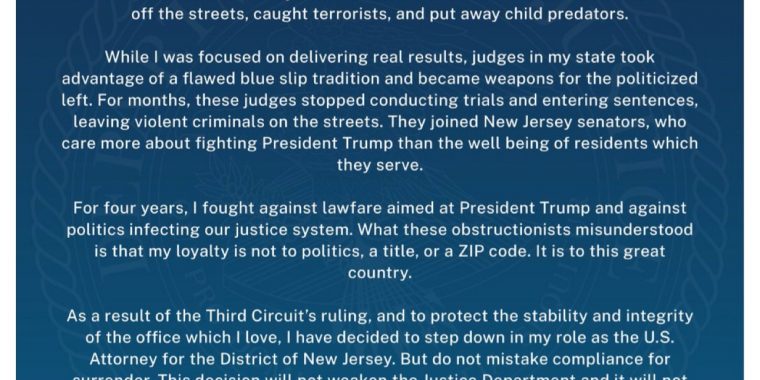
Alina
Habba
announced
today
that
she
is
“stepping
down”
from
her
position
as
Acting
U.S.
Attorney
for
the
District
of
New
Jersey.
Which
is
a
creative
way
to
describe
leaving
a
job
that
the
federal
courts
have
ruled
she
doesn’t
actually
hold.
Habba,
the
parking
garage
lawyer
plucked
from
obscurity
by
Donald
Trump
to
help
him
rack
up
a
million
dollars
in
sanctions,
had
served
as
Interim
U.S.
Attorney
for
the
District
of
New
Jersey
until
the
statutory
120-day
limit
on
that
post
expired.
At
that
point,
without
a
duly
confirmed
U.S.
Attorney,
the
district
judges
fulfilled
their
legal
duty
and
appointed
one.
Meanwhile,
the
administration
gave
Habba
the
job
as
First
Assistant
and
pretended
that
she
took
over
as
Acting
U.S.
Attorney
at
that
point.
The
courts
disagreed
and
most
recently
the
Third
Circuit
affirmed
that
decision.
Habba
has
now
pretended
to
resign
the
job
she’s
been
pretending
to
have.
Hardly
the
most
consequential
takeaway,
but
the
decision
to
write,
“my
loyalty
is
not
to…
a
ZIP
code,”
followed
by
“you
can
take
the
girl
out
of
New
Jersey,
but
you
cannot
take
New
Jersey
out
of
the
girl,”
suggests
the
statement
went
through
exactly
as
many
drafts
as
you’d
expect.
The
Third
Circuit
affirmed
what
Judge
Matthew
Brann
ruled
back
in
August:
you
cannot
play
an
elaborate
game
of
musical
chairs
with
interim
appointments
and
“special
attorney”
designations
to
circumvent
the
Senate
confirmation
process.
The
whole
point
of
the
Federal
Vacancies
Reform
Act
is
to
prevent
exactly
this
kind
of
patronage
appointment
of
unqualified
loyalists.
Now,
with
an
appellate
court
confirming
what
we
all
already
knew,
the
Habba
experiment
is
finally
over.
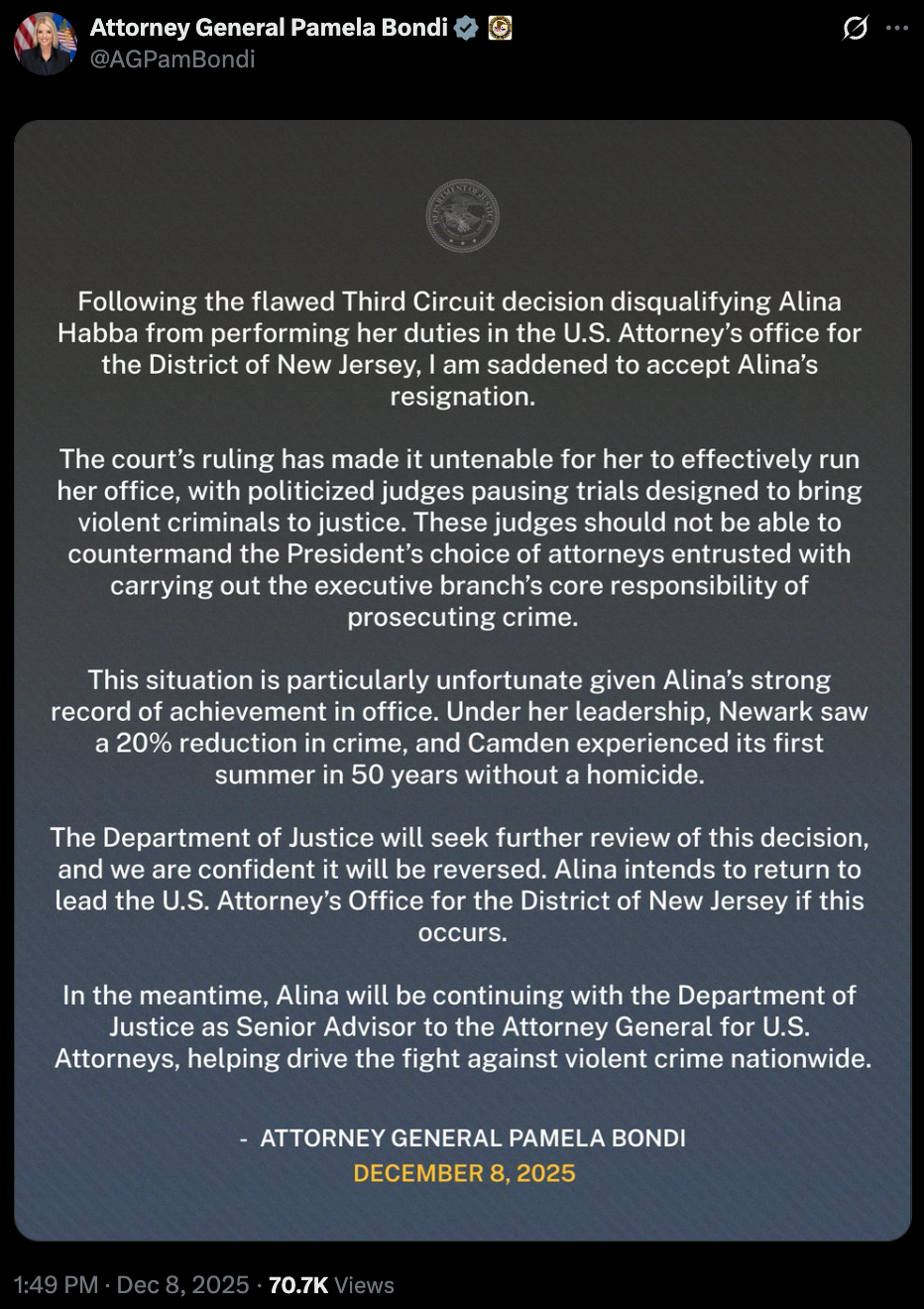
OR
IS
IT?!?
Three
minutes
after
Habba’s
announcement,
we
have
Attorney
General
Pam
Bondi
purporting
to
accept
Habba’s
resignation
while
claiming
that
the
DOJ
is
appealing
the
Third
Circuit
opinion
and
bringing
Habba
back
if
they
win.
How
is
this
not
moot?
Thankfully
for
Habba,
the
Pam
Bondi
School
for
Wayward
Lawyers
still
has
a
home
for
her.
Like
Ed
Martin,
the
proposed
U.S.
Attorney
for
D.C.
that
even
the
Republicans
refused
to
back,
who
fell
backward
into
a
made-up
“weaponization
working
group”
job
in
the
DOJ
to
harass
Trump’s
political
rivals,
Habba
will
get
a
new
DOJ
title
as
a
“Senior
Advisor”
to
“drive
the
fight
against
violent
crime
nationwide.”
Habba
leaves,
much
like
Kramer
left
Brandt
Leland:
Corporate
law
departments
have
embraced
their
inner-DIY
urge.
Thankfully,
instead
of
attempting
to
gut
their
kitchens
after
binging
HGTV,
these
lawyers
have
channeled
this
into
doing
more
and
more
of
their
own
legal
work
and
using
their
newfound
independence
to
overhaul
their
outside
counsel
relationships.
And,
as
one
might
suspect
for
a
story
in
2025,
AI
is
involved.
The
2025
Harbor
Law
Department
Survey,
conducted
in
collaboration
with
CLOC,
dropped
this
morning.
Pulling
insights
from
135
corporate
law
departments
representing
companies
with
a
median
revenue
of
$13
billion,
the
survey
indicates
a
power
shift
underway
with
GCs
capturing
the
upper
hand.
Biglaw
isn’t
going
out
of
business
any
time
soon,
but
58
percent
of
surveyed
legal
departments
expected
to
increase
their
outside
counsel
spend
last
year.
This
year,
only
37
percent
project
sending
more
money
to
the
firms.
Economic
uncertainty
probably
accounts
for
some
of
the
depressed
spending,
but
the
dropoff
is
too
significant
to
fully
blame
on
tariffs
and
federal
mismanagement.
GCs
keep
bringing
work
in-house.
In
itself,
this
isn’t
unprecedented.
Much
like
those
HGTV
viewers,
every
few
years
a
bunch
of
in-house
lawyers
get
convinced
that
they
can
save
some
money
handling
the
work
of
outside
professionals.
Whether
it’s
the
Property
Brothers
replacing
a
load-bearing
wall
or
Cravath
drafting
a
cease
and
desist,
there
will
be
someone
out
there
to
confidently
declare,
“I’m
pretty
sure
I
could
do
that.”
In
legal,
that
trend
will
last
a
year
or
so
and
then
clients
start
ticking
up
outside
spend
again.
The
difference
this
time
is
scale.
Almost
two-thirds
of
legal
departments
reported
intentionally
bringing
more
work
inside
over
the
past
two
years.
Which
just
so
happens
to
coincide
with
the
two
years
where
the
conversation
around
AI
leapt
from
nerdy
diversion
to
magic
productivity
box.
According
to
the
survey,
law
departments
embraced
the
change,
with
85
percent
indicating
that
they
have
dedicated
resources
to
managing
AI
initiatives,
with
live
or
piloting
solutions
for
general
productivity
(74%),
summarization
(56%),
legal
research
(54%),
content
creation
(54%),
and
contract
intelligence
(49%).
Beyond
reducing
outside
workload,
this
DIY
spirit
enables
a
reboot
of
the
whole
outside
counsel
relationship.
The
billable
hour
continues
to
cling
to
life
like
a
Boomer
clings
to
a
multimillion
dollar
property
they
bought
for
$15K
in
the
70s,
but
time
is
starting
to
chip
away
at
its
tenacity.
As
AI
transfers
more
leverage
to
clients,
law
departments
are
negotiating
more
budget
projection-friendly
alternative
fee
arrangements.
Over
three-quarters
of
respondents
now
use
AFAs.
Some
69
percent
have
convergence
or
preferred
provider
panels,
a
jump
from
50
percent,
reflecting
a
shift
toward
deeper
and
more
easily
managed
client
relationships.
“Departments
are
shifting
from
reactive
cost-containment
to
structured
operational
strategies
—
optimizing
outside
counsel,
implementing
workflow
technologies,
and
building
robust
AI
governance,”
said
Lauren
Chung,
survey
editor
and
Practice
Group
Lead,
Strategy
+
Transformation
at
Harbor.
“The
emphasis
on
legal
operations
and
technology
strategy
underscores
that
transformation
is
now
a
defining
capability
of
leading
corporate
law
departments.”
Which
is
consultant-speak
for
“clients
now
have
the
tools
to
actually
enforce
accountability.”
Partner
wants
to
push
back
on
fixed
fees?
Fine,
we’ll
keep
it
in-house.
Firm
balking
at
joining
the
preferred
panel
on
your
terms?
Plenty
of
other
firms
will
jump
at
becoming
one
of
our
go-to
firms.
That
5%
rate
increase
you
want?
Let
me
check
what
our
AI
budget
could
do
with
that
money
instead.
Now,
these
legal
departments
need
to
maintain
a
clear-eyed
assessment
of
their
AI-fueled
capabilities.
The
appointed
prophets
of
AI
swear
that
there’s
no
task
that
their
miracle
devices
can’t
tackle
while
we
sit
back
and
count
the
sanctions.
Playing
hardball
with
the
professionals
is
a
lot
easier
before
you’ve
accidentally
flooded
the
basement.
“Legal
leaders
are
no
longer
simply
exploring
AI,
they’re
deploying
it
to
unlock
productivity,
accelerate
legal
research,
and
enhance
content
and
contract
workflows,”
said
Jaime
Woltjen,
Senior
Director
of
Strategy
+
Transformation
at
Harbor.
“At
the
same
time,
departments
are
thoughtfully
building
governance
frameworks
to
ensure
responsible
and
secure
use.”
Much
of
that
task
is
falling
on
the
Legal
Ops
professionals,
who
reported
their
three
top
priorities
over
the
next
year
as
technology
strategy
(80%),
financial
management
(72%),
and
outside
counsel
management
(62%).
Notice
how
neatly
those
priorities
align.
A
technology
strategy
to
improve
financials
and
build
leverage
over
outside
counsel.
Quite
the
battle
plan
for
the
Legal
Ops
warriors.
While
Biglaw
continues
charting
its
own
AI
adoption,
it
needs
to
keep
an
eye
on
the
clients,
because
rate
increases
are
going
to
get
a
lot
harder
to
sell
when
the
client
has
the
same
power
tools.
Cravath Class
of
2025:
$15K
/
$6K
(prorated) Class
of
2018:
$115K
/
$25K
November
18,
2025
None
December
12,
2025
Paul
Hastings Class
of
2024:
$20K
/
$6K Class
of
2018+:
$115K
/
$25K
November
18,
2025
2000
hours
Undisclosed
Cadwalader Class
of
2025:
$15K
/
$6K
(prorated) Class
of
2017:
$115K
/
$25K
November
18,
2054
Additional
bonuses
“equal
to
120%
of
[market
bonuses]”
for
high
billers
with
2200
hours
or
more
By
or
before
end
of
February
2026
Fried
Frank Class
of
2025:
$15K
/
$6K
(prorated) Class
of
2018+:
$115K
/
$25K
November
19,
2025
1850
hours
for
special
bonus
(including
billable,
pro
bono,
qualified
nonbillable,
and
firm
matter
hours);
associates
eligible
for
“premium”
bonus
ranging
from
$3K
to
$34.5K
for
2200
hours
or
2450
hours
2000
hours
(merit
bonuses
available
for
eligible
associates;
“two-thirds”
of
legacy
MWE
associates
will
see
bonuses
above
market)
December
26,
2025
(legacy
MWE)
/
January
16,
2026
(legacy
SRZ)
Dechert Class
of
2024:
$20K
/
$6K Class
of
2018+:
$115K
/
$25K
November
19,
2025
1950
hours
(client
billable,
pro
bono,
firm
as
client,
maximum
of
50
community
hours);
associates
who
exceeded
hours
expectations
eligible
to
receive
an
“extraordinary”
bonus
(i.e.,
2200
hours
=
addt’l
30%;
2400+
hours
=
addt’l
40%)
By
or
before
end
of
January
2026
Wilkinson
Stekloff Class
of
2025:
$22.5K
/
$0
spring
bonus Class
of
2017+:
$172.5K
/
$60K
spring
bonus
November
19,
2025
None
By
December
15,
2025
Ropes
&
Gray Class
of
2025:
$15K
/
$6K
(prorated) Class
of
2017+:
$130K
/
$25K
November
20,
2024
1900
creditable
hours
(bonuses
“may
be
increased
up
to
150%
of
the
year-end
bonus
amounts”
for
those
who
have
billed
“materially
more”
than
1900
hours)
Undisclosed
Hogan
Lovells Class
of
2024:
$20K
/
$6K Class
of
2018+:
$115K
/
$25K
November
20,
2025
2000
hours;
additional
bonuses
available
include
incremental
hours-based
bonuses,
discretionary
bonuses,
and
business-generation
bonuses
End
of
December
2025
Vartabedian
Hester
&
Haynes Class
of
2025:
$21K
(total
bonus,
including
$5K
summer
bonus) Class
of
2018:
$140K
(total
bonus,
including
$5K
summer
bonus)
November
20,
2025
1800
hours
On
or
before
December
31,
2025
Paul
Weiss Class
of
2025:
$15K
/
$6K Class
of
2018+:
$115K
/
$25K
November
21,
2025
None
(additional
discretionary
bonuses
for
“outsized
contributions”)
December
22,
2025;
discretionary
bonuses
to
be
paid
in
early
2026
Proskauer Class
of
2025:
$15K
/
$6K
(prorated) Class
of
2017:
$115K
/
$25K
November
21,
2025
2000
hours
On
or
before
December
24,
2025
Baker
Botts Class
of
2024:
$20K
/
$6K Class
of
2018+:
$115K
/
$25K
November
21,
2025
2000
hours
(1800
client
billable
hours
and
200
non-client
billable
hours,
including
pro
bono,
business
development,
etc.);
“enhanced”
bonuses
available
for
“exceptional”
performance
Undisclosed
Davis
Polk Class
of
2025:
$15K
/
$6K
(prorated) Class
of
2018+:
$115K
/
$25K
November
21,
2025
None
December
30,
2025
White
&
Case Class
of
2025:
$15K
/
$6K
(prorated) Class
of
2018:
$115K
/
$25K
November
21,
2025
Eligibility
criteria
detailed
in
separate
memo
February
13,
2026
Debevoise Class
of
2025:
$15K
/
$6K
(prorated) Class
of
2018+:
$115K
/
$25K
November
21,
2025
None
Undisclosed
Skadden Class
of
2025:
$15K
/
$6K Class
of
2018+:
$115K
or
$125K
/
$25K
November
21,
2025
1800
“productive
hours”
(including
unlimited
pro
bono
time
and
up
to
150
hours
of
productive
non-billable
work)
December
15,
2025
Cleary Class
of
2025:
$15K
/
$6K
(prorated) Class
of
2018+:
$115K
/
$25K
November
21,
2025
None
December
19,
2025
A&O
Shearman Class
of
2025:
$15K
/
$6K
(prorated) Class
of
2018+:
$115K
/
$25K
November
21,
2025
2000
hours
(including
a
minimum
of
25
pro
bono
hours
and
up
to
100
investment
hours
(e.g.,
DEI/mental
health;
personal
development/training;
community
involvement;
management
&
talent
development;
knowledge
development;
origination,
client
relationships,
business
development;
and
market
innovation
group));
associates
eligible
for
an
“enhanced
year-end
bonus”
if
they
“significantly
exceed”
the
firm’s
hourly
requirements
Undisclosed
Covington Class
of
2025:
$15K
/
$6K Class
of
2018+:
$115K
/
$25K
November
21,
2025
1950
hours
(including
pro
bono
and
up
to
50
DEI
hours)
January
2026
Vinson
&
Elkins Class
of
2025:
$15K
/
$6K
(prorated) Class
of
2018+:
$115K
/
$25K
November
24,
2025
Based
on
hours
and
good
standing
On
or
about
January
30,
2026
Simpson
Thacher Class
of
2025:
$15K
/
$6K
(prorated) Class
of
2018:
$115K
/
$25K
November
24,
2025
Undisclosed
December
2025
Milbank Class
of
2025:
$15K
/
$6K
(paid
9/25) Class
of
2017:
$115K
/
$25K
(paid
9/25)
November
24,
2025
None
December
31,
2025
Willkie
Farr Class
of
2025:
$15K
/
$6K
(prorated) Class
of
2018+:
$115K
/
$25K
November
24,
2025
None
December
31,
2025
Weil
Gotshal Class
of
2025:
$15K
/
$6K
(prorated) Class
of
2018+:
$115K
/
$25K
November
25,
2025
None
January
30,
2026
Holwell
Shuster Class
of
2025:
$15K
/
$6K
(prorated) Class
of
2018:
$115K
/
$25K
November
25,
2025
None
On
or
before
December
31,
2025
Linklaters Class
of
2025:
$15K
/
$6K
(prorated) Class
of
2018+:
$115K
/
$25K
November
26,
2025
1900
hours
(including
unlimited
pro
bono,
up
to
400
hours
of
marketing,
and
other
work)
Undisclosed
Clifford
Chance Class
of
2025:
$15K
/
$6K
(prorated) Class
of
2018+:
$115K
/
$25K
November
26,
2025
None
(based
on
overall
performance,
quality
of
work,
contributions
to
firm,
teamwork,
and
pro
bono)
January
15,
2026
Perkins
Coie Class
of
2025:
$6K Class
of
2018+:
$25K
November
26,
2025
Undisclosed;
year-end
bonuses
announced
separately
December
31,
2025
Sidley Class
of
2024:
$15K
/
$6K Class
of
2017:
$115K
/
$25K
December
1,
2025
2000
hours
required
for
base
bonuses;
associates
with
“higher
productivity
and/or
exceptional
performance”
will
receive
additional
bonuses,
up
to
“more
than
50%
above
base
bonus”
2000
hours
for
base
bonus
(associates
who
record
1950
hours
will
receive
a
partial
bonus;
associates
who
record
2200
and
2400
hours
will
receive
110%
and
120%
of
the
market
bonus);
2000
hours
for
special
bonus
January
16,
2026
McKool
Smith Class
of
2025:
$15K
/
$6K
(prorated) Class
of
2018:
$115K
/
$25K
December
2,
2025
Undisclosed;
high
billers
will
receive
additional
bonus
money,
with
some
exceeding
the
market
scale
more
than
35%;
firm
previously
awarded
Thanksgiving
bonuses
based
on
tenure
at
the
firm
(ranging
from
$2.5K
to
$10K)
December
19,
2025
Cahill Class
of
2025:
$15K
/
$7.5K
(prorated) Class
of
2017:
$115K
/
$40K
December
4,
2025
Undisclosed;
select
associates
in
Classes
of
2018-2022
who
have
demonstrated
“extraordinary”
performance
eligible
for
a
“super
bonus”
up
to
$200K
(based
on
performance
and
seniority)
in
lieu
of
special
bonus
Second
half
of
January
2026
Katten Class
of
2025:
$15K
/
$6K
(prorated) Class
of
2018+:
$115K
/
$25K
December
4,
2025
2000
hours
(2100
hours
for
$16.5K-$126.5K;
2200
hours
for
$18K-$138K;
2300
hours
for
$19.5K-$149.5K;
2400
hours
for
$22.5K-$172.5K);
additional
“superstar”
bonuses
available
Undisclosed
Orrick Assoc
Year
1:
$15K
/
$6K
(prorated) Senior
Assoc
Year
2+:
$115K
/
$25K
December
4,
2025
Overmarket
merit
bonuses
for
those
who
have
displayed
“exceptional
performance”
December
31,
2025
(special
bonuses);
mid-February
2025
(merit
bonuses)














 Kathryn