(Photo
by
Michael
Buckner/Variety
via
Getty
Images)
Last
week,
the
White
House
decided
to
release
a
Juno-backed
musical
montage
of
ICE
arresting
people
on
Twitter.
Having
none
of
it,
Sabrina
Carpenter
took
to
the
site
to
call
the
video
evil,
disgusting,
and
suggested
that
the
ICE
arrests
were
part
of
an
“inhumane
agenda.”
3
for
3
honestly.
But
the
biggest
numbers
involved
the
ratio
—
Sabrina’s
fuck-off
message
got
orders
of
magnitude
more
support
than
the
White
House’s
attempt
at
socially
relevant
propaganda.
They’ve
since
deleted
the
video
and
moved
on
from
Juno,
but
they’re
still
hung
up
on
Sabrina
Carpenter.
They
can
try
the
ignore
the
loss
and
throw
another
punch
strategy,
but
the
internet
never
forgets:
Little
cringe
to
see
the
White
House
play
scorned
fangirl
with
a
pop
star
who
didn’t
want
to
be
associated
with
bottom
of
the
barrel
ICE
agents,
but
fully
in
the
realm
of
expectation
for
this
administration.
Cease-and-desist
crisis
averted,
I
guess.
That
said,
this
does
set
SNL
up
to
do
something
very
funny.
SNL
has
yet
to
respond
with
a
“stop
being
evil
and
keep
my
name
out
of
it”
post,
but
the
people
are
doing
a
great
job
of
dragging
the
White
House’s
social
media
through
the
mud
in
the
meantime:
Personally,
I
can’t
wait
for
SNL
to
file
a
cease
and
desist
against
the
administration;
it
would
make
them
the
first
comedy
show
to
make
ATL’s
“DO
NOT
PLAY
AT
RALLY
PLAYLIST,’
which
you
can
listen
to
here:
Chris
Williams
became
a
social
media
manager
and
assistant
editor
for
Above
the
Law
in
June
2021.
Prior
to
joining
the
staff,
he
moonlighted
as
a
minor
Memelord™
in
the
Facebook
group Law
School
Memes
for
Edgy
T14s
.
He
endured
Missouri
long
enough
to
graduate
from
Washington
University
in
St.
Louis
School
of
Law.
He
is
a
former
boatbuilder
who
is
learning
to
swim, is
interested
in
critical
race
theory,
philosophy,
and
humor,
and
has
a
love
for
cycling
that
occasionally
annoys
his
peers.
You
can
reach
him
by
email
at [email protected]
and
by
tweet
at @WritesForRent.
Call
me
a
skeptic
from
the
start: If
you
wanted
to
keep
criminals
from
bringing
cocaine
into
the
United
States,
then
you’d
work
with
our
allies,
rather
than
work
alone;
you’d
secure
evidence,
rather
than
destroy
it;
you’d
capture
and
interrogate
suspects,
rather
than
bomb
them;
and
you’d
work
your
way
up
to
the
ringleaders
of
a
cartel,
and
then
go
after
them.
Voila! Real
progress
in
your
new
war
on
drugs.
But
the
Trump
administration
has
chosen
to
go
after
supposed
drug
traffickers
from
Venezuela
exactly
the
opposite
way: The
United
States
works
alone;
we
blow
up
boats
with
evidence
aboard;
we
kill
suspects;
we
make
no
effort
to
work
our
way
up
the
criminal
chain.
Trump
can
say
the
operation
off
the
shores
of
Venezuela
is
meant
to
stop
crime,
but
it’s
nothing
of
the
sort. It’s
an
effort
to
appeal
to
emotionally
underdeveloped
morons
who
feasted
on
“Dirty
Harry”
films
in
their
youth
and
think
it’s
cool
when
vigilantes
kill
the
bad
guys.
I
don’t
feel
so
lucky.
The
strike
that’s
gotten
Secretary
of
Defense
Pete
Hegseth
into
hot
water
is
remarkable. The
military
blew
up
a
boat,
killing
nine
people
and
leaving
two
alive. The
alleged
drug
boat
was
apparently
split
in
two. The
two
survivors
were
clinging
to
the
top
of
a
capsized
piece
of
a
boat
trying
to
right
it. The
admiral
in
charge
of
the
mission
decided
that
the
two
survivors
might
radio
for
help,
collect
some
floating
bales
of
cocaine,
and
continue
their
effort
to
smuggle
drugs. Because
the
two
might
radio
for
help,
they
were
not
“out
of
combat”
and
remained
a
legitimate
target. The
admiral
ordered
the
two
killed
in
a
follow-up
strike.
Hegseth
had
seemingly
left
the
room
by
the
time
the
second
strike
occurred.
Can
you
find
the
mistakes
in
this
picture?
Go
ahead;
make
my
day.
First,
Hegseth
is
the
clown
with
the
intelligence
of
a
12-year-old
overseeing
this
operation. A
few
months
back,
he
tried
to
prove
that
he
was
important
by
sharing
secret
messages
about
a
forthcoming
strike
in
Yemen
in
a
Signal
chat
with
other
people: “I’m
the
Secretary
of
Defense!
I
know
some
confidential
things,
and
I’m
going
to
prove
that
I’m
cool! Let
me
share
some
secrets
with
you!”
The
guy
with
this
mindset
decides
that
he
doesn’t
want
to
stay
in
the
room
to
watch
the
follow-up
strike,
but
instead
voluntarily
walks
off
to
attend
to
more
important
business?
Maybe.
Second,
the
admiral
and
others
remaining
in
the
room
can’t
contact
the
Secretary
when
they’re
deciding
whether
to
make
a
follow-up
strike. I
guess
the
SecDef
doesn’t
have
either
a
cell
phone
or
a
military
aide
nearby
when
he’s
in
the
Pentagon. I
sure
hope
no
war
starts
when
Hegseth
is
in
the
Pentagon:
“Where’s
the
Secretary? It’s
an
emergency!”
“Damned
if
I
know.”
“Anyone
got
his
phone
number?”
“He
doesn’t
carry
a
phone.”
“Can
we
contact
him
through
one
of
his
aides?”
“We
don’t
have
his
aides’
phone
numbers
either.”
And
the
conversation
stops,
because
the
Pentagon
was
nuked
while
the
military
rooted
around
trying
to
find
the
missing
Hegseth.
Are
you
buying
it?
But
accept
it
all.
Hegseth
has
left
the
room. The
remaining
folks
in
the
room
can’t,
or
don’t
want
to,
contact
Hegseth. The
admiral
looks
at
the
situation
and
draws
some
conclusions: Two
guys
are
clinging
to
the
top
of
a
capsized
boat. Admittedly,
the
two
hadn’t
committed
a
“hostile
act,”
and
they
hadn’t
“attempt[ed]
to
escape,”
which
are
the
actions
that
the DOD
Law
of
War
Manual says
might
allow
targeting
them. But
the
shipwrecked
men
might
try
to
radio
for
help
(if
they
have
a
radio
on
top
of
their
capsized
boat)
or
otherwise
flag
down
help. The
admiral
thinks
this
means
the
two
men
are
trying
to
re-enter
combat,
which
justifies
killing
them.
Really? If
I
were
clinging
to
the
top
of
a
capsized
boat
in
the
open
ocean,
I’d
try
to
radio
(or
otherwise
call
for)
help
too,
not
because
I
wanted
to
get
back
in
the
fight,
but
because
I
was
clinging
to
the
top
of
a
capsized
boat
in
the
open
ocean,
for
chrissake! I
could
use
some
help. This
would
make
me
a
legitimate
military
target?
Finally,
for
the
military
to
make
its
case
to
the
American
people,
the
military
could
release
the
video
of
the
second
strike. Remember: The
military
voluntarily
chose
to
release
the
film
of
the
first
strike: Hegseth
played
the
video
when
he
bragged
about
the
strike
on
Fox
News,
and
Trump
later
also
showed
the
film.
(If
you
don’t
actually
show
the
film
to
the
public,
you
don’t
satisfy
the
bloodlust
of
your
emotionally
underdeveloped
vigilante
fans.)
It’s
thus
apparently
okay
to
release
the
film
of
the
first
strike. That
film
is
not
secret,
does
not
disclose
sources
and
methods
for
gathering
intelligence,
and
there’s
no
other
reason
to
keep
it
under
wraps.
Play
it
on
Fox
News.
But
when
the
public
asks
to
see
the
film
of
the
second
strike,
all
of
a
sudden
that’s
off
limits? (Or
at
least
it’s
still
off
limits
as
I’m
writing
this,
on
Saturday
afternoon. Perhaps
the
second
video
will
have
been
released
by
Monday.)
What
possible
justification
is
there
for
releasing
the
film
of
the
first
strike
and
then
withholding
the
film
of
the
second?
Unless,
maybe,
the
second
film
would
be
unhelpful
to
the
military’s
story.
I’m
not
a
military
lawyer. I’m
out
here
in
the
cheap
seats,
thinking
about
what
we’re
being
told,
what
makes
sense,
and
who’s
telling
the
truth.
Don’t
let
your
partisanship
cloud
your
vision.
Just
use
your
own
common
sense,
instead
of
your
bloodlust,
and
work
this
out
for
yourself.
Sometimes,
the
wheels
of
justice
turn
slowly.
Sometimes
they
move
at
warp
speed.
This
is
one
of
the
latter,
thanks
to
the
Justice
Department’s
shenanigans.
On
Saturday
evening,
Judge
Colleen
Kollar-Kotelly
effectively
sealed
the
evidence
in
the
government’s
case
against
former
FBI
director
James
Comey.
The
ruling
came
in
a
suit
filed
by
Daniel
Richman,
Comey’s
friend
and
sometimes
lawyer,
who
demanded
the
return
of
files
seized
from
him
in
2019
and
2020
as
part
of
the
“Arctic
Haze”
investigation
into
the
leak
of
national
defense
information.
The
government
closed
that
investigation
without
charge
and
should
have
destroyed
or
sealed
the
evidence
years
go.
Instead
it
simply
pulled
it
out
of
storage
and
dove
back
in
when
Trump
demanded
that
someone
indict
Comey.
The
DOJ
never
even
sought
a
new
warrant,
using
material
seized
from
Richman
five
years
ago
to
secure
the
now-dismissed
Comey
indictment.
The
legality
of
that
search
was
hotly
contested
this
year,
with
Magistrate
Judge
William
Fitzpatrick
assigned
to
adjudicate
Comey’s
demand
for
discovery
into
the
potential
illegal
search
and
exclusion
of
the
Richman
evidence.
The
case
was
dismissed
before
the
motion
was
adjudicated,
leaving
the
government
free
to
keep
looking
at
the
documents
without
having
to
justify
the
search.
For
the
time
being,
that’s
on
hold,
thanks
to
Judge
Kollar-Kotelly’s
order.
The
court
also
prodded
the
Justice
Department
to
quit
playing
games
and
enter
an
appearance
in
Richman’s
lawsuit,
citing
the
DOJ’s
intransigence
as
the
primary
reason
for
granting
Richman
ex
parte
relief.
After
a
week
ticked
by
with
no
response
from
the
Justice
Department,
Richman’s
counsel
emailed
Jocelyn
Ballantine,
Deputy
Chief
of
the
National
Security
section
at
the
US
Attorney’s
Office
in
DC.
He
asked
if
the
government
would
agree
not
to
paw
through
Richman’s
records
while
the
motion
was
being
adjudicated,
obviating
the
need
for
a
temporary
restraining
order.
Ballantine
promised
to
reach
out
to
her
superiors
at
Main
Justice
and
respond
by
the
close
of
business
on
Thursday,
but
Thursday
came
and
went
with
no
word.
At
9
p.m.,
Richman’s
lawyers
pinged
her
again,
and
Ballantine
replied
that
she’d
get
back
to
him
“early
next
week.”
To
be
fair
to
Ballantine,
she
was
pretty
busy
on
Thursday
with
the
criminal
complaint
against
the
DNC/RNC
pipe
bomb
suspect
Brian
Cole,
Jr.
But,
intentionally
or
not,
the
delay
had
the
effect
of
allowing
the
DOJ
extra
time
to
trawl
through
Richman’s
files.
And
the
DOJ’s
failed
effort
to
re-indict
New
York
Attorney
General
Letitia
James
—
also
on
Thursday!
—
made
it
clear
that
the
Trump
administration
is
hell
bent
on
carrying
out
the
president’s
revenge
edict,
despite
Lindsey
Halligan’s
disqualification.
“Absent
a
TRO,
the
government
may
continue
to
use
the
property
in
a
manner
that
violates
Professor
Richman’s
rights—particularly
in
light
of
recent
news
reports
that
the
DOJ
may
seek
a
new
indictment
of
Mr.
Comey,”
his
lawyers
wrote
in
the
application
for
emergency
relief
filed
Friday.
By
Saturday
evening,
their
request
was
granted.
Knock
it
off
and
show
up
In
a
brief,
four-page
order,
Judge
Kollar-Kotelly
held
that
Richman
is
likely
to
succeed
on
the
merits
of
his
Rule
41(g)
claim
for
return
of
property.
“The
Court
concludes
that
Petitioner
Richman
is
likely
to
succeed
on
the
merits
of
his
claim
that
the
Government
has
violated
his
Fourth
Amendment
right
against
unreasonable
searches
and
seizures
by
retaining
a
complete
copy
of
all
files
on
his
personal
computer
(an
‘image’
of
the
computer)
and
searching
that
image
without
a
warrant,”
she
wrote.
Ordinarily,
a
court
allows
the
party
opposing
a
motion
to
respond
before
entering
relief.
But
here,
Judge
Kollar-Kotelly
pointedly
dinged
the
DOJ
for
refusing
to
participate
in
the
case
in
an
official
capacity.
Eleven
days
after
the
suit
was
filed,
no
one
from
the
Justice
Department
has
bothered
to
enter
an
appearance.
This
is
particularly
egregious
since
the
US
Attorney’s
Office
has
been
in
contact
with
the
judge’s
chambers
and
Ballantine
participated
in
that
multi-day
colloquy
with
Richman’s
counsel.
The
government
can
hardly
claim
that
it’s
been
caught
unaware!
This
wheeze
allowed
investigators
to
keep
accessing
the
disputed
files,
while
avoiding
questions
about
their
location
and
custody
—
which
is
mighty
convenient,
in
light
of
news
reports
that
the
government
intends
to
re-indict
Comey
imminently.
“Given
that
the
custody
and
control
of
this
material
is
the
central
issue
in
this
matter,
uncertainty
about
its
whereabouts
weighs
in
favor
of
acting
promptly
to
preserve
the
status
quo,”
the
judge
wrote,
adding
that
“counsel
for
the
Government
may
move
to
dissolve
or
modify
this
Order
immediately
upon
entering
an
appearance,
and
the
Court
will
resolve
any
such
motion
as
promptly
as
justice
requires.”
The
government
will
remain
locked
out
of
the
files
through
at
least
Friday.
The
court
also
ordered
the
DOJ
to
enter
an
appearance
and
respond
to
Richman’s
motion
by
9
a.m.
Tuesday.
Now
to
find
some
assistant
US
Attorney
in
DC
willing
to
put
their
name
on
this
cursed
shitpile
and
explain
then
everything
that
went
down
here
is
very
cool
and
very
legal
…
Who
would
have
thought
that
in
2025,
Biglaw
firms
would
be
forced
onto
the
front
lines
in
a
battle
for
the
rule
of
law
against
the
president?
Faced
with
retaliatory
executive
orders,
four
firms
chose
to
challenge
the
unconstitutional
orders
in
court,
and
each
one
that
did
was
granted
summary
judgment.
One
of
those
firms
is
Jenner
&
Block,
and
after
a
year
of
protracted
litigation,
it’s
now
calling
attorneys
into
the
office
on
a
more
regular
basis.
Last
week,
the
firm
—
which
brought
in
$682,158,000
gross
revenue
in
2024,
putting
it
at
No.
83
on
the
most
recent
Am
Law
100
—
notified
associates
in
its
U.S.
and
London
offices
that
beginning
on
March
1.
2026,
they’d
be
expected
to
work
from
the
office
four
days
each
week,
on
Monday
through
Thursday.
The
firm
currently
requires
three
days
in
the
office
and
is
now
one
of
only
three
firms
ranked
in
the
Second
50
in
the
Am
Law
100
to
mandate
more
time
spent
on
site.
What
inspired
this
change?
The
American
Lawyer
has
additional
details:
The
firm’s
hiring
has
helped
lead
to
additional
investments
in
space,
which
the
memo
cites
in
making
the
change.
“If
we
are
going
to
invest
in
space,
we
need
to
use
it
fully.
Major
firms
across
the
legal
industry
are
increasingly
moving
to
4
and
5
days
in-office
attendance.
And
so,
as
we
invest
in
new
office
space,
stay
in-line
with
our
peers,
and,
most
importantly,
prioritize
the
interest
of
maintaining
the
Jenner
culture
that
sets
us
apart
and
carries
us
forward
on
behalf
of
our
clients
and
each
other,
we
believe
in-office
collaboration
is
essential
to
excellence
in
our
work
and
service,”
the
memo
stated.
As
soon
as
you
find
out
about
office
attendance
plans
at
your
firm,
please email
us (subject
line:
“[Firm
Name]
Office
Reopening”)
or
text
us
at (646)
820-8477.
We
always
keep
our
sources
on
stories
anonymous.
There’s
no
need
to
send
a
memo
(if
one
exists)
using
your
firm
email
account;
your
personal
email
account
is
fine.
If
a
memo
has
been
circulated,
please
be
sure
to
include
it
as
proof;
we
like
to
post
complete
memos
as
a
service
to
our
readers.
You
can
take
a
photo
of
the
memo
and
attach
as
a
picture
if
you
are
worried
about
metadata
in
a
PDF
or
Word
file.
Thanks.
Staci
Zaretsky is
the
managing
editor
of
Above
the
Law,
where
she’s
worked
since
2011.
She’d
love
to
hear
from
you,
so
please
feel
free
to
email
her
with
any
tips,
questions,
comments,
or
critiques.
You
can
follow
her
on Bluesky, X/Twitter,
and Threads, or
connect
with
her
on LinkedIn.
Senate
Finance
Committee
Chairman
Mike
Crapo
(R-Idaho)
and
Ranking
Member
Ron
Wyden
(D-Oregon)
introduced
a
bill
Thursday
that
aims
to
bring
more
transparency
into
the
practices
of
pharmacy
benefit
managers.
PBMs
have
come
under
a
lot
of
scrutiny
in
recent
years
due
to
their
vertical
integration
with
insurers
and
practices
that
inflate
drug
prices.
The
top
three
PBMs
—
CVS
Caremark,
Cigna’s
Express
Scripts
and
UnitedHealth
Group’s
Optum
Rx
—
control
about
80%
of
the
prescription
drug
market.
The
bill,
titled
the
PBM
Price
Transparency
and
Accountability
Act,
would
delink
PBM
compensation
from
negotiated
rebates.
This
would
disincentivize
PBMs
from
promoting
higher-priced
drugs.
It
would
also
increase
reporting
requirements
for
PBMs
to
Medicare
Part
D
plan
sponsors
and
HHS,
as
well
as
help
plan
sponsors
audit
their
PBMs.
In
addition,
it
would
strengthen
requirements
that
plan
sponsors
contract
with
any
willing
pharmacy
that
meets
standard
terms
to
protect
rural
independent
pharmacies
from
harmful
practices
and
closures.
It
would
also
mandate
retail
community
pharmacies
to
participate
in
the
National
Average
Drug
Acquisition
Cost
(NADAC)
survey
to
ensure
more
accurate
Medicaid
reimbursement
rates.
Lastly,
PBMs
would
be
required
to
pass
Medicaid
payments
directly
to
pharmacies
so
that
there
is
more
transparency
in
drug
costs
for
states
and
taxpayers.
“Pharmacy
benefit
managers
should
not
profit
from
overcharging
patients
for
their
prescriptions,”
said
Crapo
in
a
statement.
“This
bipartisan
legislation
is
a
decisive
step
toward
making
the
prescription
drug
market
easier
to
navigate
for
both
patients
and
pharmacies.
These
proposals
form
a
strong
foundation
for
additional
efforts
to
promote
pharmacy
access,
demystify
drug
pricing
and
reduce
costs
for
both
taxpayers
and
seniors.”
Wyden
echoed
these
comments.
“It’s
long
past
time
to
go
after
middlemen
who
are
making
Americans’
prescription
drugs
more
expensive,”
he
said.
“The
Finance
Committee
has
put
forward
a
comprehensive
approach
to
stop
the
pharmacy
benefit
manager
business
practices
that
are
harming
seniors
and
taxpayers
who
count
on
Medicare
to
deliver
affordable
prescription
drugs.
It’s
time
to
get
this
done.”
The
bill
was
co-sponsored
by
19
additional
senators,
including
John
Barrasso
(R-Wyoming),
Michael
Bennet
(D-Colorado),
Marsha
Blackburn
(R-Tennessee),
Catherine
Cortez
Masto
(D-Nevada)
and
Bill
Cassidy
(R-Louisiana).
Numerous
efforts
have
been
attempted
to
rein
in
pharmacy
benefit
managers,
though
few
have
actually
come
to
fruition.
For
example,
last
year,
the
federal
government
almost
passed
a
spending
bill
that
would
have
cracked
down
on
PBMs,
but
this
provision
was
taken
out
at
the
last
minute.
States
have
also
taken
their
own
steps.
California
recently
passed
a
law
that
will
regulate
PBMs.
Arkansas
also
passed
a
law
that
would
ban
PBMs
from
owning
pharmacies,
but
a
federal
judge
has
blocked
this
from
being
enacted.
Serious
Case,
Extremely
Not-Serious
Caption:
Get
ready
to
giggle
like
you’re
12-years
old
again.
“Shrug”
Is
Not
Really
The
Response
Anyone
Who
Cares
About
The
Rule
Of
Law
Wanted
To
Hear:
The
disciplinary
(non)
case
against
Lindsay
Halligan.
Say
What
You
Want
About
Kim
Kardashian’s
Quest
To
Become
An
Esquire:
But
it
sure
isn’t
a
reason
to
get
*rid*
of
the
bar
exam.
Quite
the
opposite,
actually.
USC
Law
Drama:
The
divorce
that
launched
a
Title
IX
investigation,
a
federal
lawsuit,
and
lots
of
intrigue.
2025
Is
Weird,
But
I
Didn’t
Have
Digging
Up
A
Supreme
Court
Justice’s
Bones
On
My
Bingo
Card:
Conservative
legal
analysts
may
have
lost
the
plot.
Todd
Blanche
Chilling
Warning
To
White-Collar
Lawyers:
Shut
up
or
else.
Trial
Lawyer.
Fact
Witness:
Alex
Spiro
can
do
it
all.
All
The
Latest
Biglaw
Bonus
Info:
In
one
convenient
place.
The
Ministry
of
Industry
and
Commerce
has
directed
the
Competition
and
Tariff
Commission
(CTC)
and
the
National
Competitiveness
Commission
(NCC)
to
conduct
a
study
to
better
understand
capacities
across
the
value
chain
and
problems
limiting
linkages
between
its
various
stages.
The
government
has
proposed
to
raise
by
300
per
cent
the
customs
duty
on
selected
imported
PSF
with
dyed
woven
fabrics
of
cotton
to
support
domestic
production
and
strengthen
the
cotton-to-clothing
value
chain.
The
proposal
was
announced
by
Finance,
Economic
Development
and
Investment
Promotion
Minister
Mthuli
Ncube
while
presenting
the
budget
recently.
“I,
further
propose
to
review
materials
benefitting
from
the
clothing
manufacturers
rebate
to
exclude
the
above-mentioned
fabrics,
subject
to
quality
and
competitive
pricing
from
local
manufacturers.
These
measures
take
effect
from
January
1,
2026,”
he
said.
According
to
the
Zimbabwe
Clothing
Manufacturers
Association
(ZCMA)
chairman
Jeremy
Youmans,
it
is
too
early
to
implement
these
measures
as
the
study
results
are
yet
to
be
released.
“The
intended
duty
of
40
per
cent
should
only
apply
to
finished
goods,
not
fabric,
which
is
a
raw
material
for
the
clothing
industry
and
an
intermediate
goods
for
home
textile
manufacturers,”
Youmans
was
quoted
as
saying
by
domestic
media
reports.
“The
additional
$2.50
per
kg
can
make
the
duty
rate
rise
to
between
60
and
90
per
cent
depending
on
the
weight
of
the
fabric,”
he
added.
Meanwhile,
the
Zimbabwe
Textile
Manufacturers
Association
(ZITMA)
hailed
the
government’s
proposal,
saying
more
needs
to
be
done.
The
issue
of
second-hand
clothing
must
be
decisively
dealt
with
as
it
continues
to
play
havoc
with
the
market,
ZITMA
said.
Zimbabwe’s
economy
is
projected
to
rebound
strongly
in
2025
with
an
estimated
6.6%GDP
growth
due
to
robust
growth
in
agriculture,
services,
and
continued
investments
in
mining
and
steel,
according
to
the
new Zimbabwe
Economic
Update: Fostering
a
Business-Enabling
Regulatory
Environment
for
Private
Sector
Growth,
published
on
December
2,
2025.
This
growth
outpaces
many
peers
in
the
Sub-Saharan
Africa
region.The
medium‑term
growth
also
remains
positive,
anticipated
to
remain
elevated
at
5%
in
2026,
though
fiscal
slippages,
external
shocks,
and
climate-related
disasters
such
as
droughts
still
pose
significant
threats
to
the
current
stability.
Zimbabwe’s
tight
monetary
policy
since
late
2024
has
helped
improve
inflation
dynamics
and
stabilize
the
Zimbabwe
Gold
(ZiG)
currency.
Therefore,
inflation
is
expected
to
moderate
to
single
digits
in
2026
and
decrease
further
to
5%
over
the
medium-term.
Poverty
is
expected
to
decline
gradually
as
growth
recovers,
but
remains
sensitive
to
weather
shocks
and
inflation,
with
rural
households
particularly
exposed
due
to
the
dependence
on
rain-fed
agriculture,
slow
off-farm
jobs,
and
inadequate
social
protection.
“Now
that
the
macroeconomy
is
improving,
the
Government’s
position
in
re-prioritizing
efforts
to
improve
the
ease
of
doing
business
to
improve
Zimbabwe’s
private
sector
growth
and
competitiveness
are
more
than
necessary
to
enhance
the
overall
growth
and
eventually
translate
economic
growth
into
lasting
economic
benefits,” says Victor
Steenbergen,
Senior
Country
Economist
for
Zimbabwe.
To
sustain
a
strong
economic
growth
momentum
for
Zimbabwe,
the
ZEU
recommends
the
following:
Implementation
of
the
policies
set
out
in
the
Economic
Reforms
Matrix
of
the
Structured
Dialogue
Platform
(SDP)
for
Arrears
Clearance
and
Debt
Resolution.
This
will
help
to
continue
macroeconomic
stability
and
enhance
growth.
Progress
on
the
SDP
also
provides
opportunities
to
help
unlock
affordable
external
credit
lines
and
stimulate
much-needed
public
and
private
sector
investment
to
boost
growth.
Continued
efforts
to
anchor
the
existing
price
and
exchange
rate
stability,
which
will
support
economic
growth
and
job
creation
while
avoiding
reversing
the
prevailing
stability
gains.
Sustained
implementation
of
the
Presidential
Ease
of
Doing
Business
Initiative,
to
improve
the
business
environment,
stimulate
investment,
and
promote
private
sector-led
growth
thereby
reinforcing
the
recent
gains,
boosting
competitiveness,
and
translating
economic
growth
into
lasting
economic
benefits.
The
ZEU
special
topic
“Fostering
a
Business-Enabling
Regulatory
Environment
for
Private
Sector
Growth”
analyzes
the
current
business
environment.
Case
studies
of
compliance
requirements
from
several
sub-sectors
show
significant
regulatory
burdens.
Analysis
in
agriculture,
agro-processing,
and
tourism
reveal
that
some
sub-sectors
face
up
to
28
different
legal
and
regulatory
requirements,
often
involving
multiple
government
ministries
and
agencies.
The
mapping
of
sectoral
business
regulations
provides
three
main
findings:
High
and
regressive
fee
burdens:
Compliance-related
fees
and
levies
often
generate
significant
monetary
costs
for
firms,
with
formal
requirements
in
certain
sectors
even
exceeding
annual
revenues
for
some
subsectors.
Inadequate
transparency
and
reliance
on
manual
processes:
Several
requirements
continue
to
rely
on
paper-based
processes
that
also
require
physical
visits
to
the
offices
of
relevant
Ministries,
Departments,
and
Agencies
(MDAs)
due
to
lack
of
readily
available
information
online
on
regulatory
requirements.
Overlapping
mandates:
Multiple
MDAs
often
issue
requirements
and
conduct
inspections
targeting
the
same
public
policy
goal,
creating
additional
procedural
and
cost
burdens
for
minimal
public
policy
gain.
The
ZEU
recognizes
the
notable
progress
on
the
recent
regulatory
reforms
by
the
Government
of
Zimbabwe
under
the
Presidential
Ease
of
Doing
Business
initiative,
which
among
others
is
addressing
the
current
complex
and
burdensome
regulatory
environment
especially
for
Small
and
Medium
Enterprises
(SMEs).
The
first
phase,
finalized
in
September
2025
with
analytical
support
from
the
World
Bank
Group,
focused
on
the
beef,
dairy,
stockfeed,
and
tourism
sectors,
leading
to
the
reduction
or
elimination
of
several
levies
and
fees.
To
further
support
the
Presidential
Ease
of
Doing
Business,
the
Government
of
Zimbabwe
should
complete
the
regulatory
stocktaking
and
regulatory
simplification
for
the
12
priority
sectors
in
the
next
12
months.
There
is
also
a
need
for
a
more
ambitious
medium-term
agenda
to
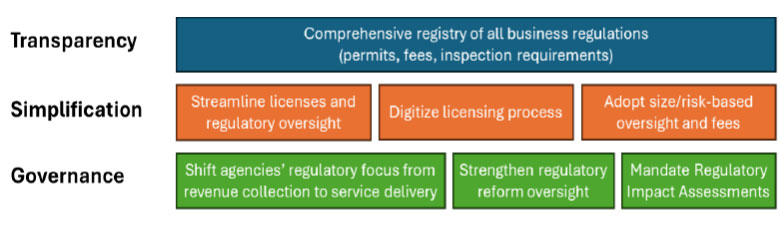
foster
Zimbabwe’s
business-enabling
environment,
which
focus
on
three
broad
pillars
of
transparency,
simplification,
and
governance
(Figure
1):
Regulatory
Transparency: Create
a
comprehensive
public
registry
of
licenses,
fees,
and
inspection
requirements
to
reduce
uncertainty
and
discretion
while
ensuring
that
all
this
information
is
regularly
updated,
and
accessible
to
firms
and
citizens.
Regulatory
Simplification: Consolidate
overlapping
procedures
and
inspections
and
adopt
risk‑based
and
size‑appropriate
compliance
regimes
to
lower
burdens
on
SMEs.
This
streamlining
will
help
lower
costs
for
firms,
while
allowing
regulators
to
allocate
resources
more
efficiently.
Regulatory
governance: Strengthen
central
oversight
of
regulatory
reforms
and
shift
agencies
towards
a
service‑delivery
mindset.
These
reforms
also
require
clarifying
institutional
mandates,
reviewing
agency
fee
structures,
and
ensuring
regulations
serve
the
public
interest
rather
than
institutional
revenue
needs.
Figure
1.
Key
policy
areas
to
foster
a
business-enabling
regulatory
environment
Effective
implementation
of
these
reforms—anchored
on
strong
institutional
leadership
and
improved
administrative
efficiency—can
lower
compliance
costs,
stimulate
firm
growth,
and
lay
the
foundation
for
a
more
competitive
and
inclusive
economy.
The
meeting,
organized
by
the
World
Council
of
Churches
(WCC)
Ecumenical
Disability
Advocates
Network,
gathered
25
leaders
from
the
Anglican
Church
of
Kenya,
the
Presbyterian
Church
of
East
Africa,
and
the
Reformed
Church
in
Zimbabwe.
“This
has
been
a
very
crucial
training
for
the
church
leaders
who
often
interact
daily
and
engage
with
persons
with
disabilities.
We
hope
that
after
this,
they
will
help
their
churches
and
congregations
ensure
inclusion
of
persons
with
disabilities,” said
Anjeline
Okola,
WCC
Ecumenical
Disability
Advocates
Network
coordinator.
“Adequate
engagement
with
the
churches
and
faith
actors,
who
remain
critical
partners
in
reaching
grassroots
communities,
is
very
important
and
at
the
core
of
work.”
From
25-27
November,
the
leaders
engaged
in
Bible
studies
and
theological
reflections,
assembled
in
groups,
and
explored
African
churches’
case
studies.
The
aim
was
to
give
them
a
theological,
legal,
and
practical
tool
to
enable
them
to
champion
for
disability
rights
in
work,
employment,
and
climate
change
adaptation.
Dr
Samuel
Kabue,
former
executive
secretary
of
the
WCC
Ecumenical
Disability
Advocates
Network,
told
the
training
that
the
UN
Convention,
adopted
in
2006,
has
since
received
a
lot
of
attention,
nearing
universal
ratification
by
the
UN
member
states.
At
the
same
time,
he
cautioned
that
the
convention
does
not
create
new
rights
but
provides
a
framework
for
persons
with
disabilities
to
enjoy
the
same
rights
as
other
people.
“Its
purpose
is
to
elaborate
in
detail
the
rights
of
persons
with
disabilities
and
set
out
a
code
of
implementation,” said
Kabue.
“To
ensure
that
the
convention
is
implemented,
there
is
a
need
for
continuous
oversight.
This
oversight
requires
the
involvement
of
all
stakeholders,
including
the
church
and
other
faith-based
organisations.”
He
encouraged
churches,
the
civil
society,
and
faith-based
organisations
to
join
organisations
of
persons
with
disabilities
in
the
preparation
of
the
parallel
report
or
even
to
have
their
own
reports,
alongside
those
of
states
that
have
ratified
the
convention.
In
the
action
plans
unveiled,
the
Anglican
Church
of
Kenya
plans
to
hold
sensitization
and
training
workshops
on
inclusion
and
awareness
creation,
assemble
disability
inclusion
committees
at
provincial,
diocese,
and
parish
levels,
and
develop
a
manual
on
disability
inclusion
policy.
The
Reformed
Church
in
Zimbabwe’s
action
plans
include
clergy
and
laity
orientation
and
training
on
the
conventions
provisions,
developing
an
inclusion
policy,
and
adopting
a
disability
inclusive
climate
change
strategy,
among
others.
Part
of
the
Presbyterian
Church
of
East
Africa
action
plan
includes
explaining
theological
statements,
including “A
Church
of
all
and
for
all”
and “The
Gift
of
being
and
the
UN
Convention
on
the
Rights
of
Persons
with
Disabilities.” It
will
also
focus
on
sustainable
agriculture
and
food
security,
and
disability,
among
other
issues.
Rev.
Zadock
Oluoch,
vicar
at
St
Augustine
Madaraka,
a
parish
of
the
Anglican
Church’s
All
Saints
Cathedral
Diocese,
said
that
after
years,
the
church
has
taken
a
turn
to
think
more
deeply
about
how
to
engage
persons
with
disabilities.
“Having
listened
to
different
denominations,
churches
present
here,
and
organizations
and
hearing
the
things
they
are
doing,
I
realize
there
is
a
needfor
partnerships,” said
the
cleric. “We
are
beginning
to
think
about
how
we
can
partner
so
that
we
avoid
duplication.”
Joyce
Matara,
acting
director
of
the
National
Association
of
Societies
for
Care
of
the
Handicapped,
Zimbabwe,
said
churches
needed
to
act
quickly
to
ensure
that
persons
with
disabilities
get
education
to
move
them
out
of
poverty,
enable
formal
employment,
and
empower
them
to
contest
for
leadership.
“The
organization
of
persons
with
disabilities
can
play
a
key
role
in
ensuring
churches
are
inclusive.
There
is
also
a
need
for
awareness
of
the
Convention
on
the
Rights
of
Persons
with
Disabilities
provision
and
other
conventions
like
the
African
disability
protocol,” said
Matara.