The Emerging Trends In Trade Secret Litigation

Has the coronavirus affected the volume of trade secret filings? What are the most active venues for trade secret cases? Who is the most active plaintiff? And are damage awards changing?

These are just a few of the questions addressed in Lex Machina and LexisNexis’s new Trade Secret Litigation Report,
which covers federal court trends from 2016-20. 

Click here for an infographic detailing its key findings.

The metrics in this report can help you decide whom to pursue as clients, whether to pursue a particular motion, or when to settle. 

You’ll learn:

  • Whether trade secret case filings have remained steady since 2017, even through the pandemic;
  • The judges and venues hearing the most cases;
  • The most active plaintiffs and plaintiffs firms;
  • The most active defense firms;
  • The frequency of settlement in trade secrets cases; and
  • The biggest awards — and trends in damages. 

Download the report report today.

(The full report is available free of charge as a complement to a Lex Machina product demo.)

A Warning To Summer Associates

We are deep into July and for law students hoping to start their career at a Biglaw firm, that means summer associateships.

There’s an old joke — it’s been making the rounds for more than 30 years — that paints a stark picture of the difference between being a summer associate and being a full-fledged associate.

A popular joke going around New York City law firms this summer tells of an old man who is accidentally sent to hell, only to be surprised by its splendor and tranquility.

Suddenly, he finds himself back on earth, where he commits every possible sin until he is banished to hell again. But this time it is as cruel as he had once imagined and he asks the Devil what happened.

”Oh, you must have been here for our summer associate program,” the Devil responds.

And, well, it’s still very, very true. And that joke has been updated for those Millennial/Gen Z cusp-ers living through their summer programs right now by Attorney Problems. And they message, as it always was, is be warned. Because it is… nothing like the Biglaw life that awaits you after graduation.


Kathryn Rubino is a Senior Editor at Above the Law, host of The Jabot podcast, and co-host of Thinking Like A Lawyer. AtL tipsters are the best, so please connect with her. Feel free to email her with any tips, questions, or comments and follow her on Twitter (@Kathryn1).

A Startup Visa: Now Or Never?

When I started my firm in 2009, I had no idea that 12 years later I’d have two books behind me and would be obsessed with changing law and policies.

As an immigrant, an immigration lawyer, and an entrepreneur, I get to see up close the incredible contributions my clients make to this country every day. They’re creating jobs. They’re innovating. They are making a difference.

During the 2008 recession, when many employers were laying people off, I had many clients and had met many international entrepreneurs who wanted to start their businesses in this country — but couldn’t. They couldn’t because a suitable visa for startup founders didn’t exist. And it still doesn’t.

Something similar, but on a lesser scale, occurred at the onset of the COVID-19 pandemic last year.  All of this has led me to become a fierce advocate for the startup visa.

In 2009, a bill was introduced in Congress to address the issue and, at the time, the idea for such a visa was still new.  It wasn’t long, however, before the value of such a visa became obvious, and the idea took hold, spreading widely, beyond the United States. By opening doors to international entrepreneurs, countries began to see immigration as a tool to boost their economies and create jobs.

Canada copied our first standalone startup bill, which Congress had introduced but failed to pass in 2010, and used it as a template to create its own. In 2013, that country implemented a startup visa which has generated economic and job growth. Since 2013, Canada has netted $3.7 million in capital investment and 68 new startups.

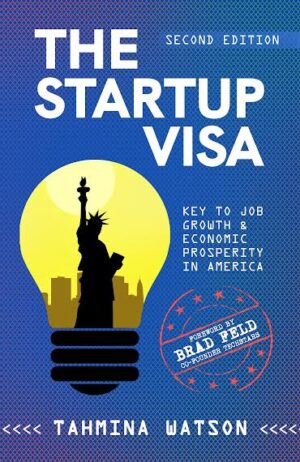
Many countries have since come to recognize immigration as an economic growth strategy. By 2015, when I wrote my first book, “The Startup Visa: Key to Job Growth and Economic Prosperity in America, there was a growing number of countries with startup visas or some variation of them. Chile is a great example.

Startup Chile’s VisaTech Program offered $40,000 in government funds to entrepreneurs who would build their companies there and hire local residents. As the program developed, not only did the country’s economy benefit, a new generation of Chileans also benefited by learning from foreign talent. Many of the recipients of the grants are now homegrown entrepreneurs who have learned about entrepreneurship and innovation. The results transcend the economy. The program has been replicated around the world.

In 2021, we have renewed hope for congressional reforms, and it is essential that the startup visa be included. However, the immigration reform bill introduced in Congress in February 2021 excluded any such a measure. And even though President Joe Biden revived the Obama era International Entrepreneur Rule, it is a regulatory stopgap. Without becoming part of the law, the regulation can be changed by future administrations.

As we try to ease our way out of this recession, we need jobs for Americans.  While there needs to be a multistrategy approach to job creation, immigration must be one of the strategies. And within that framework, the startup visa is a crucial element.

For these compelling and urgent reasons, the second edition of my book, The Startup Visa,” is out today. There’s an accompanying podcast series with leading national figures who all confirm, from their various perspectives, why we need a startup visa.

Coincidentally, the Immigration and Citizenship subcommittee of the House Judiciary committee of Congress held a hearing on July 13, 2021, titled “Oh, Canada! How Outdated U.S. Immigration Policies Push Top Talent to Other Countries.” Led by Rep. Zoe Lofgren of California, who in the past has introduced several measures to address this gaping hole in the immigration system, the hearing was informative and eye-opening.

Witnesses included Stuart Anderson, executive director of the National Foundation for American Policy, Jennifer Young, CEO, Technology Councils of North America, and Dr. Sudip Parikh, CEO and executive publisher, Science Journals, American Association for the Advancement of Science.

Their written testimonies and the recording of the hearing can be found here. I am proud that an advanced copy of my book made it into the record for this hearing.

Young stated that “[t]he United States is experiencing boiled frog syndrome. In 2019, foreign-born entrepreneurs in the United States declined by 4,400, the first annual drop since the year 2000.  We have been allowing other countries to pick up speed slowly but steadily to the point where more than 25 countries have modified their immigration policies to attract highly skilled immigrants and startups.”

Mr. Anderson gave examples, such as that of Zoom founder Eric S. Yuan, who had to “overcome the archaic system we have rather than use the immigration system in a positive way that a startup visa could do.” He noted a study by NFAP and the Kauffman Foundation that predicted Lofgren’s startup visa bill would have created between 1 million and 3.2 million jobs for Americans.

It is important to note that some House representatives stated that Americans see immigration as one big issue, most of it about the border. In my opinion, if people aren’t equating immigration with the economy, it means that more education is necessary to demonstrate the direct and unmistakable correlation.

If you are an immigrant, or somebody who cares about immigration; if you are an entrepreneur, a co-founder, or someone with immigrant heritage — whether first generation, fifth, or tenth, I invite you to listen to the podcast episode by Brad Feld, which was released today in honor of the book launch.

Co-founder of Techstars, Venture capitalist, author of multiple books on startups, and managing partner at Foundry Group, he wrote the foreword to my book. He talks about his own immigrant heritage, the talented entrepreneurs that inspired him to think about the startup visa and all his efforts to date. You will be inspired by his storytelling ability.

I hope you will read the book and agree that there’s no question that it is time for a startup visa — in America, for America.


Tahmina Watson is the founding attorney of Watson Immigration Law in Seattle, where she practices US immigration law focusing on business immigration. She has been blogging about immigration law since 2008 and has written numerous articles in many publications. She is the author of Legal Heroes in the Trump Era: Be Inspired. Expand Your Impact. Change the World and The Startup Visa: Key to Job Growth and Economic Prosperity in America.  She is also the founder of The Washington Immigrant Defense Network (WIDEN), which funds and facilitates legal representation in the immigration courtroom, and co-founder of Airport Lawyers, which provided critical services during the early travel bans. Tahmina is regularly quoted in the media and is the host of the podcast Tahmina Talks Immigration. She was recently honored by the Puget Sound Business Journal as one of the 2020 Women of Influence. You can reach her by email at tahmina@watsonimmigrationlaw.com or follow her on Twitter at @tahminawatson.

One Of World’s Richest Biglaw Firms Finally Adopts New Salary Scale

Another day, another global firm that’s decided to increase salaries for attorneys across the board. This is a trend that associates will never get tired of hearing about; after all, the only thing that lawyers love more than rankings is money. Which firm is the latest to adopt the prevailing Davis Polk salary scale?

That would be the U.S. branch of Eversheds Sutherland, an international firm that was declared the 10th richest firm in the world in Am Law’s most recent Global 200 ranking. According to a memo sent earlier this week by U.S. CEO Mark Wasserman, compensation changes are on the way for associates:

To reflect our markets and our standing as a premier global firm, we are pleased to announce we will be adjusting our base associate compensation sale for all U.S. offices. Entry level rising to $205,000 with upward adjustments to all level ranges and the Level 3 upper range rising to $350,000.

These changes are effective September 1, 2021 and will be retroactive to July 1, 2021.

Associates will have to wait a few months to see the extra cash, but as we keep repeating when it comes firms that are late to enact these salary changes, better late than never. Congratulations!

(Flip to the next page to see the memo from Eversheds Sutherland.)

We depend on your tips to stay on top of this stuff. So when your firm matches, please text us (646-820-8477) or email us (subject line: “[Firm Name] Matches”). Please include the memo if available. You can take a photo of the memo and send it via text or email if you don’t want to forward the original PDF or Word file.

And if you’d like to sign up for ATL’s Bonus Alerts (which is the alert list we’ll also use for salary announcements), please scroll down and enter your email address in the box below this post. If you previously signed up for the bonus alerts, you don’t need to do anything. You’ll receive an email notification within minutes of each bonus announcement that we publish.


Staci ZaretskyStaci Zaretsky is a senior editor at Above the Law, where she’s worked since 2011. She’d love to hear from you, so please feel free to email her with any tips, questions, comments, or critiques. You can follow her on Twitter or connect with her on LinkedIn.

Enter your email address to sign up for ATL’s Bonus & Salary Increase Alerts.

Report: Federal agencies fighting healthcare fraud recouped $3.1B in 2020 – MedCity News

Last year, almost $3.1 billion was returned to the federal government or paid to private persons following investigations into healthcare fraud, according to a new report.

Released by the Department of Health and Human Services and Department of Justice this month, the report details the law enforcement activities undertaken through the Health Care Fraud and Abuse Control Program. The program was established by the Health Insurance Portability and Accountability Act of 1996 and is under the joint direction of the attorney general and the HHS secretary.

The Department of Justice opened 1,148 new criminal healthcare fraud investigations in fiscal year 2020, with federal prosecutors filing criminal charges in 412 cases involving 679 defendants.

A total of 440 defendants were convicted of healthcare fraud-related crimes during the year.

Further, the Justice Department opened 1,079 new civil fraud investigations last year. The department had 1,498 civil fraud matters pending by the end of the year, including ones from prior to 2020.

Investigations conducted by HHS’ Office of Inspector General resulted in 578 criminal actions against individuals or entities that engaged in crimes related to Medicare and Medicaid, and 781 civil actions, which include false claims and unjust enrichment lawsuits filed in federal district court.

The federal government won or negotiated more than $1.8 billion in judgments and settlements in fiscal year 2020. Because of these efforts, as well as those of preceding years, almost $3.1 billion was returned to the government or private persons.

Of this $3.1 billion, the Medicare Trust Funds received transfers of approximately $2.1 billion. Another $128.2 million in federal Medicaid money was transferred to the treasury.

Specifically, with regard to violations of the False Claims Act and Anti-Kickback Statute, the OIG recovered more than $8.2 million in affirmative enforcement actions.

Among these was a large national takedown last September that resulted in charges against 345 individuals for submitting more than $6 billion in false claims to federal healthcare programs and private insurers. The fraudulent claims included more than $4.5 billion connected to telemedicine and more than $845 million linked to substance abuse treatment facilities and illegal opioid distribution schemes across the country.

The report also highlighted the first-ever kickback action against an EHR developer for receiving payment from a pharmaceutical company.

In January 2020, EHR developer Practice Fusion agreed to pay $145 million to resolve criminal and civil liability related to its soliciting and receiving kickbacks from a major opioid company. Practice Fusion allegedly implemented clinical decision support alerts designed to increase prescriptions for the drug company’s products in exchange for payment, according to the report.

Photo: photovs, Getty Images

Morning Docket: 07.20.21

Maybe they were telling us all along? (Photo by WILLIAM WEST/AFP via Getty Images)

* Representation Matters: Confirmed that the Party really against voter fraud hired fake supporters. [MSNBC]

* Ku Klux Klan not all that bad apparently, says Texas Senate. I know I shared something similar yesterday, but history clearly repeats itself. [HuffPost]

* Guy who committed light treason gets 8 months in prison. [USA Today]

* What? A politician suspended from Twitter because they shared information that could cause deaths?! I thought this was America! [Axios]

* SCOTUS reverts some of its COVID-related filing instructions. [SCOTUSblog]


Chris Williams became a social media manager and assistant editor for Above the Law in June 2021. Prior to joining the staff, he moonlighted as a minor Memelord™ in the Facebook group Law School Memes for Edgy T14s. Before that, he wrote columns for an online magazine named The Muse Collaborative under the pen name Knehmo. He endured the great state of Missouri long enough to graduate from Washington University in St. Louis School of Law. He is a former boatbuilder who cannot swim, a published author on critical race theory, philosophy, and humor, and has a love for cycling that occasionally annoys his peers. You can reach him by email at cwilliams@abovethelaw.com.

Just Get This Vaccine So We Can All Go Back — See Also

The Biglaw Associates Most Likely To Make A Lateral Move

Ed. Note: Welcome to our daily feature Trivia Question of the Day!

According to data by legal data company Decipher, which practice area saw the largest increase in associate lateral movement for the first half of 2021 over the four-year average?

Hint: Associates in this practice area are moving 118 percent over the four-year average. Corporate associates have the second biggest increase in movement — 78 percent — over the four-year average.

See the answer on the next page.

LawGeex Gets An Evangelist; Names Sameena Kluck To New Role

The AI-driven contract review technology company LawGeex has named legal industry veteran Sameena Kluck to the newly created position of director of brand evangelism.

Kluck, who has been with LawGeex since April 2020 as a strategic account executive, said that her new position is her dream job.

“What I’ve been put in this position to do is to tell our story externally and internally,” Kluck said. That means not only telling the company’s story, but also highlighting the “visionary” general counsel, legal operations directors, and others who use the LawGeex product.

Kluck worked for 16 years at Thomson Reuters, where her most recent position had been strategic account executive, leading a team of client managers who served some of the largest law firms in Washington, D.C., and the east coast.

In 2019, she left Thomson Reuters to join the pro bono technology company Paladin as its first vice president of business development. She moved to LawGeex in April 2020 as the company’s first account manager.

Earlier in her career, Kluck practiced law in St. Louis, Mo. She is a 1999 graduate of Washington University in St. Louis School of Law.

While she expects that she will do a significant amount of external writing and speaking in her new role, she also plans to work internally with the company’s internal go-to-market team to help them understand how to use the company’s stories.

Among her goals are to showcase the company’s executives, such as cofounder and CEO Noory Bechor, and its customers, particularly to show the innovative ways corporate counsel are using the product.

Although she is moving from sales to marketing for the first time in her career, Kluck says her sales experience over the past year perfectly positions her for this new role.

“i know our customer base so well now. I know who’s doing innovative things with their contract review workflows.”

Anatomy Of A Federalist Society Complaint

Lather. Rinse. Repeat.

While this story is about the tempest in a Twitterpot stirred up over the weekend, it can easily be lifted and dropped on the next episode of defensive outrage from the Federalist Society. This weekend it was Slate, but next time it’ll be The Atlantic. Or The New Republic. Or Cat Fancy. It doesn’t matter what kicks it off, it’ll always play out over a few stages. Just keep this post bookmarked for future reference.

Today’s installment involved a post in Slate by Nicholas Wallace. You remember Nicholas Wallace, right? The Stanford Law School student whose graduation was put on hold because a troika of Federalist Society members had a case of the feels after he produced a parody flyer suggesting that prominent Federalist Society members were deeply involved in the January 6 riots just because… prominent Federalist Society members were, in fact, deeply involved in the January 6 riots. Now graduated, Wallace wrote an article entitled Boycott the Federalist Society, pointing out the role the organization played in setting the table for the Capitol Hill putsch.

So cue the SocHeads coming out of the woodwork to scold anyone for endorsing this affront! And the seals opened and the four horses of Federalist Society defense rode forth.

“What? We’re Just A Non-Partisan Debating Society!”

Here’s ASSLaw professor David Bernstein:

…not sure why he doesn’t understand the art of finishing Tweets with complete sentences but the salient part is there.

To some extent, this is the byproduct of a farcical tax code that allows an organization so deeply in bed with the MAGA universe that its chairman took a leave of absence to funnel even more dark money into Trump’s efforts to remake the judiciary to claim that it’s non-partisan for the sake of preferential tax treatment. The American Constitution Society does the same thing, so I’m not going to begrudge the Federalist Society for playing the game at tax time.

But this isn’t tax time so we can dispense with the regulatory fig leaf.

As an organization, the Federalist Society does three things: (1) lay the pseudo-academic table for the MAGA movement; (2) recruit students to indulge their most trollish impulses — like mocking sexual assault — while placing them on greased rails to the federal bench… regardless of actual qualifications; (3) serve Chick-fil-A. Every one of those is a political position.

It’s not non-partisan. It scarcely pretends to be non-partisan.

The Secretary Will Disavow Any Knowledge Of Your Actions

What does it look like to have a leadership position in this organization? One might think it involves being selected to a post with some sort of… I dunno… title of responsibility. But whenever the Federalist Society gets in trouble and the outer shield of “non-partisan debate society” begins to collapse, the membership scurries away from titles like they’re made out of free and fair elections.

We’ll get to the second point in a minute. As for the first one, what non-sensical semantic complaint has he locked onto here? In Wallace’s article, he points to “Federalist Society officers” only once, to say that a member of the Executive Committee of one of the organization’s practice group and the Pittsburgh chapter head were “officers.”

That’s certainly what a normal person reading the situation might call them. But if they’re not the specific individuals listed on the Articles of Organization this is a semantic error of the highest order, sir! One that surely undermines every other evidenced and warranted claim in the article.

“Are you rebuking the liar?” Good heavens what a dramatist. There’s never anyone behind the curtain with these people.

But this response also sets up the next major theme.

Look… We Got SO MANY Good Ones Too!

Jonathan Adler, recently off whiffing his effort to defend Trans skepticism based on an internal org chart, enters the fray to defend the organization’s lack of moral compass as a matter of its big tent principles.

And an allusion to cancel culture for the “and-1”! Still, like a tree falling in the woods, if you’re being critical from within an organization that renounces any accountability… is really a thing?

“This is an unjustified smear,” Jonathan D. Urick tweets, linking to one of his articles. Here’s what he said in that article.

Because of these shared principles, many Federalist Society members courageously rejected Trump’s attempts to overturn the election. Across the country, dozens of Republican-appointed judges, including many of Trump’s own appointees, dismissed meritless election lawsuits. Off the bench, former appellate Judge J. Michael Luttig, Vice President Pence’s attorney Greg Jacob, and Berkeley law professor John Yoo all advised Pence that he could not unilaterally reject duly certified electoral votes. Based on the Constitution’s clear text, they convinced Pence that he had no such authority.

Hm. Unfortunately for him, Wallace came with receipts:

Most notorious among the lawsuits that sought to overturn the 2020 election was Paxton’s challenge to the voting procedures of four other states, an unprecedented legal maneuver that was summarily rejected by the Supreme Court. Of the 17 attorneys general who joined Paxton in that widely ridiculed effort, 13 are affiliated with the Federalist Society.

Other lawsuits challenging the election filed by Federalist Society officers include Stoddard v. City Election Commission, filed by Edward Greim, a member of the Executive Committee of the Federalist Society’s “Free Speech & Election Law Practice Group”; and Kelly v. Pennsylvania, filed by Gregory H. Teufel, who heads the organization’s Pittsburgh chapter.

Because identifying just how far a specific member is willing to take it misses the point in two ways. First, we wouldn’t even be at this point if we hadn’t watched the Federalist Society carry out its decades-long mission of nurturing the academic justification for undermining voting rights.

Second, and more importantly, the existence of dissenting members fundamentally misunderstands what the Federalist Society even is. Which we’ll address in the next point…

Well, What About Black Lives Matter?

WOW.

Well, just for an example, it sucks. Putting aside the racial baggage getting hauled in here, maybe one distinction could be that believing that “Black Lives Matter” is a principle and the Federalist Society is a heavily funded organization of academics, law students, and legal professionals. I guess this is why they also like to cosplay as a movement without any hierarchy despite all the officers, but as we already discussed, that rings hollow.

The analogy would be more apt if we replaced “Federalist Society” with “Originalism” — it’s just as morally bankrupt but at least it’s a loosely defined cause. Supporting the Federalist Society is not a principle, it’s a club, and a club that uses your goodwill to advance bad apples. You could just as easily quit and continue writing books about how child labor was awesome without lending your reputation to this project.

If you’re in the organization knowing this, then you’re a bad apple too.

And that’s it. We’re not political, no one is responsible for anything, we can’t be held accountable for anything we condone, and look… you’re just as bad. Every single time. There will be another controversy soon enough. I don’t know what it’s going to be, but somewhere between using slurs in an event description and defending forced sterilization of the poor, there’s going to be something. And then this whole cycle will fire itself up again.

Lather. Rinse. Repeat.

Boycott the Federalist Society [Slate]


HeadshotJoe Patrice is a senior editor at Above the Law and co-host of Thinking Like A Lawyer. Feel free to email any tips, questions, or comments. Follow him on Twitter if you’re interested in law, politics, and a healthy dose of college sports news. Joe also serves as a Managing Director at RPN Executive Search.