Stat Of The Week: Rays Of Climate Hope

Thanks to current technology, the economics of utilizing solar and wind energy have suddenly and dramatically improved, according to a new report. 

The Carbon Tracker Initiative, a financial think tank studying the path to a low-carbon future, reveals a “collapse” in the cost of renewable energy over the past three years in a study titled “The Sky’s the Limit,” a little-noticed report flagged by The New Yorker this week.

According to the report, solar and wind have the potential to meet 100 times the current global energy demand, and over 50% of today’s renewable technical potential also has economic potential. By the end of the decade, that 50% grows to over 90%. 

“The technical and economic barriers have been crossed and the only impediment to change is political,” says the report, released during Earth Week 2021.  

The Sky’s the Limit: Solar and wind energy potential is 100 times as much as global energy demand [Carbon Tracker Initiative]

Renewable Energy Is Suddenly Startlingly Cheap [The New Yorker]


Jeremy Barker is the director of content marketing for Breaking Media. Feel free to email him with questions or comments and to connect on LinkedIn

Who Is Dissenting In The Ninth Circuit?

(Photo by David Lat)

Ed. note: This article first appeared on The Juris Lab, a forum where “data analytics meets the law.”

The Ninth Circuit is the largest judicial circuit in the United States in terms of population it encompasses. It also has more judges than any other circuit. 

It has historically been recognized as a liberal circuit. Along this line, former President Donald Trump railed against the Ninth Circuit and Judge Tigar in particular for ruling against his border policy.

Along with calling Judge Tigar “a disgrace” and “an Obama judge,” Trump said the Ninth Circuit was “really something we have to take a look at because it’s not fair” and “[e]very case that gets filed in the Ninth Circuit we get beaten.” Trump was also able to appoint many judges on the Ninth Circuit moving it farther away from its liberal past. This post takes a look at the interaction of judges on the Ninth Circuit through dissents.

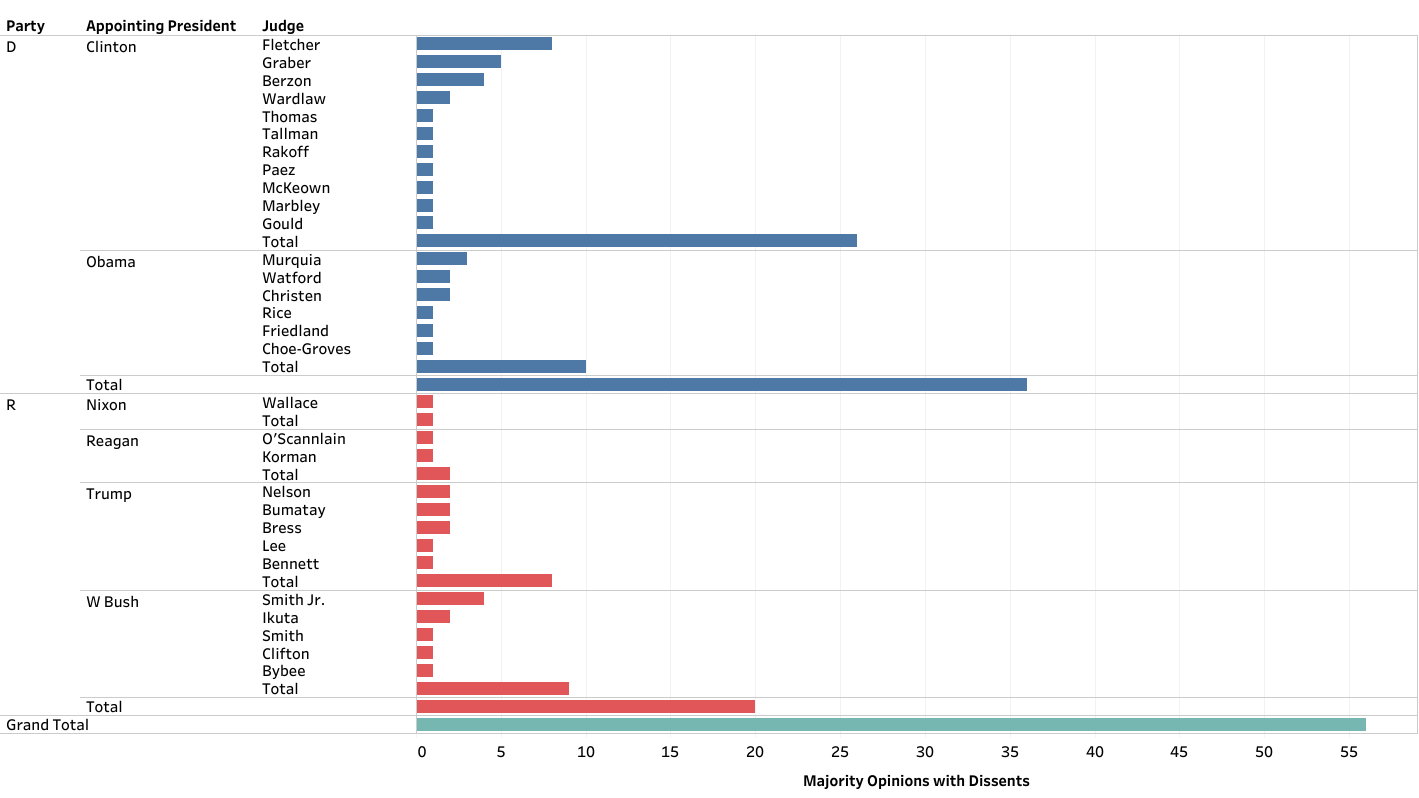
Epstein, Landes, and Posner in their book The Behavior of Federal Judges argue that the party of a judge’s appointing president tells a lot about dissenting behavior. Most importantly, they argue that judges of one party are most likely to dissent in a mixed panel with judges of another party. Looking at opinions from Court Listener from 2019 through the present, the majority authors on the Ninth Circuit who have had dissents against their opinions are as follows. 

[Note: subtotals for all columns are provided below each metric.]

Judge Fletcher had the most dissents against his opinions with eight. Of judges nominated by Republican presidents, Judge Milan Smith, Jr. had the most dissents against his opinions with four. Of the 56 total dissents that majority authors faced, 36 were against judges appointed by Democrats and 20 were against judges appointed by Republicans.  More judges also dissented against judges appointed by President Clinton than against judges appointed by any other president.

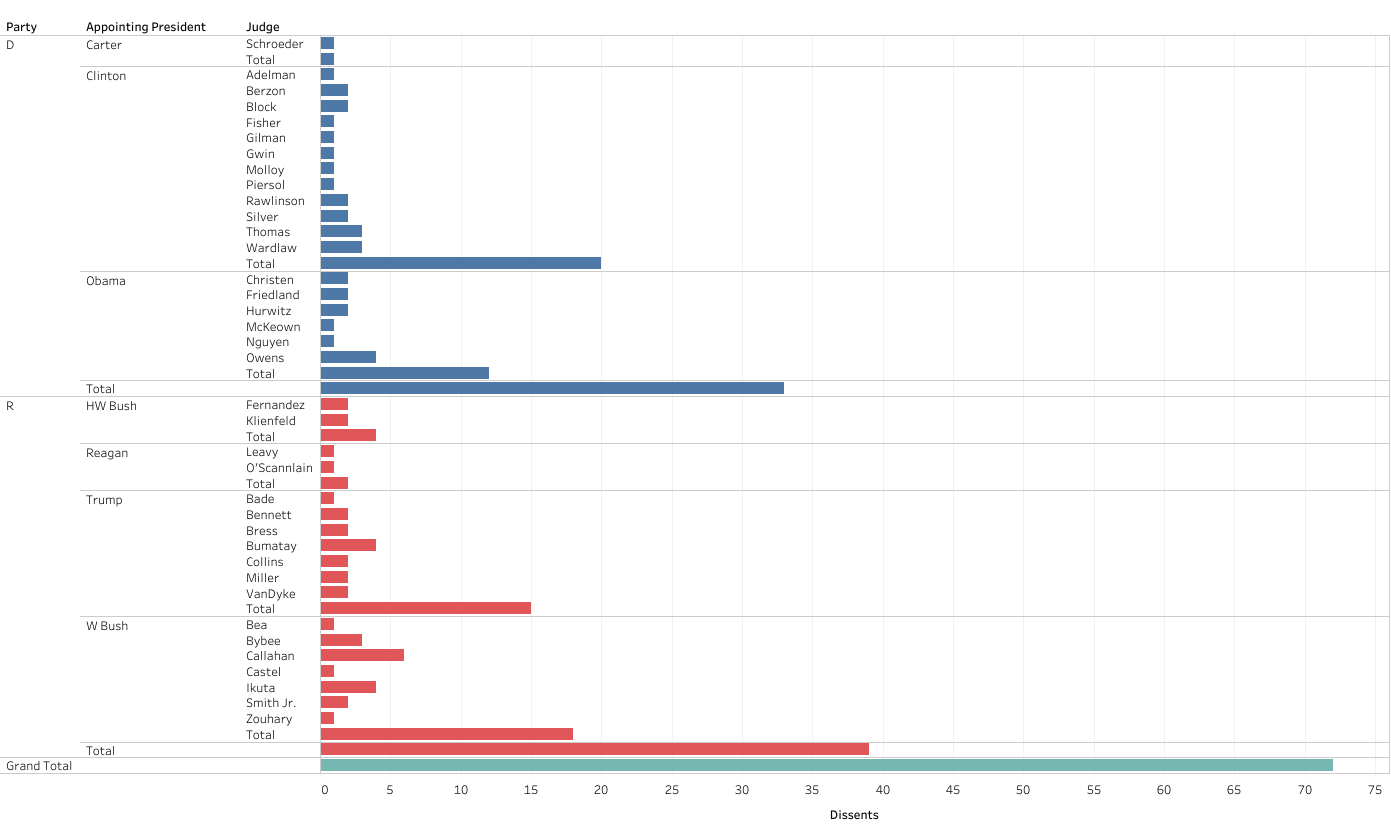
Next a look at the dissenters:

[Note: several dissents were against per curiam opinions where there was no majority author.] 

Judges appointed by Republican presidents dissented more than judges appointed by Democrats by a margin of 39 to 33. Judge Callahan, a President George W. Bush appointee, dissented the most at six times.   The Democratic nominee with the most dissents was Judge Owens with four. More judges appointed by President Clinton dissented than judges appointed by any other president.

Finally a look at the relationship between parties of the appointing president of the majority and dissenting author and the frequency of dissents.

Both Republican and Democratic nominees dissented four more times against judges appointed by presidents of the opposing party. Since judges appointed by Republicans had fewer dissents in total, their rate of dissenting against judges appointed by Democrats was higher at 60% than for judges appointed by Democrats, which was at 54.5%. These numbers show that while judges in the Ninth Circuit dissent more frequently against opinions by judges nominated by presidents of the opposing party, the disparity is not enormous and that judges in this circuit are comfortable dissenting against judges nominated by presidents of the same party as well.

Read more at The Juris Lab … 

Adam Feldman runs the litigation consulting company Optimized Legal Solutions LLC. For more information write Adam at afeldman@thejurislab.com. Find him on Twitter: @AdamSFeldman.

Hey, Rudy, Where’s The Warrant?

(Photo by Rob Kim/Getty)

Since waking up to find the FBI at his door this week, Rudy Giuliani has been making the rounds. After sending his charmless son Andrew out to reprise his performance at the 1994 mayoral inauguration, the president’s lawyer Robert Costello issued a bizarre statement excoriating the FBI agents who conducted the raid for refusing to take possession of “Hunter Biden’s hard drives.”

Of course, I’m sure you will not be surprised that the FBI left behind the only electronics that contain evidence of crimes, the Hunter Biden hard drives. Mayor Giuliani offered them on several occasions,  but the agents steadfastly declined.  Keep in mind that the agents could not read the physical hard drives without plugging them in, but they took Mr. Giuliani’s word that the hard drives were copies of Hunter Biden’s hard drive and did not contain anything pertaining to Mr. Giuliani.  Think about what that tells you. Their reliance on Mr. Giuliani’s credibility tells you everything you need to know about this case.

It’s an odd position to take just one paragraph after complaining that prosecutors refused to allow Rudy and his lawyer to “sit with the SDNY and demonstrate that Mr. Giuliani’s conduct was lawful” — i.e. take his word for it.

Then last night the president’s lawyer headed for Tucker Carlson’s White Rage Variety Hour to inveigh against rapacious federal law enforcement officers. And amazingly lightning failed to strike him on the spot.

“At the end of the search, when they had taken about seven or eight electronic items of mine, which is what they took, and two of someone else’s, they weren’t taking the three hard drives [allegedly belonging to Hunter Biden], which of course are electronic devices,” the cybersecurity expert told his credulous host. “They just mimic the computer.”

How has one laptop allegedly abandoned at a computer shop in Delaware morphed into three hard drives? Look, that’s not important now! The important thing is that Giuliani repeatedly pressed the agents to take possession of them, to no avail.

“The warrant required them to take it, and they said ‘No!’” he recounted dramatically, but without producing said warrant for inspection or even quoting language from it which would mandate the seizure of every piece of electronic equipment that “mimics the computer.”

Who among us would be surprised if Rudy mistook a broken modem for “Hunter Biden’s hard drive?” Or even a printer cable, if we’re being honest, right? And anyway, didn’t he already turn that laptop over to police in Delaware after belatedly realizing that he’d copped to possession of child pornography when he claimed to have found “photos of underaged girls” on it?

Then Giuliani went on to invent a whole new standard for executing a warrant on an attorney’s office.

“The reality is that that warrant is completely illegal,” he rasped. “The only way you can get a search warrant is if you can show that there’s some evidence that the person is going to destroy the evidence. Or is going to run away with the evidence.”

Well, no. Even the DOJ’s heightened standard for searches of an attorney’s office don’t require evidence of imminent destruction of the evidence. The U.S. Attorney’s Manual does suggest a strong preference for use of a subpoena, but that’s hardly enough to render a judicially approved search warrant “illegal.”

Although Alan Dershowitz is apparently raring to take that particular argument out for a spin, according to the Daily Beast, which reports that the famed Newsmax law professor will be giving Giuliani “constitutional advice.”

But Rudy wasn’t done talking. He still needed to blow up his own theory of being targeted by the “Biden department of justice” and “Biden Crime family.” (rAnDOm cAPitaLIzatiON iS fuN!)

“They also got it from the iCloud!” shouted Giuliani, gesturing toward the heavens where Steve Jobs arranges Rudy’s butt-texts in neat stacks.

“The DOJ in late 2019 covertly obtained access to my iCloud and never notified me,” he tweeted later, incensed that prosecutors might not disclose to the subject of an investigation that it had gotten a warrant for his data.

“They invaded the attorney client relationship as we were defending against the phony impeachment,” he howled, seemingly oblivious that he’d just acknowledged that it was Bill Barr, not Merrick Garland, who approved the original warrant for his digital data.

But Rudy was far too busy railing against the Deep State to engage with petty details like linear time.

“These prosecutors violated the laws, not me,” he huffed. “If again, nothing is done, you could be next.”

Which is probably true, as far as it goes. If you negotiate a contract with the Ukrainian chief prosecutor and then spend the next year trying to accomplish all his goals, you might well wake up to find federal agents at your front door. But then again, you’re probably not that crazy.

Which is why you aren’t going to “take Mr. Giuliani’s word” as to the contents of that warrant and what went down when it was executed. If Rudy wants us to believe that the FBI did something inappropriate, then he can bloody well fork over the evidence.

If he’s not going to shut up — and let’s face it, he’s never going to shut up — then Rudy needs to put up that warrant.

Come on, Roodles! What have you got to lose?


Elizabeth Dye lives in Baltimore where she writes about law and politics.

Biglaw’s ‘Only’ Openly Nonbinary Partner Speaks Out

When I came out, I was not aware of any other nonbinary attorneys in Biglaw. After the article came out, I got some responses from other nonbinary attorneys in Biglaw saying, “Hey, yeah, we do exist.”

I, to my knowledge, am still the only nonbinary partner out there in Biglaw, but there are certainly a handful of us who are out and speaking up to be counted in Biglaw. We are out there.

Rafael M. Langer-Osuna, a litigation partner at Squire Patton Boggs, commenting on their experience in finding more nonbinary Biglaw attorneys since they publicly came out last summer. Langer-Osuna uses they/them pronouns, and says the response from their firm has been “overwhelmingly positive.”


Staci ZaretskyStaci Zaretsky is a senior editor at Above the Law, where she’s worked since 2011. She’d love to hear from you, so please feel free to email her with any tips, questions, comments, or critiques. You can follow her on Twitter or connect with her on LinkedIn.

Lawyer Who Shot Up Co-Counsel’s Office Given… 5-Year Suspension?

In 2017, Portland-area attorney Erik Graeff engaged in a profanity-laced dispute with co-counsel Terry Hogan. After advising Hogan not to “suck too many reindeer [expletive] over the holiday,” along with some implied threats of violence, Hogan replied, “You know where I am tough guy.”

This was an error in judgment, as Graeff proceeded to drive to Hogan’s office and fire six bullets into the building. No one was harmed, though Graeff did just miss an administrative assistant still in the building at the time.

A subsequent search of Graeff’s home found meth and evidence suggesting he was trying to make his own because lawyers are nothing if not prodigious researchers.

He was sentenced to 18 months in 2019 and the state of Washington disbarred him, but the Oregon Supreme Court has taken a different path. Per the ABA Journal:

Graeff has been disbarred in Washington, but the Oregon Supreme Court instead opted for its toughest suspension. The court cited several mitigating factors supporting suspension, rather than disbarment. They included Graeff’s personal circumstances, his otherwise clear disciplinary record, his punishment for the crime, and his payment to the insurance company for the damage caused to the law office.

That seems a tad light for going GTA V on a lawyer’s office. But the state supreme court considered Graeff’s PTSD diagnosis as an Iraq War vet and the substance abuse problems it caused. If Graeff’s time away has helped him overcome those issues in the eyes of the court, then there’s no reason he should be stripped of his livelihood completely.

It’s a bold move. It’s not entirely clear it’s the best move. But it’s a compassionate move taken in light of someone’s totality of circumstances, and that’s all we can ask of judges. Let’s hope this decision pans out.

Lawyer gets 5-year suspension for firing gun into colleague’s law office [ABA Journal]

Earlier: When A Snippy Cease And Desist Letter Just Won’t Do — Lawyer Accused Of Shooting Up Adversary’s Office
Lawyer Accused Of Shooting Up Another Lawyer’s Office Now Accused Of Running A Meth Lab… As One Does


HeadshotJoe Patrice is a senior editor at Above the Law and co-host of Thinking Like A Lawyer. Feel free to email any tips, questions, or comments. Follow him on Twitter if you’re interested in law, politics, and a healthy dose of college sports news. Joe also serves as a Managing Director at RPN Executive Search.

What I Wish I Knew Before Starting A Law Firm (Part I)

At my law school, becoming a Biglaw attorney or judicial clerk was touted as the ultimate success. Unfortunately, that meant that the vast majority of my classmates ended up with … sloppy seconds? I knew the idea of billing in six-minute increments for the rest of my legal career was tantamount to spooning out my eyes. Similarly, cite-checking or writing legal opinions was not living my best life. No thanks, I’ll pass.

So, I chose the path of least resistance. Someone, hire me! For 11 years, I took the best jobs that I could. Now, I am creating them. I first had to tackle my untrue, preconceived notions, such as solo and small firm practice was not for me, and lawyers who hang their own shingles were not hireable elsewhere. It took some work, but I am so grateful that I found my way to entrepreneurship as a lawyer.

Here are some lessons I learned in my journey; some I wish I had known before I hung my shingle:

  1. Just Do It!

Remember the Colin Kaepernick Nike commercial during the height of the kneeling against police brutality controversy? Ahh, yes, a simpler time before the insurrection. The ad is chock full of video footage of athletes defying the odds despite their class, age, race, gender, ability, and religion; this is the type of video you watch to psych yourself up for a triathlon or a key presentation. The “just do it” energy is most of the battle. Setting up your shingle takes mental just do it energy.

Enter impostor syndrome, stage left.

Like a stubborn blackhead, impostor syndrome pops up at the most inopportune times. It’s that nagging self-doubt that keeps us (mostly women) from betting on ourselves. We buy the lie that we are fraudulent, not smart enough, and not worthy enough to take calculated risks. Impostor syndrome will lock you in golden handcuffs at a high-paying job or keep you stuck in the rat race rather than pursuing a life worthy of your most profound wants.

The reality is that we are worthy of entrepreneurial pursuits — if called. For some, becoming a small firm owner is a big mistake. It’s not for everyone. However, for the select few of us who desire to pursue this path, it is unbelievably rewarding. Ignore the naysayers and your internal self-doubt. Replay the Nike ad to the end. Your dreams are only crazy until you do it. So, just do it.

  1. Clarify Who I Serve And What I Do

Now that you’ve decided to strike out on your own, defining who you serve and what you do is beneficial. If you’re anything like I was when you start, your immediate thought is to take anyone with a detectable heartbeat.

Divorce? Yes.

Traffic ticket? Sure, why not.

Government contract? Sign me up.

While the spaghetti on the wall method is tempting at first, defining who you’d like to serve and what type of law to practice will help you focus and lead to more success. Be the CEO of Your Law Firm by Ally Lozano is a book with practical exercises for establishing a law firm.

3. I Must Pay Myself

It is very tempting to pour your heart and soul into your law firm and pay yourself like a part-time intern or not at all. Fight the urge to forgo payment. Yes, you may not start with a big salary, but pay yourself a living wage. What sense does it make to build a practice that does not support your lifestyle? I know so many lawyers who have thriving practices but struggle to make monthly payroll. Full disclosure: I have been there myself. Cash flow issues are the worst, but this does not have to be the norm in your practice. Build up reserves, hire a money coach, figure it out.

Next week, I will share a few more tips on what I wish I’d known before starting a law firm. Please feel free to send any constructive comments or questions to me at iffywrites@ibekwelaw.com. I would also love to hear your topic suggestions!


Iffy Ibekwe is the principal attorney and founder of Ibekwe Law, PLLC. She is an estate planning attorney evangelist for intergenerational wealth transfer with effective wills and trusts. Iffy is writing her first book on culturally competent estate planning, available in 2022 (prayers up!). She graduated from The University of Texas School of Law and has practiced law for over 14 years. Iffy can be reached by email at iffywrites@ibekwelaw.com, on her website, and on Instagram @thejustincaselawyer.

Biglaw Surprises Some With Record Profits In 2020 — Now What?

In a recent Above the Law post, Kathryn Rubino points out that, on average, the 100 highest-grossing Biglaw firms (Am Law 100) increased their revenue by 6.6 percent. When we read Ms. Rubino’s post which linked to a Law.com article by Dan Packel (“Against All Odds, The Am Law 100 Were Stunningly Successful in 2020”), three thoughts entered our minds.

First off, we say, “Bravo!” We’re happy to see our industry and many of our friends doing so well (at least in this slice of the legal industry, and we’re rooting for the rest of our industry to succeed, too). If there ever was a year when excellent, cutting-edge legal advice and services were needed and worthy of handsome compensation, it was 2020, a once-in-a-lifetime year with unimaginable challenges.

Our next thought is a shameless, self-laudatory “we told you so” point. Last spring, most media reports were all forecasting doom and gloom for the legal industry, reporting on compensation cuts, layoffs, furloughs and the like. On the other hand, a year ago, nearly to the day, in this Above the Law post, we predicted the opposite, saying (among other things):

Until the dust settles, most would agree that the near-term demand for legal services will be only in “essential” areas, such as healthcare, employment, bankruptcy, and criminal law. The dust will eventually settle, though. Then there will be an UNPRECEDENTED level of demand for legal services. Unlike the aftermath of the 2008 Great Recession, where the legal industry was unable to drive any aspects of a recovery, the U.S. legal industry can be a critical force in the aftermath of the COVID-19 pandemic. Legal industry professionals will pore over mounds of insurance policies, contracts, and other documents to assess the legal rights of the afflicted, to be followed by years of lawsuits. These lawsuits will be complex and multi-jurisdictional (or multi-national) and, quite literally, without precedent. Demand will skyrocket, giving the entire legal industry a serendipitous “do-over” to re-imagine new ways to deliver legal services.

We suggested that law firms think about reallocating their professionals to areas of immediate need (“surge lawyering”), considering tele-lawyering (which, of course, we all have now been doing for a while), and embracing innovation.  Many firms implemented much of what we suggested during 2020, some out of necessity and some out of strategic forethought. The reality is that, in turbulent times, lawyers tend to rise to the occasion, and talented lawyers are in high demand. The profession’s understanding of the dynamic nature of the law is critical to novel challenges, and good lawyers’ problem-solving skills are essential to navigating complex issues. When it comes to COVID-19-centric matters and other matters put on hold during the pandemic, we’re still in the early stages of the legal industry’s Renaissance Period that we had predicted.

Our third thought is: Okay, Biglaw: The pandemic forced your hand and afforded you some cover on making some long overdue (since 2008) “hard” decisions, and you made some of the changes that needed to be made. You’ve gotten the “do-over” that we predicted and made many positive moves.  We noted that, in 2008, the legal industry’s fairly quick economic recovery didn’t force any lasting, needed change but allowed for an industry-wide sense of complacency in which the industry could return to its “old” regressive habits.  The “do-over” has arrived, and it’s time to strategize on continuing the positive momentum to advance our industry during the “Renaissance Period.”

Every week, we talk with countless legal professionals — in all areas of practice, in all sectors, at all levels — about challenges and opportunities in the legal industry; we consume as much content as we can about the legal industry; and we think constantly about how we, as legal professionals, can take positive, meaningful steps to make the legal profession the best that it can be. In this regard, we have some thoughts and suggestions on how to continue the positive momentum:

  1. If you want to do a good job for your clients, you need to make sure that you mentor (train) and sponsor (promote) a truly diverse workforce.

Our clients deserve the best advice and best service that we can offer.  This happens when service and advice is provided by a truly diverse workforce. We’ve all been in rooms in which people come to agreement on a plan quickly, and the plan falls apart later or yields suboptimal results. One of the likely causes is that everyone in the room has a mostly overlapping set of experiences (or put otherwise, they lack diversity in the broadest sense). If everyone has the same set of experiences, there’s no one in the room to say, “wait a minute — you haven’t factored in X or Y.” The more diverse your team and your team’s set of experiences is, the broader and deeper will be the strategies, tactics, and options that the team will pursue and implement. (One caveat: everyone on the team needs to feel comfortable with speaking up to discuss ideas. Silenced or unmentored diverse teams don’t help you make better decisions. When diverse legal teams are empowered to share their smart ideas, clients wind up receiving the best advice and service.)

  1. Solicit more client feedback.

Despite what one sees far too often in the media, clients and their lawyers ARE on the same side. It’s a principal-agent relationship guided by robust conflicts of interest principles to make sure that client interests come first. In other aspects of our lives today, we cannot escape customer feedback surveys, polls, likes, thumbs-up, thumbs-down, smiley faces, and frowns. Feedback loops in the legal industry, however, are rare even though client interests are not secret and clients will share what they value most. . They already share some views in the form of billing guidelines, by signaling what they prefer that their outside firms do (and how it’s done). But if a firm spends time — non-billable time — sitting down with major clients to solicit feedback and ask them what industry changes they foresee, it’s immeasurably easier to be able to partner with them to prepare for those changes. Clients don’t resent paying for a well-spent billable hour when they feel that it meets their standards and provides value. When clients see firms spinning wheels with inefficient workflow, though, that doesn’t lead to feelings of good hours having been billed. Misallocation of professionals (too many or the wrong experience level for particular tasks) won’t lead to good hours. Clients don’t expect firms to operate at a loss, but they expect their counsel to behave as true fiduciaries, with their best interests at heart. With a better feedback loop, you can help them help you.

  1. Invest in legal tech that provides a measurable client benefit.

Law firms must invest in legal technology tools that extend beyond their own internal operational needs (Office365, billing & matter management, Zoom, etc..) and drive direct client benefits (e.g., contract automation, document review tools, etc….). There are just some things that computers do better than humans do. We already know this about things like the first cut in document production. Computers don’t get tired or hungry; they don’t get distracted out of boredom; they do things consistently, time and time again. Clients benefit from and encourage tech-enabled document review, which is more cost-effective than human first-cut reviews. As fiduciaries, lawyers are supposed to make decisions in their clients’ best financial interests as well as their best legal interests. Though we espouse this proposition as being in the best interest of clients (and law firms), we are mindful of a “knock-on” effect: it runs the risk of creating a legal “lost generation” of legal professionals. If law schools aren’t giving their students practical training, and if the work of a first- and second-year associate doesn’t include those tasks that trained all of us to know what to look for as we draft, or cull through documents, or take depositions, or negotiate, then those new associates won’t have a good foundation for developing their legal skills. Which leads us to:

  1. Biglaw (via the ABA) needs to remind law schools to train students to practice law (yes, Yale, we’re even talking about you).

Law schools are great at teaching theory, and great lawyers use theory to develop advances in the law. We applaud theory; however, theory devoid of a practical framework just trains people to be law professors (and there are precious few new law professor jobs out there). Everything that we know about pedagogy says that students learn best when they get to apply what they’re learning in new ways, when they get regular feedback, and when they learn in a variety of modalities. Historically, law schools have done nothing of this nature. During the pandemic, though, law professors have had to develop new ways of communicating material: pre-class videos or narrated PowerPoints; quizzes; small-group exercises, and the like. As law schools revisit online education with the ABA’s Section on Legal Education, it’s time to develop the “applied theory” side of the equation to train students in a practical manner. If law professors are too far-removed from today’s practice of law, they can partner with adjuncts to provide some real-world lawyering practice. Why not “Contracts lab,” a one-hour course that lets students try their hands at drafting basic agreements? “Professional Responsibility lab” could give students a chance to deconstruct situations to see if any ethics issues arise and then try to resolve the issues. If we don’t want a lost generation of lawyers, then we need to bridge the gap between what law schools are teaching and what lawyers need their new colleagues to know.

  1. Data can be your friend.

Businesses today use technology and data to measure previously unimaginable things and make lots of money from the related business intelligence that’s been generated. We’ve written recently about how auto insurers have been using telematic data to “watch” a driver’s driving behavior in real time to generate more accurate auto insurance underwriting metrics and how we could use the same principles in the legal profession. Law firms are slowly realizing the enormous value of the raw data in their network, particularly their billing and timekeeping systems. Biglaw firms have billions of lines of data that tell them how long various tasks should take and who should be doing them. Those lines of data are called “time entries.” Data can tell managing partners who’s efficient, who’s not, who’s billing on time, who’s delaying submitting bills, how each partner’s realization rate is faring, and other equally valuable data points. Maybe no one in your firm has time to deconstruct what the data are telling you, but there are companies that can do that (and one of us runs one of those companies). The old way of pricing matters (“what do I feel that I should charge”) is leaving money on the table for law firms or frustrating clients with inaccurate budgets. Why not use the data you have to do a better job of pricing legal services and evaluating the behavior of legal professionals?

  1. Budgets can be your friend, too.

The old trope that “there’s fast, good, and cheap, but you can have only two of the three” only works for non-fiduciaries. Fiduciaries (that’s us!) have to have “good.” That leaves only “fast” and “cheap” as variables. It’s better to have the discussion with a client about how much a matter is likely to cost (remember, you already have that data in your timesheets) beforehand than to engage in work that a client thinks was well out of whack with what you promised to do. Unlike a few years ago, clients are not wasting time negotiating hourly rates anymore.  Instead, they are asking for budgets and treating the budgets as hard caps on matters both by phase and in the aggregate. Tracking a budget during the work on a matter lets you give your client a heads-up when the variables on which your budget depended have changed. Communication is a fiduciary duty, too, and your budget can help you communicate with your client in real time.

  1. Speaking of budgets, why don’t you save for a rainy day?

Other businesses use retained earnings to save for a rainy day (or for the next pandemic). You can, too.  Where accounting, tax, or financial issues preclude a law firm from keeping cash in the firm, there’s no question that a smart CFO can figure out how to effectuate the functional equivalent of retained earnings through prepayment of expenses or the like. The firms that did not have the make the “hard” decisions during the pandemic were those that had plenty of cash on hand or access to cash.

  1. Your most important investment is in your people.

Every time a firm loses someone who has given up on Biglaw, the firm loses the time spent in training that person (and the revenue that walks out the door when the person does). We know that law firms often disproportionately lose their colleagues of color and their female colleagues, which in turn affects a firm’s ability to staff a diverse team. We also know that most people who start at Biglaw don’t stay there forever. If you value your newest colleagues, invest in them. If you value your senior colleagues, invest in them, too, by planning what to do if and when they depart. Great leaders don’t last forever. People die. They retire. They leave for greener pastures. A firm that doesn’t have a solid succession plan, both at the top and at the departmental level, is missing an obvious way to deal with future crises. Moreover, a firm that doesn’t develop both the breadth and depth of their associates’ training (more expertise and more across-the-board skills) is one that won’t be able to pivot during the next crisis. Firms can’t reallocate associates with exceptionally narrow skills. Likewise, sophisticated clients know that when their outside counsel team is made up primarily of senior-level personnel, they will have significant switching and/or training cost when the senior-level personnel depart. Think broadly about what new things your colleagues can do to make your firm crisis-resistant.

If the post-2008 era taught us anything in the legal industry, it showed us the potential danger of complacency. The Renaissance is here, the “do-over” is possible, and the positive 2020 momentum can be continued.  The Am Law 100 has, on average, 6.6% more funds to invest, and there are no obvious immediate scares on the horizon. Let’s use these funds and the relative calm to become stronger.


Nancy B. Rapoport is the Garman Turner Gordon Professor of Law at the William S. Boyd School of Law, University of Nevada, Las Vegas, and an Affiliate Professor of Business Law and Ethics in the Lee Business School at UNLV. Her specialties are bankruptcy ethics, ethics in governance, law firm behavior, and the depiction of lawyers in popular culture.

After practicing law for nearly 20 years, Joe Tiano founded Legal Decoder because he saw that clients and law firms lacked the analytic tools and data to effectively price and manage the cost of legal services delivered by outside counsel. He set out to build an intelligent, data driven technology company that would revolutionize the way that legal services are priced and economically evaluated.


Biglaw Firms In Rumored Tie-Up Talks Refuse To Comment On Would-Be Merger

Has your firm experienced declining revenue and drops in headcount thanks to lateral departures? Did you have to take out a $5.3 million PPP loan during the pandemic? Were layoffs and salary cuts part of your coronavirus crisis survival plans? After a financially successful finish in 2020, are you looking ahead to the future but unsure about next steps? You may be experiencing the urge to merge.

This is reportedly what’s happening at Chicago-based Schiff Hardin, and the firm is supposedly in talks with D.C.-based Arent Fox, which has been larding itself up with lateral hires in recent weeks. The firms seem to be well matched in terms of finances: last year, Schiff had a revenue per lawyer of $827,000 and $1.07 million in profits per equity partner, while Arent had a revenue per lawyer of $866,000 and $1.11 million in profits per equity partner. But not so fast, matchmakers….

According to the American Lawyer, neither firm would confirm the tie-up talks.

“Schiff Hardin is committed to a vision of growth that best positions the firm to serve our clients’ needs. Our focus is on earning the trust of our clients every day and maintaining our culture of quality and professional excellence. To advance our goals, from time to time we evaluate potential strategic combinations to expand our service offerings to our clients, but we do not comment on rumor or speculation,” the Chicago firm said.

For its part, Arent Fox also said the firm doesn’t comment on specific rumors. The firm added in a statement: “We are always looking for opportunities to expand into high-growth markets in a way that responds to client demand while protecting Arent Fox’s collegiality and culture. Our priority is typically to focus on shared strengths in terms of industries and practices.”

Will they or won’t they? We suppose we’ll have to wait and see.

Schiff Hardin, Seeking Merger Partner, Eyes Arent Fox [American Lawyer]
Ahead of a Possible Merger, Arent Fox Bulks Up With Lateral Hires [American Lawyer]


Staci ZaretskyStaci Zaretsky is a senior editor at Above the Law, where she’s worked since 2011. She’d love to hear from you, so please feel free to email her with any tips, questions, comments, or critiques. You can follow her on Twitter or connect with her on LinkedIn.

The Life And Legacy Of Ruth Bader Ginsburg

(Photo by MANDEL NGAN/AFP/Getty Images)

Today, we have a very special episode of The Jabot, where we discuss the life of the woman who inspired the name of this podcast, Ruth Bader Ginsburg.

On the latest episode of The Jabot, I’m joined by Berkeley Law Professor Amanda L. Tyler. She’s also a former clerk of Justice Ruth Bader Ginsburg and the co-author on the Justice’s final book, Justice, Justice Thou Shalt Pursue: A Life’s Work Fighting for a More Perfect Union. We discuss how Amanda went from clerk to writing this book with Justice Ginsburg. We also discuss the book as Justice Ginsburg’s final work, and how it frames her legacy. We talk about Justice Ginsburg’s penchant for writing powerful dissents and what RBG’s perspective was on that. We chat about what it was like working with Justice Ginsburg and how was clerking for her different than putting the book together.

The Jabot podcast is an offshoot of the Above the Law brand focused on the challenges women, people of color, LGBTQIA, and other diverse populations face in the legal industry. Our name comes from none other than the Notorious Ruth Bader Ginsburg and the jabot (decorative collar) she wore when delivering dissents from the bench. It’s a reminder that even when we aren’t winning, we’re still a powerful force to be reckoned with.

Happy listening!


headshotKathryn Rubino is a Senior Editor at Above the Law, and host of The Jabot podcast. AtL tipsters are the best, so please connect with her. Feel free to email her with any tips, questions, or comments and follow her on Twitter (@Kathryn1).
Credit Suisse Basically Headquartered In Court These Days

Thomas Gottstein has been CEO of Credit Suisse for 63 weeks. There is no doubt that the overwhelming majority of them, and indeed all of the last eight or so, have been waking nightmares. Surely, however, there have been some consecutive five-day calendrical periods that he has enjoyed the job he has presumably been pining and preparing for most if not all of his professional career, some Fridays when he walked out of his office with a genuine spring in his step and ability to enjoy the weekend as much as any Swiss can enjoy such a frivolity.