

8.11.2025
3:55
Analysis
in
English
on
Zimbabwe
about
Agriculture,
Food
and
Nutrition
and
Drought;
published
on
7
Nov
2025
by
FEWS
NET
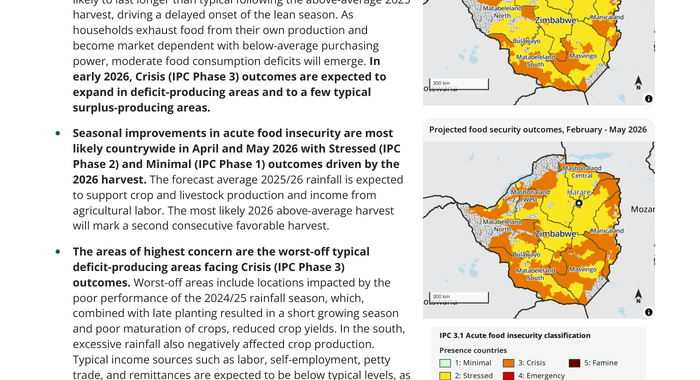
Key
Messages
-
Crisis
(IPC
Phase
3)
outcomes
are
expected
to
emerge
in
November
across
many
typical
deficit-producing
areas in
Matabeleland
North
and
South,
Masvingo,
Midlands
and
Manicaland
provinces,
and
the
far
northern
parts
of
the
Mashonaland
provinces.Own-produced
food
stocks
this
year
are
likely
to
last
longer
than
typical
following
the
above-average
2025
harvest,
driving
a
delayed
onset
of
the
lean
season.
As
households
exhaust
food
from
their
own
production
and
become
market
dependent
with
below-average
purchasing
power,
moderate
food
consumption
deficits
will
emerge. In
early
2026,
Crisis
(IPC
Phase
3)
outcomes
are
expected
to
expand
in
deficit-producing
areas
and
to
a
few
typical
surplus-producing
areas. -
Seasonal
improvements
in
acute
food
insecurity
are
most
likely
countrywide
in
April
and
May
2026
with
Stressed
(IPC
Phase
2)
and
Minimal
(IPC
Phase
1)
outcomes
driven
by
the
2026
harvest. The
forecast
average
2025/26
rainfall
is
expected
to
support
crop
and
livestock
production
and
income
from
agricultural
labor.
The
most
likely
2026
above-average
harvest
will
mark
a
second
consecutive
favorable
harvest. -
The
areas
of
highest
concern
are
the
worst-off
typical
deficit-producing
areas
facing
Crisis
(IPC
Phase
3)
outcomes. Worst-off
areas
include
locations
impacted
by
the
poor
performance
of
the
2024/25
rainfall
season,
which,
combined
with
late
planting
resulted
in
a
short
growing
season
and
poor
maturation
of
crops,
reduced
crop
yields.
In
the
south,
excessive
rainfall
also
negatively
affected
crop
production.
Typical
income
sources
such
as
labor,
self-employment,
petty
trade,
and
remittances
are
expected
to
be
below
typical
levels,
as
is
the Mopane worm
(Gonimbrasia
belina) harvest. -
Food
assistance
needs
are
expected
to
increase
through
the
peak
of
the
January
to
March
2026
lean
season. Overallfood
assistance
needs
are
expected
to
be
at
near-average
levels,
though
lower
than
the
atypically
high
El-Niño-induced
needs
during
the
last
2024/25
lean
season.
Thereafter,
food
assistance
needs
are
expected
to
declinewith
the
availability
of
the
2026
harvest.
Post
published
in:
Agriculture