
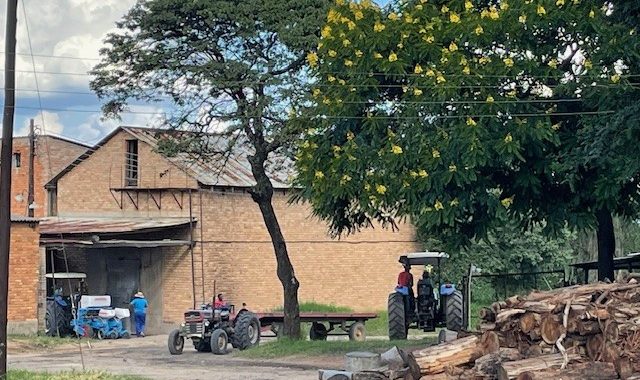

There
is
reliable
rainfall,
good
soils,
excellent
connections
to
markets,
an
available,
skilled
workforce
and
an
impressive
inherited
infrastructure
of
small
dams,
roads
and
farm
buildings.
However,
once
again
A2
farms
have
struggled
over
the
last
25
years,
although
again
with
much
variation
and
some
important
innovations
in
land
use
and
investment.
Investing
in
farming
Across
our
sites
there
has
been
significant
investment
in
as
well
as
rehabilitation
of
existing
infrastructure.
The
Mvurwi
area
has
around
1000
small
dams
built
during
the colonial
era
to
support
white
agriculture,
and
these
are
crucial
for
irrigated
production.
Many
are
being
used
as
irrigation
expands,
but
challenges
of
siltation
and
environmental
degradation
through
chrome
mining
has
become
an
issue
of
late.
With
the
new
farms
being
subdivisions
of
often
large
estates,
there
has
been
a
need
to
drill
boreholes
and
extend
pipework
to
standing
water,
and
there
has
been
a
significant
expansion
of
horticultural
production
across
A2
farms.
Case
1:
MM,
Pembi
Chase
I
was
born
in
1995
in
Mvurwi.
I
inherited
this
plot
from
my
late
parents
who
acquired
the
land
in
2002.
My
father
was
a
farm
manager
in
Concession
where
he
also
grew
up.
He
passed
away
in
2012
and
my
mother
passed
away
in
2020.
When
my
parents
were
still
alive,
we
used
to
grow
tobacco,
maize
and
sweet
potatoes.
Following
my
mother’s
death,
I
decided
to
abandon
tobacco
because
it’s
such
a
‘jealousy’
crop
(fodya
ine
shanje).
Instead,
I
ventured
into
horticulture.
As
young
people,
we
prefer
to
engage
in
horticulture,
while
older
people
prefer
tobacco
farming.
I
grow
water
melons
and
tomatoes.
This
year,
I
purchased
a
solar-powered
submersible
pump
and
two
solar
panels.
Using
proceeds
from
horticulture,
I
have
managed
to
educate
my
siblings.
I
was
born
in
a
family
of
three
–
two
boys
and
one
girl.
My
sister
(born
2000)
just
completed
her
degree
in
Business
and
Industrial
Economics
from
the
University
of
Zimbabwe,
and
my
younger
brother
is
doing
Form
2
in
Mvurwi
town.
Despite
the
growth
of
horticulture,
the
core
commodity
in
this
area
remains tobacco.
Nearly
all
A2
farmers
grow
tobacco,
some
in
large
quantities.
The
amount
of
tobacco
production
in
Mvurwi
has
sky-rocketed
across
A1
and
A2
areas,
and
there
are
now
14
tobacco
auction
floors
in
the
town.
This
has
been
driven
by
investment
through
contracting
companies,
ranging
from
the
big
players
like
Tian
Ze
(Chinese)
and
Mashonaland
Tobacco
Company
(subsidiary
of
Alliance
One,
a
global
conglomerate)
to
an
array
of
small
operators,
with
a
total
of 32
players operating
nationally.
The contractors supply
inputs,
finance
for
labour,
fuel
for
curing
(coal)
and
offer
guaranteed
markets.
Given
the
scale
of
operation
most
A2
farmers
cannot
afford
to
self-finance
fully,
so
reliance
on
contracting
is
critical.
Tobacco
requires
good
infrastructure,
including
irrigation
for
seedlings,
barns
for
curing,
and
a
skilled
workforce,
especially
when
grading
and
selling.
Investments
have
been
significant
in
new
barns,
and
for
some
more
sophisticated
fuel-efficient
rocket
barns.
In
addition
to
houses
built
on
the
A2
farms,
the
array
of
new
or
repurposed
farm
buildings
including
curing
barns,
sheds
and
so
on,
across
Mvurwi
is
impressive.
This
is
witness
to
the
huge
tobacco
boom
driven
from
the
land
reform
areas,
with
this
last
season
resulting
in
Zimbabwe’s
biggest
ever
tobacco
harvest
of
350,000
tonnes.
Mobilising
labour
for
commercial
agriculture
Access
to
labour
is
a
continuous
complaint
amongst
A2
farmers
in
Mvurwi.
Despite
many
having
resident
labour
in former
compounds nearby,
mobilising
the
former
farmworkers
for
the
level
of
salary
being
paid
(as
little
as
US$3.50
per
day)
can
be
challenging.
Many
farmworkers
prefer
to
focus
on
their
own
small
plots
that
they
were
allocated
(some
before,
more
after
land
reform),
where
on
even
just
a
hectare
of
land
they
can
make
good
money
from
tobacco
given
their
significant
agronomic
skills
in
tobacco
production.
Many
also
rent
in
land
to
expand
production
–
including
from
A2
farmers,
turning
the
tables
in
terms
of
land
use.
The
result
is
that
the
captive
resident
workforce
that
existed
for
former
white
farmers
is
often
no
longer
available.
At
certain
times,
tobacco
production
requires
maybe
several
hundred
labourers
on
an
A2
farm,
so
farm
owners
must
seek
labour
from
further
afield,
including
the
A1
areas
and
the
communal
areas
in
Chiweshe,
Muzarabani
and
Guruve.
However,
agriculture
must
now
compete
with
mining
in
Mvurwi,
especially
since
the
chrome
boom
that
started
in
March
2024.
Large
numbers
of
people
flock
to
the
Great
Dyke
to
dig
and
then
process
chrome
for
sale
to
Chinese,
South
Africans
and
other
traders.
Some
A2
farmers
have
begun
to
seek
new
solutions
that
replicate
to
some
extent
the
arrangements
that
existed
before
when
white
farmers
controlled
the
land
and
labour
in
a
system
of
paternalistic
and
exploitative
‘domestic
government’.
In
order
to
secure
reliable
labour,
a
core
group
is
created
on
the
farm,
with
tenancy
arrangements
providing
them
housing
and
small
farm
plots,
but
with
a
closer
engagement
(and
control
by)
the
farm
owner
than
under
the
current
compound
system
where
former
farmworker
families
have
no
obligations
towards
the
new
landowners.
Case
2:
MM,
Pembi
Chase
I
have
two
sisters
who
are
single
women
who
live
on
the
farm
with
their
children.
These
women
are
not
my
relatives.
They
are
from
Muzarabani.
The
arrangement
is
that
they
provide
labour
for
me
in
exchange
for
accessing
land
to
farm.
However,
a
rule
of
thumb
here
is
that
the
area
should
not
exceed
2
ha.
These
two
women
have
access
to
2
ha
of
land
between
them
in
return
to
providing
me
with
farm
labour.

Financing
agriculture
The
lack
of
access
to
finance
is
a
continuous
refrain
from
farmers
in
Mvurwi.
Without
funds,
investment
in
infrastructure
and
annual
financing
of
crops
is
impossible.
In
the
past,
white
farmers
were
offered
generous
loans
through
the
banks,
and
in
the
early
days,
promises
were
made
to
new
A2
farmers
that
the
government
would
support
them
too.
This
has
not
been
forthcoming
and
the
opportunity
to
borrow
against
land
assets
has
been
impossible
without
an
agreement
between
the
banks
and
the
government
on
the
wording
of
the 99-year
lease,
which
were
to
be
issued
to
A2
farm
owners
but
never
materialised
(bar
a
few
high-profile
media
cases).
The
long
litany
of
failure
to
support
A2
farmers
has
meant
that
potentials
have
often
not
been
realised.
Command
Agriculture
was
supposed
to
offer
a
solution
–
a
loan
arrangement
from
the
government
with
logistics
supported
by
the
military
and
with
backing
from
the
highest
level.
This
was
the
flagship
programme
from
2016
and
ran
for
around
four
years.
As
has
been
extensively
discussed
(see earlier
blog),
the
Command
Agriculture
programme
was
controversial,
as
it
was
open
to
capture
by
elites
and
became
a
site
of
selective
patronage.
Only
a
few
benefited,
and
even
in
the
high
potential
area
of
Mvurwi
where
the
programme
was
supposed
to
have
been
concentrated,
the
percentage
of
A2
farmers
who
received
support
–
mostly
for
maize
growing
with
supplementary
irrigation
–
was
minimal.
Many
of
these
recipients
complained
that
inputs
were
late
or
in
the
wrong
quantities
and
combinations
and
that
the
programme
only
really
benefited
the
real
elite
who
could
jump
the
queue
and
gain
the
full
package
with
very
little
expectation
that
it
would
be
paid
back.
Due
to
high
default
rates
and
a
shift
in
priority,
the
Command
Agriculture
programme
(and
its
many
spin-offs)
was
wound
down
in
late
2019.
Now
farmers
must
seek
private
finance
to
support
their
operations.
CBZ
offers
bank
loans,
but
against
collateral,
including
houses
in
town.
Some
with
such
assets
have
been
given
loans,
but
agriculture
is
risky,
and
default
is
likely.
Many
have
suffered,
even
with
town
homes
being
reclaimed
by
the
bank.
This
has
resulted
in
much
stress,
and
in
one
case
a
suicide
of
a
farmer
in
Pembi
Chase
near
Mvurwi
after
the
farmer
had
used
a
son-in-law’s
house
as
collateral.
Another
option
is
to
rely
on contract
farming,
which
is
available
mostly
for
tobacco.
Getting
a
contract
for
a
limited
area
(a
few
hectares)
allows
farmers
to
spread
the
inputs
to
other
areas,
but
the
contractors
require
high
quality
leaf,
and
some
farmers
fail
to
supply,
with
defaults
again
being
common.
Combining
contracting
with
self-financing
is
the
most
common
strategy
as
risks
are
spread
and
at
least
some
of
the
area
cropped
has
a
guaranteed
market
through
the
contract
arrangement.
Other
contracting
arrangements
are
with
seed
companies
(for
maize,
wheat
and
soya),
but
these
have
even
more
challenging
requirements
so
that
the
seed
is
pure,
and
this
requires
irrigation
and
significant
management
and
labour.
Many
A2
farmers,
especially
those
absent
from
the
farm,
fail
to
comply
with
the
stringent
requirements,
and
it
is
the
joint
venture
farmers
with
capital
who
can
benefit
from
these
arrangements.
The
growing
value
of
land:
land
markets,
crime
and
violence
Due
to
the
demand
for
land
and
the
high
potentials
there
has
been
a
massive
growth
in
land
markets
in
the
A2
areas
of
Mvurwi.
There
is
a
lot
of
leasing,
borrowing,
illegal
selling/purchase
and
many
joint
ventures.
There
are
a
number
of
different
types
of
such
arrangements,
with
many
different
actors
involved,
as
will
be
discussed
in
the
next
blog.
The
high
value
of
land
reform
areas
in
Mvurwi,
increasing
through
these
processes
of
external
investment,
means
that
these
farms
are
subject
to
significant
levels
of
theft
and
other
crime,
sometimes
violent
with
a
number
of
murders
having
been
recorded
in
the
last
season
following
tobacco
sales.
This
has
been
a
growing
concern
in
the
last
few
years,
making
it
imperative
that
farm
owners
are
frequently
present
and
invest
in
the
necessary
security.
Thefts
of
produce,
equipment,
fencing,
livestock
and
other
assets
is
a
frequent
challenge,
as
A2
farms
are
surrounded
by
other
communal
areas,
A1
farms,
small
towns
and
compounds
with
many
former
farmworkers
live
on
these
farms
but
without
any
direct
relationship
with
the
owner.
Gender
and
generational
changes:
questions
about
land
ownership
As
in
our
other
study
sites,
many
of
the
original
owners
of
the
farms
have
now
died,
leaving
wives,
sons
and
daughters
(or
other
relatives)
to
manage
the
farm.
The
arrangements
are
often
complex,
with
different
people
having
a
stake
in
the
farm,
with
divided
responsibilities
and
accountabilities.
Disputes
frequently
arise,
resulting
in
confusions
that
disrupt
farming.
A2
farmers’
children,
perhaps
especially
in
Mvurwi,
where
there
is
a
greater
preponderance
of
‘elites’,
are
often
reluctant
to
take
over
farms.
They
are
living
abroad
and
are
happy
to
continue
to
support
parents
when
they
are
alive,
but
when
they
pass
on,
what
happens
to
the
land
is
a
big
question.
As
in
other
areas,
many
women
are
reluctant
to
engage
in
A2
farm
production,
as
they
have
social
reproduction
obligations
in
other
places,
notably
the
town
home
and
may
be
involved
in
other
income
earning
activities,
including
employment.
Case
3:
CM,
Leeuws
Rust
83-year-old
CM
is
a
widow
who
lives
in
Concession.
Her
late
husband,
a
war
veteran,
acquired
a
92ha
A2
plot
in
2002
in
Leeuws
Rust.
At
the
time,
he
was
a
farm
manager
at
the
farm.
However,
he
passed
away
in
2003,
soon
after
acquiring
the
farm.
Since
then,
the
farm,
had
been
standing
idle,
while
CM
and
the
children
continued
to
live
in
Concession
town
while
children
attend
school.
In
2016,
CM
and
her
sons
decided
to
deploy
a
‘caretaker’
to
stay
on
the
farm
as
a
strategy
to
hold
on
to
the
land.
The
‘caretaker’,
whose
wife’s
mother
shared
a
similar
‘Nzou’
totem
with
CM,
now
lives
on
the
plot
with
his
family.
The
caretaker
is
originally
from
Rusape.
The
arrangement
is
that
he
does
his
own
farming
in
return
for
looking
after
the
plot.
According
to
the
caretaker,
the
farm
was
“just
bush”
with
no
homestead.
He
had
to
build
two
pole
and
dagga
houses,
which
he
still
lives
in
today.
CM
is
now
old,
and
continues
to
live
in
town.
His
two
sons
are
also
engaging
in
‘mushikashika’
in
Concession
and
Bindura.
The
family
has
since
sold
30
ha
of
the
land
to
an
urban
investor
from
Harare
who
is
engaging
in
cattle
fattening,
while
renting
out
the
rest
of
the
grazing
land
to
another
cattle
farmer.
Case
4:
TC,
Balwick
The
late
war
veteran,
TC
acquired
an
A2
plot
in
2001.
Upon
acquiring
the
farm,
he
moved
with
his
wife
to
the
farm.
With
all
their
children
working
in
towns,
TC
stayed
with
his
‘muzukuru’
(sister’s
son)
who
helped
him
with
farming.
In
2021,
TC
died
due
to
COVID-19
and
his
widow
returned
to
their
original
home
in
Chiweshe.
However,
the
muzukuru
still
lives
on
the
farm
with
his
wife
and
young
children.
They
survive
on
‘maricho’.
Currently,
the
household
has
a
joint
venture
with
a
young
white
Zimbabwean.
The
household
is
also
leasing
out
grazing
to
a
cattle
farmer
who
also
employs
his
‘muzukuru’.
TC’s
son,
who
is
now
responsible
for
managing
the
farm,
lives
in
Harare.
The
assumption
of
the
ideal
farming
operation
being
led
by
a
middle-aged,
active
male
farming
head
who
can
lead
an
agricultural
business
(getting
finance,
managing
labour,
organising
markets,
negotiating
joint
ventures/rentals
and
so
on)
is
becoming
a
problematic
one
today.
Wives,
children
and
others
are
not
able
or
willing
to
comply
with
this
model.
This
is
of
course
what
happened
in
white
owned
farms
before,
but
such
farms
could
be
sold
on
if
the
family
was
not
able
to
continue
to
manage
it,
but
this
is
currently
illegal
in
the
land
reform
areas.
For
this
reason,
joint
ventures
are
a
good
solution
–
coming
in
a
whole
variety
of
forms
(see
next
blog).
Surprisingly,
few
A2
farms
are
being
subdivided,
unlike
the
pattern
we
see
in
A1
areas.
In
part
this
is
reluctance
by
sons/daughters
but
there
are
other
hurdles,
as
recognising
new
land
holders
with
A2
farms,
with
new
offer
letters
is
challenging,
requiring
negotiation
with
land
officers
(and
bribes).
The
legality
of
such
subdivisions
is
also
questioned,
as
officially
A2
farms
(as
A1)
are
supposed
to
retain
the
expected
size
for
commercial
production.
Some
farmers
however
have
subdivided
successfully,
suggesting
one
future
trajectory
for
such
areas,
as
seen
in former
African
Purchase
Areas.
Without
transferrable
leases
and
with
uncertainty
around
the
new titling
programme,
there
is
an
impasse
in
how
in
the
longer-term
land
will
be
managed
and
transferred.
A2
farmers
we
spoke
to
sounded
enthusiastic
about
the
idea
of
getting
title,
but
worried
both
about
the
expense
and
the
length
of
time
it
would
take
and
the
arduous
bureaucratic
requirements.
Those
in
joint
ventures
might
lean
on
their
business
partner
to
facilitate
the
process,
but
even
those
who
have
got
started
on
the
paperwork
are
uncertain
as
to
where
it
will
lead.
Lawyers
have
been
employed,
but
they
too
are
unclear
about
the
legal
status
of
such
titles
and
whether
they
can
be
upheld
–
and
in
turn
transferred.
Others
are
investing
in
the
titling
process
because
of
fears
of
grabs
of
land
from
urban
expansion
or
new
investments
in
tourist
areas,
golf
courses
and
so
on.
They
hope
to
protect
their
land
or
potentially
cash
in,
but
one
whose
land
has
been
eyed
up
for
a
major
high-profile
‘smart
city’
investment
has
not
heard
anything
about
the
title
application
over
many
months,
suspecting
it
is
being
held
up
by
others
with
interest
in
the
land.
A
policy
vacuum
Perhaps
especially
in
Mvurwi
amongst
our
study
sites,
in
the
future
we
can
expect
more
wrangles
over
land
ownership,
either
through
inheritance
disputes
or
because
of
uncertainties
around
land
titling.
In
the
absence
of
a
full
land
market
supported
by
a
clear land
administration
system,
we
can
expect
the
number
of
joint
ventures
to
continue
to
expand.
The
result
will
be
more
and
more
of
the
land,
even
if
notionally
owned
by
land
reform
beneficiaries,
will
be
run
by
external
investors,
whether
former
white
farmers,
black
business
people
or
Chinese
investors.
The
lack
of
clarity
about
ownership
and
how
land
is
used,
as
well
as
the
on-going
challenges
of
inheritance,
may
continue
to
disrupt
the
clear
potentials
for
agricultural
growth
in
this
area,
which
we
can
clearly
see
across
a
number
of
our
sample
farms,
whether
run
by
land
reform
farmers
or
in
partnership
with
investors.
Potentials
are
being
held
back
by
the
failure
to
have
an
effective
land
administration
system
with
transferable
land
ownership
arrangements
(leases
or
titles),
along
with
a
lack
of
cheap
finance
for
agriculture
and
challenges
with
labour.
All
these
areas
are
amenable
to
policy
intervention,
yet
the
only
highly
visible
effort
surrounds
titling,
which
is
occurring
in
a
wider
policy
vacuum
on
agricultural
development,
and
with
much
suspicion
about
motives
as
well
as
questions
around
implementation
being
raised.
This
post
was
written
by Ian
Scoones and Tapiwa
Chatikobo and
first
appeared
on Zimbabweland.
Post
published
in:
Agriculture