
Thomson
Reuters
President
and
CEO
Steve
Hasker
believes
the
legal
profession
is
experiencing
“the
biggest
disruption
…
in
its
history”
due
to
generative
and
agentic
artificial
intelligence,
fundamentally
rewriting
how
legal
work
products
are
created
for
the
first
time
in
more
than
300
years.
Speaking
to
legal
technology
reporters
during
ILTACON,
the
International
Legal
Technology
Association’s
annual
conference,
Hasker
outlined
his
company’s
ambitious
goal
to
become
“the
most
innovative
company”
in
the
legal
tech
sector
while
navigating
what
he
described
as
unprecedented
technological
change
affecting
a
profession
that
has
remained
largely
unchanged
since
its
origins
in
London
tea
houses
centuries
ago.
Fundamental
Game-Changer
“There
have
been
lots
and
lots
of
technologies
introduced
to
that
process
over
time,
but
there
hasn’t
been
one
that
is
quite
as
disruptive
as
generative
and
now
agentic
AI
because
in
our
view,
it
really
does
rewrite
and
rewire
the
way
in
which
the
fundamental
work
product,
the
first
draft,
is
produced,”
Hasker
said.
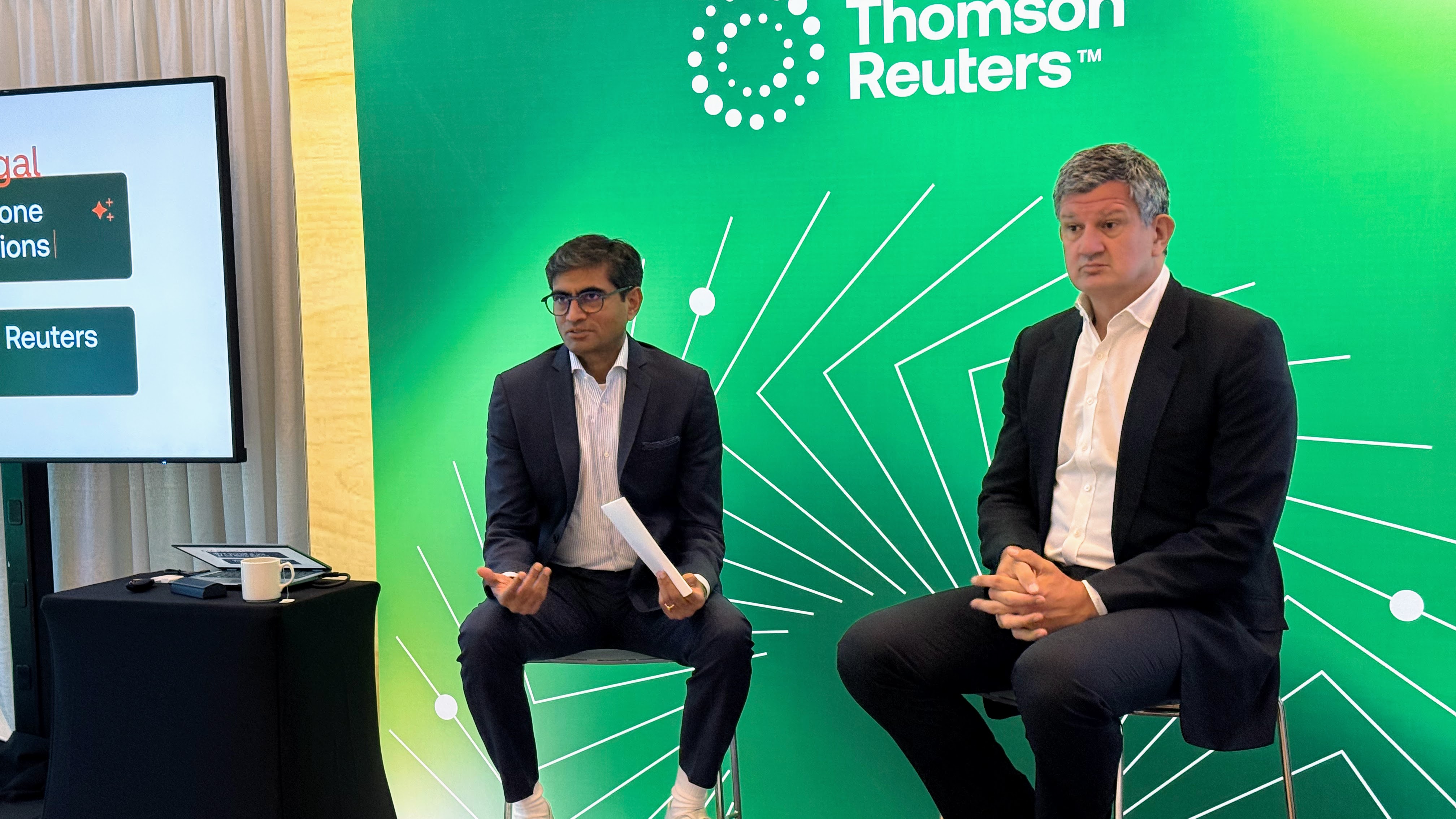
The
media-only
event
was
presented
as
a
conversation
between
Hasker
and
Ragunath
Ramanathan,
Thomson
Reuters’
president
of
legal
professionals.
After
the
media
event,
I
sat
down
privately
with
Hasker
for
a
brief
supplemental
interview.
The
CEO,
who
joined
TR
as
CEO
in
March
2020,
emphasized
that
while
AI
doesn’t
replace
attorneys’
responsibilities,
it
fundamentally
changes
how
initial
legal
work
is
created.
“It
does
not
absolve
an
attorney,
a
qualified
lawyer,
of
their
rights
and
responsibilities.
It
does
not
enable
anyone,
including
us,
to
sort
of
defer
to
the
machine.”
His
conversation
with
Ramanathan
came
on
the
heels
of
TR’s
launch
of
CoCounsel
Legal,
with
sophisticated
agentic
AI
and
deep
research
capabilities.
Wide
Adoption,
Limited
Strategic
Planning
Hasker
noted
that
virtually
every
law
firm
is
experimenting
with
AI
tools.
“I
can’t
find
a
law
firm,
large,
medium
or
small,
that
isn’t
experimenting
with
or
adopting
one
or
more
AI
technologies.
There
may
be
a
firm
out
there,
but
I
haven’t
found
it.”
Government
entities
such
as
court
systems,
attorneys
general,
and
the
U.S.
Department
of
Justice,
Hasker
said,
“are
perhaps
a
half
a
step
behind,
but
I’ve
no
doubt
that
they
will
also
come
along.”
However,
he
observed
that
few
firms
have
developed
comprehensive
transformation
strategies.
“I
think
there
are
very
few
firms
that
have
truly
got
their
minds
around
the
broader
transformation
required
to
take
advantage
of
these
technologies.
And
there
are
even
fewer
firms
that
have
a
laser
like
view
of
how
they’re
going
to
win
in
this
environment.”
Revenue
Model
Challenges
Before
joining
TR,
Hasker
was
senior
adviser
to
TPG
Capital,
CEO
of
CAA
Global,
and
spent
nearly
eight
years
as
global
president
and
COO
at
Nielsen.
He
began
his
career
at
PwC
and
later
spent
over
a
decade
as
a
partner
in
McKinsey’s
global
media,
information,
and
technology
practice.
In
his
ILTACON
conversation
with
Ramanathan,
Hasker
acknowledged
that
the
industry
faces
significant
structural
changes,
particularly
around
billing
models.
“Most
of
the
firms
still
have
a
good
chunk
of
their
revenues
based
on
per-hour
billing.
And
if
you
start
to
meddle
with
your
revenue
model,
that
can
be
very
disruptive.”
He
noted
that
firms
must
balance
innovation
with
practical
concerns:
“And
they’ve
got
partners
to
pay
and
colleagues
to
sort
of
provide
apprenticeships
to.
And
the
second
thing,
of
course,
is
that
lawyers
are
the
salespeople.
And
so
if
you
mess
with
that
too
much,
you
lose
your
sales
force.”
Copyright
Protection
Concerns
In
a
separate
private
interview
I
had
with
Hasker,
he
expressed
strong
views
on
copyright
protection
in
the
AI
era,
particularly
regarding
TR’s
ongoing
litigation
with
ROSS
Intelligence.
While
declining
to
comment
specifically
on
the
case,
he
argued
that
copyright
protection
is
essential
for
maintaining
incentives
for
content
creators.
“For
me,
what
this
is
about
is
incentives
for
creatives
to
create,
journalists
to
write
and
create
content,
videographers,
filmmakers,
recorded
music
artists,
or
legal
editors.
Because
if
the
copyright
is
fundamentally
undermined,
then
so
too
are
the
incentives
for
people
to
create
content,”
Hasker
told
me.
He
rejected
arguments
that
the
U.S.
should
weaken
copyright
protections
to
compete
with
China
in
AI
development.
“And
so
where
does
the
U.S.
have
it
fundamental
advantage?
It’s
in
the
quality
of
the
underlying
content
that
feeds
these
problems,”
he
said
in
the
private
interview.
Three-Phased
Transformation
During
their
conversation,
Ramanathan
outlined
Thomson
Reuters’
view
of
industry
transformation
occurring
in
three
phases.
“The
first
is
exactly
like
you
said,
experimentation.
That’s
the
phase
we
are
in.
The
second
phase
will
be
what
we
call
process
reengineering.
You’re
re-engineering
the
legal
workflows,
the
processes,
the
hiring
processes.
…
The
third
way,
which
I
do
agree
is
at
least
five
years
away,
is
real
business
model
change.”
‘$10
Billion
in
Dry
Power’
Hasker
detailed
Thomson
Reuters’
approach
to
AI
development,
emphasizing
the
company’s
financial
resources.
“We
talk
about
having
$10
billion
in
dry
powder
–
by
the
end
of
2027,
it
will
be
$10
billion.
By
the
end
of
2028,
it’ll
be
$12.5
billion.”
The
company
recently
acquired
Safe
Sign,
a
group
of
scientists
from
Cambridge
and
Harvard
universities
working
on
specialized
legal
language
models.
“We
don’t
know
whether
the
world
will
continue
to
rest
upon
the
large
language,
the
foundation
models,
or
whether
there
will
be
some
really
interesting
ways
in
which
our
products
and
outcomes
can
be
differentiated
on
the
basis
of
the
work
that
Jonathan
[Schwartz]
and
the
Safe
Sign
team
are
doing,”
Hasker
said.
The
Casetext
Acquisition
In
my
side
interview
with
Hasker,
I
asked
him
about
TR’s
“build
vs.
buy”
decision
to
acquire
Casetext
for
$650
million,
given
that
TR
already
had
a
long
history
of
developing
AI
and
its
own
AI
lab
in
Toronto.
At
the
time,
Hasker
said,
TR’s
internal
efforts
were
“moving
pretty
quickly”
around
integrating
ChatGPT
with
Westlaw
and
Practical
Law,
with
Mike
Dahn,
SVP
and
head
of
Westlaw
product
management,
leading
the
charge
on
Westlaw,
and
Emily
Colbert,
SVP
of
product
management,
doing
the
same
for
Practical
Law.
“We
were
already
on
high
alert
and
acceleration.”
But
the
reason
he
wanted
to
acquire
Casetext
was
to
provide
a
second
option,
as
he
was
not
sure
how
long
internal
development
would
take
before
bearing
fruit.
“We
literally
said
that,
because
we
figured
out
[the
Casetext
deal]
could
take
a
while
for
us
to
close,
let’s
run
the
internal
teams
as
hard
and
fast
as
we
can.”
At
the
same
time,
he
would
encourage
Casetext
CEO
Jake
Heller
and
his
team
“to
run
as
hard
and
then
the
day
we
integrate,
we’ll
pick
the
best
code
base.
Simple
as
that.
“That
may
sound
dispassionate,
but
I
think
in
this
environment
you
have
to
–
and
it’s
not
favoring
one
person
or
one
team
over
another.
It
just
says,
‘Look,
we’ll
just
make
a
dispassionate
call
as
to
who’s
made
the
most
progress
and
we’ll
adopt
that.’”
In
the
end,
he
said,
he
felt
that
Casetext
had
made
the
most
progress
in
developing
an
legal
AI
assistant,
while
Dahn
and
his
team
had
made
the
most
progress
in
injecting
Open
AI
into
Westlaw.
“So,
for
better
or
worse,
we
ended
up
taking
both
of
those
and
now
we’ve
bought
them
–
truly
brought
them
–
together”
Small
Firm
Adoption
Contrary
to
traditional
technology
adoption
patterns,
Hasker
observed
that
AI
tools
are
seeing
rapid
uptake
among
small
and
solo
practitioners.
He
recounted
meeting
a
solo
practitioner
who
immediately
embraced
the
technology
after
seeing
a
demonstration.
The
solo
told
Hasker
he
was
about
to
hire
another
paralegal
at
a
salary
of
$90,000
a
year
plus
expenses,
but
he
conceded,
“I’m
not
very
good
at
hiring
them.
I’m
not
very
good
at
managing
them.
They
come
and
go.”
TR’s
AI
tools
would
cost
him
a
fraction
of
that,
the
solo
said,
adding,
“And
I
think
this
is
going
to
be
able
to
do
their
work
just
as
well,
and
I’d
much
prefer
to
manage
this
than
I
would
another
human
being
in
my
office.”
The
lawyer
then
asked
to
start
using
the
tool
immediately,
saying:
“I’ve
got
a
big
case
tomorrow
and
I
really
want
to
start
to
use
the
tool
today,
so
can
I
sign
up?”
Professional-Grade
AI
Emphasis
Hasker
stressed
the
importance
of
professional-grade
AI
that
addresses
data
security
and
privacy
concerns
specific
to
legal
practice.
He
criticized
recent
comments
by
OpenAI’s
Sam
Altman
about
privacy
limitations.
“I
was
astonished
to
hear
Sam
Altman
last
week
just
sort
of
throwing
out
and
saying,
well,
you
know,
one
of
the
things
that
ChatGPT
doesn’t
have
is
any
form
of
privacy.
You
know
what
I
mean?
We
really
need.
Okay,
but
Sam,
your
people
are
out
there
telling
lawyers
that
they
can
just
use
that.
So
pick
one.
Right.
Does
it
lack
privacy
or
can
it
be
used
by
lawyers?
Because
it’s
not
both.”
Content-Driven
Tech
Company
Hasker,
who
joined
TR
as
CEO
in
2020,
said
he
realized
almost
immediately
that
TR
needed
to
migrate
from
“being
a
content
company,
predominantly
–
as
some
people
would
have
traditionally
said,
a
publisher
–
to
a
content
driven
technology
company.”
He
said
the
company’s
focus
is
now
on
“the
seamless
integration
of
unique
and
proprietary
content,
both
ours
and
that
of
our
customers,
that
of
third
parties,
where
it
makes
sense
to
do
so
with
AI.”
Both
Hasker
and
Ramanathan
noted
the
company’s
inclusion
in
the
NASDAQ
index
as
a
validation
point
–
both
for
TR
and
for
the
legal
industry
more
broadly.
“I
think
it’s
a
sort
of
a
signpost
along
the
way,”
Hasker
said.
“It
certainly
meant
more
to
our
colleagues
than
I
thought
it
would.”
His
‘Aha
Moment’
for
AI
In
our
separate
interview,
I
asked
Hasker
whether
there
was
an
“aha
moment”
for
him
regarding
the
potential
of
ChatGPT
and
generative
AI.
“When
it
passed
the
bar
exam,”
he
replied,
leading
him
to
think,
“Okay,
this
is
going
to
be
a
real
disruptor.”
Another
aha
moment
came
soon
after
than,
when
he
was
at
a
TR
event
for
managing
partners
of
major
law
firms.
When
the
topic
of
AI
came
up,
he
described
observing
their
varied
reactions,
from
those
planning
aggressive
adoption
to
others
hoping
to
“hold
your
breath
until
retirement.”