
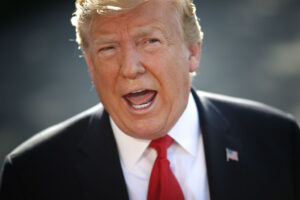
by
Win
McNamee/Getty
Images)
On
Tuesday,
Judge
Charles
Breyer
ordered
the
Trump
administration
to
quit
violating
the
Posse
Comitatus
Act
(PCA).
The
court
found
that
the
Defense
Department
illegally
used
Marines
and
federalized
National
Guard
troops
to
enforce
civil
law
during
a
surge
of
immigration
raids
in
and
around
Los
Angeles
in
June
and
July.
Worse
still,
Secretary
of
Defense
Pete
Hegseth
and
his
minions
deliberately
countermanded
their
own
instruction
materials
to
authorize
illegal
conduct.
“Defendants
knew
that
they
were
ordering
troops
to
execute
domestic
law
beyond
their
usual
authority,”
Judge
Breyer
wrote,
concluding
that
“Defendants’
systemic
use
of
Task
Force
51
troops
to
execute
domestic
law
in
and
around
Los
Angeles
violated
the
Posse
Comitatus
Act.”
Judge
Breyer
is
clearly
aware
of
the
stakes.
“Los
Angeles
was
the
first
U.S.
city
where
President
Trump
and
Secretary
Hegseth
deployed
troops,
but
not
the
last,”
he
wrote,
noting
that
National
Guard
troops
have
descended
on
Washington
DC
to
“stand
with
their
law
enforcement
partners.”
Even
today
Trump
is
threatening
to
send
troops
to
Oakland,
Baltimore,
Chicago,
and
San
Francisco
to
“clean
up”
those
cities
as
well.
And
so
the
jurist
took
pains
to
explain
why
erecting
a
cordon
and
shutting
down
streets
amount
to
domestic
law
enforcement,
and
not
simply
“protecting”
ICE
and
DHS
agents.
Parading
through
MacArthur
Park
in
full
battle
rattle
to
demonstrate
“presence”
is
less
of
a
close
call.
The
opinion
serves
as
a
roadmap
for
states
and
federal
judges
when
the
“national
police
force
with
the
President
as
its
chief”
rolls
onto
their
streets.
And
so,
of
course,
the
administration
is
trying
to
stick
a
shiv
in
it,
immediately
filing
an
emergency
motion
to
stay
during
its
appeal.
Background
Newsom
v.
Trump
has
followed
a
weird
procedural
trajectory.
After
a
few
hours
of
anti-ICE
rioting
which
was
quickly
quelled
by
police,
Trump
seized
on
the
“emergency”
as
justification
to
federalize
the
California
National
Guard
over
the
objections
of
Governor
Gavin
Newsom.
The
state
sued,
alleging
that
there
was
no
emergency,
the
Guard
had
been
illegally
federalized,
and
that
the
Guard
and
Marines
were
grossly
violating
the
PCA.
Judge
Breyer
issued
a
temporary
restraining
order
as
to
the
first
two
issues,
rubbishing
the
so-called
“emergency”
of
a
few
kids
throwing
rocks
and
ruling
that
10
USC
§
12406’s
requirement
that
the
Guard
be
federalized
“through”
the
governor
did
not
allow
for
Hegseth
to
unilaterally
deploy
them.
But
the
trial
judge
saved
the
issue
of
the
PCA
for
the
preliminary
injunction
stage,
reasoning
that
a
couple
of
weeks
of
troops
on
the
ground
would
yield
evidence
relevant
to
the
PCA
issue.
The
administration
immediately
appealed
the
(unappealable)
TRO,
as
is
its
habit.
And
a
Ninth
Circuit
panel,
which
contained
two
Trump
appointees,
ultimately
reversed
Judge
Breyer’s
TRO
with
respect
to
the
emergency
declaration
and
the
federalization
under
§
12406,
staying
the
order
pending
appeal.
But
that
left
the
issue
of
the
PCA
unresolved,
and
so
Judge
Breyer
held
a
three-day
bench
trial
in
August
to
determine
whether
the
Trump
administration
was
using
“any
part
of
the
Army,
the
Navy,
the
Marine
Corps,
the
Air
Force,
or
the
Space
Force
as
a
posse
comitatus
or
otherwise
to
execute
the
laws.”
The
law
doesn’t
count
if
you
cross
it
out?
As
Judge
Breyer
explained,
the
PCA
issue
turns
on
whether
troops
“actively
assisted
with
the
execution
of
domestic
law,”
or
“whether
the
military’s
involvement
isso
indirect
as
to
not
violate
the
Act.”
Luckily,
the
Defense
Department
produced
a
handy-dandy
PCA
training
manual
for
the
“Task
Force
51”
troops
deployed
to
Los
Angeles.
Less
luckily
(for
the
government
defendants),
they
seem
to
have
taken
a
giant
Sharpie
to
it,
crossing
out
stuff
they
really
wanted
to
do
anyway.
Here’s
the
PowerPoint
slide
of
“Prohibited
Law
Enforcement
Functions”
entered
into
evidence.
It
explains
that
the
PCA
prohibits
twelve
categories
of
actions:
pursuit,
arrests,
apprehension,
search,
seizure,
security
patrols,
traffic
control,
crowd
control,
riot
control,
evidence
collection,
interrogation,
and
serving
as
an
informant.
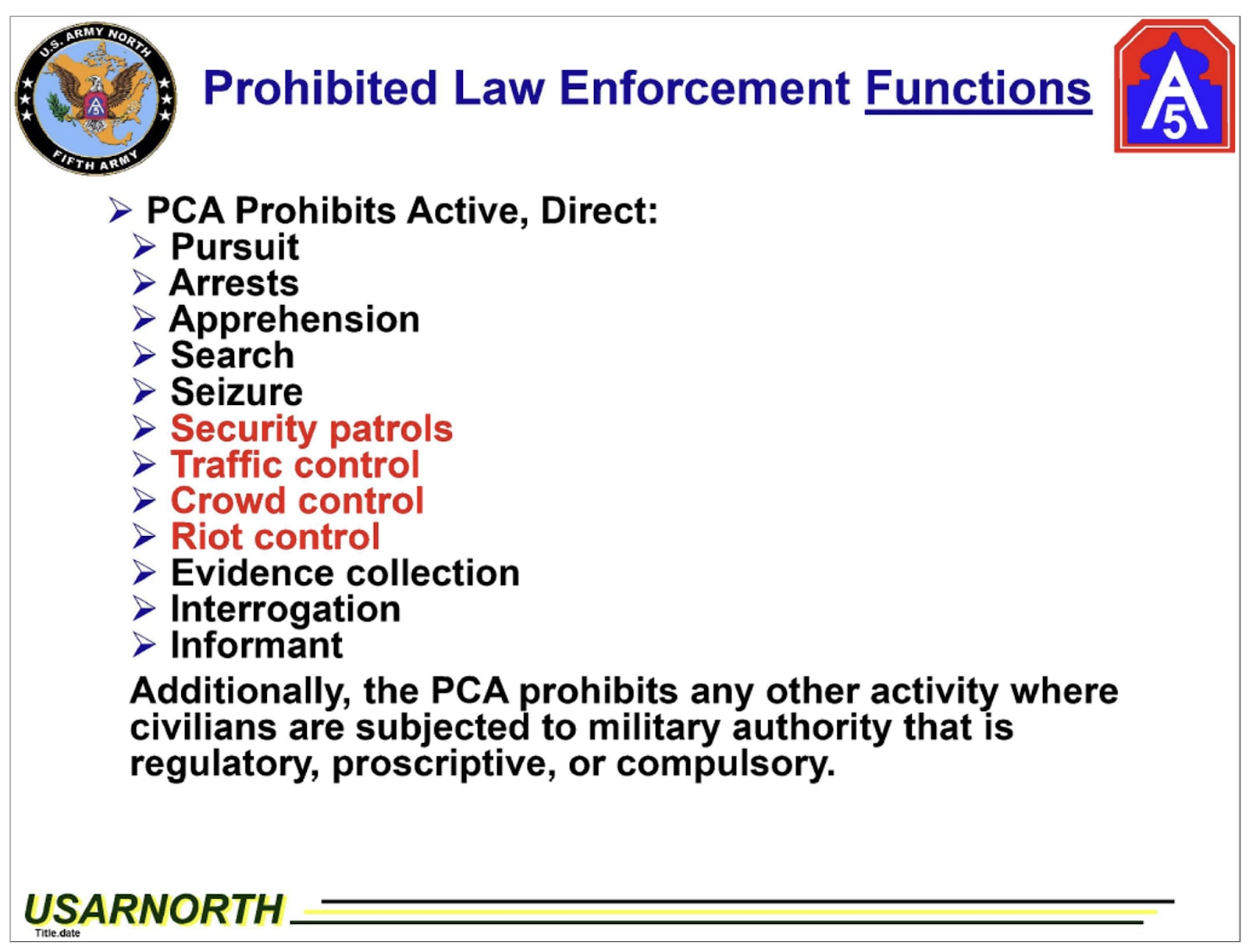
But
four
of
those
—
establishing
security
patrols,
traffic
control,
crowd
control,
and
riot
control
—
were
rendered
in
red.
That’s
because
troops
were
“orally
instructed”
that
those
four
were
part
of
a
“so-called
constitutional
exception
to
the
Posse
Comitatus
Act.”
There
is
no
such
“constitutional
exception.”
As
Judge
Breyer
noted,
“This
assertion
is
not
grounded
in
the
history
of
the
Act,
Supreme
Court
jurisprudence
on
executive
authority,
or
common
sense.”
And
so
the
Defense
Department
tried
hard
—
albeit
ineffectively
—
to
hide
what
they
were
doing.
“This
instruction
was
initially
not
put
in
writing,”
the
court
observed
dryly.
But
on
June
23,
Hegseth
sent
out
a
memo
authorizing
“measures
for
temporary
detention,
cursory
search,
and
the
steps
necessary
to
ensure
the
safety
of
Federal
personnel”
including
“perimeter
protection
against
third
parties
and
such
crowd
control
measures
as
are
reasonably
necessary
to
ensure
the
execution
of
Federal
functions
and
the
safety
of
Federal
personnel.”
In
short,
“Task
Force
51
troops
were
openly
instructed
that
they
could,
consistent
with
the
Posse
Comitatus
Act,
engage
in
some
law
enforcement
actions
as
long
as
they
were
doing
so
to
protect
federal
property,
personnel,
or
functions.”
And
engage
in
them,
they
did.
TL,
DR:
If
you’d
otherwise
have
ICE
agents
or
cops
doing
it,
it’s
law
enforcement
After
Hegseth’s
memo
and
the
green
light
from
the
Ninth
Circuit,
the
Task
Force
51
troops
were
deployed
as
virtual
bodyguards
for
ICE,
blocking
streets
and
forming
cordons
for
every
law
enforcement
action.
They
even
participated
in
a
chest
thumping
military
parade
through
MacArthur
Park,
using
Humvees
and
tactical
vehicles
to
block
traffic
along
Wilshire
Boulevard
as
part
of
Hegseth’s
plan
“to
demonstrate,
through
a
show
of
presence,
the
capacity
and
freedom
of
maneuver
of
federal
law
enforcement
within
the
Los
Angeles
Joint
Operations
Area.”
Judge
Breyer
held
that
all
of
this
violated
the
PCA.
He
also
rejected
a
truly
bizarre
claim
made
by
the
DOJ
that
§
12406
is
an
exception
to
the
PCA,
so
the
federalized
troops
were
free
to
act
as
a
roving
police
force.
“The
Court
is
unaware
of
any
person—government
lawyer,
military
or
civilian
official,
court,
or
commentator—who
has
made
this
argument
other
than
Defendants’
lawyers
in
this
case,”
he
scoffed.
“The
Department
of
Defense
has
not
taken
this
position
in
its
publications
on
the
Posse
Comitatus
Act.”
The
court
did,
however
partially
excuse
the
DOJ’s
bonkers
argument,
chalking
it
up
as
the
“consequences
of
the
Ninth
Circuit’s
highly
deferential
reading
of
the
statute.”
(Shaaaaaaade.)
Judge
Breyer
laid
out
three
metrics
to
assess
whether
a
particular
military
action
complies
with
the
PCA’s
ban
on
using
the
military
to
“execute
the
laws.”
It
is
more
likely
that
an
activity
violates
the
PCA
if
it
involves:
-
Troops
engages
in
direct
law
enforcement
functions,
such
as
“setting
up
protective
perimeters,
traffic
blockades,
crowd
control,
and
the
like”; -
Coordinated,
ongoing
activities
as
opposed
to
isolated,
passive
ones;
and -
Actions
taken
without
the
support
of
state
and
local
law
enforcement,
particularly
when
troops
are
used
as
a
substitute
for
security
that
local
police
would
otherwise
proved.
Here,
there’s
ample
evidence
of
all
three.
Task
Force
51
routinely
blockaded
the
roads
and
“used
riot
shields
and
military
vehicles
to
establish
a
perimeter
at
the
DEA
enforcement
operation”
at
a
marijuana
farm
in
Mecca,
California.
It
mustered
in
advance
of
ICE
actions,
not
as
a
response
to
actual
violence
or
protest,
but
to
discourage
it
and
impede
the
movement
of
people
into
and
out
of
the
area.
It
performed
functions
that
would
otherwise
have
been
carried
out
by
ICE
agents
or
local
law
enforcement.
Even
some
of
the
government’s
witnesses
were
“unable
to
distinguish”
Task
Force
51
troops
from
ICE
agents
in
photos
of
joint
actions.
And,
once
the
troops
were
on
the
ground,
ICE
virtually
ceased
cooperating
with
the
Los
Angeles
Police
and
Sheriffs
Departments.
Even
though
multiple
federal
agencies
and
Task
Force
51
rehearsed
Operation
Excalibur
several
times,
they
provided
LAPD
and
LASD
with
a
mere
two
hours’
notice
of
the
operation.
Likewise,
federal
agencies
notified
local
law
enforcement
of
cannabis
farm
raids
only
at
the
time
of
the
raids,
not
beforehand.
This
is
not
typical.
In
those
Posse
Comitatus
Act
cases
where
state
and
local
law
enforcement
had
jurisdiction…
federal
troops
generally
worked
alongside
state
and
local
officials.
Defendants’
lack
of
cooperation
with
their
state
and
local
counterparts
raises
red
flags.
It
also
highlights
the
lack
of
any
showing
by
Defendants
that
state
and
local
officials
were
unable
or
unwilling
to
execute
the
laws
before
Defendants
deployed
troops
to
engage
in
typical
law
enforcement
functions.
The
court’s
conclusion
was
inescapable:
“Defendants
instigated
a
months-long
deployment
of
the
National
Guard
and
Marines
to
Los
Angeles
for
the
purpose
of
establishing
a
military
presence
there
and
enforcing
federal
law.
Such
conduct
is
a
serious
violation
of
the
Posse
Comitatus
Act.”
Avenues
of
attack
This
case
is
clearly
headed
to
the
Supreme
Court.
Trump
is
fixated
on
unleashing
the
military
on
Democratic
cities,
and
he
knows
that
the
six
conservative
justices
are
largely
supine
to
the
“unitary
executive”
—
if
only
when
that
executive
is
a
Republican.
Even
if
the
Court
does
wind
up
ruling
against
him,
the
administration
can
likely
wrangle
many
more
months
of
delay
from
a
Court-imposed
stay,
during
which
time
the
military
will
be
allowed
to
run
riot
in
Democratic
strongholds.
Hell,
if
DOJ
times
this
thing
right,
they
might
be
able
to
drag
this
out
until
November
of
2026,
so
Trump
can
flood
the
swing
states
with
troops
during
the
election.
But
if
the
Supreme
Court
wants
to
avoid
the
issue,
they
might
kick
this
case
on
standing
grounds.
The
Posse
Comitatus
Act,
codified
at
18
USC
§
1385
is
a
criminal
statute
that
doesn’t
on
its
face
allow
for
civil
actions
to
enforce
it.
Judge
Breyer
found
that
California
had
equitable
standing
to
sue
the
Trump
administration
because
having
troops
on
the
street
conducting
domestic
law
enforcement
infringes
on
the
“quintessential
power
that
the
Constitution
reserves
to
the
states,”
that
is,
the
state’s
police
power
to
enforce
its
own
laws.
It
is
not
hard
to
imagine
the
Court’s
howler
monkey
wing
seizing
on
standing
as
a
convenient
excuse
to
let
the
Trump
administration
to
continue
flagrantly
violating
the
law.
But
for
now,
we
wait
for
the
Ninth
Circuit.
Judge
Breyer
stayed
his
order
until
September
12,
and
so
we
get
to
spend
the
week
playing
the
Laws,
Do
They
Even
Matter?
game.
Again.
Liz
Dye and Andrew
Torrez produce
the
Law
and
Chaos Substack and podcast.