

Philosopher
Paul
Virilio
wrote
of
the
integral
accident
—
with
technological
advancement
there
comes
a
corresponding
new
accident.
Planes
beget
plane
crashes,
electricity
begets
electrocution.
Artificial
intelligence
has,
in
turn,
delivered
the
AI
hallucination.
Lawyers
do
it,
judges
do
it,
our
clients
do
it.
When
Mata
v.
Avianca
came
down
—
the
ur
text
of
lawyer
AI
hallucination
screw
ups
—
we
defended
the
technology
against
critics,
stressing
that
the
problem
in
this
case
remained
fundamentally
human.
It
shouldn’t
matter
where
the
fake
cite
comes
from…
lawyers
have
an
obligation
to
check
their
filings
for
accuracy.
Don’t
hate
the
(video)
game,
hate
the
player.
Now,
after
a
couple
years
of
sustained
hallucination
embarrassments
across
the
industry,
we
have
to
wonder
if
it’s
time
to
start
hating
the
game.
It
seems
like
they’re
just
not
stopping
and
it
doesn’t
seem
to
matter
if
the
sanctions
are
understanding
or
draconian.
There’s
another
story
coming
out
of
last
week:
Christine
Lemmer-Webber
described
generative
AI
as
Mansplaining
As
A
Service,
and
I
don’t
know
if
an
AI
tool
suggested
telling
the
judge
that
there
were
attached
cases
that
weren’t
attached,
but
it
raises
the
mansplaining
bar.
How
is
this
still
happening?
There’s
an
interesting
back-and-forth
among
law
professors
today:
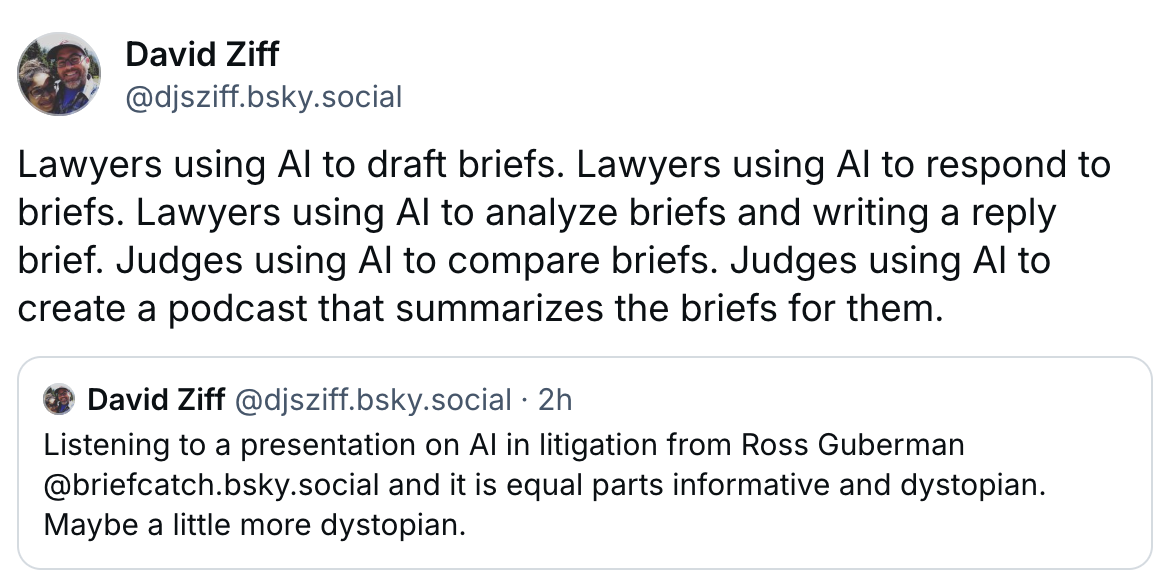
In
response,
Professor
Frye
states:

Which
is
fair.
Plagiarism
should
be
your
friend
in
a
common
law
legal
system.
Whenever
an
enterprising
lawyer
tries
to
assert
copyright
over
their
public
filings,
a
puppy
dies.
But
there’s
an
art
to
knowing
what
to
properly
copy
to
advance
the
client’s
argument.
Though
even
with
a
“human
in
the
loop”
—
the
industry
polite
phrasing
for
“you’re
still
responsible,
dumbass”
—
does
the
human
process
of
finding
good
material
and
copying
it
lose
something
when
automated?
On
a
surface
level,
it
shouldn’t.
However
the
material
gets
there,
the
human
checking
it
should
make
sure
it’s
right
before
it
goes
out
the
door.
But
returning
to
Virilio,
another
of
his
core
arguments
was
that
speed
changes
the
nature
of
an
event.
Applying
this
sort
of
dromological
displacement
to
the
process
of
writing,
Virilio
might
say
that
these
tools
aren’t
just
typing
faster,
but
changing
what
a
“brief”
(or
“opinion”)
even
is.
Is
the
brief
merely
the
manifestation
of
the
argument
to
the
tribunal,
or
is
it
also
the
site
of
the
lawyer’s
thinking
through
of
the
argument.
To
the
extent
it’s
the
latter,
automation
collapses
that
temporal
space.
The
lawyer
doesn’t
write
with
time
anymore,
as
much
as
they
write
against
it.
When
we
talk
about
how
AI
accelerates
the
process,
a
lawyer’s
conception
of
the
workflow
itself
can
change
and
the
human
act
of
tediously
checking
cites
becomes
so
jarring
when
juxtaposed
to
the
writing
process
that
we
look
down
upon
it
as
an
obstacle
to
be
half-assed…
or,
probably
inevitably,
turned
over
to
yet
another
bot.
The
hype
surrounding
“Agentic”
AI
tends
to
suggest
the
industry
has
a
hankering
for
this
“GPT-sus
Take
The
Wheel”
approach.
Truly
Agentic
AI
is
miserably
inaccurate.
Thankfully,
most
agentic
applications
in
legal
are
can
only
very
tenuously
be
called
“agentic,”
which
may
irritate
marketing
teams,
but
should
make
lawyers
more
comfortable.
Regardless,
the
fact
that
we’re
talking
about
Agentic
AI
as
a
goal
is
indicative
of
a
desire
to
erode
the
human
from
the
loop.
There’s
a
fundamental
difference
between
(1)
the
iterative
process
of
querying
the
bot,
checking
the
output,
refining
the
query,
checking
the
output,
rethinking
strategy,
running
the
query
again,
checking
that,
and
then
moving
to
step
2
in
a
five-step
workflow;
and,
(2)
showing
up
after
an
AI
churned
through
the
five-step
workflow
uninterrupted
and
trying
to
reverse
engineer
the
delivered
work
product
to
make
sure
it
makes
sense.
Because
the
first
option
is
where
AI
more
or
less
exists
as
a
legal
tool
now
and
the
second
is
the
“promise”
of
agentic.
And
anyone
who
doesn’t
believe
there’s
a
difference
between
the
two,
consider
how
you
would
normally
work
on
a
brief
with
junior
associates
every
day
and
assigning
the
brief,
taking
a
three-week
vacation,
and
then
editing
a
draft
for
the
first
time
six
hours
before
it’s
due.
Those
are
two
very
different
processes.
Which
brings
us
back
to
the
question:
has
AI
made
lawyers
dumber?
Is
it
just
shining
a
light
on
lawyers
who
were
already
too
careless,
or
has
it
changed
the
whole
process
in
a
way
that
creates
more
carelessness?
And
if
it
is
the
latter,
the
answer
isn’t
to
reject
the
technology.
There
may
well
be
a
catastrophic
bubble
bursting
sometime
soon,
but
the
underlying
technology
will
find
a
way
to
go
on.
How
do
lawyers
adapt
to
this
psychological
reordering
of
the
process?
Like
most
continental
philosophy,
Virilio
isn’t
saying
speed
is
necessarily
bad,
it
just…
is.
And
understanding
what
it’s
doing
to
you
is
half
the
battle.

Joe
Patrice is
a
senior
editor
at
Above
the
Law
and
co-host
of Thinking
Like
A
Lawyer.
Feel
free
to email any
tips,
questions,
or
comments.
Follow
him
on Twitter or Bluesky if
you’re
interested
in
law,
politics,
and
a
healthy
dose
of
college
sports
news.
Joe
also
serves
as
a Managing
Director
at
RPN
Executive
Search.