
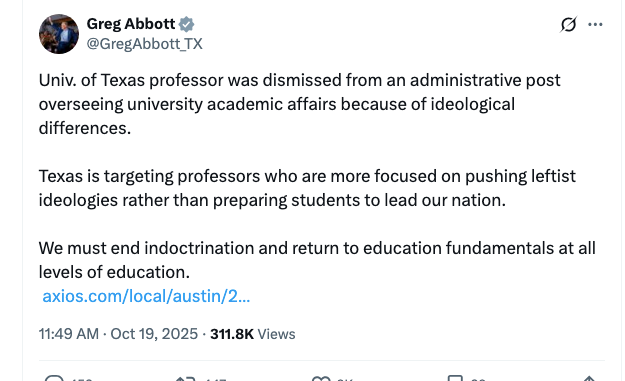
Dear
Governor,
State
Senator,
or
Representative,
Thank
you
for
your
interest
in
my
course,
[redacted]. You
probably
discovered
my
course
by
accessing
“Simple
Syllabus”
or
scouring
our
course
offerings
page,
rather
than
engaging
in
some
other
constituent
concern. I
appreciate
your
devotion
to
higher
education
and
ensuring
that
students
get
the
maximum
opportunity
to
learn
in
a
school
in
our
state.
I
noted
in
your
social
media
post
that
you
consider
my
course
“woke”
and
“DEI”
or
part
of
some
“progressive
left
agenda”
to
indoctrinate
your
children. Just
for
clarification,
I
don’t
think
you
mean
your
actual
children,
all
of
whom
you
sent
to
Harvard
and
not
to
the
state
university
at
which
I
teach. I
suspect
you
meant
your
constituents’
children.
Effect
On
Taxpayers
I
understand
that
you
are
concerned
about
the
massive
amount
of
tax
dollars
spent
on
my
course. I
assure
you
that
is
not
the
case,
neither
in
terms
of
my
course
as
a
percentage
of
aggregate
tax
dollars
nor
even
as
a
percentage
of
each
individual
taxpayer’s
overall
liability. My
course
is
small
potatoes. Even
if
you
were
to
look
at
the
percentage
of
classes
you
deem
“woke”
versus
total
class
offerings
at
my
university,
you
would
not
conclude
that
the
“woke”
courses
are
in
any
way
breaking
anyone’s
bank.
Nor
could
you
know
what
financial
impact
my
course
has
on
the
university,
absent
more
investigation. You
have
not
examined
enrollment
patterns
for
the
course,
which
is
surprising
given
you
are
a
firm
believer
in
markets
and
“liberty.” Thus,
it’s
hard
to
determine,
absent
more,
whether
my
course
subsidizes
the
university,
mitigating
tax
dollar
requirements,
or
vice
versa. I’m
sure
you
agree
that
if
a
course
has
high
demand,
liberty
dictates
that
we
offer
this
course
to
your
constituents.
You
point
out
that
taxpayers
(in
part)
pay
my
salary. I’ll
start
by
saying
thank
you
very
much
for
my
3%
pay
raise
over
the
past
eight
years. But
beyond
that,
you
are
measuring
the
opportunity
cost
between
offering
this
course
and
offering
a
different
course. Which
is
of
highest
value? Is
it
a
wise
use
of
your
time
to
try
to
make
that
determination
without
any
information
other
than
the
course
description
when
there
are
provosts,
deans,
department
chairs,
and
faculty
who
have
experience
with
this?
In
sum,
be
assured
if
no
students
were
taking
the
course,
or
if
they
uniformly
hated
the
course,
or
if
some
other
courses
could
be
regarded
as
of
higher
value,
I’d
be
teaching
something
else
instead,
and
we
wouldn’t
be
having
this
conversation.
To
paraphrase
Gil
Scott-Heron,
not
only
will
the
revolution
not
be
televised,
it
won’t
be
listed
in
the
course
catalog
if
no
one
wants
to
take
the
course. Even
a
mandatory
course
which
is
subject
to
hostile
evaluations
and
attack
is
not
likely
to
be
long-lived. Markets
work,
sometimes.
Is
My
Class
‘Woke’
Or
‘DEI’?
Discussing
a
societal
issue
in
a
course
does
not
mean
a
course
is
“woke”
or
“DEI.”
In
my
opinion,
both
terms
have
now
become
terms
that
do
not
mean
what
you
think
they
mean.
DEI,
before
you
altered
the
term
to
mean
any
course
you
hate,
meant
inclusion
of
diverse
groups
on
an
equal
basis. For
example,
as
some
have
pointed
out
facetiously,
your
argument
for
greater
inclusion
of
more
conservative
professors
is
a
DEI
claim.
Including
LGBTQ+
courses
does
not
make
it
DEI
or
woke. For
example,
let’s
assume
there
is
a
course
called
“Dealing
with
Clients,”
in
which
“LGBTQ+
issues
will
be
addressed.” Your
search
of
courses
would
flag
this
and
suggest
that
it
is
wasting
taxpayer
dollars
on
woke
issues. But
did
you
consider
some
alternative
explanation
for
the
course
before
summarily
dismissing
it?
For
example,
if
this
course
were
offered
in
a
medical
school,
law
school,
school
of
social
work,
department
of
psychology,
or
other
department,
it
may
very
well
mean
assuring
the
competency
of
the
student
to
handle
clients. You
don’t
always
get
to
pick
your
clients,
and
foreclosing
understanding
of
clients
merely
because
a
state
senator
doesn’t
understand
that
would
be
to
not
fully
train
my
students
in
the
hopes
of
saving
my
own
skin. You
would
seek
to
make
our
students
worse
off
using
your
“standard.”
Am
I
Indoctrinating
Students?
All
signs
suggest
I’m
not
indoctrinating
my
students,
even
the
one
or
two
who
have
fully
read
my
syllabus.
First,
indoctrination
probably
doesn’t
mean
what
you
think
it
means.
Correct
me
if
I’m
wrong,
but
you
seem
to
think
that
if
a
student
walks
into
my
class
there
is
some
power
I
will
hold
over
them
to
compel
them
to
my
beliefs,
whether
it
be
my
charisma
(thank
you),
Jedi
mind
tricks
(insulting
to students),
or
some
other
mechanism
which
you
don’t
describe
in
detail. Indoctrination
is
far
more
complex,
and
that
complexity
explains
its
impossibility.
Second,
there
is
a
difference
between
indoctrination
and
education,
and
I
believe
you
often
conflate
the
two.
Introduction
of
an
idea
might
give
the
idea
temporary
appeal,
even
if
the
idea
is
presented
in
a
fashion
that
lists
all
of
the
idea’s
caveats.
Without
more,
that
temporary
appeal
comes
from
novelty
and
dissipates
over
time.
Second,
it
is
not
as
if
the
course
is
a
cult.
I
have
no
ability
to
isolate
the
student
on
an
island
and
use
force
to
compel
the
drinking
of
the
Kool-Aid.
Even
a
threat
of
a
final
exam
can
be
an
exercise
of
“fodder
in,
fodder
out”
without
acceptance
of
any
indoctrination.
Thus,
exposure
to
ideas
isn’t
indoctrination,
unless
your
definition
of
indoctrination
is
so
broad
as
to
suggestion
all
education
is
indoctrination.
Third,
evidence
suggests
that
indoctrination
(from
faculty)
simply
does
not
exist. The
Economist
(hardly
a
leftist
rag,
I’ll
note)
discusses
the
phenomenon
and
concludes
that
faculty
indoctrination
of
students
is
unlikely.
Even
if
one
were
to
think
that,
despite
all
evidence,
indoctrination
exists,
other
sources
appear
to
be
stronger
contributors
than
what
professors
do
in
the
classroom.
As
one
commentator
noted,
to
“the
limited
extent
that
student
views do shift
during
college,
the
changes
seem
to
have
much
more
to
do
with
fitting
in
with
peers
than
being
shaped
by
their
professors
or
the
books
they
read.” Another
commentator
puts
it
more
bluntly:
Furthermore,
um,
have
you
ever
met,
or
been,
an
adolescent?
If
so,
you
might
remember
that
there
are
a
lot
of
things
more
likely
to
influence
you
than
a
(most
likely)
uncharismatic,
middle-aged
professor
assigning
a
difficult
text
like
Foucault’s
Discipline
and
Punish.
There
are
your
friends.
Your
parents.
Religious
institutions.
Fraternities
or
sororities,
if
you
belong
to
one.
Your
cultural
heroes,
whether
found
in
sports,
entertainment,
or
(more
and
more)
among
the
deeply
online.
If
Judith
Butler
or
Angela
Davis
went
to
give
a
lecture
at
the
University
of
Michigan,
I
sincerely
doubt
they
would
get
an
audience
even
five
percent
of
the
number
who
show
up
for
the
university’s
home
football
games
—
probably
much
less.
(In
fairness,
this
commentator
is
biasing
the
numbers,
because
it’s
not
as
if
it’s
a
HUGE
event
like
an
Ohio
State
Game.)
But
seriously,
even
conservative
bloggers
who
are
concerned
about
indoctrination
note
that
the
classroom
isn’t
the
biggest
issue:
“The
trap:
Years
(usually
more
than
the
advertised
four)
of
indoctrination
in
the
classroom
and,
more
harshly,
the
dormitories”
(emphasis
added).
Even
if
I
were
to
indoctrinate
students
(which
hardly
seems
worth
the
effort
given
my
salary),
it
would
seem
your
concern
is
only
about
my
indoctrination
and
not
the
indoctrination
of
other
faculty
members. You
are
hardly
scouring
business
school
courses,
economics
courses,
or
other
schools
where
there
are
theories
and
schools
of
thought
that
are
incredibly
one-sided. In
economics
for
example,
you
are
not
concerned
that
they
are
only
teaching
neoclassical
economics
and
not
other
schools
of
thought. I’m
not
saying
you
should
bother,
I’m
just
saying
that
selective
attacks
for
indoctrination
may
itself
be
an
attempt
at
indoctrination.
Personally,
I
should
point
out
that
several
of
my
students
have,
in
the
past,
worked
for
your
administration,
currently
work
in
the
Trump
administration,
or
work
in
similarly
conservative
administrations. If
I’m
trying
to
indoctrinate,
I
sure
do
suck
at
it.
A
Guaranteed
Way
To
Increase
The
Power
Of
An
Idea
Is
To
Suppress
It
Finally,
I
mention
what
I
had
hoped
would
be
obvious
to
students
of
history
(as
it
is
taught
in
nonoppressive
states). Namely,
the
best
way
to
give
force
and
power
to
an
idea
is
to
suppress
it.
Whether
it
is
called
the
“Streisand
Effect”
or
the
“Boomerang
Effect,”
the
principle
is
the
same:
Suppressing
ideas
only
makes
them
stronger. Openly
discussing
ideas,
particularly
where
trained
professors
can
present
the
strengths
and
weaknesses
of
particular
theories,
is
a
better
(and
more
liberal
in
the
classical
sense)
approach. As
Professor
Kinsley
puts
it,
“individuals
who
perceive
that
their
freedom
to
express
a
certain
position
or
to
offer
a
certain
form
of
speech
is
threatened
will
take
actions
to
continue
engaging
in
the
censored
expression,
thereby
contributing
their
message
to
the
free
speech
marketplace
to
a
greater
degree
than
before
the
censorship
took
place.”
Ideas
have
power. And,
by
suppressing
ideas,
you
are
pouring
gasoline
on
the
idea’s
fire.
Conclusion
If
you’re
just
posting
on
X
that
your
universities
are
woke
for
cheap
political
points,
carry
on. But
it
seems
you
are
targeting
students,
faculty,
and
staff
for
particular
ideas
and
viewpoints,
both
in
and
out
of
the
classroom.
If
you’re
seriously
concerned,
I
hope
this
letter
is
a
starting
point
of
discussion.
I’m
happy
to
meet
with
you
in
person. The
bottom
line
is
you
are
wrongly
implying
things
from
a
course
description
that
do
not
necessarily
follow.
And
that
has
had
an
impact
in
terms
of
faculty
holding
back
on
teaching,
and,
in
doing
so
giving
power
to
ideas
you
claim
you
do
not
wish
empowered.
But
you
are
doing
more
than
that. For
example,
Constitutional
Law
has
an
LGBTQ+
component. Consider
Obergefell. You
may
not
want
me
teaching
the
outcome
of
the
case. You
may
want
to
ban
me
from
teaching
it. But
that
means
I
won’t
teach
the
dissents
by
Justices
Alito,
Roberts,
Scalia,
and
Thomas,
either.
In
suppressing
one
idea,
you
suppress
five,
injuring
understanding
and
my
students
(your
constituents)
in
the
process.
LawProfBlawg is
an
anonymous law professor.
Follow
him
on X/Twitter/whatever (@lawprofblawg).
He’s
also
on
BlueSky,
Mastodon,
and
Threads
depending
on
his
mood. Email
him
at [email protected].
The
views
of
this
blog
post
do
not
represent
the
views
of
his
employer,
his
employer’s
government,
his
Dean,
his
colleagues,
his
family,
or
himself.