
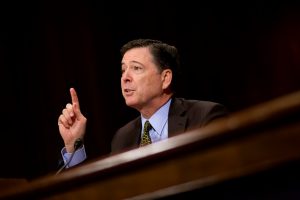

Comey
(Photo
by
Eric
Thayer/Getty
Images)
Getting
disqualified
as
US
Attorney
for
the
Eastern
District
of
Virginia
is
the
best
thing
that
could
happen
to
Lindsey
Halligan.
The
Florida
insurance
lawyer
currently
LARP-ing
as
a
federal
prosecutor
was
installed
on
a
statutory
basis
that’s
been
rejected
by
three
courts
already.
A
fourth
court
is
now
considering
motions
to
boot
her
filed
by
former
FBI
director
Jim
Comey
and
New
York
Attorney
General
Letitia
James.
No
other
lawyer
at
EDVA
would
touch
the
Comey
and
James
cases,
Halligan
presented
them
herself
to
the
grand
jury,
and
her
name
is
the
only
one
on
the
indictments.
So
if
she’s
out,
then
those
prosecutions
are
likely
DOA.
That
would
be
a
kindness,
if
only
because
it
would
spare
Halligan
the
ignominy
of
watching
the
humiliating
implosion
of
both
high-profile
cases.
Three
motions
filed
yesterday
by
Comey’s
legal
team
illustrate
the
fatal
flaw
in
the
prosecution.
The
barebones
indictment
—
just
a
page
and
a
half
stating
in
conclusory
fashion
that
Comey
lied
to
Congress
back
in
2020
—
is
so
vague
that
it
could
apply
to
two
alternate
theories
of
the
case.
Was
Halligan
saying
that
Comey
lied
about
authorizing
his
former
deputy
Andrew
McCabe
to
speak
to
the
Wall
Street
Journal?
Or
was
she
suggesting
that
he
lied
about
dispatching
his
friend
and
lawyer
Daniel
Richman,
to
speak
to
the
New
York
Times?
Comey’s
lawyer
Pat
Fitzgerald
said
that
he
himself
only
learned
that
“PERSON
3”
was
Richman
the
day
before
the
arraignment.
Neither
theory
of
the
case
makes
much
sense,
but
the
Richman
plot
seems
almost
comically
ridiculous,
since
the
testimony
in
question
very
clearly
pertained
to
McCabe
only.
The
first
motion
requests
a
bill
of
particulars
laying
out
specifically
how
Halligan
thinks
this
crime
went
down.
When
and
how
did
this
authorization
take
place?
What
did
Comey
order
Richman
to
leak?
What
was
the
Senate
inquiry
he
“corruptly”
influenced?
Which
statement
in
Comey’s
testimony
was
false?
Inquiring
minds
—
and
Jim
Comey
—
want
to
know!
The
second
motion
requests
the
disclosure
of
the
grand
jury
transcripts
for
all
the
reasons:
Halligan
was
installed
as
US
Attorney
after
the
president
pushed
out
her
predecessor,
a
career
prosecutor,
for
refusing
to
indict
Comey
and
James.
Four
days
later,
in
her
very
first
appearance
before
a
grand
jury,
she
secured
the
instant
indictment
—
after
first
getting
no-billed,
and
then
holding
the
jurors
over
until
almost
7
p.m.
No
line
attorneys
were
willing
to
put
their
names
on
the
indictment,
and
the
only
lawyers
willing
to
associate
themselves
with
the
prosecution
had
to
be
imported
from
North
Carolina.
The
theory
of
the
case
is
so
vague
that
it
suggests
an
inexperienced
prosecutor
(who
may
or
may
not
have
been
illegally
appointed)
might
have
fudged
the
details.
And,
on
top
of
all
that,
Comey
says
that
an
FBI
investigator
who
testified
before
the
grand
jury
was
likely
tainted
by
exposure
to
privileged
materials.
Whoopsie
doodle!
The
third
filing
was
a
Bronston
motion
to
dismiss
based
on
the
literal
truth
of
Comey’s
answers
to
Ted
Cruz’s
ambiguous
questions.
During
the
exchange,
the
senator
fired
off
a
series
of
accusations,
characterizing
prior
statements
by
Comey
and
McCabe
as
diametrically
opposed,
and
scarcely
providing
room
for
Comey
to
reply.
CRUZ:
Now,
as
you
know,
Mr.
McCabe,
who
works
for
you,
has
publicly and repeatedly
stated
that
he
leaked
information
to
the
Wall
Street
Journal and that
you
were
directly
aware
of
it and that
you
directly authorized it.
Now,
what
Mr.
McCabe
is
saying and what
you
testified
to
this
committee
cannot
both
be
true.
One
or
the
other
is
false.
Who’s
telling
the
truth?COMEY:
I
can
only
speak
to
my
testimony.
I
stand
by
the
testimony
you
summarized
that
I
gave
in
May
of
2017.CRUZ:
So
your
testimony
is
you’ve
never authorized anyone
to
leak? And Mr.
McCabe,
if
he
says
contrary,
is
not
telling
the
truth,
is
that
correct?COMEY:
Again,
I’m
not
going
to
characterize Andy’s
testimony,
but
mine
is
the
same
today.
As
the
motion
points
out,
this
hectoring
was
not
a
careful
deposition
designed
to
elicit
clear
responses,
but
rather
an
exercise
of
political
rhetoric.
And
saying
“I
stand
by
my
testimony”
is
basically
a
non-response
to
an
inchoate
shouting.
It
is
literally
true,
and
the
lack
of
context
in
the
indictment,
which
claims
that
he
“falsely
stat[ed]
to
a
U.S.
Senator
during
a
Senate
Judiciary
Committee
hearing
that
he,
JAMES
B.
COMEY
JR.,
had
not
‘authorized
someone
else
at
the
FBI
to
be
an
anonymous
source
in
news
reports’
regarding
an
FBI
investigation,”
strongly
suggests
that
Halligan
painted
an
incomplete
picture
for
the
jurors.
If
Comey
does
manage
to
get
his
hands
on
those
grand
jury
transcripts,
he’ll
obviously
be
supplementing
the
Bronston
motion.
But
it
likely
won’t
come
to
that,
thanks
to
Judge
Cameron
McGowan
Currie,
the
senior
judge
from
South
Carolina
designated
to
hear
the
disqualification
motion.
If
she
agrees
with
courts
in
New
Jersey,
Nevada,
and
California
that
28
USC
§
546
permits
the
president
one,
and
only
one,
120-day
interim
appointment,
then
Halligan’s
installation
was
ultra
vires
and
prosecutions
she
alone
secured
are
likely
a
nullity.
Judge
Currie
has
also
ordered
Halligan
to
turn
over
“all
documents
relating
to
the
indictment
signer’s
participation
in
the
grand
jury
proceedings,
along
with
complete
grand
jury
transcripts”
so
that
she
may
“determine
the
extent
of
the
indictment
signer’s
involvement
in
the
grand
jury
proceedings.”
It
should
make
for
fascinating
reading.
US
v.
Comey
[Docket
via
Court
Listener]
Liz
Dye lives
in
Baltimore
where
she
produces
the
Law
and
Chaos substack and podcast.