

WASHINGTON
—
The
US
has
come
out
swinging
against
a
draft
law
by
the
European
Union
that
Washington
claims
would
establish
restrictive
market
barriers,
impose
costly
environmental
protection
requirements,
and
create
regulatory
hurdles
for
US
commercial
firms
—
thus
undermining
bilateral,
as
well
as
NATO-wide,
cooperation.
The
US
“expresses
deep
concern
regarding
measures
in
the
proposed
Act
that
would
impose
unacceptable
regulatory
burdens
on
U.S.
providers
of
space
services
to
European
customers,”
the
State
Department
charges
in
a
document
submitted
to
the
EU
on
Tuesday.
The
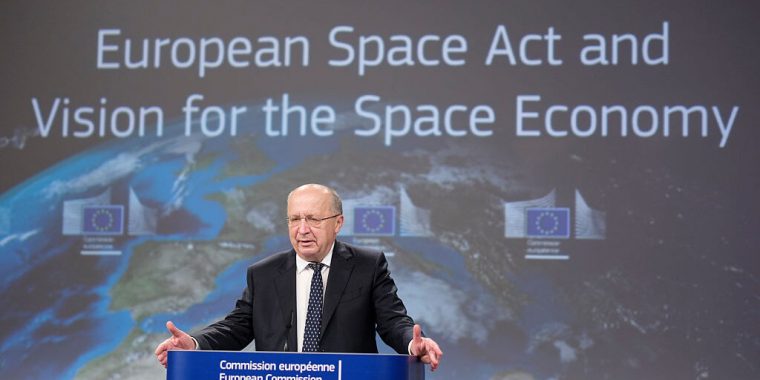
draft
EU
Space
Act,
publicized
in
June,
has
three
key
pillars,
according
to
a
fact
sheet
by
the
European
Commission,
the
EU’s
executive
branch:
-
“Safety:
The
Act
introduces
robust
rules
for
tracking
space
objects
and
mitigating
space
debris,
preserving
Europe’s
secure
and
uninterrupted
access
to
space. -
Resilience:
Tailored
cybersecurity
requirements
will
strengthen
protection
of
European
space
infrastructure
and
ensure
business
continuity. -
Sustainability:
Operators
will
need
to
assess
and
reduce
the
environmental
impact
of
their
space
activities,
while
benefiting
from
support
for
innovation
in
emerging
technologies
like
in-orbit
servicing
and
debris
removal.”
The
European
Commission
maintains
that
the
goals
of
the
draft
law
are
primarily
aimed
at
domestic
issues
—
namely
to
overcome
national
stovepipes
and
create
a
unified
regional
space
market,
as
well
as
protect
EU
space
systems
from
malicious
cyber
attacks
by
criminals
and
adversary
governments
alike.
“The
EU
Space
Act
intends
to
cut
red
tape,
protect
space
assets,
and
create
a
fair,
predictable
playing
field
for
businesses,”
the
Commission
said
in
a
June
24
press
release
presenting
the
draft.
But
it’s
also
yet
another
prong
in
a
cross-institutional
regional
effort
to
bolster
“strategic
autonomy”
in
the
face
of
widespread
European
government
concerns
about
the
direction
of
US
policy,
ranging
from
the
Trump
administration’s
about-face
on
Ukraine
support
in
war
with
Russia
to
the
president’s
punitive
tariffs
on
European
imports.
The
push
for
EU
security
independence
includes
the
planned
move
by
the
European
Space
Agency,
for
the
first
time
in
its
50-year
existence,
to
take
on
projects
in
support
of
European
defense
ministries.
“This
is
about
safeguarding
Europe’s
place
in
the
next
era
of
space
innovation,”
the
European
Commision,
the
EU’s
executive
branch,
said
in
a
June
24
post
on
Facebook.
The
State
Department’s
analysis,
meanwhile,
claims
the
Act’s
provisions
in
general
amount
to
“non-tariff
barriers.”
If
approved,
the
law
would
“introduce
challenges”
to
US
government-to-government
cooperation
with
the
27-member
EU,
individual
EU
countries,
and
ESA,
State
says.
This
would
include
cooperation
in
the
areas
of
“space
weather,
remote
sensing,
space
exploration,
spaceflight
safety,
space
debris
mitigation
and
remediation,
[and]
communications.”
Provisions
of
specific
concern
include
environmental
protection
requirements
for
commercial
satellites
that
are
more
strict
than
those
imposed
by
US
regulatory
bodies
and
a
“discriminatory”
clause
that
says
outside
EU
launch
providers
will
only
be
approved
“when
‘no
readily
available
substitute
or
realistic
alternative
exist
in
the
Union
[…].’”
The
document
asserts
that
the
draft
law
thus
“contradicts”
the
Aug.
21
“United
States-EU
Framework
on
an
Agreement
on
Reciprocal,
Fair
and
Balanced
Trade”
designed
“to
resolve
trade
imbalances,
improve
market
access,
increase
our
trade
and
investment
relationship,
and
reduce
or
eliminate
non-tariff
barriers.”
State
also
argues
that
even
some
EU
member
states
may
not
approve
of
any
union
restrictions
on
their
individual
government
rights
to
choose
space
partnership
agreements
with
third-party
nations.
“As
currently
drafted,
the
EU
Space
Act
would
apply
to
civil
governmental
activities
of
European
countries
and
European
institutions
such
as
the
European
Space
Agency
(ESA)
and
the
European
Organisation
for
the
Exploitation
of
Meteorological
Satellites
(EUMETSAT).
Many
USG
[US
government]
departments
and
agencies
cooperate
with
EU
member
states
and
these
institutions,”
the
document
stresses.
For
example,
the
Defense
Department
relies
in
part
on
data
from
EUMETSAT
birds
for
weather
prediction
crucial
to
planning
operations
abroad.
“We
are
concerned
that
as
drafted,
the
requirements
of
the
Act
could
be
interpreted
as
applying
to
these
USG
activities.
That
is
not
acceptable,
and
we
expect
many
EU
member
states
will
share
our
concerns
about
application
of
the
Act
to
national
sovereign
activities,”
State’s
analysis
stresses.
Further,
the
document
asserts
that
the
provision
in
the
draft
EU
law
to
allow
exemptions
by
member
states
for
national
security
reasons
is
not
enough
to
ensure
military-to-military
cooperation
with
the
US
and
NATO-wide.
“[W]hile
the
EU
Space
Act
attempts
to
exempt
national
security
activities,
this
exemption
could
cause
issues
in
practice
as
currently
drafted.
The
United
States
does
not
believe
the
provisions
are
sufficient
to
protect
national
security
equities,
assets,
and
operations
because
the
Act
threatens
U.S.
and
EU
development
of
commercial
space
capabilities,
introducing
doubt
about
interoperability
of
systems
and
the
ability
to
use
collaboratively
developed
or
owned
space
assets
for
national
security
purposes,”
it
states.
The
submission
notes
that
the
response,
which
includes
provision-by-provision
criticisms
and
recommendations
for
changes,
was
coordinated
with
other
US
agencies
and
space
industry
representatives.
“Following
the
release
of
the
draft
EU
Space
Act
in
June
2025,
the
U.S.
Departments
of
State
and
Commerce
solicited
feedback
from
USG
agencies
and
commercial
stakeholders
on
its
potential
impact
on
the
United
States.
This
consultation
included
input
from
U.S.
trade
associations
representing
a
broad
cross-section
of
the
U.S.
commercial
space
industry,
as
well
as
over
70
responding
companies
that
have
active
or
potential
future
commercial
interests
in
the
EU
market,’
the
document
explains.
In
particular,
State
argues
that
several
provisions
seemed
aimed
at
US
companies
solely
because
of
their
size
and
dominance
in
the
global
market,
especially
in
the
area
of
“large
telecommunications
constellations”
—
that
appears
to
be,
while
not
specifically
saying
so,
taking
aim
at
EU
efforts
to
counter
SpaceX.
“Such
unfair
and
unwarranted
regulations
are
unacceptable
to
the
United
States
and
must
be
removed,”
the
document
states.
The
draft
EU
Space
Act
has
been
referred
to
the
EU
Parliament
for
debate.
If
given
a
thumbs
up,
the
draft
will
then
go
to
the
ruling
EU
Council
of
Ministers
for
a
vote.