
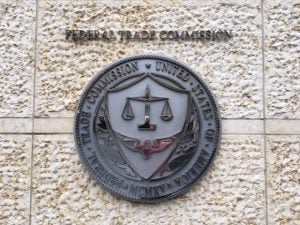
Federal
Trade
Commission
–
FTC
(photo
by
David
Lat).
One
of
the
odder
threads
in
the
ABA
being
attacked
as
part
of
political
theatre
saga
has
been
the
antitrust
accusations.
It
makes
sense
that
there
would
be
pushback
for
stances
like
“the
rule
of
law
is
good
and
worth
defending”
at
a
time
when
the
collective
shrugs
off
the
due-process-skirting
president
being
touted
as
a
King:
As
stupid
as
it
is
to
argue
that
the
ABA
should
be
abandoned
as
an
accrediting
body
because
it
is
“forcing
DEI
down
our
throats”
is
(it
has
been
retreating
from
DEI
for
years
and
just
went
race
neutral
with
their
Legal
Opportunity
Scholarship
Fund),
there’s
a
colorable
argument
that
by
supporting
diversity
the
ABA
is
no
longer
neutral,
an
argument
that
flies
especially
well
when
the
party
in
power
is
White
supremacy
posting
on
main.
But
even
among
these
heavy
hitters,
the
ABA
is
an
evil
monopoly
angle
is
particularly
weak
considering
that
it
does
its
job
at
accreditation
pretty
well.
Nonetheless,
the
FTC
is
stepping
in
to
ask
state
supreme
courts
to
take
on
extra
burdens
to
usurp
the
ABA;s
powers.
ABA
Journal
has
coverage:
Brendan
Chestnut,
the
director
of
the
FTC’s
Office
of
Policy
Planning,
and
Daniel
Guarnera,
director
of
its
Bureau
of
Competition,
wrote
in
an
April
30
letter
that
the
state
supreme
court
should
reassess
its
“reliance
on
American
Bar
Association
law
school
accreditation.”
They
said
allowing
the
ABA
to
determine
educational
requirements
for
taking
the
bar
exam
and
practicing
law
in
Tennessee
“raises
serious
competitive
risks.”
Are
the
serious
competitive
risks
in
the
room
with
us?
The
argument
is
that
the
ABA’s
monopoly
as
an
accrediting
institution
“thwart[s]
lower
cost
alternatives
for
legal
education.”
But
here’s
the
thing:
consumers
are
benefitted
when
lawyers
(like
most
professions)
are
held
to
a
quality
baseline
level.
You
may
have
a
jump
in
lawyers
if
bypassing
the
ABA
lets
DeVry
become
a
lawyer
mill,
but
who
would
want
them
as
their
attorney?
And
on
the
other
side
of
the
set-up,
what
prospective
students
in
their
right
mind
would
want
to
go
to
a
law
school
that
doesn’t
fall
within
the
ABA’s
cut-offs
for
education
quality
and
bar
passage
rates?
Of
course
the
school
could
be
held
to
some
other
accrediting
body’s
standards,
but
let’s
be
honest
when
someone
is
going
through
a
lot
of
effort
to
reinvent
the
wheel.
When
Texas’s
Supreme
Court
decided
to
become
a
law
school
accrediting
body,
they
effectively
copy
and
pasted
ABA
standards
316,
502(a)-(c),
503,
and
509.
What
good
did
that
do
except
give
the
justices
some
additional
paper
work?
The
biggest
issue
with
knighting
some
other
body
to
hand
out
law
school
accreditation
is
portability.
As
it
stands,
the
ABA
is
the
gold
standard.
The
Texas
and
Florida
supreme
courts
may
vet
law
schools
in
their
state,
but
why
should
employers
in
New
Jersey
or
Minnesota
respect
the
vetting?
They
will
probably
cross
reference
the
school
with
the
ABA’s
rating
of
them.
If
they
pass
ABA
muster,
the
state
supreme
courts’
thumbs
up
was
superfluous.
If
the
school
gets
a
court’s
approval
but
not
the
ABA’s,
why
risk
it?
It’s
an
uphill
battle
to
switch
off
the
ABA.
But
hey,
good
luck
to
the
FTC
and
Tennessee.
If
they
flip,
its
only
40+
states
to
go!
FTC
Calls
On
Tennessee
Supreme
Court
To
End
Reliance
On
ABA
Law
School
Accreditation
[ABA
Journal]
Earlier:
FTC
Blames
High
Law
School
Costs
On
ABA
Accreditation
ABA
Strikes
Back
At
Trump,
Condemning
His
Attacks
On
Lawyers
And
The
Rule
Of
Law
Texas
Supreme
Court
Takes
On
Role
As
Law
School
Accreditor
ABA’s
Defunct
Diversity
In
Law
School
Standard
Moves
Toward
Getting
Repealed

Chris
Williams
became
a
social
media
manager
and
assistant
editor
for
Above
the
Law
in
June
2021.
Prior
to
joining
the
staff,
he
moonlighted
as
a
minor
Memelord™
in
the
Facebook
group Law
School
Memes
for
Edgy
T14s
.
He
endured
Missouri
long
enough
to
graduate
from
Washington
University
in
St.
Louis
School
of
Law.
He
is
a
former
boat
builder
who
is
learning
to
swim
and
is
interested
in
rhetoric,
Spinozists
and
humor.
Getting
back
in
to
cycling
wouldn’t
hurt
either.
You
can
reach
him
by
email
at
[email protected]
and
by
Tweet/Bluesky
at @WritesForRent.