

Legacy
Matters
Among
a
president’s
most enduring
legacies are
the
federal
judges
they
appoint—particularly
Supreme
Court
justices.
This
permanence
stems
from
life
tenure,
a
constitutional
provision
that
ensures
judicial
independence
but
also
transforms
each
appointment
into
a
generational
bet
on
the
nation’s
legal
future.
Yet
history
is
littered
with
presidential
miscalculations.
President
Eisenhower
famously
called
his
appointment
of
Earl
Warren
to
Chief
Justice
one
of
his
“biggest
mistakes,”
as
Warren
became
a
liberal
stalwart
for
over
a
decade.
Justices
Stevens
and
Souter,
both
nominated
by
Republican
presidents,
evolved
into
some
of
the
Court’s
most
liberal
members.
Had
Republican
presidents
consistently
installed
reliably
conservative
justices
since
the
mid-20th
century,
the
Court
would
have
been
exponentially
more
conservative
than
it
actually
was.
But
presidential
legacy
is
only
part
of
the
story.
The
judges
themselves
have
developed
their
own
succession
strategies.
In
recent
years,
a
striking
pattern
has
emerged:
Supreme
Court
justices
now
appear
ready
to
retire
only
with
tacit—or
perhaps
explicit—assurances
that
they
will
be
replaced
by
someone
they
helped
shape,
typically
a
former
clerk.
Since
Justice
Kennedy
retired
after
the
2017
term,
this
has
become
the
norm
rather
than
the
exception.
Kennedy’s
retirement
exemplified
this
new
dynamic.
He
secured
not
one
but
two
former
clerks
in
succession:
Justice
Gorsuch
filled
Justice
Scalia’s
seat,
which
had
remained
vacant
longer
than
any
in
Court
history,
and
Kennedy’s
own
seat
went
to
Justice
Kavanaugh.
These
consecutive
Kennedy-clerk
appointments
represented
a carefully
orchestrated
transition,
a
carrot
from
President
Trump
to
convince
Kennedy
to
step
down
with
his
legacy
intact.
For
Trump,
the
bargain
was
equally
advantageous:
he
could
install
more
consistently
conservative
justices
than
Kennedy,
who
had
occasionally
sided
with
liberals
on
consequential
civil
liberties
cases
like
the
same-sex
marriage
decision
in
Obergefell
v.
Hodges.
The
pattern
continued
with
Justice
Barrett,
a
Scalia
clerk,
replacing
Justice
Ginsburg
after
her
death,
and
Justice
Ketanji
Brown
Jackson,
a
Breyer
clerk,
succeeding
her
former
mentor.
Based
on
this
emerging
template,
I previously
wrote
about how
I
anticipate
that
President
Trump
might
appoint
Judge
Ho
or
Judge
Rao—both
Thomas
clerks—to
fill
Justice
Thomas’s
seat,
and
Judge
Oldham,
an
Alito
clerk,
to
succeed
Justice
Alito
should
either
retire
during
Trump’s
tenure.
This
pattern
of
legacy-based
decisions
augments
the
theory
of
strategic
retirement,
where
federal
judges
retire
under
likeminded
presidents
to
ensure
the
balance
of
each
court
does
not
shift
in
the
opposing
ideological
direction. I
wrote
about
the
possibility
of
this
occurring and
how
the
consequence
of
Justice
Barrett
potentially
filling
this
seat
prior
to
Justice
Ginsburg’s
death.
Many
others
also contemporaneously, previously,
and after
me wrote
about
the
potential
and
actual
downstream
effects
of
Justice
Ginsburg’s
decision.
At
the
bottom
of
it
all,
this
highlights
the
importance
of
federal
judgeships,
not
only
the
president,
but
more
importantly
to
future
generations
and
to
the
embedding
of
particular
values
and
preferences
within
the
federal
judiciary
for
decades
to
come.
Consequences
and
Methodology
The
importance
of
federal
judge
replacements
reaches
beyond
presidential
legacy.
This
analysis
examines
which
current
and
former
federal
judges
have
placed
the
most
former
clerks
on
the
federal
bench,
using
data
from
the
Biographical
Directory
of
Federal
Judges
maintained
by
the
Federal
Judicial
Center.
Building
on
previous
analysis
of
federal
judges
appointed
from
Reagan
through
the
current
Trump
administration,
this
examination
focuses
specifically
on
judicial
legacy
through
clerk
placement.
After
correcting
for
inconsistencies
in
how
the
Biographical
Directory
formatted
clerkship
entries
(First
Liberty’s
Hiram
Sasser
noted
in
a
comment
some
of
the
missing
entries
in
a previous
post which
I
now
corrected
and made
freely
accessible),
the
data
reveals
a
clear
hierarchy
of
influence
across
district,
appeals,
and
Supreme
Court
levels.
Presidential
Appointments:
The
Foundation
of
Judicial
Legacy
If
presidents’
legacies
are
bound
to
their
judicial
appointments—especially
Supreme
Court
justices—then
the
number
of
justices
each
president
installs
becomes
a
meaningful
measure
of
lasting
influence.
While
not
every
appointment
produces
the
jurisprudence
a
president
envisions,
each
represents
an
attempt
to
implant
their
vision
of
constitutional
interpretation.
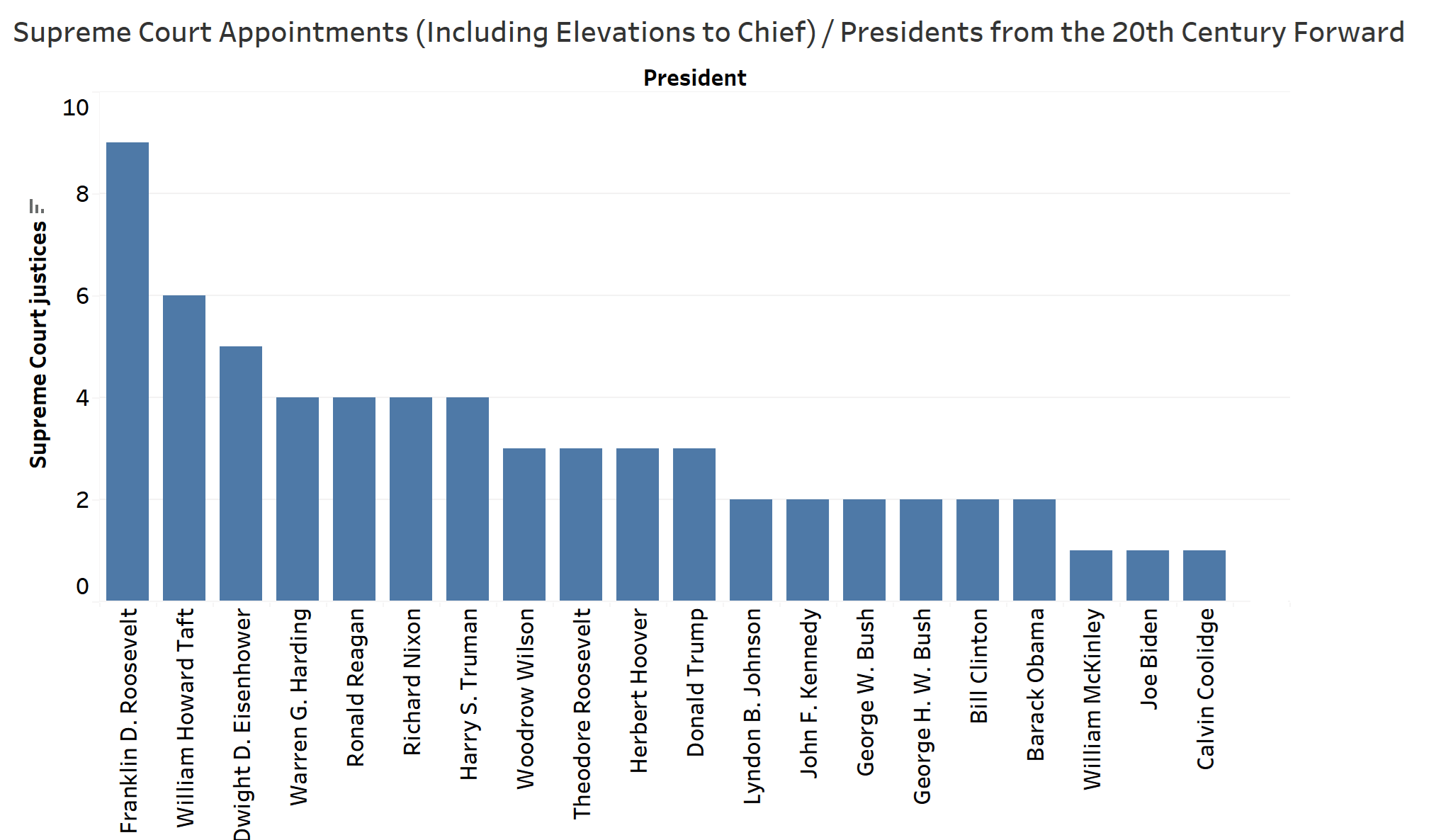
Among
20th
and
21st-century
presidents,
Franklin
D.
Roosevelt
stands
as
the
overwhelming
leader,
appointing
nine
Supreme
Court
justices
during
his
unprecedented
four
terms.
Taft
follows
with
six
appointments,
while
Eisenhower
made
five.
More
recent
presidents
show
markedly
fewer
opportunities
although
Trump
with
three
in
his
first
term
was
a
clear
outlier.
These
numbers
reflect
not
just
presidential
priorities
but
the
vagaries
of
timing—how
long
justices
serve,
when
they
choose
to
retire,
and
the
unpredictability
of
death.
Roosevelt’s
nine
appointments
came
during
the
constitutional
crisis
of
the
New
Deal,
while
recent
presidents
have
faced
a
Court
where
justices
increasingly
time
their
retirements
strategically,
often
waiting
for
a
president
of
their
preferred
ideology.
Supreme
Court:
Where
Judicial
Dynasties
Begin
The
downstream
effects
of
Supreme
Court
clerkships
can
reshape
American
law
across
generations.
Consider
the
lineage
from
Justice
Robert
Jackson
to
William
Rehnquist,
who
clerked
for
Jackson,
to
John
Roberts,
who
clerked
for
Rehnquist
and
now
serves
as
Chief
Justice.
This
chain
of
influence
spans
more
than
half
a
century,
with
each
generation
of
jurists
passing
their
interpretive
methods
to
the
next.
Supreme
Court
clerkships
represent
a
relatively
modern
phenomenon,
emerging
primarily
as
the
Court
evolved
through
the
20th
century.
The
number
of
clerks
per
justice
has
steadily
increased,
expanding
the
pool
of
potential
judicial
heirs.
The
data
reveals
which
justices
have
been
most
successful
at
placing
their
clerks
throughout
the
federal
judiciary.
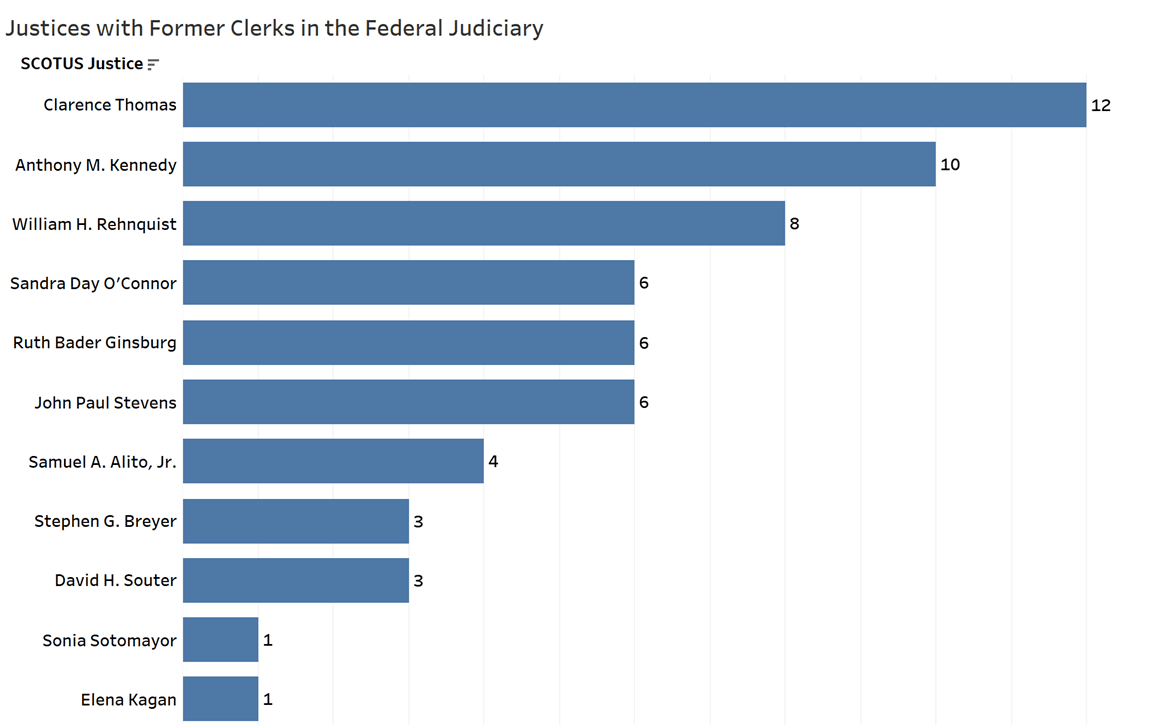
Justice
Clarence
Thomas
leads
by
a
substantial
margin,
with
twelve
former
clerks
now
serving
as
federal
judges—a
testament
both
to
his
long
tenure
and
his
deliberate
cultivation
of
conservative
judicial
talent.
Justice
Anthony
Kennedy
follows
with
ten
clerk-judges,
including
the
two
Supreme
Court
justices
mentioned
earlier.
Justice
Rehnquist
placed
eight
former
clerks,
continuing
his
influence
even
after
his
2005
death.
Justices
O’Connor
and
Ginsburg
each
count
six
former
clerks
in
the
federal
judiciary,
while
Justice
Stevens
also
placed
six.
Justice
Alito
has
four
clerk-judges,
while
Justices
Breyer
and
Souter
each
have
three.
Perhaps
most
surprisingly,
given
his
position
as
Chief
Justice,
John
Roberts
has
not
yet
seen
a
former
clerk
become
a
federal
judge
according
to
Federal
Judicial
Center
data.
Originalism
Across
Generations:
Scalia
to
Barrett
The
transmission
of
judicial
philosophy
from
justice
to
clerk-turned-justice
reveals
itself
most
clearly
in
interpretive
methodology.
Justice
Scalia’s
originalist
approach
in McDonald
v.
City
of
Chicago exemplified
his
commitment
to
understanding
constitutional
provisions
through
their
historical
meaning.
Writing
about
the
Second
Amendment’s
application
to
the
states,
Scalia
emphasized
the
settled
understanding
that
the
Bill
of
Rights
originally
constrained
only
the
federal
government.
His
opinion
methodically
traced
the
historical
record,
citing
Chief
Justice
Marshall’s
1833
opinion
in Barron
v.
Baltimore and
noting
that
the
question
was
“of
great
importance”
but
“not
of
much
difficulty.”
Scalia’s
analysis
embodied
his
conviction
that
constitutional
interpretation
must
begin
with
original
public
meaning,
regardless
of
whether
that
meaning
comports
with
modern
sensibilities.
Justice
Barrett,
who
clerked
for
Scalia,
has
inherited
this
originalist
framework
but
applies
it
with
a
notably
different
rhetorical
style
and,
at
times,
different
conclusions.
In Haaland
v.
Brackeen,
her
majority
opinion
defending
the
Indian
Child
Welfare
Act
demonstrated
both
continuity
and
evolution
in
originalist
methodology.
When
petitioners
challenged
ICWA
by
arguing
it
was
inconsistent
with
the
Constitution’s
original
meaning,
Barrett’s
response
revealed
a
more
institutionally
cautious
approach
than
her
mentor
might
have
taken.
She
wrote
that
petitioners
“offer
no
account
of
how
their
argument
fits
within
the
landscape
of
our
case
law”
and
noted
they
“neither
ask
us
to
overrule
the
precedent
they
criticize
nor
try
to
reconcile
their
approach
with
it.”
This
represents
a
subtle
but
significant
shift
from
Scalia’s
more
aggressive
originalism.
Where
Scalia
often
championed
overturning
precedents
he
viewed
as
wrongly
decided,
Barrett
demanded
that
litigants
reckon
with
existing
doctrine
and
explain
the
broader
implications
of
their
originalist
claims.
Her
question—”Would
it
undermine
established
cases
and
statutes?
If
so,
which
ones?”—reflects
an
originalism
tempered
by
concerns
about
legal
stability
and
institutional
legitimacy.
The
clerk
has
inherited
the
mentor’s
interpretive
framework
but
adapted
it
to
a
Court
increasingly
conscious
of
its
public
standing.
Courts
of
Appeals:
The
Proving
Ground
Circuit
judges
occupy
a
unique
position
in
the
federal
judiciary.
While
they
lack
the
Supreme
Court’s
ultimate
authority,
they
effectively
have
the
final
word
in
the
vast
majority
of
federal
cases.
Their
opinions
shape
entire
areas
of
law
within
their
circuits,
making
them
powerful
vectors
for
transmitting
judicial
philosophy.
The
data
on
circuit
judges
with
three
or
more
former
clerks
now
serving
as
federal
judges
reveals
who
has
been
most
effective
at
extending
their
influence.
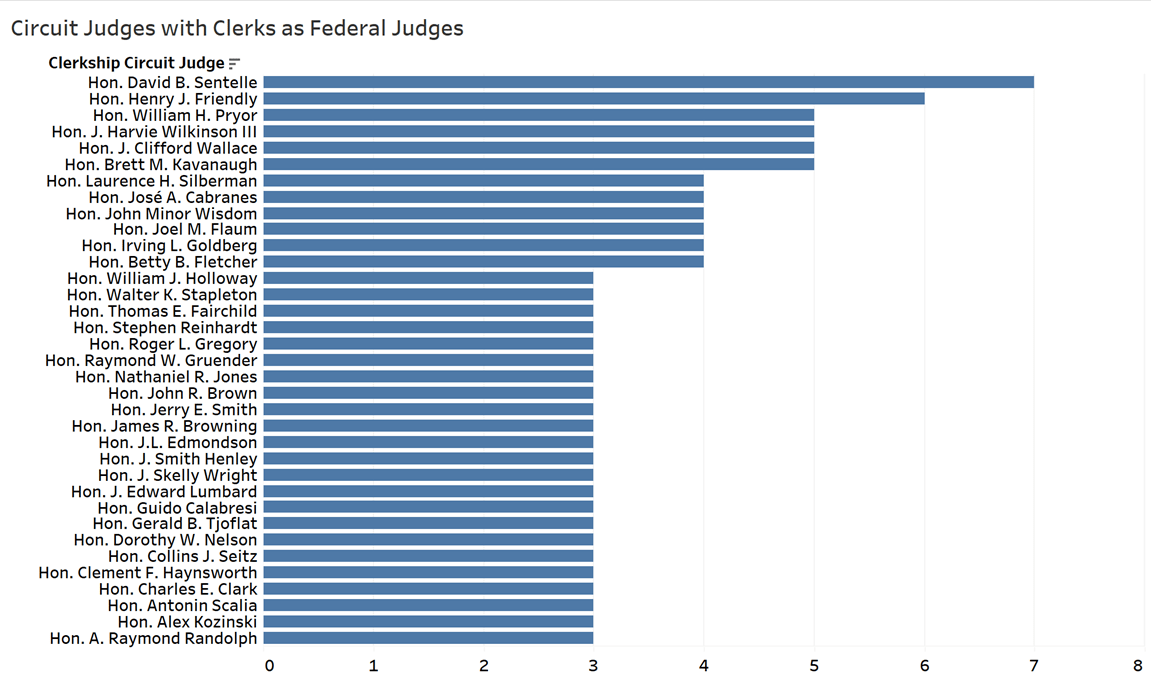
Judge
David
B.
Sentelle
of
the
D.C.
Circuit
leads
all
circuit
judges
with
seven
former
clerks
in
the
federal
judiciary—an
extraordinary
record
that
reflects
both
his
long
service
and
his
role
in
shaping
conservative
legal
thought.
Judge
Henry
J.
Friendly
of
the
Second
Circuit
and
Judge
William
H.
Pryor
of
the
Eleventh
Circuit
follow
with
six
clerk-judges
each.
Several
other
prominent
circuit
judges,
including
J.
Harvie
Wilkinson
III,
J.
Clifford
Wallace,
and
Brett
Kavanaugh
(before
his
Supreme
Court
appointment),
have
placed
five
former
clerks.
The
concentration
at
the
top
of
this
list
is
striking.
While
thirty-five
circuit
judges
have
placed
at
least
three
former
clerks,
the
gap
between
Sentelle’s
seven
and
the
next
tier
reflects
his
particular
success
at
cultivating
judicial
talent.
Many
of
these
judges
served
or
continue
to
serve
on
influential
circuits—the
D.C.,
Fourth,
and
Ninth
Circuits
appear
frequently—where
high-profile
cases
and
proximity
to
political
power
create
natural
pipelines
to
future
judicial
appointments.
The
Textualist
Thread:
Sentelle
to
Gorsuch
The
connection
between
Judge
Sentelle
and
Justice
Gorsuch
illuminates
how
circuit
court
judges
transmit
interpretive
approaches
that
later
appear
in
Supreme
Court
jurisprudence.
In NLRB
v.
Canning,
Judge
Sentelle’s
opinion
for
the
D.C.
Circuit
panel
exemplified
his
textualist
methodology.
Interpreting
the
Recess
Appointments
Clause,
Sentelle
focused
on
the
plain
meaning
of
“happen,”
construing
it
to
mean
“arise”
and
emphasizing
textual
consistency
across
constitutional
provisions.
He
wrote
that
“inconsistency
[within
the
Constitution]
is
to
be
implied
only
where
the
context
clearly
requires
it,”
citing
a
1949
precedent.
For
Sentelle,
the
clause’s
text
demanded
that
a
qualifying
vacancy
must
have
“come
to
pass
or
arisen
‘during
the
Recess’”—a
reading
he
found
consistent
with
the
Senate
Vacancies
Clause
while
the
Board’s
interpretation
was
not.
Justice
Gorsuch’s
approach
in Bostock
v.
Clayton
County echoes
his
former
mentor’s
commitment
to
text
over
expected
applications.
Writing
for
the
Court
in
the
landmark
Title
VII
case,
Gorsuch
rejected
the
employers’
argument
that
Congress
could
not
have
intended
the
statute
to
cover
sexual
orientation
and
gender
identity
discrimination.
He
acknowledged
the
employers
“take
pains
to
couch
their
argument
in
terms
of
seeking
to
honor
the
statute’s
‘expected
applications’
rather
than
vindicate
its
‘legislative
intent,’”
but
insisted
“the
concepts
are
closely
related.”
Gorsuch’s
retort—”However
framed,
the
employer’s
logic
impermissibly
seeks
to
displace
the
plain
meaning
of
the
law
in
favor
of
something
lying
beyond
it”—could
have
been
written
by
Sentelle
himself.
Yet
Gorsuch’s
opinion
in Bostock also
reveals
how
judicial
philosophy
evolves
across
generations.
While
Sentelle’s
textualism
in Canning served
conservative
ends
(limiting
executive
power
under
a
Democratic
president),
Gorsuch’s
textualism
in Bostock produced
a
liberal
outcome
that
many
conservatives
opposed.
Both
judges
prioritized
text
over
expected
applications,
but
Gorsuch
demonstrated
a
willingness
to
follow
the
text
even
when
it
led
somewhere
his
mentor’s
ideological
allies
found
uncomfortable.
The
methodology
remains
consistent;
the
outcomes
can
surprise.
District
Courts:
Building
From
the
Ground
Up
District
court
judges
handle
the
vast
bulk
of
federal
litigation,
conducting
trials,
managing
discovery,
and
making
the
factual
findings
that
appellate
courts
later
review.
While
individual
district
judges
may
lack
the
precedential
authority
of
their
appellate
colleagues,
collectively
they
shape
how
federal
law
operates
on
the
ground.
The
judges
who
have
placed
multiple
former
clerks
on
the
federal
bench
represent
an
often-overlooked
tier
of
judicial
influence.
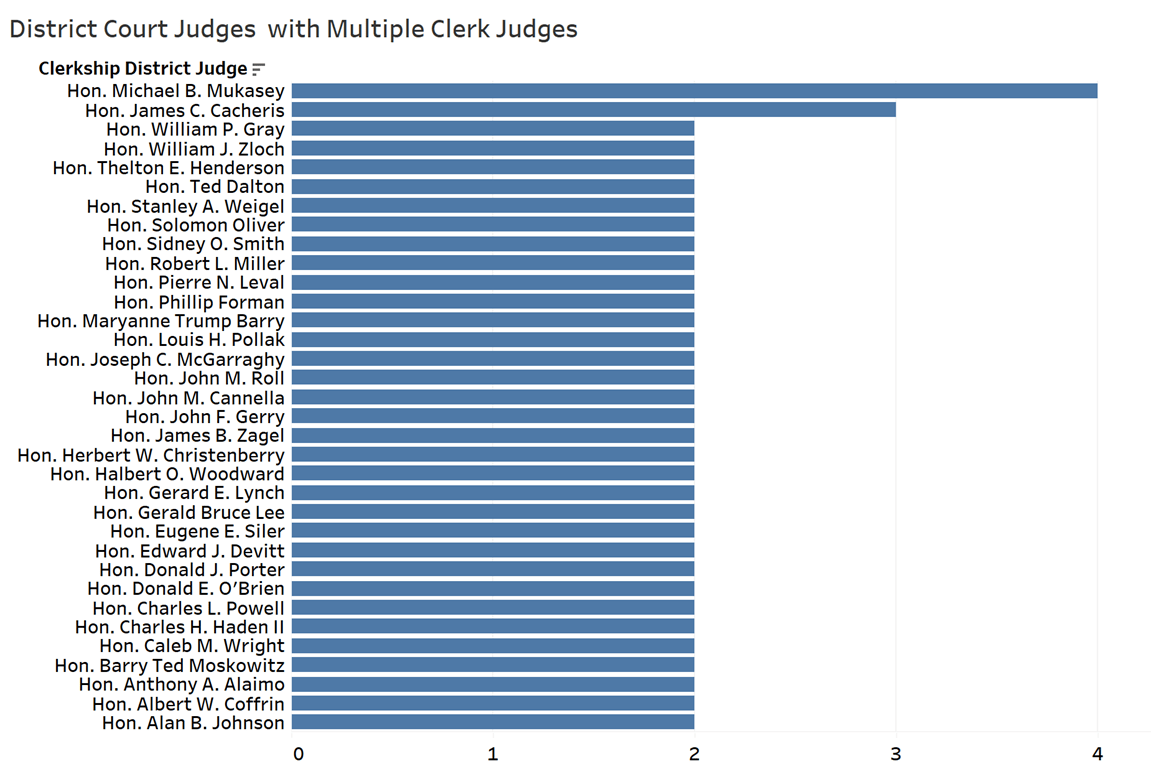
The
data
reveals
a
more
dispersed
pattern
than
at
the
circuit
or
Supreme
Court
levels.
Judge
Michael
B.
Mukasey
of
the
Southern
District
of
New
York
leads
with
four
former
clerks
in
the
federal
judiciary—an
impressive
figure
given
that
district
judges
typically
have
fewer
clerks
and
less
name
recognition
than
their
appellate
counterparts.
Judge
James
C.
Cacheris
of
the
Eastern
District
of
Virginia
follows
with
three
clerk-judges,
while
numerous
other
district
judges
have
placed
two
former
clerks.
The
geographic
concentration
is
notable.
Many
judges
on
this
list
served
in
high-profile
districts—the
Southern
District
of
New
York,
the
Eastern
District
of
Virginia,
and
the
District
of
Columbia—where
challenging
cases
and
visibility
create
opportunities
for
clerks
to
distinguish
themselves.
Judges
in
these
districts
often
handle
national
security
cases,
complex
white-collar
prosecutions,
and
politically
sensitive
litigation,
providing
clerks
with
experience
that
later
recommends
them
for
judicial
appointments.
First
Amendment
Doctrine:
From
Mukasey
to
Pan
The
judicial
lineage
from
Judge
Mukasey
to
Judge
Patricia
Millett
Pan
of
the
D.C.
Circuit
demonstrates
how
district
court
approaches
to
constitutional
doctrine
can
influence
appellate
jurisprudence.
In Nonnenmann
v.
City
of
New
York,
Judge
Mukasey
granted
summary
judgment
on
First
Amendment
claims
with
a
terse
analysis
that
exemplified
his
pragmatic
approach.
He
concluded
that
the
plaintiff’s
speech
“did
not
address
a
constitutionally
protected
issue
of
public
concern,”
disposing
of
the
claim
in
a
single
sentence
within
a
broader
opinion
rejecting
multiple
theories
of
liability.
Mukasey’s
treatment
reflected
the
district
court’s
role:
apply
established
doctrine
efficiently,
manage
complex
dockets,
and
move
cases
toward
resolution.
Judge
Pan’s
opinion
in Ateba
v.
Leavitt reveals
a
more
elaborate
First
Amendment
framework,
though
one
that
reaches
a
similarly
government-friendly
conclusion.
The
case
involved
a
journalist’s
challenge
to
the
White
House
hard
pass
policy.
Pan
acknowledged
the
First
Amendment
concerns
but
applied
the
established
reasonableness
standard,
concluding
that
conditioning
fuller
access
on
Senate
Daily
Press
Gallery
accreditation
was
“both
reasonable
and
viewpoint
neutral.”
Her
analysis
engaged
more
deeply
with
the
constitutional
doctrine,
addressing
arguments
about
unbridled
discretion
and
procedural
protections
while
ultimately
deferring
to
the
government’s
access
policy.
Much
of
the
difference
in
depth
of
analysis
may
relate
to
the
objectives
and
extent
of
constitutional
interpretation
of
district
court
versus
appeals
court
judge.
The
comparison
reveals
both
continuity
and
evolution.
Both
judges
applied
First
Amendment
doctrine
to
uphold
government
restrictions,
and
both
wrote
with
relative
brevity.
Yet
Pan’s
opinion
shows
the
more
elaborate
reasoning
expected
at
the
appellate
level,
engaging
with
constitutional
standards
and
potential
objections
while
Mukasey’s
district
court
opinion
moved
quickly
to
disposition.
The
student
has
learned
to
elaborate
on
the
framework
while
reaching
conclusions
that
likely
would
satisfy
her
mentor.
Implications:
The
Self-Replicating
Judiciary
These
patterns
of
clerk
succession
point
toward
a
fundamental
transformation
in
how
the
federal
judiciary
perpetuates
itself.
What
began
as
an
informal
preference
for
continuity
has
evolved
into
something
approaching
a
self-replicating
system,
where
judicial
philosophies
pass
from
one
generation
to
the
next
through
carefully
cultivated
mentor-clerk
relationships.
The
implications
extend
far
beyond
individual
careers
or
even
the
ideological
balance
of
particular
courts.
First,
the
clerk
pipeline
is
creating
unprecedented
ideological
coherence
within
judicial
camps.
When
Justice
Scalia’s
originalism
passes
to
Justice
Barrett,
or
Judge
Sentelle’s
textualism
appears
in
Justice
Gorsuch’s
opinions,
or
Judge
Mukasey’s
First
Amendment
skepticism
echoes
in
Judge
Pan’s
rulings,
we
see
not
just
individual
judges
but
schools
of
thought
reproducing
themselves
across
levels
of
the
federal
judiciary.
This
coherence
increases
predictability—probably
a
good
thing
for
the
rule
of
law—but
also
reduces
the
kind
of
creative
tension
that
historically
produced
judicial
evolution.
Second,
the
emphasis
on
clerk
credentials
may
be
narrowing
the
diversity
of
judicial
backgrounds
and
experiences.
When
Supreme
Court
seats
increasingly
go
to
former
clerks
of
previous
justices,
and
circuit
judgeships
follow
similar
patterns,
the
federal
judiciary
risks
becoming
a
closed
system
that
prizes
insider
credentials
over
other
forms
of
distinction.
A
lawyer
who
built
a
successful
trial
practice,
or
led
a
civil
rights
organization,
or
served
as
a
state
judge
may
find
themselves
disadvantaged
compared
to
someone
who
clerked
for
the
right
justice
at
the
right
time.
Third,
strategic
retirement
is
likely
to
become
even
more
entrenched
as
justices
and
judges
see
their
former
clerks
successfully
ascend
to
higher
courts.
Why
risk
having
your
seat
filled
by
someone
who
will
dismantle
your
life’s
work
when
you
can
time
your
retirement
to
ensure
a
former
clerk
succeeds
you?
This
calculus
transforms
judicial
service
from
a
commitment
to
decide
cases
until
incapacity
into
a
more
strategic
career
management
decision.
The
Court
becomes
less
independent
of
politics,
not
more,
as
retirements
increasingly
align
with
electoral
cycles.
Fourth,
the
concentration
visible
in
these
numbers—particularly
Justice
Thomas’s
twelve
clerk-judges
and
Judge
Sentelle’s
seven—suggests
that
a
relatively
small
number
of
judges
are
having
outsized
influence
on
the
composition
of
the
federal
bench.
This
has
the
effect
of
concentrating
enormous
power
in
the
hands
of
a
few
individuals
to
shape
the
judiciary’s
future
direction,
particularly
when
combined
with
ideologically
motivated
appointment
processes.
Looking
forward,
several
questions
demand
attention.
Will
this
trend
continue
to
accelerate?
Will
judges
who
lack
Supreme
Court
or
prominent
circuit
clerkships
find
their
paths
to
the
bench
increasingly
blocked?
Will
the
public’s
perception
of
judicial
independence
suffer?
Perhaps
most
intriguingly,
will
the
next
generation
of
judges—those
who
clerked
for
justices
who
themselves
were
clerks—develop
distinctive
approaches
that
break
from
their
mentors’
methods?
Justice
Gorsuch’s
surprising
Bostock
opinion
suggests
that
judicial
philosophy,
even
when
transmitted
through
close
mentorship,
remains
more
dynamic
and
unpredictable
than
a
simple
model
of
replication
would
suggest.
The
clerks
may
learn
their
mentors’
methods,
but
they
apply
those
methods
in
new
contexts,
facing
new
questions,
and
sometimes
reach
conclusions
that
would
have
shocked
their
teachers.
The
data
presented
here
captures
a
moment
in
the
evolution
of
the
federal
judiciary—a
moment
when
the
clerk
pipeline
has
become
visible
enough
to
analyze
but
perhaps
not
yet
so
entrenched
that
it
cannot
be
questioned
or
redirected.
As
President
Trump’s
second
administration
considers
judicial
appointments,
and
as
sitting
justices
contemplate
their
retirement
timing,
these
patterns
of
succession
will
likely
intensify.
Whether
that
produces
a
judiciary
that
is
more
coherent
and
predictable,
or
one
that
is
closed
and
self-referential,
remains
to
be
seen.
What
seems
certain
is
that
the
era
of
unpredictable
judicial
appointments—when
Republican
presidents
might
appoint
liberal
justices
or
when
judges
might
dramatically
evolve
on
the
bench—is
largely
over.
The
clerk
pipeline,
combined
with
more
sophisticated
vetting
processes
and
strategic
retirement
decisions,
has
made
judicial
appointments
far
more
predictable.
We
know
not
just
what
ideology
a
nominee
holds,
but
where
they
learned
it,
from
whom,
and
how
they
are
likely
to
apply
it.
The
federal
judiciary
is
becoming,
for
better
or
worse,
a
self-perpetuating
institution
where
each
generation
of
judges
carefully
selects
and
trains
the
next.
Click
here
to
read
more
from
Legalytics…
Adam
Feldman
runs
the
litigation
consulting
company
Optimized
Legal
Solutions
LLC.
Check
out
more
of
his
writing
at Legalytics and Empirical
SCOTUS.
For
more
information,
write
Adam
at [email protected]. Find
him
on
Twitter: @AdamSFeldman.