

Editor’s
note:
A
companion
webinar
featuring
these
speakers
is
available
on-demand,
with
CLE
credit
available.
Use
the
form
at
the
bottom
of
this
article
to
access
the
presentation.
This
is
the
first
in
a
three-part
series.
Although
the
deals
market
has
shown
a
modest
rebound
in
early
2025,
a
recent
report
by
Deloitte
notes
that
today’s
dealmakers
must
“navigate
perpetual
uncertainty.”
This
uncertainty
is
driven
by
numerous
factors:
economic
changes,
evolving
risk
management,
and
emerging
technologies,
for
example.
As
a
result,
Deloitte
says,
“pivoting
has
emerged
as
a
core
competency”
for
dealmakers.
The
same
goes
for
law
departments
involved
with
a
corporate
transaction
—
or
even
the
possibility
of
a
future
transaction.
“‘Logistics’
is
an
important
word
here,
because
the
whole
M&A
process
is
also
a
process
of
logistics,”
says
Kariem
Abdellatif,
the
head
of
Mercator
by
Citco
(Mercator),
a
specialist
entity
management
provider
that
helps
organizations
manage
their
global
entity
portfolios,
including
during
complex
M&A
transactions.
Having
the
right
partner
in
place
to
oversee
a
transaction’s
numerous
and
intricate
details
will
allow
the
lawyers
to
focus
on
high-level
work
like
pricing
and
negotiation,
he
notes.
This,
in
turn,
enables
the
flexibility
that
today’s
dealmakers
must
cultivate.
In
this
series
presented
by
our
friends
at
Mercator,
we’ll
be
providing
a
step-by-step
guide
for
general
counsel
navigating
a
merger
or
other
corporate
transaction.
To
start,
we’re
exploring
best
practices
for
corporate
law
departments
in
the
pre-merger
phase.
Stay
tuned
for
our
upcoming
articles
detailing
how
GCs
can
help
negotiate
and
close
a
deal,
as
well
as
how
the
law
department
can
help
integrate
organizations
post-merger.
We’ll
also
be
discussing
these
topics
in
a
webinar.
You
can
pre-register
here.
Get
Good
Data
(and
Know
What
to
Do
With
It)
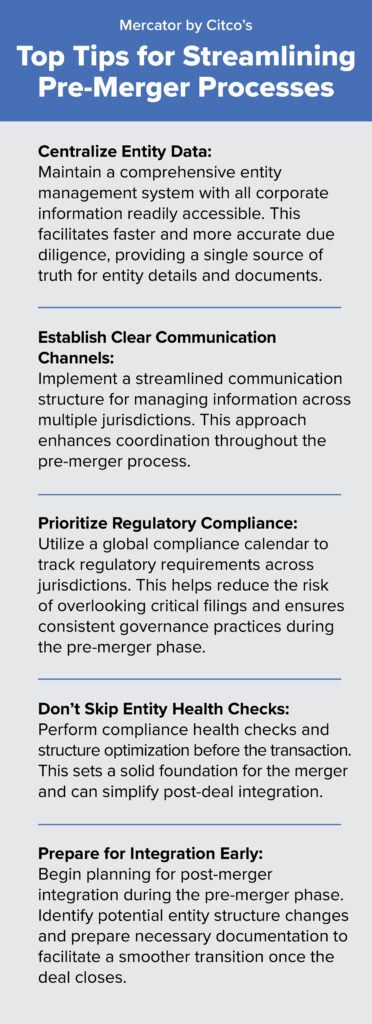
A
first
step
for
any
legal
department
involved
in
a
corporate
transaction
is
to
understand
the
portfolio
of
companies
involved.
The
only
way
to
do
this
is
by
gathering
trustworthy
data.
“When
it
comes
to
data,
there
are
several
critical
questions
that
need
answering,”
Abdellatif
says.
“What
information
do
we
need?
Where
is
it
stored?
Who
maintains
it?
How
can
we
verify
its
accuracy?
Is
it
up
to
date?
Getting
clear
answers
to
these
questions
early
on
is
essential
for
making
informed
decisions
and
planning
effective
integration.”
A
platform
like
Mercator’s
Entica
can
take
this
a
step
further
by
applying
that
data
to
create
detailed
and
interactive
corporate
org
charts.
The
platform
can
also
generate
hypothetical
charts
to
model
potential
acquisitions.
These
charts
map
out
the
“family
tree”
of
an
organization
—
showing
which
entity
sits
on
top,
what
happens
if
entities’
locations
are
moved,
what
it
would
mean
if
an
entity
were
liquidated.
“Our
technology
enables
legal
teams
to
visualize
the
entire
org
chart,”
Abdellatif
says.
“From
there
they
can
toy
around
with
it
to
see
how
changes
might
affect
the
overall
corporate
structure.
This
is
particularly
valuable
during
M&A
discussions,
where
understanding
complex
entity
relationship
is
key.”
Determine
Your
Lane
While
gathering
corporate
data
is
critical,
knowledge
of
a
potential
deal
must
typically
be
kept
confidential
outside
of
a
few
key
stakeholders.
When
the
GC
is
brought
under
the
umbrella,
their
first
step
is
to
determine
their
role.
Will
the
GC
be
engaging
outside
counsel?
Will
they
be
managing
these
lawyers?
Will
the
GC
be
the
primary
point
of
contact
for
the
transaction?
The
scope
of
these
potential
roles
varies
widely,
notes
Josh
Hollingsworth,
an
M&A
partner
with
Barnes
&
Thornburg
LLP.
The
GC
of
a
company
being
acquired,
for
example,
might
be
limited
to
assisting
the
buyer
in
conducting
due
diligence.
In
other
circumstances,
the
GC
might
be
expected
to
lead
the
entire
deal.
“Navigating
where
they
fit
in
and
asking
affirmative
questions
so
that
there
aren’t
any
assumptions
—
it’s
important
for
a
GC
to
just
figure
out
what
their
role
is
in
some
cases,”
Hollingsworth
says.
Master
Organizational
Psychology
When
a
GC
is
involved
in
advancing
a
transaction,
they
must
draw
on
their
soft
skills
as
much
as
their
legal
training
in
the
pre-merger
phase.
Thinking
strategically
about
the
organization
and
the
stakeholders
involved
is
a
key
to
success.
“I
don’t
think
there’s
a
specific
playbook
for
each
circumstance,”
Hollingsworth
says.
“I
think
it’s
just
a
matter
of
being
aware
of
everyone
who’s
involved
and
making
sure
that
you
understand
the
universe
of
how
this
transaction’s
going
to
affect
everybody.”
An
initial
step
is
to
determine
who
will
be
brought
into
the
deal,
and
who
will
not
be
informed.
This
requires
thinking
through
who
in
the
organization
will
be
important
—
the
IT,
HR,
and
risk
management
teams,
for
example.
“If
nobody
in
HR
knows,
it’s
going
to
be
hard
to
get
through
employee
and
benefits
diligence,”
Hollingsworth
says.
“If
nobody
in
IT
knows
about
a
transaction,
and
an
IT
issue
comes
up,
similarly,
that
will
be
challenging.”
Abdellatif
notes
that
technology
like
Mercator’s
Entica
system
can
play
a
role
in
ensuring
the
knowledge
of
the
deal
sits
only
with
the
stakeholders
who
are
looped
in.
“What
we
want
to
make
certain
is
that
data
access
is
available
to
those
who
need
it,
but
not
beyond
that,”
Abdellatif
says.
“That
data
is
only
accessible
to
those
who
actually
require
it,
and
you
don’t
have
people
rummaging
through
information
they
shouldn’t.”
Understand
Your
Team
It’s
also
important
to
gauge
the
likely
motivations
of
each
stakeholder
with
a
role
in
the
transaction.
Hollingsworth
notes
that
anyone
informed
of
a
potential
deal
will
first
ask
themself
a
simple
question.
“Literally,
‘What
does
this
mean
for
me?’
is
going
to
be
the
first
question
that
everybody
who’s
brought
under
the
tent
is
going
to
think
about,
and
that’s
just
human
nature,”
Hollingsworth
says.
“So
just
being
prepared
to
work
through
those
dynamics
is
important
for
a
GC.”
If
a
company
is
being
acquired,
for
example,
that
could
be
seen
as
a
threat
to
many
stakeholders,
who
may
work
to
undermine
the
deal.
It’s
true
of
acquiror
companies
as
well,
Hollingsworth
notes.
Some
may
see
someone
in
the
acquired
organization
as
a
threat
to
their
position.
Some
may
simply
think
it’s
too
much
work
to
go
through
with
the
deal.
Will
a
stakeholder
be
gaining
or
losing
in
job
title
and
status?
Are
there
financial
incentives,
like
parachute
payments
to
a
departing
CEO,
involved?
“I
think
a
lot
of
people
take
it
for
granted
that
if
the
CEO
or
the
board
says,
‘We’re
gonna
do
something,’
that
we’re
gonna
do
it,”
Hollingsworth
says.
“What
ends
up
happening
in
any
group
dynamic
is
there
are
various
levels
of
resistance.”
For
a
company
potentially
being
acquired,
maintaining
impeccable
data
and
compliance
can
help
thwart
resistance
to
a
deal.
These
practices
can
even
provide
bargaining
leverage,
according
to
Abdellatif.
“Having
this
level
of
organization
builds
confidence
with
potential
acquirers
and
can
positively
influence
their
approach
to
the
transaction”
he
says.
If
a
company
doesn’t
seem
to
have
well-maintained
regulatory
compliance,
by
contrast,
an
acquiring
company
will
likely
become
more
critical.
Technology
can
also
help.
Mercator’s
Entica,
for
example,
features
a
corporate
compliance
calendar
that
tracks
all
requirements
a
year
in
advance
and
ensures
a
company
maintains
proper
structures
around
compliance.
Abdellatif
has
seen
acquired
companies
impressing
acquirors
with
the
thoroughness
of
their
regulatory
compliance,
and
the
acquiring
companies
in
turn
seeking
to
adopt
their
systems.
This
thoroughness
can
also
help
stave
off
any
internal
resistance
to
a
deal.
“The
best
defense
is
making
sure
that
you
have
your
ducks
in
a
row,
that
your
information
and
data
is
properly
set
up,
and
that
you
can
demonstrate
just
how
effectively
you
run
your
department,”
he
says.
Don’t
Forget
About
Your
JD
In
addition
to
organizational
management,
of
course,
a
GC
must
also
consider
legal
risks
at
this
stage.
One
top
risk
in
a
pre-merger
environment
is
confidentiality.
For
publicly
traded
companies,
insider
trading
laws
will
kick
in,
and
for
nonpublicly
traded
companies,
there
can
be
issues
with
employees
or
vendors
knowing
of
the
deal
at
the
early
stages.
A
GC
must
ensure
there
are
robust
nondisclosure
agreements
—
and
serious
consideration
around
which
internal
and
external
stakeholders
are
informed
to
begin
with.
“Confidentiality
will
be
at
the
very
top
of
your
legal
risk
in
the
pre-transaction
phase,”
Hollingsworth
says.
“Similarly,
antitrust
considerations
go
hand-in-hand.”
Corporate
transactions
will
often
take
place
between
competing
companies,
which
must
make
a
pre-merger
filing
with
the
Federal
Trade
Commission
under
the
Hart-Scott-Rodino
Act.
If
there
are
foreign
operations,
a
variety
of
other
regulations
apply
as
well.
Competing
companies
that
are
exploring
a
merger
must
also
be
careful
about
the
level
of
cooperation
during
this
stage
because
of
antitrust
concerns
known
as
“gun-jumping.”
“The
expectation
is
that
you’re
going
to
operate
the
business
independently
all
the
way
up
through
closing,”
Hollingsworth
says.
Leverage
Your
Tech
As
with
all
things
in
the
corporate
world,
AI-enabled
technology
is
playing
an
increasing
role
in
mergers
and
acquisitions.
In
the
pre-merger
phase,
generative
AI
will
come
into
play
for
in-house
lawyers
—
particularly
when
drafting
pre-merger
documents
like
nondisclosure
agreements.
New
technology
can
also
immediately
inform
counsel
of
“what’s
market,”
giving
negotiators
detailed
knowledge
of
precedent
regarding
every
aspect
of
a
transaction.
The
Entica
platform
combines
workflows
with
data
management,
ensuring
actions
as
varied
as
filing
financial
statements,
appointing
directors
and
auditors,
and
executing
documents
are
all
tracked
and
accounted
for.
It
allows
quick
access
to
this
data
throughout
a
company’s
full
portfolio,
and
segments
it
to
ensure
it’s
only
accessible
to
stakeholders
who
require
it.
“When
you
come
back
to
logistics,
it
really
serves
as
the
backbone
in
many
ways,”
Abdellatif
says.
Seasoned
practitioners
like
Hollingsworth
remember
the
due
diligence
process
of
decades
ago,
where
there
was
a
physical
data
room
that
contained
banker
boxes
full
of
documents
related
to
the
transaction.
These,
of
course,
have
been
replaced
by
online
data
rooms
that
can
be
accessed
24/7.
Similarly
to
due
diligence,
closings
and
negotiations
have
moved
from
in-person
to
virtual.
For
negotiators,
though,
this
convenience
may
create
a
new
pitfall
to
avoid.
If
you’ve
flown
across
the
country
for
an
in-person
meeting,
the
expectation
is
that
items
will
be
resolved
in
that
meeting,
Hollingsworth
notes.
“Allowing
virtual
negotiations
leads
to
more
iterations
of
the
document,”
he
says,
“and
it
may
actually
lead
to
the
negotiations
taking
longer.”
Stay
tuned
for
the
next
article
in
this
series,
where
we’ll
be
exploring
steps
to
consider
during
the
negotiation
and
closing
of
a
transaction.
Register
Here!
1
hour
of
CLE
credit
is
available.