
Andrew
Yang
hasn’t
had
a
lot
of
success
at
the
polls,
but
the
former
Davis
Polk
associate
turned
tech
entrepreneur
still
enjoys
his
Yang
Gang
following
on
social
media.
Over
the
weekend,
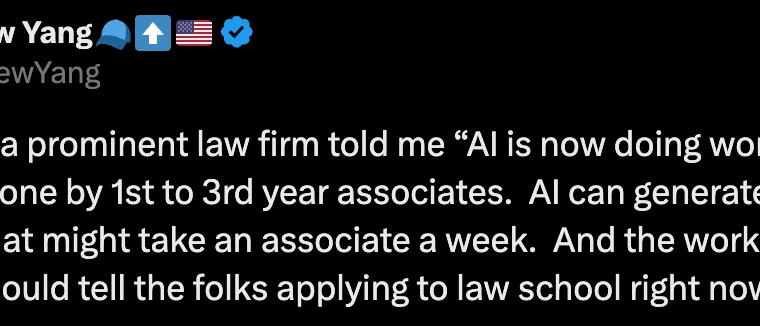
Yang
offered
a
bleak
assessment
of
the
future
of
the
profession
based
on
a
conversation
with
an
unnamed
Biglaw
partner.
No,
it’s
not.
No,
it
can’t.
No,
it’s
not.
And
of
the
million
reasons
to
second-guess
that
law
school
application,
this
is
none
of
them.
To
be
a
little
more
fair
to
the
unduly
credulous
Yang,
AI
might
be
doing
some
work
that
used
to
be
done
by
junior
associates,
but
most
of
that
sort
of
drudgery
—
the
proverbial
first-pass
review
in
a
Topeka
warehouse
—
had
already
been
outsourced
one
way
or
another
years
ago.
The
work
that
departed
in
favor
of
contract
attorneys
in
the
2000s
may
now
be
in
the
hands
of
an
algorithm,
but
that’s
not
what
this
Tweet
is
about.
First
of
all,
AI
doesn’t
“generate
a
motion
in
an
hour.”
If
you’re
just
looking
for
AI
to
do
the
job,
then
AI
can
produce
a
motion
in
minutes…
as
long
as
you
don’t
care
how
much
the
firm
will
get
sanctioned.
AI
still
screws
up.
Often.
Most
of
the
work
involved
in
a
draft
motion
isn’t
generating
the
words,
it’s
making
sure
it’s
the
best
words.
If
a
motion
generated
by
AI
“in
an
hour”
is
better
than
what
a
junior
can
produce
in
a
week
—
it
won’t
be
—
it
probably
says
more
about
the
partner’s
warped
recollection
of
their
own
genius.
Professional
AI
solutions
absolutely
speed
up
the
workflow,
perhaps
helping
that
junior
associate
complete
a
non-embarrassing
first
draft
in
two
days
instead
of
a
week,
but
that’s
still
a
draft
the
junior
associate
prepares
even
if
the
AI
sped
up
the
process.
Which
puts
the
lie
to
the
claim
“And
the
work
is
better.”
The
work
is
still
a
junior
associate’s,
pushed
along
by
an
algorithm
spitting
out
filler
text
or
summarizing
the
statement
of
facts
or
producing
better
research
results
teased
out
of
the
natural
language
prompt.
If
the
partner
really
thinks
the
work
is
better,
that’s
not
the
AI’s
doing.
The
AI
is
busy
trying
to
shove
Mack
v.
Armstrong
into
the
brief
even
though
it
doesn’t
exist.
So
students
shouldn’t
let
AI
become
the
reason
not
to
go
to
law
school.
Let
the
Trump
administration
making
it
prohibitively
expensive
do
that
work
for
you.
If
there’s
a
lesson
to
extract
from
the
last
few
AI
hallucination
scandals,
it’s
that
the
hallucination
problem
is
almost
always
a
partner’s
fault.
It’s
the
partners
who
have
convinced
themselves
that
the
magic
chatbot
is
replacing
their
costly
associates
before
bonus
season.
The
associates
themselves
seem
to
understand
how
to
actually
use
AI
while
the
partners
keep
trying
to
lawyer
via
AI
about
as
well
as
they
could
explain
Italian
Brainrot
memes.
So
it’s
not
surprising
that
a
partner
claims
—
smittenly
—
that
some
vague
AI
can
“generate”
work
that’s
“better”
than
the
associates.
The
tech
bros
of
the
world
aren’t
helping,
perpetually
overpromising
on
what
this
tool
can
accomplish
in
their
mad
pursuit
of
VC
money.
It
makes
me
sound
like
I’m
down
on
AI,
which
is
not
true
at
all:
I
think
AI
is
a
revolutionary
technology
that
—
assuming
the
bubble
doesn’t
burst
—
will
accelerate
the
legal
workflow.
But
it’s
not
about
to
replace
associates
because
what
we
have
right
now
is
about
as
good
as
it’s
going
to
get.
At
least
for
a
long
while.
And
then
only
if
the
bubble
doesn’t
burst.
But
this
is
the
critical
distinction:
AI
does
not
in
any
way
replace
lawyer
jobs.
Whalers
were
replaced
by
electric
lightbulbs.1
Manual
typesetters
were
replaced
by
digital
printing.
AI
isn’t
replacing
associates,
it’s
a
tool
allowing
them
to
work
faster.
In
that
sense,
it’s
not
unlike
the
advent
of
online
research:
junior
associates
didn’t
disappear
because
they
didn’t
spend
half
their
day
running
back
and
forth
to
the
library…
they
just
did
more
research.
That
might
mean
the
industry
has
fewer
openings
for
new
lawyers.
If
junior
lawyers
do
their
jobs
twice
as
fast,
the
firm
needs
half
as
many
to
do
the
the
same
work.
While
the
distinction
may
not
be
much
comfort
to
the
law
grad
left
outside
looking
in,
it’s
important
because
jobs
lost
to
efficiency
come
back
when
there’s
more
work
to
be
done.
Indeed,
the
legal
industry
probably
will
get
bigger.
The
world
keeps
growing
in
size
and
complexity
and
that
means
more
legal
work
over
the
long
haul
and,
by
extension,
more
junior
associate
jobs
for
partners
to
systematically
devalue
by
pretending
AI
is
doing
everything.
No
one
is
picking
Captain
Ahab
up
off
the
unemployment
line.
I’d
say
he
should
learn
to
code,
but
AI
actually
might
replace
that.
[1]
Or
relocating
to
Carolina
in
1997.
 Joe
Joe
Patrice is
a
senior
editor
at
Above
the
Law
and
co-host
of
Thinking
Like
A
Lawyer.
Feel
free
to email
any
tips,
questions,
or
comments.
Follow
him
on Twitter or
Bluesky
if
you’re
interested
in
law,
politics,
and
a
healthy
dose
of
college
sports
news.
Joe
also
serves
as
a
Managing
Director
at
RPN
Executive
Search.