
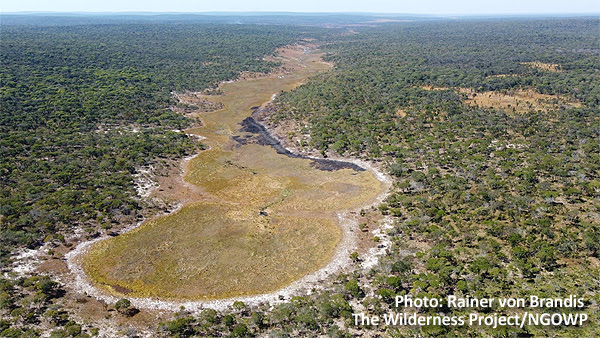

However,
new
research has
discovered
that
the
actual
source
of
the
river
lies
in
a
shallow
depression
in
Angola’s
southern
highlands,
at
the
source
of
a
river
called
the
Lungwebungu
(pictured
above).
This
gives
the
Zambezi
a
new
total
length
of
3,421
km
(2,126
mi),
or
342
km
(213
mi)
longer
than
previously
thought.
The
research
was
carried
out
in
2022
and
2023
by The
Wilderness
Project,
in
collaboration
with
the National
Geographic
Okavango
Wilderness
Project and
the Wild
Bird
Trust.
Two expeditions
travelling
the
entire
length
of
the
Zambezi
River
from
its
traditional
source
in
Zambia
and
its
most
distal
source
in
the
Angolan
Highlands
Water
Tower,
all
the
way
to
the
Indian
Ocean,
collected data
on
human
impact,
biodiversity,
water
quality,
and
river
discharge.
Their
findings
revealed
that
the
Lungwebungu
and
several
other
Angolan
rivers
contribute
about
70%
of
the
water
reaching
Victoria
Falls,
making
them
critical
to
the
long-term
health
of
the
Zambezi
and
the
people
and
wildlife
who
depend
on
it.
The
study
highlights
the
importance
of
protecting
the
Upper
Zambezi
Basin,
where another
recent
study recorded
significant
forest
loss
over
the
past
three
decades.
In
July
2025,
at
a
Ramsar
Convention
on
Wetlands
held
in
Victoria
Falls, The
Wilderness
Project presented
its
case
for
a
large
part
of
the
Angolan
water
tower
to
be
declared
a
Wetland
of
International
Importance,
to
boost
its
recognition
and
protection.
Approval
for
the
site,
known
as Lisima
lya
Mwono,
or
“the
source
of
life,”
is
expected
later
this
year
or
early
next.
–
Zambezi
Society
Bulletin
–
December
2025
Post
published
in:
Featured