DLA Piper Plans To Dump Tons Of Bonus Cash On Associates

This time last year, Biglaw firms were still figuring out how to adapt to remote working environments thanks to the pandemic, but now, Biglaw firms are figuring out when (or whether) they’ll announce additional rounds of special bonuses to reward all of their attorneys’ hard work over the course of the past 12 months. Top-ranked firms have been announcing Davis Polk bonus matches left and right. Which one is it this time?

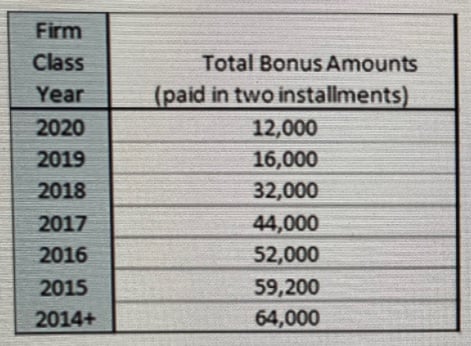
DLA Piper — a firm that came in at No. 3 on the most recent Am Law 100 ranking, with $3,112,130,000 in gross revenue in 2019 — thrilled associates with its special bonus announcement today. The firm has fully matched the bonus scale announced by Davis Polk. In case you’ve forgotten what that looks like, DLA’s bonus scale can be seen below (the full memo is available on the next page):

Bonuses at DLA Piper will be paid half in May and half in September to all associates in good standing. Congratulations to all!

(Flip to the next page to see the full memo from DLA Piper.)

Remember everyone, we depend on your tips to stay on top of important bonus updates, so when your firm matches, please text us (646-820-8477) or email us (subject line: “[Firm Name] Matches”). Please include the memo if available. You can take a photo of the memo and send it via text or email if you don’t want to forward the original PDF or Word file.

And if you’d like to sign up for ATL’s Bonus Alerts (which is the alert list we also use for salary announcements), please scroll down and enter your email address in the box below this post. If you previously signed up for the bonus alerts, you don’t need to do anything. You’ll receive an email notification within minutes of each bonus announcement that we publish. Thanks for all of your help!


Staci ZaretskyStaci Zaretsky is a senior editor at Above the Law, where she’s worked since 2011. She’d love to hear from you, so please feel free to email her with any tips, questions, comments, or critiques. You can follow her on Twitter or connect with her on LinkedIn.

Enter your email address to sign up for ATL’s Bonus & Salary Increase Alerts.

U.S. News Pulls Law School Diversity Ranking Less Than A Week Before Publication

I’m happy that they’re backtracking. But [U.S. News’] myopia on these critically important issues of diversity explains why the rankings continue to sustain and exacerbate systemic inequities of all kinds. That’s what I think is so important about this. Their antiquated and absurd definition of who underrepresented minorities are—which excludes a person like me as diverse, I’m Black and Korean. Their initial ranking undid decades of progress, in terms of its exclusionary definition of diversity.

— Dean L. Song Richardson of the University of California, Irvine School of Law, commenting on a decision made by U.S. News to remove its new diversity ranking due to two errors: the ranking initially failed to include Asian students (that recalculation was made earlier this week) and multiethnic students. After 162 law school deans requested a further revision to the diversity ranking, Bob Morse of U.S. News said, “[W]e’ve removed the law diversity ranking and will publish it at a later, as yet undetermined date in order to include students of two or more races.”


Staci ZaretskyStaci Zaretsky is a senior editor at Above the Law, where she’s worked since 2011. She’d love to hear from you, so please feel free to email her with any tips, questions, comments, or critiques. You can follow her on Twitter or connect with her on LinkedIn.

Remote Depositions Keep Cases Moving In Pandemic Times

In the world of high-stakes litigation, one can imagine a tense deposition, where an attorney implements a strategy to draw out the witness and looks for insights in the twitch of an eye, the slump of shoulders, a jittery leg.

Of course, as is true for so many areas of legal practice, the COVID-19 pandemic completely upended the process for taking depositions. Attorneys may have lost the opportunity to size up a deponent from across a table, but remote depositions have become a viable alternative thanks to sophisticated technology and careful preparations. 

“Tactically, there are things you can do when sitting across the table with non-verbal communication that are harder to do when you’re looking at a screen,” said Eric J. Marandett, a partner with Choate Hall & Stewart LLP, and a faculty member for Fundamentals of Taking and Defending Depositions 2021, a continuing legal education program of the Practising Law Institute. 

Even so, Marandett said his remote depositions have gone smoothly, and they offer efficiency and cost savings: “You don’t have to deal with the travel expenses and the lost time associated with travel.”

A good thing, considering nearly all depositions have gone remote. 

“I don’t think there’s any justifiable reason for people to be in rooms together with strangers … for an extended period of time,” said Robin A. van der Meulen, a partner with Labaton Sucharow LLP and a faculty member for the PLI program on depositions. In the few instances where litigants requested in-person depositions, “the courts have rejected those,” she added.

The Federal Rules of Civil Procedure have long allowed for remote depositions. Rule 30(b)(4) permits them and Rules 29(a) and (b) explicitly state they may be used for the same purpose as any other deposition. 

However, before the pandemic they “were few and far between,” according to Gerald A. Stein, a partner with Norton Rose Fulbright US LLP and the program chair for the PLI program on depositions. Occasionally, Stein said, depositions were remote if they were needed only to authenticate documents or they involved less important witnesses.

The pandemic has also led many state courts to issue temporary orders regarding oath taking. Oaths were normally administered in-person so it was easier to confirm a person’s identity, van der Meulen said. The new orders, which might come from a chief judge as an administrative order or from individual judges, authorize oaths to be administered remotely, she explained.

The Quirks of Virtual Questioning

The swearing-in method is just one of many differences. During remote depositions attorneys must also be mindful of the quirks of virtual interaction. 

“The problem is you can’t always hear people very well,” van der Meulen said. 

For instance, the microphone may be too close or too far away from a witness’s mouth, or there may be a lot of background noise. And then there is the problem of people speaking over each because of a slight delay.

“The conversations back and forth can be a little stilted for that reason, which makes it harder to get into a flow,” van der Meulen said. “It certainly makes it harder for the court reporter to accurately transcribe. … [E]verything takes a little bit longer than it might in an in-person situation.”

Stein recommended attorneys take extra care with their exhibits. 

“It’s much harder to control the flow of exhibits and what you’re showing the witness. And it takes a lot of time, because now you need the cooperation of the witness to figure out how to manipulate the screen. You rely on their cooperation to use a computer.”

Problems arise if the witness doesn’t want to cooperate or doesn’t know how to use technology, Stein added. 

“You might have to trust your opposing counsel a little more than you want [and] send the exhibits ahead of time.”

Another protocol may involve who gets to be in the room during the deposition, including someone who may not necessarily be on camera, Stein said. 

“If Witness One is being deposed and Witness Two is going to be deposed the next day, are they going to be sitting in the room, seeing the deposition? Because usually that’s not how it happens, but now there’s nothing stopping your next witness from viewing the deposition.”

Preparation Is Key

All these details require preparation, which is where remote depositions differ the most from their in-person counterparts. While van der Meulen noted there have always been protocols regarding such things as how many depositions each side gets to take, how long they can last, and the confidentiality of exhibits, to go remote means a whole other suite of preparatory agreements.

According to materials from the PLI program on depositions, these may include which technology platform to use and the need to test it before the deposition; an agreement to go off the record when technical issues arise; rules on who is allowed to be in the same room as the witness during the deposition; rules for the use of other forms of communication during the deposition like texting, chatting, emailing, and social media; an agreement that no one may communicate with the witness by any means during the on-the-record deposition; rules on use of the deposition platform’s chat functions and private breakout rooms; whether exhibits will be electronic or hard copy; and if paper, an agreement on how they should be handled.

Marandett said he hasn’t found exhibits to be an issue. In all the remote depositions he’s done, they’ve handled them electronically rather than sending hard copies ahead of time. 

This wasn’t because he was concerned about them being out in the world, but because, “we had the platform and real-time electronic access more closely approximates the way an in-person deposition works,” with all parties seeing the exhibit at the same time. In addition, Marandett said he hasn’t experienced any significant technical difficulties thus far.

“It can be smoother in a remote deposition than in-person,” he said.

An Audio-Visual Production

A big reason for this is no doubt the prowess of companies that have added remote-deposition services to the trial services they already offered, according to Marandett. The technician who runs things is often called a “hot-seat operator.” 

Trials these days — especially in complex cases with a lot of witnesses, exhibits and evidence — have taken on an aspect of show business, with high-tech providers making sure juries are presented with information quickly, clearly, and with a touch of style to help attorneys communicate their theory of the case. 

“The service [for depositions] is no different than what you see at trial. The hot-seat operator is the person who handles the exhibits during depositions, calls up the documents, and then blows them up and highlights as you go.”

If the budget supports it, using one of these trained technicians will dramatically enhance efficiency, according to the PLI materials.

These vendors “have a ton of experience in handling exhibits in electronic ways and that’s exactly what you have to do with depositions in a remote setting,” van der Meulen said. “They’re using those skills to present them to the witnesses and the parties and using their own platforms.” This new role, she added, is “really perfect for them.”

Cybersecurity

As with all communications platforms that connect people virtually, attorneys need to be aware of data privacy and security issues.

Van der Meulen mentioned that one of the early problems with Zoom was crashers and hackers taking over Zoom meetings. The incidents put attorneys on notice. 

“You definitely need to have a conversation with whoever is going to be providing your remote deposition platform,” she said. Security must be sufficient to ensure unauthorized people can’t “eavesdrop on your confidential deposition, and also to make sure that there are no hackers trying to take the transcript or the video. I think most vendors have that capability already, but it’s certainly a concern.”

Marandett said he expects there to be cybersecurity issues. 

“I’ve seen the implications of a data breach with documents held under protective order. I’ve not seen it in a deposition. We can’t ignore it, though.”

Plain, Old Malfeasance

Aside from bad actors out there in the cyber world, remote depositions also raise the possibility of bad behavior by participants. Although Marandett has not experienced it himself, “I do think we will see problems with less scrupulous lawyers and clients communicating by text,” he said. “There’s no real way to prevent that. You can get people to say on the record that they’re not doing it, but there is no way to enforce it.”

While van der Meulen thinks most lawyers are going to conduct themselves with integrity, someone could stay off-camera “signaling to the witness what to say or what not to say. And that goes to how much you trust your opposing counsel. Those are certainly things that attorneys think about. . . . Because you want the deposition to have integrity, the testimony to be accurate and truthful.”

Communicating with a witness via a text has been illegal for a long time, Stein said. As far as he knows, this and other unscrupulous actions — such as examining documents early in breach of an agreement — have not been happening more now that depositions have gone remote.

“We all work in small enough circles that you don’t want to engage in that type of thing because word gets out pretty quickly,” Stein said. “The cases come and go, but you’ll always have your reputation.”

Here to Stay?

Considering their prevalence these days, attorneys may wonder if remote depositions are here to stay, the way some expect telecommuting to become a permanent feature of our work lives. Stein doesn’t think so. Outside of small cases, or minor depositions, Stein expects almost everyone to return to in-person depositions as soon as the pandemic restrictions are lifted.

Remote depositions are convenient, and “obviously cost less because you eliminate substantial travel costs and things like that, but I would say they are very distant second,” Stein said. “I don’t see, in the future, people saying, ‘Should we do it by remote or should we do it in person? Let’s flip a coin.’ . . . There is no substitute for questioning witnesses live.”

Marandett thinks there will be a place for remote depositions going forward, perhaps for less important witnesses. 

“For key depositions, there is a strong preference to do it in person. I bet we move to a scenario where 75 to 80 percent are in person and the rest are remote.”

PLI offers additional programs and program segments related to remote trials, mediations, and depositions, including: Current Developments in Federal Civil Practice 2021; Remote Depositions: Practical Considerations and Best Practices for Taking and Defending Virtual DepositionsSecurities Arbitration – Arbitration and Mediation Settlement Practicum; and Specialized Deposition Techniques 2020.


Elizabeth M. Bennett was a business reporter who moved into legal journalism when she covered the Delaware courts, a beat that inspired her to go to law school. After a few years as a practicing attorney in the Philadelphia region, she decamped to the Pacific Northwest and returned to freelance reporting and editing.


Have You Considered Not Doubling Down On Racism?

Put a plug in your “well, actually.”

It’s a pretty common story here. Law professor/lawyer/law student engages in bigoted trolling behavior for some reason. People object because that’s what you do when you live in a society founded on the principle that other people deserve basic respect and human dignity. Original actor throws a tantrum doubling down on their behavior.

Now, why would they do that?

The simplest explanation is that most people willing to come right out and say bigoted stuff are awful people and they’re doubling down because they legitimately refuse to believe they’re wrong. Whether they do it by demonizing “cancel culture” for calling them out on their reprehensible actions or they gussy it up with some quasi-intellectual veneer like the “use-mention distinction” it boils down to refusing to take responsibility because they don’t feel they owe anything to anyone who isn’t them.

A reader crystalized this mentality by replying to this article with “You [sic] insulting description of libertarians is much more bigoted than anything you describe in this article.” The “anything” in the article is “using the n-word” and the description of libertarians was that it’s childish to use free speech as an excuse to gratuitously use slurs. The implied formula is “infantilizing a philosophy > racial slurs.” It was such a perfect self-own that I wish it was parody. I’m pretty sure it wasn’t.

But two stories from this week ventured into territory that we don’t see often at Above the Law. We learned that CUNY Law’s Dean Mary Lu Bilek, who we already knew was stepping down, decided to leave her post after remarking at a meeting that she was a “slaveholder.” In context, her comment reads as acknowledging that she was the one ultimately responsible in an ongoing tenure dispute over perceived racial bias, making it a straightforward analogy if an extraordinarily problematic one. We also heard from Michigan’s Dean Mark West apologizing for the covers used on his past published books. Dean West is an expert on Japanese law and the published works exploit common stereotypes.

In both cases, the person involved is owning up to it and, in Bilek’s case, leaving her post since her actions directly impact school management. In both cases, we still heard from folks that the responses were “too little too late.” Everyone has to judge the quality of an apology from their own perspective. Someone apologizing under duress isn’t genuine, for example.

I don’t think the people who wrote us meant it that way, but the “too little too late” word choice got me thinking about whether or not some of these double-down artists are motivated by a perception that no conciliatory path exists for them, so they may as well be jerks about it. One of the worst side-effects of the whole right-wing “cancel culture” rhetoric is that it portrays people criticizing bigotry as impossible to satisfy and therefore unworthy of attention.

And that’s bad, because confronting incidents like these head on is much more conducive to a productive discussion. Engaging and listening might be all it takes to resolve the matter to everyone’s satisfaction. Come to it with some basic humility. Maybe what was said wasn’t even bad per se but the speaker didn’t understand the context that made the audience hear it that way. That’s still something to acknowledge and address. If people at the center of these controversies start shutting down and trying to avoid these conversations because they don’t see any productive outcome, it just incentivizes bad behavior.

I thought about this a lot in the Bilek situation, because one of the strong arguments made by the student government in continuing to criticize Bilek even after she took the serious step of leaving her post is that she tried to cover up why she was leaving. Was it because she thought nothing could come of engaging the problem head on? Because right or wrong, it seems as though it only made it worse.

Make no mistake, most people double down because they’re just jerks. But I’m willing to hear them out on it.


HeadshotJoe Patrice is a senior editor at Above the Law and co-host of Thinking Like A Lawyer. Feel free to email any tips, questions, or comments. Follow him on Twitter if you’re interested in law, politics, and a healthy dose of college sports news. Joe also serves as a Managing Director at RPN Executive Search.

Stop Managing Your Law Firm From Crisis To Crisis

For most of us, the past 12 months have been one long global crisis punctuated by a series of lesser upheavals. As COVID-19 began spreading across the planet, law firm leaders found themselves feeling like they were in a boxing ring with Mike Tyson — getting punched by a new crisis daily. Each week brought new challenges: do we send our workers home? How long should we stay there? How do we shift our technology to serve an all-remote workforce? How do we maintain productivity, business development, and budgetary discipline while our kids go to Zoom school across the dining room table?

Amidst all the chaos and strife, the best many firm leadership teams could do was hold on for dear life and manage for the moment. Handle what you can, kick what you can down the road, and take each crisis in turn according to your needs and abilities.

Frankly, my friends, that’s not good enough.

 Playing The Long Game

The decisions firms make today will define their existence for decades to come. The legal landscape has fundamentally changed since last year. Work from home is the new norm. Some sectors of the economy are booming as others fell flat, and entire books of business have risen and fallen in that wake. Real estate needs have changed, staffing needs have changed, lateral and summer-associate hiring needs have changed, and generally speaking everything we thought we knew is up for reevaluation.

Yet many law firms remain in a reactive stance. Defense might win championships in sports, but it’s a losing strategy in business. Firms that want to survive and thrive in the coming years need to go on the offense, and that means having a long-term plan for the firm’s development.

In fact, I’d go so far as to argue that without a long-term plan in place, a firm’s ability to handle day-to-day crises is almost nonexistent. If all we’re doing in an individual moment is reacting to new challenges, we’re not building toward anything or headed in any particular direction. At best, we’re standing in place, waiting for the current challenges to blow over. More often than not we end up watching what other firms do and playing follow the leader, because no one ever got fired for making the safe bet, right?

If that sounds like an underwhelming strategy, it’s because it is. Firms that want to succeed need to be deliberate about developing short-, medium-, and long-term plans to guide them through whatever crises happen to come next. Here’s my best advice for firms looking to develop the vision they need to steer through 2021 and beyond.

Get Specific

Any strategy a firm sets down needs to provide a roadmap for how to position the firm for sustained competitive advantage. “Grow Profits” is undeniably a long-term goal, but it’s not a strategy.

Harvard Business School professor Michael Porter admonishes businesses to follow one of two options when formulating a competitive strategy: “Do what everyone else is doing (but spend less money doing it), or do something else no one else can do.” Can you honestly say your firm is doing either of these? If you’re like most Am Law 200 firms, you’re probably doing what everyone else is doing, but are you really finding ways to reduce overhead, salaries, or leverage technology to bring down costs in a meaningful way relative to competitors? Or are you fundamentally providing a service that’s different from any of the other firms in your market?

When starting out developing a firm’s strategy, it’s important to understand what it is your firm does, what it does best, and what makes it unique. You need to inventory your resources and capabilities in an honest way. Shaquille O’Neal and Michael Jordan were both dominant NBA players on championship teams, but they played wildly different styles of basketball. The 7’1” Shaq was both an unstoppable force and an immovable object close to the basket, but he couldn’t shoot a free throw to save his life. Jordan was fluid in almost every aspect of the game, but had to rely more on speed, smarts, and shooting than physical dominance to beat the other team. If Shaq had tried to play like Mike, or vice versa, hilarity — and turnovers — would have ensued. It was by building their games around their respective strengths that they each grew to be first-ballot NBA Hall of Famers.

If you’ve got a young, agile partner base willing to take risks to grow, use that. If you have a robust, established client base, leverage your contacts and explore ways to get more work from them or their colleagues in the same industry. If your firm has a large number of attorneys and big geographic footprint, identify additional ways to capitalize on economies of scale. Lean into what gives your firm advantage in the marketplace and build from there. If you’re built like Shaq, don’t plan on threading needle-like passes to your teammates; just go dunk the dang ball.

Set Concrete Goals

 Once you identify who you are and where you want to go, how do you know if you’re actually making progress? For that, I’m a fan of the management concept of OKR, or “Objectives and Key Results.” It’s pretty much what it says on the label. Under the method, you set Objectives, the “why” behind your goals. You then identify one or more specific Key Results you’re going to use to accomplish them along with a fixed timeframe for evaluation. At the end of the time period, you can answer that you either hit your key result or didn’t. Think of OKRs like SMART goals on steroids.

Say for example your firm has a major client that generates 25% of the firm’s revenue. Your firm is in a precarious position. If that client hires a new GC and flips the work to another firm, you could find yourself facing an existential crisis with lots of salaried lawyers and legal professionals and nothing to do. Under the OKR method, a reasonable Objective — the reason you’re undertaking the effort — would be to promote economic stability within the firm. The related Key Result could be to grow business from other clients to a point where the major client accounts for 23% of firm revenue by the end of the year (and hopefully you can do that without reducing revenue from the major client). To achieve your Key Result, you could have other supporting Key Results related to pitching a certain number of new clients for work, increasing revenue from a smaller and more profitable client by 10%, or responding to three additional RFPs. Check back regularly, figure out what Key Results are being met, and reformulate new Objectives as needed from there. Assuming you’re successful, the next year you can set a new target of 21% of firm revenue and so forth.

It’s not rocket science. But unless you’re Elon Musk at the helm of SpaceX, you don’t need rocket science. What you need to do is systematically focus on the key drivers of success that will make your business take off.

Make More Than One Plan

Law firms are complex beasts facing complex times. No single plan will cover everything a firm might face in the coming years. Just for the changes caused by COVID-19 alone, the planning is dizzyingly broad and includes major changes to budgeting, technological adoption policies, employee oversight and retention, client development, pricing model blends, client-specific changes, and more. That’s before even considering the potential revolutions the legal industry was already heading toward before COVID-19 hit.

Each of the myriad challenges coming down the pipe needs its own plan for dealing with it, and all of those plans have to be crafted with an eye on the bigger picture of the firm itself. It’s never been more important to have strong, coordinated law firm leadership, and it’s never been more important that those leaders have a deliberate vision for the future of their organizations.

If you’ve got a long-term vision for your firm in place already, now is the time to revisit it, expand it, and develop quantifiable metrics to track your success. If you don’t have a plan in place, start working today to put one together.

Otherwise, you’re just planning for failure.


James Goodnow is the CEO and managing partner of NLJ 250 firm Fennemore Craig. At age 36, he became the youngest known chief executive of a large law firm in the U.S. He holds his JD from Harvard Law School and dual business management certificates from MIT. He’s currently attending the Cambridge University Judge Business School (U.K.), where he’s working toward a master’s degree in entrepreneurship. James is the co-author of Motivating Millennials, which hit number one on Amazon in the business management new release category. As a practitioner, he and his colleagues created and run a tech-based plaintiffs’ practice and business model. You can connect with James on Twitter (@JamesGoodnow) or by emailing him at James@JamesGoodnow.com.

SEC Upgrades Interest In SPAC Boom From ‘Passing’ To ‘Nearly Interrogatory’

Last year was the year of the SPAC—for two-and-a-half months. Whatever happens from here out, 2021 will be the new year of the SPAC, as they’ve already raised $87.9 billion this young year, $4.5 billion more than last year and 6.5 times as much as in any prior year.

The Power Of Mentorship, Allyship, And Sponsorship

Left to right: Mary Ann Hynes, Christine Castellano, Gloria Sandrino, and Monique Burt Williams.

In honor of Women’s History Month, please join us on Monday, March 29, for a captivating, one-of-a-kind experience with the first woman to serve as General Counsel of a Fortune 500 company, Mary Ann Hynes, in conversation with her longtime colleague and friend, Christine Castellano, who is currently serving in her second role as a Fortune 500 General Counsel. They will be joined by Gloria Sandrino, Global Chair of Partner and Group Recruiting at Lateral Link, and Monique Burt Williams, CEO of Cadence Counsel.

Our discussion will cover a range of themes from the Am Law to the C-suite, as we create a space for women to share their unique experiences within the legal profession. This event is sponsored by the National Association of Women Lawyers (NAWL), and it will be neither reported nor recorded. You will not want to miss this candid, dynamic discussion. Please join us!


Lateral Link is one of the top-rated international legal recruiting firms. With over 14 offices worldwide, Lateral Link specializes in placing attorneys at the most prestigious law firms and companies in the world. Managed by former practicing attorneys from top law schools, Lateral Link has a tradition of hiring lawyers to execute the lateral leaps of practicing attorneys. Click here to find out more about us.


Cadence Counsel is a boutique search firm that focuses exclusively on the placement of in-house counsel. We specialize in Retained Executive Search, Ad Hoc Counsel Placement, and Diversity & Development Consulting. A certified Women’s Business Enterprise, Cadence Counsel is a leading diversity supplier of in-house legal professionals within the Fortune 500.

Baby Pls Don’t Go: An Ode To Biglaw Special Bonuses

Ed. note: Please welcome BigLawBoiz (“BLB”) to the pages of Above the Law. BLB will be writing about what associate life is like in Biglaw.

You spent the last 12 months hunched over at your kitchen table redlining documents and fielding Zoom calls, pretending you’re wearing pants and have showered in the last three days.  You hardly saw the sunlight, and somehow in the midst of a global pandemic where the economy should be tanking you worked… more?  Well, your bonus check finally cleared.  You’re dipping your toe in the water to see what else is out there: greener pastures, work-life balance, more hands-on experience.  You never thought you’d be in Biglaw this long.  Most top out at the midlevel somewhere; it’s no secret that this is how the business model works.  Lawyers and law firms bank on it.

Well, it looks like a lot of people got wise to that business model, all while the SPAC craze kept M&A and Capital Markets activities at all-time highs.  Biglaw firms need their people, more than ever it may seem.  Goldman Sachs caught the business end of the chainsaw when a few of their analysts very publicly complained they “work too hard for this shit.”  Some Biglaw firms wised up and did what they know best: throw money at an issue and pretend it’s the same thing as respect.

These bonuses are significant.  It is certainly a lot of money to give out to your team, and it makes sense — costs were certainly down.  Firms don’t have an entire office, or multiple offices, to keep lit up 24/7 (you paid your increased utilities bill), the extravagant summer programs did not happen (instead of firm-sponsored lunch at Michelin-starred restaurants, you ate a string cheese and Gatorade), and revenues were flat, if not up across many firms.  It’s good to see some of the wealthiest lawyers in the country spreading the love with their people who make the firms so successful.

However, let’s not mistake these as purely altruistic.  The way these bonuses are structured scream “Please don’t leave us!”  You get some now-ish, and some later.  How much later?  Well, wait until fall when we bring in a new class of associates.  These bonuses will not be “free,” and I don’t think are meant to reward associates for the past work they have done, but rather to entice them to stay through what could, and likely will, be a grueling few months.

With vaccine rollouts and cases decreasing, the COVID catastrophe will at some point end.  I’ve heard the rumors of back to office by July, or September.  The far-off dreams of 2022 return seem to have been crushed underneath Joe Biden’s feet as he tripped up the stairs.  If you thought you were busy last year, you better gear up for this year.  It will continue to be SPAC-tacular!  A true SPAC-tacle.  When the money is free, can you really blame banks and law firms for getting in on the SPAC-tion?

Firms really can’t afford to lose you.  They want to hire short-term staff and move associates from different groups into the hot spaces.  They just need the manpower.  You can stay.  You will get worked like a dog. (Side bar, dogs work the least out of any animal.  All dogs I’ve known spend their entire day sleeping.  Bad idiom.)  But you’ll get a nice little piece of change to make you feel special.  You can buy things that fill the void in your life, I know those red bottoms and rollies are looking real right now.

So, you have to ask yourself:  is it worth it?  You may have been ready to leave, maybe take a modest pay cut, but regain some control over your life.  Or do you double down on the golden handcuffs, spend the summer and leave when you get the “surprise” bonus?  But wait, then the winter bonus is only a few months away… might as well stay for that too… Maybe the model has changed.


BigLawBoiz (“BLB”) is a Biglaw associate in New York. BLB anonymously runs a popular Instagram-based meme page which chronicles and mocks the most absurd facets of life in Biglaw, corporate America, and being a lawyer in general. Who is BLB? BLB be could be the associate who’s two doors down, could be you — there’s a BLB inside of all of us.

Enter your email address to sign up for ATL’s Bonus & Salary Increase Alerts.

Associate Compensation Scorecard: Which Firms Are Sharing The Wealth Through Special Bonuses?

Spring is in the air, and bonus season is here once again. We don’t usually see many bonuses in March, but like 2020, 2021 is turning out to be an odd year.

Since we broke the news of the special bonus scale for associates and counsel at large law firms in the United States — a trend that was started by Willkie on Friday, March 19, 2021 (offering between $7,500 and $40,000), and quickly one-upped by Davis Polk on Monday, March 22, 2021 (offering between $12,000 and $64,000) — many firms quickly fell in line and matched the generous scale. When will your firm announce its special bonuses?

As usual, we are compiling a table of all the firms that have already matched the special bonus scale, the minimum hours required to receive those bonuses (if available), and the date those bonuses will be paid. Today, we unveil that table for your viewing pleasure. We will be updating this table on a daily basis, sometimes multiple times, as news on bonuses is announced. If you see any information here that is incorrect or needs clarification, let us know.

Help us help you now (and if/when you decide to make a lateral move in the future). Let us know what your firm’s minimum billable hours targets are for special bonus eligibility and when your firm will pay those bonuses. You generally must remain at your firm until the payout date to receive them, as stated in most memos, which could make it all the more difficult for you to leave your job.

As a little reminder, we love covering Biglaw bonuses, but we need your help. As soon as your firm’s bonus memo comes out, please email it to us (subject line: “[Firm Name] Bonus”). We always keep our sources on bonus stories anonymous. There’s no need to send the memo using your firm email account; your personal email account is fine. Please be sure to include the memo as proof; we like to post complete bonus memos as a service to our readers. You can take a photo of the memo and attach as a picture if you’re worried about metadata in a PDF/Word file.

Firm Date Matched Minimum Hours Payout Date
Willkie
Class of 2020: $7.5K $12K
Class of 2014+: $40K $64K
FIRST MOVER
March 19, 2021
None June 30, 2021 / September 30, 2021
Davis Polk
Class of 2020: $12K
Class of 2014+/Counsel: $64K
March 22, 2021 None April 26, 2021 / September 30, 2021
Fenwick & West
Tier 1/Level 1: $12K
Tier 3/Counsel: $64K
March 23, 2021 1950 creditable hours, measured pro rata May 2021 / September 2021
Milbank
Class of 2020: $12K
Class of 2013: $64K
March 24, 2021 None (September bonuses “may take into account individual contributions” and “some individuals may receive a higher or lower amount than the specific level described above”; counsel bonuses “determined and communicated on an individual basis”) April 30, 2021 / September 30, 2021
Skadden
Class of 2020: $12K
Class of 2014+: $64K
March 24, 2021 1800 “productive” hours, measured pro rata (those who don’t meet the eligibility requirement in June will receive “catch-up” payments in December if the hours threshold is met by then) June 2021 / December 2021
Cleary
Class of 2020: $12K
Class of 2014+: $64K
March 24, 2021 None April 30, 2021 / August 30, 2021
Paul Weiss
Class of 2020: $12K
Class of 2014+/Counsel: $64K
March 24, 2021 None June 30, 2021 / September 30, 2021
Debevoise
Class of 2020: $12K
Class of 2014+/Counsel: $64K
March 24, 2021 None June 30, 2021 / September 30, 2021
Simpson Thacher
Class of 2020: $12K
Class of 2013: $64K
March 25, 2021 None (bonuses for counsel/senior counsel “determined at year-end on a case-by-case basis”) June 30, 2021 / September 30, 2021
Paul Hastings
Class of 2020: $12K
Class of 2014+: $64K
March 25, 2021 Eligibility details to come sometime in April 2021 May 28, 2021 / October 29, 2021
Goodwin
Class of 2020: $12K
Class of 2014+: $64K
March 25, 2021 1850 annualized hours (1750 hours for special counsel ($64K total), senior attorneys ($44K total), and department and discovery attorneys/science advisors/science law clerks ($12K total)) July 1, 2021 / October 1, 2021
Proskauer
Class of 2020: $12K
Class of 2013: $64K
March 25, 2021 None May 14, 2021 / November 15, 2021
Hueston Hennigan
Class of 2020: $12K
Class of 2013: $64K
March 26, 2021 None June 2021 / September 2021

Staci ZaretskyStaci Zaretsky is a senior editor at Above the Law, where she’s worked since 2011. She’d love to hear from you, so please feel free to email her with any tips, questions, comments, or critiques. You can follow her on Twitter or connect with her on LinkedIn.



Enter your email address to sign up for ATL’s Bonus & Salary Increase Alerts.

Biglaw Partner’s Suspension Quadrupled On Appeal Following Fraudulent Billing Scandal

Doreen Zankowski

Timesheets are the bane of almost every law firm attorney’s life. Keeping track of your work time in six-minute increments can be a time-consuming and tedious affair. We all know it’s important since that’s how firms get paid, but that doesn’t mean an attorney can be lax in their ethical obligations.

Back in 2019, we told you about the hot water Duane Morris partner Doreen Zankowski was in. The issue stems from her time at Saul Ewing — specifically her time entry in 2015, the year she made equity partner. Zankowski billed 3,173 hours and worked more than 720 non-billable hours that year, but during a compensation review, the firm became concerned with her hours. And though Zankowski left Saul Ewing in 2016 and joined Duane Morris, the investigation into her timesheets continued.

According to the initial ethics opinion, Zankowski “falsely inflated the number of hours on final bills sent to several clients, improperly entered her time as work by her associates, and knowingly billed clients for taking depositions that she did not attend.” And though the board of bar overseers recommended a two-year suspension, Associate Justice Frank Gaziano felt that was “too severe” and knocked it down to six months. In justifying the shorter suspension, Gaziano also noted even absent the billing irregularities, Zankowski was a significant revenue generator and that her evidence that the overbilling was unintentional was compelling.

But after an appeal to the Massachusetts Supreme Judicial Court, the suspension was quadrupled to two years, as reported by Law360:

[Associate Justice David A.] Lowy — writing for a four-judge panel of the top court — increased the penalty to two years on Thursday.

“Our focus, however, is not on the quantum of excessive fees that were billed, but on the fundamental dishonesty inherent in the respondent’s client billings themselves,” Justice Lowy wrote. “It is not the sheer number of unworked hours that establishes the misconduct but, rather, the dishonesty manifested by billing for them at all.”

In addition to padding her own hours, Zankowski also faced criticism for adding billable hours for associates who worked for her. She said that time added was for work Zankowski actually did and she simply added it to associates’ time to avoid the effort of creating an entry for herself, and also to discount the work to an associate’s rate. But this order takes a more hardline approach, eviscerating Zankowski’s justification of adding 350 hours to associates’ timesheets noting, “even if the work was done, it was not done by the attorney identified on the bill.” And it goes on:

“On twelve different dates, if the hours the respondent claimed she worked but attributed to associate attorneys were added to the hours the respondent billed under her own name (which the respondent testified would have been the correct allocation of time), she would have worked more than twenty-four hours,” the order states.

And the order calls out Zankowski’s actions as intentional dishonesty:

“Although the respondent testified that the additional hours reflected her own time spent working on those matters, the hearing committee declined to credit the testimony, finding instead that the clients were intentionally, dishonestly, and excessively billed for the time,” Justice Lowy wrote.

Zankowski’s attorney, Thomas Mullen, said, “All I can say is I am very disappointed with the decision.”


headshotKathryn Rubino is a Senior Editor at Above the Law, and host of The Jabot podcast. AtL tipsters are the best, so please connect with her. Feel free to email her with any tips, questions, or comments and follow her on Twitter (@Kathryn1).