Zimbabwe is pinning its hopes on the mining sector to drive the recovery of an economy grappling with rolling power cuts and shortages of foreign exchange and fuel.
Russia’s Vi Holding, through its JSC Afromet subsidiary, owns half the shares in GDI, which is developing the Darwendale platinum project near Harare, while Zimbabwe’s Landela Mining Venture (Pvt) Ltd owns the rest.
Landela is a subsidiary of commodity trading firm Sotic International Ltd, linked to Zimbabwean fuel tycoon Kudakwashe Tagwireyi, one of President Emmerson Mnangagwa’s advisors.
Former Zimplats chief executive David Brown is the new GDI chairman, the company said.
Tagwirei did not respond to calls to his mobile phone. Brown could not be reached for comment.
The Darwendale project is located in the mineral-rich Great Dyke belt and had initially earmarked $400 million for the first phase of the project. It aims for the mine to start production in 2021 and at its peak to produce 860,000 ounces of platinum group metals and gold per year.
Last year, Zimbabwe produced 978,692 ounces of platinum.
Zimbabwe is seeking to exploit its reserves of platinum, which is used in catalytic converters to limit auto emissions, at a time when vehicle manufacturers are boosting production of electric cars powered by lithium batteries.
GDI said in a statement its lead financial arranger African Export-Import Bank was targeting financial closure for the syndicated funding by March 31, 2020.
“Advanced negotiations are currently underway with a number of South African, Russian and Zimbabwean financial institutions to participate in the syndicate providing funds for equipment, machinery and services procurement,” GDI said.
GDI was also finalizing contractual terms with foreign and local contractors, suppliers and service providers.
Brown said in a statement that the Darwendale project had potential to become a significant low-cost PGM producer.
Anglo Platinum and Impala Platinum Holdings already mine platinum in Zimbabwe. Impala also owns a joint-venture mine with Sibanye-Stillwater.
Karo Mining Holdings, part-owned by South Africa’s Tharisa Plc, plans a $4.2 billion platinum mining venture, while Bravura, owned by Nigerian billionaire Benedict Peters, was given a concession to explore for platinum in May.
Magombeyi, who was abducted a month ago after leading demonstrations against the intolerable conditions that healthcare givers in Zimbabwe are working under, is recuperating in SA after seeking care for a medical condition associated with his abduction. He spoke to Maverick Citizen.
According to Dr Peter Magombeyi, the salaries of doctors in Zimbabwe have been slashed from $1,800 a month to a mere $80. This left doctors unable to sustain themselves and their families. Many of them cannot even afford to pay for transportation. The drastic salary cut was never communicated to doctors officially: the news came via an SMS notification.
The decrease in salaries is speculated to be a consequence of switching from the US dollar to the RTGS dollar, Zimbabwe’s new currency. With the prices of essential commodities soaring by nearly 1,000%, Zimbabwe’s economy is at an all-time low, leaving most of the population unable to afford basic living expenses.
Resources such as fuel are scarce, and the country is in the throes of rolling power cuts, some lasting up to 18 hours. Many patients have been turned away from their surgical appointments because of the power cuts and those on life support are in a precarious position, to say the least.
In the midst of severe economic unrest, the Zimbabwean healthcare system has collapsed. Just under 2,000 doctors serve a population of 14-million, who are largely unemployed.
“This collective job action is not a strike; we are incapacitated,” said Magombeyi.
Magombeyi, who practises as a doctor at the Harare Central Hospital, said the current working conditions of healthcare practitioners were tantamount to slave labour.
“Imagine being in a hospital that accepts all referrals, and then not having things as simple as gloves or bandages. Patients have to buy and bring their own test tubes,” Magombeyi said.
In some instances, patients are forced to buy medication privately. “We don’t even have Paracetamol,” Magombeyi said. Paracetamol is the most basic pain medication. Millions of Zimbabweans who rely on the public healthcare system bear the brunt of the under-resourced facilities as they are unable to access the private healthcare system.
“The private system is for the rich and politicians, and they often have the option of flying out of the country to access healthcare,” said Magombeyi.
He described the situation in Zimbabwean hospitals as a “silent genocide”.
“Our government is averse to truth-telling. When we speak out about what is happening, we are labelled as a third force trying to destabilise the country; if you tell the truth, you become an enemy of the state. We can no longer subsidise the government, our people must know exactly what is happening.
“The government should have policies that enable us to look after the population, and that is not happening. We subscribe to the codes of health practice that outline that we cannot do harm to our patients. If the government does not create policies that allow us to execute our duties in a safe manner, then our patients’ lives are at risk.”
The public healthcare system in Zimbabwe has become dysfunctional even at the lowest level of care. The primary healthcare system is severely incapacitated, forcing their referrals onto even more incapacitated central hospitals, which are supposed to cater to the needs of patients from all over the country.
“There are very high rates of death linked to HIV/AIDS as well as chronic illnesses such as diabetes and high blood pressure. Thousands of people have died,” Magombeyi lamented.
On 21 October, doctors in Zimbabwe had been on an “incapacitated” demonstration for 50 days. None of them has received a salary since they embarked on demonstrations against the government. Magombeyi said the government had refused to respond to the healthcare crisis with any degree of urgency. He criticised the state for skirting around the issue of remuneration of healthcare givers.
He further refuted government claims that there were only five doctors who were disgruntled with the state of affairs and influencing other doctors to take part in the demonstrations.
“How can 1,600 doctors be influenced by five people? Our requests are not a matter of greed, we are not being unreasonable either, our patients are dying. Thousands have already died. If we don’t advocate for them, who will?” asked Magombeyi.
Despite the doctors’ continued action of incapacitation, Magombeyi clarified that the collective job action was structured so that emergency cases were still attended to.
“It’s not that we are all on leave at once. We have doctors on call to attend to life-threatening cases. If a patient is identified as baton red, they are attended to. We are an essential service and we honour those ethical engagements.”
Doctors and the government are at a stalemate, as doctors continue their collective job action awaiting a favourable resolution to address their dire situation. MC
In the latest episode of The Jabot podcast, I chat with Kate Reder Sheikh, managing director in the Associate Practice Group at Major, Lindsey & Africa, who specializes in helping her clients negotiate parental leave. We discuss what a robust parental leave policy consists of, how to have uncomfortable conversations about parental leave, what to really expect when you take parental leave in Biglaw, and how gender-neutral parental leave can help close the gender pay gap.
The Jabot podcast is an offshoot of the Above the Law brand focused on the challenges women, people of color, LGBTQIA, and other diverse populations face in the legal industry. Our name comes from none other than the Notorious Ruth Bader Ginsburg and the jabot (decorative collar) she wears when delivering dissents from the bench. It’s a reminder that even when we aren’t winning, we’re still a powerful force to be reckoned with.
Happy listening!
Kathryn Rubino is a Senior Editor at Above the Law, and host of The Jabot podcast. AtL tipsters are the best, so please connect with her. Feel free to email her with any tips, questions, or comments and follow her on Twitter (@Kathryn1).
These days if you say, Ukraine, the next word that comes to mind is likely to be, whistleblower. When we think of whistleblowers, we tend to assume that they have extensive protections against the seemingly inevitable efforts to smear them, fire them or dismiss their claims. But attorney Eric Havian, who represents many whistleblowers, says the Intelligence Community Whistleblower Protection Act does not offer intelligence whistleblowers the protections that corporate whistleblowers get. What should be done? Read on! The Editor.
Eric Havian
President Trump demands that he be allowed to “confront” the national security whistleblower who exposed the president’s phone call with the president of Ukraine. National security whistleblowers need financial rewards and protection, not exposure. Unfortunately, the mis-named “Intelligence Community Whistleblower Protection Act” provides neither. Although exposure of national security wrongdoing ought to be a higher priority than exposing corporate fraud, whistleblowers who report fraud are treated much more favorably. It’s time to revise the ICWPA to provide national security whistleblowers with the same protection and compensation that corporate whistleblowers receive.
Our firm’s attorneys represent corporate fraud whistleblowers, and our clients receive protections and incentives that are critical to the success of corporate whistleblower programs. They are not available to national security whistleblowers.
First, the law provides substantial financial compensation to reward corporate whistleblowers with the courage to speak out. Our clients have received tens of millions of dollars in rewards for exposing fraud by government contractors, auto makers, securities dealers, tax cheats and others. Those rewards are important to incentivize whistleblowers to risk their livelihood and, in some cases, their safety, to expose corporate wrongdoing. The ICWPA provides no such financial reward.
Second, corporate whistleblower laws provide robust remedies to sanction employers who fire or otherwise retaliate against whistleblowers. These laws do not merely prohibit retaliation, but allow a whistleblower to go to court to seek substantial damages if retaliation occurs. The ICWPA states that retaliation is impermissible, but provides no access to the courts to remedy such retaliation.
Third, corporate whistleblower laws provide strong assurance of anonymity for whistleblowers. For example, the False Claims Act requires that whistleblowers file their complaints “under seal” in federal court, and anyone who improperly discloses their complaint or their identity is subject to severe court-imposed punishment. Indeed, corporate whistleblower programs not only prohibit disclosure of the whistleblower’s identity; the target cannot even be told that a whistleblower exists. Although the ICWPA prohibits disclosure of the whistleblower’s identity, no mechanism punishes persons who violate that provision.
The absence of these incentives and protections is exacerbated by added risks created by the structure of the ICWPA regime. No other whistleblower program requires the whistleblower to deliver her written complaint to her employer, the very organization whose conduct is the subject of the whistleblowing. Unfortunately, that is precisely what the ICWPA demands.
A national security whistleblower, whose complaint alleges wrongdoing by the Executive Branch, must deliver that complaint to an official in the Executive Branch (the Inspector General). While the IG is nominally “independent,” he must report the complaint to the Director of National Intelligence, appointed by and reporting to the president.
The Ukraine scandal revealed the inadequacy of this flawed structure. The DNI sought approval from a partisan Attorney General, who quashed the report to Congress. That unprecedented interception was later leaked, causing a media frenzy that revealed both the existence of a whistleblower complaint and details about the whistleblower’s identity. None of this would likely have occurred if the ICWPA were modeled after our corporate whistleblower laws.
President Trump and his allies would probably object to extending the rewards and protections of corporate whistleblowing to national security whistleblowers. The president has tried to learn the whistleblower’s identity so he can “confront” his “accuser.” Like many corporate targets of whistleblowing, the president wants to shift the focus from the credibility of the evidence, which appears largely undisputed, to the credibility of the whistleblower.
This calculated distraction further illustrates the wisdom of programs that preclude disclosure of the existence of a whistleblower, much less their identity.
The president’s supporters insist that the whistleblower has very little first-hand information. If true, that observation highlights that the case against the president, like corporate fraud that whistleblowers typically expose, does not depend on the whistleblower’s credibility, but upon the credibility of witnesses who do have first-hand information. The record of the call between Mr. Trump and the President of Ukraine, and the testimony of witnesses to that call, are the real “evidence” — not the whistleblower’s indirect knowledge of the call.
If an impeachment trial occurs, the president will be allowed to “confront” the witnesses who present first-hand testimony and test their credibility before judgment is pronounced. But at this point the president has no greater right to learn the identity of the whistleblower than a mob boss has the right to know, while the investigation is ongoing, who tipped off the police.
Current events have laid bare the inadequacy of our national security whistleblower process. We should extend the same benefits to national security whistleblowers that we now provide to corporate fraud whistleblowers. National security whistleblowers deserve rewards and protection, not confrontation.
This is a new low for Judge Ho, Trump’s worst appeals court nominee. He declares that, to stop mass shootings, we must shield police from legal accountability. Shocking and despicable. https://t.co/UAjNiDnzng
For the record, there is no shred of evidence that piecing the veil on qualified immunity for police officers will lead to more mass violence from gun owners. But “evidence” stopped being a concern of Republican judges a long, long time ago.
— Justice Ruth Bader Ginsburg, at a question-and-answer session with Professor Amanda Tyler at Berkeley Law School, revealing her comparatively healthy outlook following her fourth bout with cancer earlier this year. She also told the crowd she continued to exercise throughout her diagnosis, noting, ”I do pushups,” and that she planks, “both front and side.”
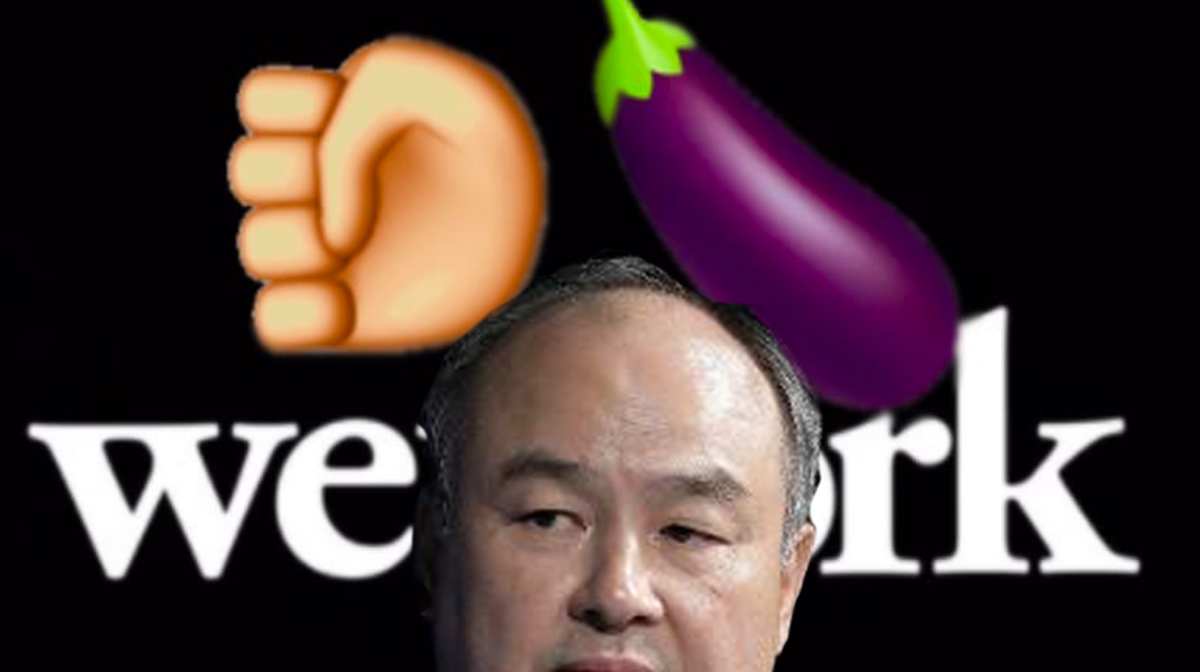
SoftBank is ready to fix WeWork because co-dependent relationships are toxic.
WeWork is a shiny, famous, charismatic startup with terrible personal habits and an uncertain future. SoftBank is the sad finance bro who just knows in his heart he can save her. And like every scenario in which someone too needy hooks up with someone with too much to give, there are no winners, only sadness:
Softbank will take control of embattled company WeWork, according to people familiar with the matter.
Softbank, led by Japanese billionaire Masayoshi Son, plans to spend somewhere between $4 billion and $5 billion on new equity, existing shares, sources say. The deal will value WeWork between $7.5 billion to $8 billion and could be announced as soon as Tuesday.
Those numbers don’t look that bad until you remember that SoftBank has already sunk more than $10 billion into A̶d̶a̶m̶ ̶N̶e̶u̶m̶a̶n̶n̶’̶s̶ ̶f̶a̶m̶i̶l̶y̶ ̶o̶f̶f̶i̶c̶e̶ WeWork, bringing the company’s total investment to likely more than $15 billion…at an optimal valuation of $8 billion. We’re not quants or anything, but it seems to us like that math sucks ass.
And what does Masa Son even do with this thing? Sure, he kind of needs to bail it out at this point but how does the world’s greatest living financial performance artist put Adam Neumann’s co-working Humpty Dumpty back together again? Bring Neumann back to find a new vein of new-age bullshit to peddle in lieu of profits? pivot to platform CRE lending with free cold brew? Start growing weed?
Softbank exec Marcelo Claure will be involved in the company’s management, while former CEO Adam Neumann’s stake will fall to low double digits.
That’s not not a start…
JPMorgan is still expected to make its own offer at a shot to rescue WeWork, but will it really? And also, why?
We’re sure we’ll be talking about this nonsense all week!
After a long day at work, it’s entirely normal for an attorney to head to the local pub to grab a quick drink. But the tequila poppers go too far when you’re dumping client confidences all over the place. That’s what apparently happened in Orlando the other night according to a viral tweet.
if your name is Christy and you’re fighting a custody battle in Orlando. fire your lawyer bc I found your whole case file at the bar last night.
Some of the reaction to this tweet scolds folks for trying to get a lawyer fired for a simple mistake. I’m all for forgiveness, but this is Attorney 101 here. You don’t throw client files around willy-nilly. Losing a laptop does put client confidences at risk — and attorneys should use encryption, or better yet put files in the cloud, to prevent that sort of disclosure — but it happens. But she’s not saying “you lost your bag” or “lost your computer.” When she’s saying a lawyer lost a whole file, she’s talking about a redweld that someone just took into the bar and left behind after 6 rounds of beer pong. There’s no forgiveness for that. Getting canned is the only appropriate punishment.




 Kathryn Rubino is a Senior Editor at Above the Law, and host of