
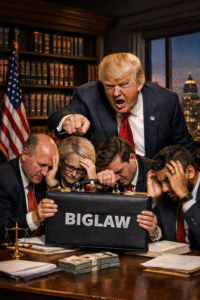
ChatGPT
If
you
thought
the
fight
over
Trump-era
executive
orders
targeting
Biglaw
firms
might
lose
some
of
its
edge
on
appeal,
think
again.
The
four
firms
still
standing
—
Perkins
Coie,
Jenner
&
Block,
WilmerHale,
and
Susman
Godfrey
—
have
now
filed
their
response
briefs
in
the
D.C.
Circuit,
and
they
are
not
exactly
mincing
words.
Susman
Godfrey,
never
one
to
shy
away
from
a
punchy
line,
framed
the
stakes
in
stark
constitutional
terms,
calling
the
executive
order
targeting
the
firm
“a
grave
abuse
of
presidential
power
that
threatens
the
essential
postulates
of
our
constitution
and
the
rule
of
law
itself.”
A
point
that’s
more
than
just
rhetorical
flourish,
it’s
actually
the
throughline
of
all
four
briefs.
Because,
as
Susman
puts
it,
if
this
order
stands,
lawyers
are
no
longer
independent
actors:
“Susman’s
lawyers
would
effectively
be
under
the
thumb
of
the
president,
forced
to
submit
to
his
whims
regardless
of
their
own
sense
of
duty
to
the
constitution,
their
clients,
and
the
rule
of
law.”
And
the
risk
the
orders
spread
is
real,
“Today,
it
is
Susman.
Tomorrow,
it
could
be
any
law
firm
or
lawyer.”
The
Framers,
they
note,
baked
the
First
Amendment
and
due
process
protections
into
the
Constitution
precisely
to
prevent
this
kind
of
strong-arm
governance.
Over
at
Jenner,
the
brief
leans
hard
into
what
should
be
an
uncontroversial
proposition
but
apparently
now
needs
litigating,
that
the
government
does
not
get
to
punish
lawyers
for
who
they
represent.
“Our
Constitution
forbids
the
government
from
retaliating
against
lawyers
based
on
the
clients
they
represent
and
the
people
with
whom
they
associate,”
Jenner
writes,
before
twisting
the
knife:
“The
executive
orders
challenged
here
defy
this
fundamental
precept.”
And
in
case
anyone
in
the
back
row
missed
the
implications,
Jenner
spells
it
out
the
harsh
reality.
If
lawyers
fear
sanctions
for
doing
their
jobs,
they
cannot
effectively
advocate,
which
stunts
clients’
ability
to
vindicate
their
rights.
Which
is
a
system-wide
failure.
The
orders,
Jenner
warns,
“cast
a
chill
over
the
entire
legal
profession.”
Jenner
also
takes
a
not-so-subtle
swipe
at
the
government’s
appellate
strategy:
Faced
with
defending
the
indefensible—and
after
wavering
on
whether
to
maintain
this
appeal
at
all—the
government
has
little
to
say.
On
the
merits,
it
protests
that
the
order
has
nothing
to
do
with
Jenner’s
representations
or
associations,
but
instead
was
prompted
by
unspecific
and
unsubstantiated
allegations
of
hiring
discrimination.
Meanwhile,
Perkins
Coie
—
the
OG
Biglaw
target
—
situates
the
dispute
in
a
broader
landscape
of
fear
and
capitulation.
Nine
firms,
they
note,
folded
under
pressure
and
struck
deals
with
the
administration
rather
than
risk
existential
sanctions.
(A
fact
that
continues
to
hang
over
this
entire
saga
like
a
particularly
judgmental
cloud.)
Nine
law
firms,
cowed
by
the
threat
of
firm-ending
sanctions,
‘settled’
with
the
President.
But
Perkins,
followed
by
Jenner,
WilmerHale,
and
Susman,
sued
to
defend
themselves
and
their
clients.
Four
different
district
judges
recognized
the
President’s
executive
orders
for
what
they
are:
shocking
abuses
of
power
that
trample
the
constitutional
rights
of
the
law
firms
and
their
clients.
This
Court
should
recognize
the
same.
WilmerHale’s
brief,
for
its
part,
zeroes
in
on
what
it
calls
the
order’s
“unabashed”
retaliatory
purpose,
pointing
to
the
laundry
list
of
penalties
imposed
on
the
firm,
from
restricting
access
to
federal
buildings
to
effectively
blacklisting
it
from
government
engagement
and
leaning
on
its
clients
to
walk
away.
Wilmer
doesn’t
sugarcoat
it,
calling
the
EO
a
“direct
assault”
on
the
First
Amendment,
separation
of
powers,
and
the
adversarial
system
itself.
And
that’s
really
where
all
four
briefs
converge,
framing
the
legal
fight
as
something
much
bigger
than
the
individual
firms
and
whether
the
executive
branch
can
weaponize
its
power
to
reward
friendly
lawyers
and
kneecap
the
ones
who
displease
the
administration.
The
question
isn’t
whether
Biglaw
can
survive;
it’s
whether
the
legal
system,
as
we
understand
it,
can.

Kathryn
Rubino
is
a
Senior
Editor
at
Above
the
Law,
host
of The
Jabot
podcast,
and
co-host
of Thinking
Like
A
Lawyer.
AtL
tipsters
are
the
best,
so
please
connect
with
her.
Feel
free
to
email her with
any
tips,
questions,
or
comments
and
follow
her
on
Twitter @Kathryn1 or
Mastodon @[email protected].