Elite Firms Recognized By Working Mother Magazine (2021)

(Image via Getty)

Supporting women and parents in the workplace is obviously a vital element to any diverse workplace. But it is also essential to look beyond the platitudes about diversity and dive into what it is really like at elite law firms. Earlier this week, Working Mother released their annual list of the Best Law Firms For Women.

Every year, Working Mother puts out this list, but with all the garbage that folks had to deal with in 2020 due to the pandemic, they made some changes to their methodology:

[Working Mother’s parent company] Seramount’s 2021 Best Law Firms for Women application includes more than 300 questions about attorney demographics at different levels, schedule flexibility, paid time off and parental leaves, and development and retention of women. This year, in light of COVID-19, several questions were added about the success of working from home for lawyers.

So what do we know about the recognized firms? Well, 40 percent of attorneys at the firms are women, 34 percent of non-equity partners at the firms are women, and 25 percent of equity partners are women. The firms average 13 weeks of paid parental leave and 100 percent of the firms on the list let parents return to work on reduced schedules.

Without further ado, here are this year’s honorees:

Akin Gump Strauss Hauer & Feld
Arnold & Porter Kaye Scholer
Baker McKenzie
Baker, Donelson, Bearman, Caldwell & Berkowitz
Ballard Spahr
Bass, Berry & Sims PLC
Blank Rome
Chapman and Cutler
Constangy, Brooks, Smith & Prophete
Cooley
Crowell & Moring
Davis Wright Tremaine
Day Pitney
DLA Piper LLP (US)
Dorsey & Whitney
Duane Morris
Epstein Becker & Green
Faegre Drinker Biddle & Reath
Fenwick & West
Finnegan, Henderson, Farabow, Garrett & Dunner
Fish & Richardson
Frankfurt Kurnit Klein & Selz
Goodwin Procter
Hanson Bridgett
Holland & Knight
Jackson Lewis
Kirkland & Ellis
Lane Powell PC
Latham & Watkins
Lathrop GPM
Littler
Manatt, Phelps & Phillips
McDermott Will & Emery
Morgan, Lewis & Bockius
Morrison & Foerster
Ogletree, Deakins, Nash, Smoak & Stewart
Orrick, Herrington & Sutcliffe
Paul, Weiss, Rifkind, Wharton & Garrison
Perkins Coie
Pillsbury Winthrop Shaw Pittman
Reed Smith
Ropes & Gray
Sheppard, Mullin, Richter & Hampton
Shook, Hardy & Bacon
Sidley Austin
Skadden, Arps, Slate, Meagher & Flom
Stinson
Taft Law
Wiley
WilmerHale

Congrats to everyone on the list!


Kathryn Rubino is a Senior Editor at Above the Law, and host of The Jabot podcast. AtL tipsters are the best, so please connect with her. Feel free to email her with any tips, questions, or comments and follow her on Twitter (@Kathryn1).

‘Looking For Rationality In An Irrational Market’: Why Are Some Firms Matching The New Salary Scale?

I’m not surprised that firms with less than stellar years are matching, because they think this will vault them into competitiveness. I’m also not surprised that firms with stellar years are matching, because they think they must do so to remain competitive.

Tim Corcoran, a legal compensation consultant, commenting on the summer salary wars that have taken hold across the large law firm landscape, even at firms that are coming off a down year in 2020. “You’re looking for rationality in an irrational market,” he continued. “There’s no shortage of capable associates.”


Staci ZaretskyStaci Zaretsky is a senior editor at Above the Law, where she’s worked since 2011. She’d love to hear from you, so please feel free to email her with any tips, questions, comments, or critiques. You can follow her on Twitter or connect with her on LinkedIn.

Enter your email address to sign up for ATL’s Bonus & Salary Increase Alerts.

LexisNexis Expands Analytics Offerings To Finance

As a litigator, I never had to scour through hundreds of contracts to piece together the proper market language for clause 58(c)(6)(iii)(⏁), but it sounded horrible. Say what you will about trying to divine meaning from 10 years of easily distinguishable opinions, but it beats spending all night doing that. On the other hand, transactional attorneys are way more marketable on the back end so… maybe it would’ve been worth it.

Thankfully, there are a lot of tools out there now that make deal work less an exercise in drudgery. We’ve talked before about how all contract lifecycle products aren’t the same, so there’s no one magic bullet to solve all contract issues, but there’s a combination of tools that can make a remarkably efficient deal process.

And another tool on that market came out today with the announcement of LexisNexis Market Standards — Finance, a new solution for “researching and comparing recent and relevant transactions, finding on-point precedent and clause language, and evaluating specific deal points for more thorough document drafting and more successful negotiations.”

For LexisNexis, it’s the logical extension of the work they’ve been doing the last few years. The company launched its M&A tool back in October. Now the company’s extensive library of data and its analytics capabilities are being brought to the finance space. In a few weeks, the company promises to unveil an Employment solution. The steady march of analytics continues.

The new offering boasts more than 2,200 SEC-filed credit agreements over $50 million and more than 350 bank commitment letters filed since 2017. On that library — which is expanded with new deals every two weeks — Market Standards runs analysis up to 90 deal points within credit agreements and around 70 deal points within commitment letters.

The easy to use filter system allows users to limit to deals based on industry, purpose, size, date, and more. A user can filter it down to deals involving the same agents or borrowers to get a straightforward picture of what’s been agreed to in the past as well.

Per the company’s press release, “Market Standards – Finance is included at no additional charge for Lexis and Lexis+ customers who subscribe to the Corporate or Finance modules within Practical Guidance.” That’s not a shock as the Lexis+ platform has been at the forefront of pushing data-driven practice. Folks can learn more about how to get access to the product here.

It’s another exciting announcement out of LexisNexis. Stay tuned in a few weeks for the unveiling of the Employment product.

Earlier: LexisNexis Context Expands To AI Driven Attorney Insights
Just Calling A Product ‘Artificial Intelligence’ Isn’t Good Enough


HeadshotJoe Patrice is a senior editor at Above the Law and co-host of Thinking Like A Lawyer. Feel free to email any tips, questions, or comments. Follow him on Twitter if you’re interested in law, politics, and a healthy dose of college sports news. Joe also serves as a Managing Director at RPN Executive Search.

Associates At This Biglaw Firm Won’t Be Taking A Bath When It Comes To Compensation

Biglaw firms come in all shapes and sizes, and even the smaller ones are quickly adopting the DPW’s money moves when it comes to associate compensation.

Brown Rudnick — a firm with just over 200 attorneys that brought home $$216,367,000 gross revenue in 2020, landing it at No. 144 in the most recent Am Law 100 ranking — will be paying out salaries on the new Davis Polk scale for associates at all of its U.S. offices. Here’s what that looks like at the firm:

  • 2020: $205,000
  • 2019: $215,000
  • 2018: $240,000
  • 2017: $275,000
  • 2016: $305,000
  • 2015: $330,000
  • 2014: $350,000

As noted in the firm’s memo, summer associates will also share in the firm’s largesse when it comes to their salaries. What exciting news for law students.

Congratulations to everyone at Brown Rudnick!

(Flip to the next page to see the full memo from Brown Rudnick.)

We depend on your tips to stay on top of this stuff. So when your firm matches, please text us (646-820-8477) or email us (subject line: “[Firm Name] Matches”). Please include the memo if available. You can take a photo of the memo and send it via text or email if you don’t want to forward the original PDF or Word file.

And if you’d like to sign up for ATL’s Bonus Alerts (which is the alert list we’ll also use for salary announcements), please scroll down and enter your email address in the box below this post. If you previously signed up for the bonus alerts, you don’t need to do anything. You’ll receive an email notification within minutes of each bonus announcement that we publish.


Staci ZaretskyStaci Zaretsky is a senior editor at Above the Law, where she’s worked since 2011. She’d love to hear from you, so please feel free to email her with any tips, questions, comments, or critiques. You can follow her on Twitter or connect with her on LinkedIn.

Enter your email address to sign up for ATL’s Bonus & Salary Increase Alerts.

Associates Are Kings For A Day With New Raises

At King & Spalding associates have been patiently wait (and counsel still are) for word that the firm would ante up the cash for raises. After all, with over a billion dollars in gross revenue last year ($1,529,418,000 to be exact) and ranking 21st on the Am Law 100, K&S sure seems like the kind of elite firm that will match market compensation.

Well, today the wait ended.

In a firmwide email, Chair Robert D. Hays announced that partner-track associates would be getting raises, and yes, they’re moving to the Davis Polk scale effective July 1:

You can read the full memo on the next page.

And remember, we depend on your tips to stay on top of this stuff. So when your firm matches, please text us (646-820-8477) or email us (subject line: “[Firm Name] Raises”). Please include the memo if available. You can take a photo of the memo and send it via text or email if you don’t want to forward the original PDF or Word file.

And if you’d like to sign up for ATL’s Bonus Alerts (which is the alert list we’ll also use for salary announcements), please scroll down and enter your email address in the box below this post. If you previously signed up for the bonus alerts, you don’t need to do anything. You’ll receive an email notification within minutes of each bonus announcement that we publish.


Kathryn Rubino is a Senior Editor at Above the Law, and host of The Jabot podcast. AtL tipsters are the best, so please connect with her. Feel free to email her with any tips, questions, or comments and follow her on Twitter (@Kathryn1).

Enter your email address to sign up for ATL’s Bonus & Salary Increase Alerts.

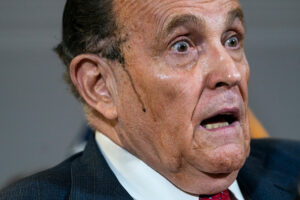
BREAKING: NY Bar Suspends Rudy Giuliani From Practicing Law For Spreading Election Disinformation

(Photo by Drew Angerer/Getty Images)

The New York Attorney Grievance Commission does not play. It just suspended Rudy Giuliani from practicing law citing “uncontroverted evidence that respondent communicated demonstrably false and misleading statements to courts, lawmakers and the public at large in his capacity as lawyer for former President Donald J. Trump and the Trump campaign in connection with Trump’s failed effort at reelection in 2020.”

The AGC didn’t even hold a hearing first. They just listed a pile of his lies, including to a federal judge in Pennsylvania, said he was bringing the profession into disrepute and using his authority as a member of the bar to mislead the public, and kicked him to the curb. Sorry, Grandpa, no more driving for you. Take it up with the DMV!

In a per curiam holding, a five justice panel of the Appellate Division detailed “uncontroverted evidence of professional misconduct,” including Giuliani’s numerous false public statements and erroneous claims about voter fraud, despite the fact that the fraud allegations had been excised from the complaint, during that disastrous Pennsylvania hearing in front of U.S. District Judge Matthew Brann.

The AGC cited multiple bizarre falsehoods, including Rudy’s oft-repeated canard about Joe Frazier continuing to vote in Pennsylvania, despite having died in November of 2011 and being removed from the polls three months later. As proof that he had not knowingly lied, Rudy drew the AGC’s attention to a rando blog post from 2019. Which, even if it were a reliable source of information — and it wasn’t — could not have been a source for Rudy’s allegation that the deceased boxer voted in 2020.

In fact, the president’s lawyer appears to have shown the same due diligence in defending his license to practice law as he did in flogging those bogus election claims, relying heavily on affidavits and confidential sources not supplied to the presiding justices to prove that he didn’t actually lie.

In opposition to this motion, respondent refers to affidavits he has not provided. He also relies on a “confidential informant”. We do not understand, nor does respondent explain why, as a private attorney seemingly unconnected to law enforcement he would have access to a “confidential informant” that we cannot also have access to. At yet another point respondent claims he relies on a Trump attorney who chooses not to be identified. Respondent also refers to hundreds of witnesses, experts, and investigative reports, none of which have been provided or identified and an Excel spreadsheet, also not provided, purportedly listing the names of thousands of deceased voters who allegedly cast ballots in Michigan. [Citations omitted.]

Rudy’s secret Excel spreadsheet is so hot you wouldn’t believe it. But you don’t know her, she goes to another school. In Canada.

“Respondent cannot create a controverted issue of misconduct based upon what he does not submit to this Court,” the Justices responded drily, adding, “Nor will offers to provide information at a later time, or only if the Court requests it, suffice.”

They also point out that Giuliani cannot claim to have a valid belief in his own bullshit numbers when those numbers vary from hour to hour. In December, he claimed without evidence that 6,000 dead people had voted; by January that number had grown to 10,515, of whom 800 allegedly cast their zombie ballots in Georgia. Only two such fraudulent ballots were ever substantiated.

On December 17, he claimed that upwards of 10,000 undocumented immigrants voted illegally in Arizona. A week later he had revised his estimates upward, saying on his podcast “the bare minimum is 40 or 50,000, the reality is probably about 250,000.” By January, he was claiming 32,000.

When asked for evidence to support these wildly divergent claims, Giuliani claimed to have read “newspaper and records,” as well as information from Arizona State Senator Kelly Townsend. Naturally, no “newspaper and records” or affidavit from the Senator were ever provided.

Citing the “risk that respondent will continue to engage in future misconduct while this disciplinary proceeding is pending,” and his continued peddling of election lies even after the complaint was filled, the AGC opted to immediately suspend Giuliani’s license to practice.

The hallmark of our democracy is predicated on free and fair elections. False statements intended to foment a loss of confidence in our elections and resulting loss of confidence in government generally damage the proper functioning of a free society. When those false statements are made by an attorney, it also erodes the public’s confidence in the integrity of attorneys admitted to our bar and damages the profession’s role as a crucial source of reliable information. It tarnishes the reputation of the entire legal profession and its mandate to act as a trusted and essential part of the machinery of justice. [Citations omitted.]

Just last week the DC Bar stuck its fingers in its ears and refused to even docket a complaint against Bill Barr lest they be accused of meddling in politics. But in New York?

Fuhgeddaboudit.


Elizabeth Dye lives in Baltimore where she writes about law and politics.

Biglaw Lawyer Bills 2000+ Hours To Closed Matter… Disciplinary Committee Displeased

Padding hours is bad. No one is arguing that. But there are always gray areas where a 10-minute phone call can be rounded up or down. Or where a substantive epiphany hits during a commute. The point is there’s some acceptable leeway in the billing process and we rely on attorneys as professionals to ethically navigate those questionable waters.

That said, wherever that line is, billing over 2000 hours to a non-existent case would be over it.

The Illinois Attorney Registration and Disciplinary Commission[1]
published its complaint against John Paul Paleczny, formerly of Lewis Brisbois. Lewis Brisbois has since fired Paleczny for the reasons detailed in the complaint, yet for some reason still has his bio up on their website (here’s the screenshot if and when the firm gets around to deleting it). That seems like a substantial oversight! And yet, the further we dig into the details, this will seem entirely predictable.

It all began with a pro bono matter representing an inmate in a civil rights suit. After the judge dismissed the inmate’s claims, the partner on the matter wrote the plaintiff informing him that the firm’s representation had ended.

This was January 3, 2020.

At that point, well…

13. Between January 3, 2020 and December 23, 2020, Respondent recorded 2,061.4 hours to the Robinson matter, even though the matter had been closed and LBBS’s representation of Robinson had ended. Respondent knew by at least January 21, 2020, the lapse of the 28-day period to appeal, that the firm would not be appealing the adverse ruling on behalf of Mr. Robinson. In records created to account for the time he purportedly spent on the matter in 2020, Respondent described the work he did as drafting, editing, and amending a motion for summary judgment. For each day that Respondent claimed that he worked on the Robinson matter, he entered a description of his purported legal services and the time that he claimed he spent, with each entry specific to the tenth of an hour. Any time that Respondent spent on the summary judgment motion prior to January 21, 2020 served no purpose because the case had been dismissed and no appeal had been filed. All of the entries for January 21, 2020 and later were false because Respondent had not worked on the Robinson matter since at least January 21, 2020. Respondent knew each time he recorded time to the Robinson matter between January 21, 2020 and December 23, 2020 that his time entry was false.

That’s 2061.4 hours. For some reason, the point-4 is the funniest part to me.

Obviously the attorney is going to get the lion’s share of the blame here, but can we take a second to wonder what the hell the firm was doing this whole time? They were getting his timesheets, which for a year continued to show time entries in which he “described the work he did as drafting, editing, and amending a motion for summary judgment” even though the firm had ended the representation. Is there a billing department? Is there a partner reviewing non-billed time? Who was supervising this? Is there an assignments committee keeping track of what associates are doing? How did this go on for more than a month, let alone a year.

Scratch that, more than a year. Because for the first five and a half weeks of 2021, he recorded 245.80 hours to the summary judgment motion. That means he was on track for a 2000-hour year in 2021 too. Putting aside that the matter was closed, what kind of summary judgment motion did the firm think he was drafting for over a year?

While dishonest, at least billing time to a pro bono matter isn’t defrauding any clients. Though it would have a tangible impact if the firm keys its bonuses to hours billed.

Guess what Lewis Brisbois does?!

14. In 2020, LBBS awarded quarterly bonuses to associates who met an annual “billable hours” requirement. For each quarter in 2020, Respondent falsely billed enough hours to the Robinson matter to demonstrate that he would achieve the annual billable hours requirement. Based on these false representations, LBBS paid Respondent a bonus each quarter totaling $12,000 for the year.

Associates who haven’t had their passion for helping the downtrodden systematically crushed by the firm yet always complain when firms cap the amount of hours that count toward bonuses at 100 or 200. It is a wretched policy that penalizes attorneys trying to fulfill their professional obligations. But this right here is why we can’t have nice things.

In one last instance of truly astounding grit and determination, the complaint says that two partners and an administrator confronted him over the status of the case in February and he went ahead and told them he’d been working on the summary judgment motion. That’s epic levels of chutzpah.

Lest this story get better for the attorney:

21. After Respondent’s termination from LBBS, he began to seek other employment. Respondent interviewed with at least four Chicago law firms. In the course of the interview process, each of those law firms asked Respondent about the circumstances surrounding his departure from LBBS. Each time, Respondent told the law firm with which he was interviewing that LBBS had laid him off because LBBS did not have enough work to support his continued employment.

22. Respondent’s statements to the law firms that he interviewed with were false because Respondent had not been laid off because LBBS had insufficient work to support his continued employment. Rather, Respondent had been terminated on February 11, 2021 by LBBS for the misconduct described in Count I, above.

In his defense, it’s a deceit that would be pretty easy to pull off when the old firm still hasn’t removed his profile. Frankly, he was being generous by admitting that he’d left Lewis Brisbois at all — he could’ve plausibly presented himself as still working there and linked to his bio and no one would’ve been the wiser.

In any event, this is a truly remarkable fact pattern, and one that should encourage Lewis Brisbois to do some serious rethinking of its protocols. Because it’s hard to deal with dishonesty, but dishonesty on the level of these allegations should be impossible to slip past the goalie.


[1] Do we have to put in a parenthetical before we start calling it IARDC? Wait, SCOTUS has even stopped doing that? Amazing!

HeadshotJoe Patrice is a senior editor at Above the Law and co-host of Thinking Like A Lawyer. Feel free to email any tips, questions, or comments. Follow him on Twitter if you’re interested in law, politics, and a healthy dose of college sports news. Joe also serves as a Managing Director at RPN Executive Search.


Britney Spears Conservatorship Update

Britney Spears (Photo by Jason Merritt/Getty)

Watching Britney Spears’s conservatorship begin, evolve, and explode before all of our eyes is not only shocking and upsetting, but also very strange.  Conservatorships, also known as guardianships in some jurisdictions, are a rather niche area of law, often found within a trusts and estates, elder law, or family law practice. Certainly it is not widely reported in legal reports or law journals, and when it is, the subject identities are removed, and the cases sealed. Determining whether an individual requires a conservator is fact-specific. Each person is different, and the range of individuals who require a guardian of the person, property, or both is wide, including the elderly, the young, the rich, the poor, and individuals of all races and religions.

To watch superstar Britney Spears’s conservatorship publicly unfold, for more than a decade, is a unique experience. It is a peek into a courtroom that most people will otherwise never see. Unlike a personal injury case or a murder trial, in conservatorships the public does not hear the testimony or see the entirety of the evidence. We are not shown confidential medical reports or sensitive psychological notes. Simply put, we do not know the reasons why Spears has a conservatorship or why it is has subsisted for so long.

When documents or information are revealed, as they were yesterday when Spears gave a statement to the Los Angeles Superior Court, we got a small  snippet of a complicated and sensitive story. All news outlets are reporting Spears’s emotional testimony and giving her words an audience that she has feels she does not have under the conservatorship. We are all obliged, as media consumers, to hear Spears. For those who are fans, we want to hear more and retweet and repost all that we learn, which is not the whole picture. We must also, however, understand that we have not been privy to 13 years of records, statements, and testimony. And we should not be permitted to see the confidential and medical details about her matter, yet we have been given a  glimmer of what is going on. We are now angry or upset, and most certainly interested. We want more.

Spears’s case is a paradox. On the one hand, the media has zoomed in on the matter, and given her a voice that based on her statement yesterday, she has felt she does not have. The media has also highlighted her fans, from the #freebritney movement, who have supported her and brought their concerns to the forefront on Facebook, Instagram, and various podcasts. On the contrary, the media has also accentuated a very private situation, reporting (but not the whole story because they cannot) on a matter whose totality is unknown to the public, and whose privacy should remain protected. Moreover, any time Spears makes a misstep, it is reported or shared, which frames our opinions about her life. Perhaps it is the media reports and paparazzi pictures that have been used as evidence that she needs a conservator. We do not know.

The public may forget, or not know, that a conservatorship proceeding is a legal proceeding, a trial or a hearing, that is adversarial in nature, with attorneys arguing for and against a conservatorship. To obtain a conservator, there is evidence, testimony, and experts who present testimony and evidence. A judge rules, or sometimes there is even a jury. A personal needs and/or property guardian may be appointed and then the court supervises thereafter and makes changes, adjustments, or removals on application.

I do not know whether Spears needs a conservator. In this case, it would seem that a most urgent issue is if she does require a conservator, who should it be and what powers should they hold. There are instances when an individual only needs a personal needs conservator or only a financial conservator. Arrangements can be tailored to limit powers. As is the case in all conservatorships, there needs to be a working relationship between the individual and the conservator. This seems to be lacking in the instant case.

Spears is perhaps one of the most famous individuals of all time. We cannot think that her matter will not be reported or get attention. But unlike other famous litigants such as O.J. Simpson or Phil Spector, whose cases were broadcast around the world, in this case, Spears  is not on trial for something she allegedly did wrong. Spears is innocent here and based on her wrenching testimony as to her dissatisfaction, it is she who is a victim. The question that remains,  is who is the perpetrator: an individual, the media, the legal system, or society at large.


Cori A. Robinson is a solo practitioner having founded Cori A. Robinson PLLC, a New York and New Jersey law firm, in 2017. For more than a decade Cori has focused her law practice on trusts and estates and elder law including estate and Medicaid planning, probate and administration, estate litigation, and guardianships. She can be reached at cori@robinsonestatelaw.com.

The 2021 ATL Top 50 Law School Rankings Are Finally Here

We now present the ninth (!) annual ATL Top 50 Law School Rankings.

As always, our methodology is based purely on outcomes, especially on the schools’ success in placing their graduates into quality jobs as lawyers. In addition to focusing exclusively on such outcomes, ours are the only rankings to incorporate the latest ABA employment data concerning the Class of 2020.

This year, for the first time, we’re requiring readers to cough up an email address to access the full list. (Sorry for the inconvenience, but at least it’s not a paywall.) However, here is a preview of our 2021 Top Ten. Can you spot the surprising tie?

      1. U Chicago
      1. U Virginia
      1. Duke
      1. Cornell
      1. U Michigan
      1. Yale
      1. U Penn (Carey)
      1. Stanford
      1. Washington University in St. Louis
      1. Harvard

    If you have questions, complaints, or feedback, please reach out to research@abovethelaw.com.

Scripps Health hit by 4 class-action lawsuits on heels of ransomware attack – MedCity News

Following a ransomware attack that disrupted its IT systems for nearly a month, Scripps Health is now facing four class-action lawsuits from patients for allegedly failing to protect their personal health information.

In early May, the San Diego-based health system experienced a cybersecurity incident, which it later confirmed was a ransomware attack. In response, the health system took several of its systems offline and blocked user access to certain IT applications, including its website and the MyScripps patient portal.

Scripps Health later notified an estimated 147,267 patients that their data was stolen by hackers in the attack, Modern Healthcare reported. The stolen data included both health and financial information.

The four class-action lawsuits, filed over the course of the month, claim that Scripps Health did not adequately protect their information. The health system declined to comment as it is “ongoing litigation,” said Janice Collins, Scripps’ senior director of public relations, social media, content marketing, in an email.

The first suit specifically claims that the health system “negligently created, maintained, preserved, and stored Plaintiffs’ and the Class members’ confidential, individual[ly] identifiable medical information in a non-encrypted form.”

The exposure of the data has resulted in injury to the patients, another lawsuit states. This includes the lost or diminished value of their personal health information, out-of-pocket expenses associated with the prevention, detection and recovery from identity theft, tax fraud and/or unauthorized use of the information, and lost opportunity costs, including but not limited to lost time.

Further, the exposed personal health information of the plaintiffs could be sold on the dark web, which opens them up to a “lifetime risk of identity theft,” according to one of the lawsuits.

The health system has done very little to protect plaintiffs and the class members, providing only 12 months of identity theft and credit monitoring protection to a select few victims, alleges another one of the suits.

“In effect, Defendant is shirking its responsibility for the harm and increased risk of harm it has caused Plaintiff and members of the Class, including the distress and financial burdens the Data Breach has placed upon the shoulders of the… victims,” it states.

In three of the lawsuits, plaintiffs want the court to award $1,000 per violation to the plaintiffs individually and to each member of the class. This could result in the health system paying out about $150 million if all those who received data breach notices are included in the class.

The fourth lawsuit asks that the court require Scripps Health to engage independent third-party security auditors and internal personnel to run automated security monitoring and to segment data by creating firewalls and access controls, among other actions.

Plaintiffs in all four suits are demanding a jury trial.

Photo: anyaberkut, Getty Images