Paul Singer Swears He’s Definitely Not Thinking About Deposing Jack Dorsey With These 3.5 Million New Shares He Just Bought

About 15 months ago, Paul Singer wanted Jack Dorsey’s head on a plate, wherever in the world it was. Since agreeing to hold off the decapitation for at least the time being, in exchange for two seats on the board and a $2 billion share buyback, Dorsey—who Singer wanted canned in favor of a full-time CEO—has started a bank and brought more unwanted attention onto himself and the company, and Twitter—and with it, its share price—has continued to struggle.

Morning Docket: 05.05.21

Jeff Bezos (Photo by David McNew/Getty Images)

* Attorneys in the Gates divorce also worked on the Bezos split-up. Maybe Gates read a good online review of the lawyer written by Bezos… [CNN]

* A Kevin Spacey accuser must reveal his name in order for his lawsuit to proceed. [Huff Post]

* The military promotion of the South Dakota Attorney General has been blocked because of his involvement in a deadly car collision last year. [ABC News]

* Coca-Cola is pausing its plan to incentivize the use of diverse attorneys after the general counsel that spearheaded the effort resigned. [New York Post]

* Check out this interesting article about which judges get their opinions affirmed or overturned the most at the Supreme Court. [Juris Lab]


Jordan Rothman is a partner of The Rothman Law Firm, a full-service New York and New Jersey law firm. He is also the founder of Student Debt Diaries, a website discussing how he paid off his student loans. You can reach Jordan through email at jordan@rothmanlawyer.com.

Florida’s Terrible Idea — See Also

(Photo by Olga Thompson/Walt Disney World Resort via Getty Images)

It’s Like DeSantis Is Trying To Kill The Florida Tourism Industry: Oh, and people.

Lowenstein Slow Plays Going Back To The Office: Associates should be pleased.

OANN Tries To Bait Law Professor: Thankfully he resists.

More Trouble For Florida Coastal Law School: Because of course.

Gamers Let Their Feelings Be Known: By disrupting court proceedings.

Anti-Counterfeit Tag Team #2

(Image via Getty)

A few months ago, I wrote about an interesting anti-counterfeiting collaboration between Amazon and Ferragamo, aimed at stopping sales of fake Ferragamo belts on the world’s largest retail online platform. Calling that joint effort “turbocharged,” my column pointed out how dealing with counterfeit activity was no longer the sole responsibility of the brand owner, but nowadays also includes the “major online retail platforms like Amazon.” We can now expand the list of motivated anti-counterfeiters to include leading social media sites like Facebook and its daughter company Instagram, as they have given us yet another example of luxury brand-online platform legal collaboration to discuss.

In news last week that was picked up by a wide swath of media outlets — with each servicing a varied readership from finance and fashion — a joint anti-counterfeiting effort was announced involving Facebook and Italian-luxury goods stalwart Gucci. Modeled at least in part on the Amazon-Ferragamo approach, Facebook and Gucci jointly filed a lawsuit in California against a serial Russia-based counterfeiter, who had been circumventing both Facebook and Instagram’s technological barriers by continuously opening accounts driving social media users on those platforms to websites selling counterfeit Gucci products. Importantly, it was announced that actually filing a joint lawsuit was a first-of-its-kind step for both Gucci and Facebook, even as the lawsuit built on each company’s robust efforts to stop counterfeiting activity online.

For a company like Gucci, of course, public adoption of a multistrategy anti-counterfeiting approach is a must, if only to protect the company’s brand equity as a luxury purveyor. To that end, Gucci took pains in conjunction with the announcement of the joint lawsuit with Facebook to demonstrate just how robust its anti-counterfeiting efforts are. As reported by CNBC “in 2020 alone the actions of Gucci’s in-house intellectual property team had resulted in four million on-line counterfeit product listings being taken down, the seizure of 4.1 million counterfeit products, and 45,000 websites, including social media accounts, being disabled.” While those impressive numbers are a testament to Gucci’s dogged determination in protecting its brand and customers online, those very same numbers also illustrate just how big a problem online counterfeiting activity already is. Take the counterfeiter that is the target of Gucci’s joining filing; even based in Russia, she was able to target consumers worldwide via Facebook and Instagram. That reach highlights that the threat to luxury brands from online counterfeits exceeds that of traditional counterfeit bastions like Chinatown’s leather goods-purveying storefronts.

Because the threat posed by online counterfeiting is a more robust one for brand owners to deal with, securing the cooperation of the online platforms on which the counterfeiting activity takes place is a must. At the same time, dealing with counterfeits on different platforms requires different approaches, tailored to the activity found on a particular platform. On Amazon, for example, that may mean looking for new listings advertising counterfeit goods for sale. In contrast, because Facebook and Instagram are not really used for direct purchases — especially from strangers — the challenge for brand owners is to distinguish between innocent (and welcome) showcasing of products by consumers to their followers from more nefarious activity, such as trying to direct unsuspecting users to purchase counterfeits from shady websites. Put another way, a brand like Gucci wants a legitimate customer to show off their new pair of loafers or their handbag to prospectively jealous — and thus likely to purchase Gucci themselves — family and former classmates. But Gucci doesn’t want those same viewers to buy counterfeits of what the customer is showcasing off buy-gucci-online.ru or some other unauthorized website linked in a posting.

There is a fair question we can ask about Facebook-Gucci adopting the anti-counterfeiting tag team approach first espoused by Amazon-Ferragamo. Namely, what does shutting down one counterfeiter — no matter how prolific or evasive — really accomplish? The easy answer of course is that there is great benefit to making an example out of someone, especially when you are trying to deter others from being attracted to criminal activity. But the benefit of the joint effort, even if directed against a single target, goes deeper. First, acting jointly increases the media attention on the maneuver, if only by encouraging a broad group of outlets to position the story for their respective readers. Second, joint action sends a clear message to counterfeiters that there is no space between the online platforms and brand owners when it comes to shutting down counterfeit activity. Which helps force counterfeiters off the legitimate internet toward the nefarious Dark Web, a place where enlightened and responsible people do not dare to venture. Thereby reducing the reach of the counterfeiters, at a minimum.

Ultimately, both the online platforms — whether they are e-commerce or social media-oriented doesn’t really matter — and brand owners like Gucci benefit from taking high-profile steps like filing federal lawsuits against counterfeiters. Joint actions of this sort send the message that counterfeiting on online platforms will not be tolerated — and that there are two sets of motivated eyes on any counterfeit activity currently being attempted. Moreover, whenever a legal collaboration is announced involving two well-known companies, the public is reminded just how broad a reach counterfeiting activity has, as well as why it must be stopped to the extent possible. So we can expect to see more anti-counterfeit tag teams being formed going forward.

Please feel free to send comments or questions to me at gkroub@kskiplaw.com or via Twitter: @gkroub. Any topic suggestions or thoughts are most welcome.


Gaston Kroub lives in Brooklyn and is a founding partner of Kroub, Silbersher & Kolmykov PLLC, an intellectual property litigation boutique, and Markman Advisors LLC, a leading consultancy on patent issues for the investment community. Gaston’s practice focuses on intellectual property litigation and related counseling, with a strong focus on patent matters. You can reach him at gkroub@kskiplaw.com or follow him on Twitter: @gkroub.

Prohibiting Harmless Consensual Or Self-Regarding Acts By Adults Is Bad Law And Policy

In 2019, in one of this country’s largest cities an amazing (but unintended) social experiment took place that should demand more of our attention. It began with the firing of New York City police officer Daniel Pantaleo. If you recall, Pantaleo was fired after an internal disciplinary hearing for killing Eric Garner by choking him to death. In response to the firing, the head of the police union asked for officers to engage in what can only be described as a work slowdown. The likely intent of the slowdown was to demonstrate that if cops were not out aggressively patrolling the streets, crime would rise, and life would become intolerable. You hear this “thin blue line” rhetoric often from police apologists who portray cops as the slim barrier preventing society from plunging into absolute chaos.

But here is the remarkable thing, although cops stopped doing their jobs in 2019 and arrests plummeted, crime, including violent crime, also plummeted. What’s even more remarkable is that this was not the first time something like this happened. As Scott Shackford explained in Reason:

Back in December 2014, after two officers were killed in the line of duty — and after outrage by citizens boiled over again after a grand jury declined to indict Pantaleo — NYPD officers slowed down arrests. Petty crime enforcement came to a near standstill.

A study years later analyzing that slowdown in 2014–2015 found that major crime [complaints] actually dropped in the Big Apple during that time frame[.]

These results should overturn many of the dogmas associated with the “thin blue line” narrative. It should also call into question the degree to which law enforcement is involved in the everyday lives of Americans. Yet, despite the abundance of evidence that overcriminalization is unnecessary and destructive, local, state, and federal governments just can’t seem to let go.

For example, sticking with New York City, Manhattan District Attorney Cy Vance recently announced that his office would no longer prosecute sex workers but will continue to prosecute their customers. This strategy is often referred to as the “Nordic Model,” and its proponents argue it is the only sensible path to target the demand that fuels prostitution while not criminalizing sex workers who are wrongly being treated as criminals. But if treating sex workers as criminals is wrong why is criminalizing their customers still desirable?

Of course, no serious person is arguing that underage sex work should be permitted or that forcing individuals to perform sex work should be legalized. But I have not seen anyone offer a legitimate reason for why two adults cannot agree to perform a consensual sexual act for money that does not harm anyone. Or what benefit is derived by society in criminalizing sex acts made in such commercial contexts. Meanwhile, legalizing sex work brings undeniable benefits as it gets rid of unregulated black markets, allowing for greater transparency and regulation of harms where they exist.

But even if the act is personally harmful but does not harm anyone else (otherwise known as a self-regarding act) there stands little reason for state intervention. In fact, state intervention can result in more harm than the self-regarding act being prohibited. But try telling that to Joe Biden. Last week, President Biden announced his administration was planning to propose a ban on menthol cigarettes. The move is meant to correct the injustice of decades of aggressive marketing of menthol cigarettes to Black people.

Although any sane person can agree that the aggressive marketing of a harmful product presents moral objections, criminalizing the product, particularly a drug product, presents serious hazards. Think about it this way, the reason Pantaleo came into contact with Garner was over selling loose cigarettes. Do we really want to create more reasons for such confrontations? Biden does, and that’s a tragedy.


Tyler Broker’s work has been published in the Gonzaga Law Review, the Albany Law Review, and the University of Memphis Law Review. Feel free to email him or follow him on Twitter to discuss his column.

How To Talk To Asian Americans* Right Now

“I support you guys, and I really feel for you.”

I heard these words last Wednesday at my neighborhood pub in Atlanta, where I was meeting a friend for a socially distant late drink to celebrate his 40th birthday. The day before, just a few miles away, eight people had been killed, six of whom were Asian women.

These were the words that a man sitting at the bar had spoken, determining from the exposed portion of our faces he could see (our eyes). He paid for our round and, before leaving, the next one.

I expected to feel patronized. I thought I would feel a little embarrassed. Instead, I was surprised to find I felt deeply grateful, even relieved.

The Atlanta mass killings reminded me of all of the dangerous people around us that are affected by systemic anti-Asian bias. It’s a reality to which we, Asian Americans, often meet with willful blindness. And maybe I wasn’t rational after this one incident to feel as though my city had become a more dangerous place overnight. But, in a similarly irrational way, this man’s words and gesture made me feel … safer.

This operated almost at an evolutionary level. Regardless of whether the tragic events were truly “racially motivated” to meet the legal definition of a hate crime, the brutal killing of vulnerable Asian American women at the impulse of a white male pierced the veil of my own invulnerability. A simple act of connectedness, on the other hand, immediately improved my view significantly.

Over the past week, I’ve seen many messages of affirmation and encouragement, both to me personally and telegraphed over social. Some of them evoked safety, like the story above; others did not, and to some I found myself bristling against what I knew fit in the hotly debated category of virtue signaling. What was the difference? Was this subject to the whim of my mood in that moment? Were there other contributing factors, like the history of my relationship with each supposed well-wisher?

I am far from an expert on this topic. I am not an organizational scientist, a behavioral health guru, or a diversity consultant. But I have some thoughts on the topic, based on my experience, listed in no particular order. I hope you find them helpful as you try to approach your Asian American colleagues, friends or the community at large.

  1. Test your motives. If you are trying to approach someone or assemble a public statement, perhaps on behalf of an organization, understand why you are trying to do this. This is perhaps the first litmus test of whether you are about to demonstrate authentic solidarity or engage in virtue signaling. What has spurred you to do anything at all, instead of doing nothing?
  2. Begin with empathy, then get to compassion. Without doing the real hard work of empathy, you cannot assume you know how someone else is feeling. In fact, consider deleting the phrase “I know how you feel” from your lexicon. Asian Americans, in particular, struggle with putting vocabulary or form to our experience. But more importantly, empathy is the foundation for emotional intelligence, and prioritizing someone else’s perspective helps mitigate the risk of the image management commonly associated with virtue signaling. Let empathy connect to compassion, the recognition of suffering in another person with a motivation to help. (Interestingly, empathy by itself can actually be manipulated and could lead to bad outcomes.)
  3. Remember that intersectionality creates high complexity. The tragic killings in Atlanta trigger a special set of responses from Asian American women (I found this response particularly mind-opening), and yet another specific response for first-generation immigrant Asian American women. I cannot tell you what they are, although I can point you to others who have, but I understand that intersectionality is at work. The complexity of intersectionality cannot be neatly addressed by citing a generic condemnation of racially related violence.
  4. Express a desire to learn more. This is most easily explained by considering the opposite — imagine starting your conversation with an Asian American with “yet another reason why we need gun reform” or “it’s basic that racism is so dumb, why doesn’t everyone just get it.” They may not be completely unsound opinions, but the tone quickly begins to resemble virtue signaling. The statements extol the speaker’s command of policy or supposed solution to the problem, instead of an acknowledgement that this is not a problem that is waiting to be outsmarted and expressing intellectual humility about what is an extremely complicated issue.
  5. Embrace awkwardness, if you feel it. Along with confessing a level of ignorance (see #4), awkwardness may serve to be disarming, especially because this is super awkward for us too. (Writing this post is extremely awkward for me right now!) Leading with awkwardness communicates the dilemma of good intent and “the right thing to say.” And awkwardly forcing yourself to adopt hackneyed but authentic statements like “I will do everything within my knowledge to help you” or “if you ever want to talk, I am always available” is a lot better than nothing.
  6. Speaking of that, something is not always better than nothing, but nothing will always be bad. Some people defend virtue signaling with a “something is better than nothing” theory of contribution. The truth is, both virtue signaling and silence can send highly unsupportive messages. It may take some courage and a little effort, but it is not too much to ask for you to find a way to express support AND to do it right.
  7. Finally, the upside of genuine empathy is high. Expressing heartfelt support, offering to help, and genuinely committing to learn more are data points that reinforce a pattern of safety to counteract the narrative of danger that looms large at times like these. Opting out and choosing to wait for things to blow over is always an option, but it guarantees a missed opportunity to help someone.

Many Asian Americans struggle with vulnerability, especially in professional settings. But in the face of these killings and the documented spike in racially motivated violence against AAPIs, the thing that exacerbates that vulnerability is the isolation of conspicuous silence or the frustration of cheap virtue signaling. Combatting that vulnerability means showing up in the places and hours that fill our days with a genuine, sometimes awkward, expressed desire to walk alongside us with safety and reassurance. Each of you — and each of the organizations you may speak for — has an opportunity to convey genuine connectedness and compassion in an hour of real need.

*I have used the term “Asian American” here. APA, AAPI, and a host of other terms are also being used — the intersectionality, as noted above, is considerable. For instance, on one hand, Pacific Islanders are racially similar and confront much of the same systemic racist adversity as Asian American immigrants and their descendants; there is a basis for solidarity in that experience. On the other hand, Pacific Islanders have a rich indigenous history in the United States and wrestle with different issues from their community position. As seen in Latinx and Black communities, pan-Asian terminology can result in reductive grouping.


Ed Sohn is SVP, Head of Solutions at Factor. After more than five years as a Biglaw litigation associate, Ed spent two years in New Delhi, India, overseeing and innovating legal process outsourcing services in litigation. You can contact Ed about ediscovery, legal managed services, expat living in India, theology, chess, ST:TNG, or the Chicago Bulls at via Twitter (@edsohn80).

NRA Plan To Bankruptcy Its Way Out Of New York Backfires Bigly

Wayne LaPierre is a crap shot. The NRA CEO’s lousy aim is the second worst kept secret at the gun charity — the first is the alleged rampant self-dealing — and his latest effort to use the bankruptcy court in Dallas to parachute the organization out of New York appears to have missed the mark spectacularly.

LaPierre has made no bones about the ploy, writing on the NRA’s website that that the charity is in its “strongest financial condition in years” and is only filing for bankruptcy to escape “the unhinged and political attack against the NRA by the New York Attorney General.”

But he was probably not banking on having to testify publicly about the details of his plan. To wit, that he’d executed it without approval or knowledge of the board members, who only found out after the fact that LaPierre secretly established Sea Girt LLC as a beachhead in Texas from which to declare Chapter 11. Or that he’d moved $5 million to finance the maneuver to an attorney’s escrow account, the better to disburse it without oversight.

Or that LaPierre’s authority to do all of that rests on a provision inserted in his latest employment contract granting him “corporate authority” to “reorganize or restructure the affairs of the Association.” Wichita judge Phil Journey, himself an NRA board member, referred to the maneuver as a “fraud perpetrated on the court,” a description echoed by attorney Gerrit Pronske, representing the NYAG.

“There is no question that the NRA board was tricked into attempting to delegate authority to file bankruptcy, and that’s not just fraud on the board, that’s a fraud on this court,” he said.

And LaPierre was certainly not banking on the Justice Department popping into the case to tell Judge Harlin D. Hale that he ought to reject the NRA’s bankruptcy petition and dismiss the case.

Assistant U.S. Trustee Lisa Lambert appeared yesterday to remind the court of several bookkeeping oopsies at the gun charity — from LaPierre’s secretary using $40,000 of NRA money to pay for her son’s wedding (what’s the big deal, she gave the money back!), to the $13.5 million for Wayne LaPierre’s private travel consultant between 2014 and 2020, to LaPierre’s testimony that he had no idea the association’s former treasurer was given a $360,000/year “consulting contract” after leaving under a cloud.

Safe to say Lambert isn’t buying NRA lawyer Greg Garman’s promise that the charity turned the corner in 2019 and will go forth and sin no more. Ditto for Garman’s assertion that the bankruptcy is a heroic act, something “very, very hard” and “very, very brave.” in filing for bankruptcy.

And the feeling is mutual!

“I’m disappointed that I hear for the first time in closing arguments that the United States Trustee has now taken a position for which I’m expected to respond in real time, but that is what it is,” Garman grumbled yesterday. “Your honor, we have natural enemies. This Department of Justice may not see eye to eye with the National Rifle Association, but so be it, we have done the right thing.”

This came at the end of a trial in which Garman insinuated that judges in New York could not be trusted to impartially adjudicate the “politically motivated” suit brought by NYAG Letitia James. So … points for consistency?

Arguments wrapped yesterday, and Judge Hale promised to issue a written opinion next week. It’s a stressful time for LaPierre, who won’t even be able to blow off steam on a vendor’s yacht or shoot an endangered elephant while he waits. Thoughts and prayers!

N.R.A. Leadership and Bankruptcy Assailed by U.S. Trustee [NYT]


Elizabeth Dye lives in Baltimore where she writes about law and politics.

Exclusive: Ruth Bader Ginsburg’s Law School Textbook To Be Sold At Auction

Justice Ruth Bader Ginsburg (Photo by Nikki Kahn/The Washington Post via Getty Images)

Judicial icon Justice Ruth Bader Ginsburg, a beacon of hope for women’s rights in America, passed away in September 2020, but her legacy will last forever. The liberal lioness has been memorialized in bronze in her hometown and has been cast in stone for tasteful busts, but for those who’d like to get a little more personal with the late, great justice — and perhaps get inside her mind — have we got the deal for you.

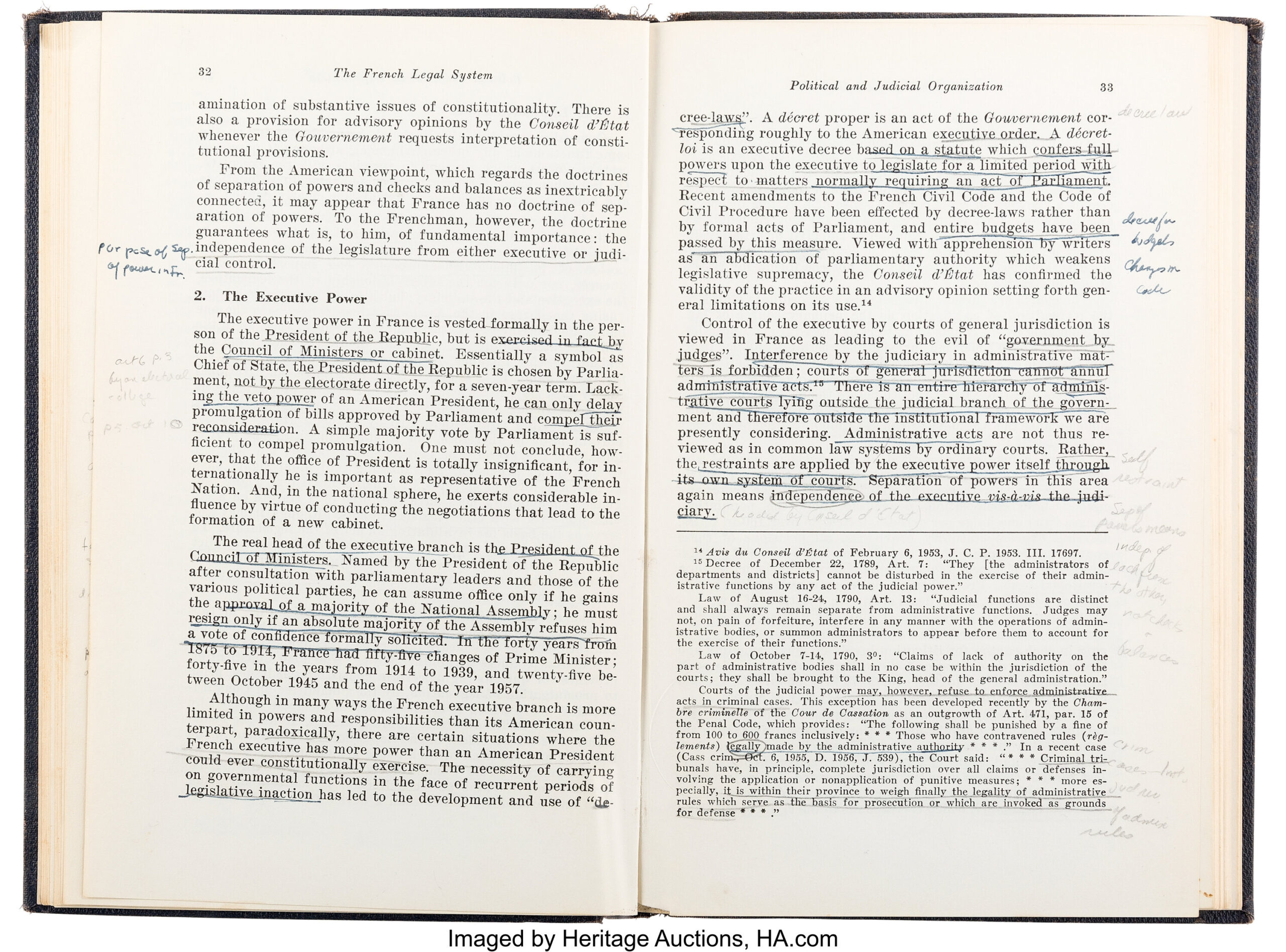
Heritage Auctions, the largest fine art and collectibles auction house founded in the United States, and the world’s largest collectibles auctioneer, has unveiled a piece of Justice Ginsburg’s life — a textbook full of notes from her days at Columbia Law — that’s expected to sell for more than $10,000.

The book itself, The French Legal System – An Introduction to Civil Law Systems, is likely one of Ginsburg’s first textbooks ever brought to market. It contains notes in pencil and in ink, and has a bookplate which states that it came “From the Library of Ruth & Martin Ginsburg” on its interior front board.

Here are some images of the book being auctioned by Heritage (click to enlarge):

(Photo by Heritage Auctions, HA.com)

(Photo by Heritage Auctions, HA.com)

Here’s a short video showcasing Her Honor’s law school textbook:

“Her character and personality entertained many, but her persona grew out of her legal prowess, which started in books like this one,” Heritage Historical Manuscripts Director Sandra Palomino said of the late Justice Ginsburg. “Her handwritten notes offer a glimpse into her mind when she was just beginning to pursue a career in law, making this book an exceptional find for anyone who collects legal or historical documents.”

The opening bid for the Notorious One’s textbook is $5,000 ($6,250.00 with a Buyer’s Premium). The final auction will take place on Wednesday, May 19, at 12 p.m. ET. Proxy bidding ends on the same date at 11:50 a.m. ET.

Click here to place your bids and follow the auction.


Staci ZaretskyStaci Zaretsky is a senior editor at Above the Law, where she’s worked since 2011. She’d love to hear from you, so please feel free to email her with any tips, questions, comments, or critiques. You can follow her on Twitter or connect with her on LinkedIn.

How To Create A Strong Personal Brand Through Storytelling And Digital Content

In today’s digital landscape, your personal brand matters more than ever, and lawyers are not immune from having one. Whether you own a law firm, work in Biglaw, or serve as a corporate counsel, your unique value, passion, and the work you do should be easily recognizable. In fact, the very first place companies, law firms, and clients venture to search for you is on Google. Not sure where to begin building your personal brand? Here are some tips to get you started.

Build Your Social Media Presence

With social media being the foundation for how we network, engage, and converse with our target audience, it’s incumbent upon us to showcase our professional image and business value. Having a distinct online presence is key, especially a robust LinkedIn profile that gets you seen and noticed.

Before you launch your brand on LinkedIn, first determine what your unique value is to the outside world and your target audience. Ask yourself the following questions: What makes you different? What’s your practice area? What are you an expert in? What are you most passionate about? What problems do you solve for your clients?

In your LinkedIn profile, consider the wide range of people you may connect with, since you want your profile to speak to a broad audience. Be sure to include your contact details, and complete all pertinent sections: headline, summary (“about”), experience, education, and skills. Don’t overlook the “featured” section, which is great for linking your law firm’s bio, a recent blog post or article you’ve authored, an upcoming speaking engagement, or even a podcast interview.

Tell Your Story And Engage

Whether you believe it or not, your hobbies, struggles, and other facets of your career are part of your story and personal brand. They can form the impetus to a new connection, a new client, a new conversation, or even a written story behind your “why.” Let me give you a real-world example. I ran the New York City Marathon in 2011. I am not an athlete by any means. I was just an average woman with health struggles who had a dream to run a marathon and finish it.

I entered the lottery, got in, ran the race injured, and crossed the finish line. One of my first HuffPost articles chronicled how it led me to chase my long-time dreams of leaving law to be a professional writer. That article was promoted by the editors and led to a surge of outreach once I shared it on social media. The moral here: reflect on your passions, talents, and hobbies — look for the ones that can tell a story and connect a reader with you.

When it comes to posting content on LinkedIn, I’m a proponent of publishing content off LinkedIn (via a blog or article), and then sharing it on LinkedIn — whether through a link to your post, or via a comment in your post. Outside content is part of a long-term strategy that will continue to remain searchable on Google. Tell your story and have a way for people to connect with you or link back to you. Otherwise, you are just waiting for someone to “click” on a long-form LinkedIn post without sending them to your firm’s website, other published media, or the link to the event you want them to register to attend.

Remember that building a personal brand takes time. Building an audience takes time. Building your legal career or law firm takes time. However, all of it circles back to your story and brand. Your personal brand is just that — personal. Start thinking about how you can share that story through digital content.


Wendi Weiner is an attorney, career expert, and founder of The Writing Guru, an award-winning executive resume writing services company. Wendi creates powerful career and personal brands for attorneys, executives, and C-suite/Board leaders for their job search and digital footprint. She also writes for major publications about alternative careers for lawyers, personal branding, LinkedIn storytelling, career strategy, and the job search process. You can reach her by email at wendi@writingguru.net, connect with her on LinkedIn, and follow her on Twitter @thewritingguru.